


Portugal adopted the Heckler & Koch G3 as the Espingarda Automática m/961 in 1961, just two years after West Germany itself had made the design the Bundeswehr's standard rifle.1 That timing put Portugal among the very first foreign licensees of a rifle that was still new even in its own country of origin, and it was not a coincidence. The first fighting of what became the Portuguese Colonial War broke out in Angola in February 1961, and Lisbon needed a proven infantry rifle fast rather than an experimental one.1
- Simple to train conscripts on at scale
- Proven [delayed blowback](/en/glossary/delayed-blowback-2) action, reliable in heat and humidity
- Cheaper to produce domestically than the FN FAL alternative
- Extraordinarily long service life across multiple conflict generations
- Lower ammunition load carried per soldier than opposing AK-pattern rifles
- Handling less agile than the AKM in close bush contacts
- Heavier and harder-recoiling than the 5.56mm rifles that eventually replaced it
The name itself is often misread as a Heckler & Koch model designation. It is not. Portugal's military nomenclature assigns the prefix m/ (modelo) followed by the year a piece of equipment entered service, a system applied across completely unrelated hardware, from the m/937 Mauser rifle to a 1953 anti-aircraft machine gun.6 The number m/961 simply records that the rifle was adopted in 1961. Domestic manufacture began the following year at the state arsenal Fábrica Militar do Braço de Prata (FMBP) in Lisbon, which built the rifle's components and handled final assembly under license from Heckler & Koch.2 FMBP's assets were later absorbed into a broader state holding company, INDEP (Indústrias Nacionais de Defesa), which continued producing the G3 under the same license after that reorganization. The original 1961 to 1962 adoption and tooling-up belongs to FMBP, not yet to INDEP, a distinction worth keeping straight since later sources tend to credit INDEP alone.3,4
Portugal actually weighed three separate 7.62mm rifle programs in the early 1960s before the G3 emerged as the true standard, alongside a Portuguese-built FN FAL (designated m/962) and a small batch of Dutch-built Artillerie-Inrichtingen AR-10 rifles issued mainly to paratroopers.8 Portugal's army reportedly judged the G3 better suited to troops without extensive prior education and training, a blunt but telling reason it became the primary rifle despite the FAL purchases running in parallel.12 The rifle mechanically matches the standard Heckler & Koch G3, a select-fire battle rifle chambered for 7.62x51mm NATO, with Portugal's early m/961 batch distinguished mainly by its furniture and sights rather than any change to the operating mechanism.
Fabrica Militar do Braco de Prata built the rifle's components domestically and handled final assembly under Heckler & Koch license from 1962, a genuine indigenous-manufacture program rather than mere assembly of imported kits, though the core roller-delayed design itself remained the licensed German original.
The m/961 uses the G3's roller delayed blowback action, a system Heckler & Koch inherited from the Spanish CETME rifle, itself a postwar development of German wartime work on the StG45(M).2 A rotating bolt head is not present. Instead, two rollers lock the bolt head against the barrel extension, delaying rearward movement long enough for chamber pressure to drop to a safe level before the case extracts. Feed is from a detachable magazine, standard 20 rounds, in 7.62x51mm NATO.
- First Production Year1962
- Service Entry Year1961
- DesignerHeckler & Koch (original design); licensed production by Fabrica Militar do Braco de Prata (FMBP), later continued by INDEP
- Weight (Empty)4.4 kg
- Currently In ServiceYes
- Notable UsersPortugal, Ukraine
Where the Portuguese rifle visibly differs from later G3A3-pattern production is furniture and sights, not internals. The m/961 carries a first-pattern muzzle brake and flash suppressor distinct from the later, more common HK flash hider, ventilated stamped-steel handguards that collectors nickname cheesegrater furniture, a flip-up rear sight rather than the rotating diopter drum sight fitted to later rifles, and an integrated folding bipod.15 Its painted wooden buttstock was deliberately styled after the preceding Spanish CETME Model 58's stock, a small visual nod back to the design the G3 itself descends from.15 A bayonet lug accepted a saber-pattern bayonet.5
- Cartridge7.62x51mm NATO
- Calibre7.62 mm
- Case Length51 mm
- Bullet Weight9.3 g
- RimfireNo
- Caseless AmmunitionNo
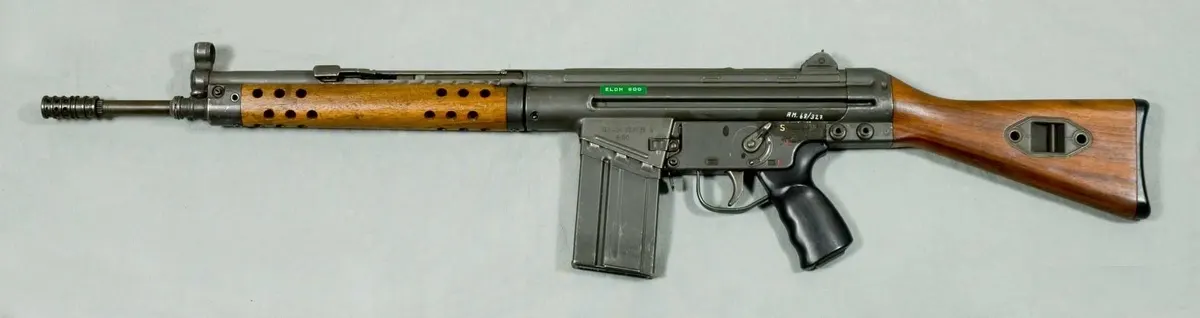
Portuguese paratroopers and naval special-operations troops received a separate variant with a folding or retractable stock rather than the fixed wooden buttstock, prioritizing compactness for parachute insertion and small-boat work over the standard infantry pattern.13 Roughly three years into production, the m/961's furniture and sights were superseded by the plastic-stocked, drum-sighted m/963, which became the far more numerous and visually familiar Portuguese G3 in later Colonial War photographs.15,18
- Action TypeDelayed Blowback
- Fire Modessemi-auto, full-auto
- Select FireYes
- Feed SystemDetachable Magazine
- Magazine Capacity20
- Cyclic Rate of Fire550
A recurring point of confusion among collectors deserves a direct answer. Some enthusiast sources claim the Dutch-built AR-10 issued to a portion of Portugal's paratroop battalions also carried the m/961 designation, which would put two unrelated rifle families under the same number.7 Portugal's own naming logic makes that unlikely, since it assigns one designation per adopted item, and the Portuguese military's own historical archive holds a document titled explicitly Espingarda automática G3, 7,62 mm, M/961 e M/963, while independent order-of-battle references list m/961 against the G3 and the AR-10 separately.9,8 The safest reading, and the one used here, is that m/961 belongs to the G3, and the AR-10 claim traces to a repeated transcription error rather than a real dual assignment.
- Muzzle Velocity790 m/s
- Barrel Length450 mm
- Optic RailNo
- Iron SightsYes
- Overall Length1,024 mm
- Length (stock folded)840 mm
- Receiver MaterialStamped steel
- Furniture MaterialPainted wood buttstock, stamped-steel handguard (m/961 pattern); plastic furniture on the later m/963
- Folding / Collapsing StockNo
- Bullpup LayoutNo
- Production Start1962
- Production End1965
The G3's path into Portuguese service moved unusually fast by licensing standards. West Germany's own Bundeswehr had only finalized the G3A3 as its standard rifle in 1959, and within two years Portugal had adopted the same design as war broke out in its African territories.1 An initial batch of complete rifles arrived from West Germany in 1961 to arm the first units deploying to Angola, while FMBP tooled up for full domestic production the following year.12
The rifle's defining chapter was the Portuguese Colonial War, fought simultaneously from 1961 across three African theaters. Angola saw the first fighting in February 1961, Guinea-Bissau followed from 1963 against the PAIGC, and Mozambique from 1964 against FRELIMO.10 Across all three, the m/961 and its m/963 successor served as the standard-issue infantry rifle, alongside the smaller stock of imported FN FAL and Dutch AR-10 rifles.8
Reports from the period describe the rifle holding up well in heat, humidity, and dust, with Portuguese troops generally satisfied with its accuracy and ease of maintenance in the field.1 That reputation, however, came with a real tactical shortfall against guerrilla forces armed with Soviet-supplied AK-47 and AKM rifles. In the close-range bush contacts typical of the war, the AK pattern's handling was judged more agile than the heavier G3, and its lighter 7.62x39mm ammunition let a fighter carry meaningfully more rounds for the same number of magazines.11 Set against that, the G3 remained cheaper to build domestically and far simpler to train large numbers of conscripts and colonial troops on than the alternative FN FAL, which is the reason it stayed Portugal's primary rifle despite the disadvantage in the bush.1
By the war's end, the m/961 and m/963 had been standard issue for well over a decade. The conflict, and with it the rifle's defining combat role, closed with the Carnation Revolution in Lisbon on 25 April 1974, which brought down the Estado Novo regime and led rapidly to independence for Angola, Mozambique, and Guinea-Bissau over the following year.
Portugal finally began retiring the G3 family in 2019, when NATO's Support and Procurement Agency awarded FN Herstal a roughly $50.3 million contract on Portugal's behalf for 11,000 FN SCAR-L rifles in 5.56x45mm, plus smaller numbers of 7.62mm FN SCAR-H rifles for designated marksmen.16 Public training with the new rifle began at the Army's School of Arms in Mafra in July 2019.17 Some Portuguese special units had already taken a different, more gradual path, fitting Spuhr mounts and Aimpoint red-dot optics to existing G3A3 and G3A4 rifles rather than waiting for a fleet-wide replacement.2
The rifle's story did not end with retirement. Following Russia's 2022 invasion of Ukraine, Portugal donated roughly 1,000 of its retired G3A3 and G3A4 rifles as part of a military aid package, giving a design adopted for a colonial counterinsurgency in 1961 one more active conflict appearance six decades later.2
The Portuguese Colonial War is the m/961's central combat record, and it was really three overlapping wars fought at once. In Angola, fighting began in 1961 against the MPLA, FNLA, and later UNITA, the Angolan War of Independence.10 In Guinea-Bissau, the Guinea-Bissau War of Independence against the PAIGC ran from 1963. In Mozambique, the Mozambican War of Independence against FRELIMO began in 1964. All three sat under the umbrella of the broader Portuguese Colonial War.10

Named units illustrate how the rifle was distributed. The 12th Paratrooper Hunter Battalion, formed in late 1966, deployed to Guinea-Bissau equipped with the G3.13 The Navy's Fuzileiros Especiais special marine detachments carried the folding-stock m/961 alongside HK21 light machine guns, a combination suited to the swampy river and mangrove terrain of Guinea-Bissau where their raids were concentrated.10 Portugal's paratroop force was itself split between the G3 and the Dutch AR-10, with only two of its four Africa-based battalions receiving the AR-10, the Netherlands having cut off further AR-10 sales in 1963 over Portugal's African policy.7
The war's most prominent special operation involving Portugal's elite, G3-armed troops was Operação Mar Verde (Operation Green Sea) on 22 November 1970, an amphibious raid by 350 to 420 Portuguese soldiers and allied Guinean fighters against Conakry, capital of neighboring Guinea-Conakry. The raid aimed to topple President Ahmed Sékou Touré's government, a key backer of the PAIGC, and to capture or kill PAIGC leader Amílcar Cabral.14
Weapons moved in both directions across the front lines. MPLA and PAIGC fighters captured and reused Portuguese equipment, including G3 rifles, while Portuguese colonial forces captured SKS rifles from PAIGC fighters and reissued them to their own colonial troops in Guinea-Bissau.11 The guerrilla movements' main arms supply nonetheless came from state sponsors rather than battlefield capture, chiefly Soviet-pattern rifles and Chinese recoilless weapons, with captured Portuguese gear serving only as a supplement.11
Independence in 1975 did not end the fighting the m/961 had been part of. Angola's rival MPLA, FNLA, and UNITA factions turned inherited and captured G3 rifles against one another in the Angolan Civil War that followed almost immediately, and Guinea-Bissau's post-independence forces likewise inherited stocks of the rifle that outlasted Portuguese rule itself.
The original m/961 pattern, with its stamped-steel handguards, flip-up rear sight, and integral bipod, gave way after roughly three years of production to the m/963, which adopted plastic furniture and the later rotating drum diopter sight standard on most G3A3-pattern rifles worldwide.15 The m/963 ultimately proved far more numerous and is the version most visible in later Colonial War photography.
A folding or retractable-stock variant, functionally equivalent to the standard G3A4 pattern, was issued to paratroopers and to the Navy's Fuzileiros Especiais, trading the fixed wooden buttstock for a shorter, air-droppable and boat-portable profile.13 Portugal also fielded a locally developed belt-fed light machine gun derivative of the G3 action, broadly comparable to the international HK21, extending the same roller-delayed mechanism into a support-weapons role.18


| Year | Buyer | Quantity | Amount | Present Value (2025) |
|---|---|---|---|---|
| 2022 |  Ukraine | 1,000 | — | — |
Portugal is the m/961's sole primary operator, having fielded it as the standard infantry rifle from 1961 through the phased 2019 to 2022 transition to the FN SCAR-L.16 Ukraine became a secondary operator in 2022, receiving roughly 1,000 retired Portuguese G3A3 and G3A4 rifles as military aid following Russia's invasion.2
Portugal ran the G3 and its own FN FAL variant, the m/962, side by side through the early 1960s, and the choice between them says more about training pipelines than raw performance. Both were domestically produced 7.62x51mm rifles adopted within a year of each other for the same war. The FAL was purchased in real quantity, but the Army judged the G3 better suited to conscripts and colonial troops without extensive prior training, and the G3's lower production cost reinforced that decision.1,12 The FAL ended up as Portugal's supplementary rifle rather than its primary one, a reversal of the FAL's dominant position in many other NATO-aligned armies of the period.
| G3 m/961 (Portugal) | FN FAL m/962 (Portugal) | |
|---|---|---|
| Cartridge | 7.62x51mm NATO | 7.62x51mm NATO |
| Action | Delayed blowback | Gas-operated |
| Role in Portuguese service | Primary standard rifle | Secondary, limited standard |
| Production start | 1962 (domestic) | 19618 |
A more distant comparison sits with Pakistan's POF G3, another G3 built under license roughly a decade after Portugal's own program began. Where Portugal adopted the G3 as an emergency wartime rifle for a counterinsurgency it did not expect to win quickly, Pakistan's Pakistan Ordnance Factories line grew out of a longer-term Cold War alignment and border posture, producing the design over a far longer run and larger total volume. Portugal's m/961 is best understood as an early, wartime-driven license, while POF's version reflects a licensee building for sustained, large-scale national service rather than a single conflict.


Is the G3 rifle still in Portuguese service? No. Portugal replaced the G3 family with the FN SCAR-L under an 11,000-rifle contract signed in 2019, with training beginning that July and deliveries running through 2022.16,17
What does the designation m/961 mean? It is not a Heckler & Koch model number. Portugal's m/ naming system pairs modelo with the year of adoption, so m/961 simply records that the rifle entered Portuguese service in 1961.6
What is the difference between the m/961 and m/963? The m/961 carries stamped-steel handguards, a flip-up rear sight, and an integral bipod. The m/963 that succeeded it after roughly three years of production switched to plastic furniture and the later rotating drum sight, and became the more common version.15
Did Portugal really adopt the G3 only two years after West Germany? Yes. West Germany adopted the G3A3 for the Bundeswehr in 1959, and Portugal adopted its own version in 1961, making it one of the earliest foreign licensees of the design.1
- "Military Rifles of Portugal Part 2", Firearms News — firearmsnews.com ↩
- "Heckler & Koch G3", Wikipedia — en.wikipedia.org ↩
- "INDEP", Wikipedia — en.wikipedia.org ↩
- "Fábrica de Braço de Prata", Wikipedia — en.wikipedia.org ↩
- "Espingarda G3 7,62 m/961 e m/963", 1library — 1library.org ↩
- "List of equipment of the Portuguese Army", Wikipedia — en.wikipedia.org ↩
- "The Portuguese A.I. AR-10", Historical Firearms — historicalfirearms.info ↩
- "Portuguese Equipment in the Colonial War", balagan.info — balagan.info ↩
- "Espingarda automática G3, 7,62 mm, M/961 e M/963", Arquivo Histórico Militar — ahm-exercito.defesa.gov.pt ↩
- "Portuguese Order of Battle during the Portuguese Colonial War", balagan.info — balagan.info ↩
- "List of weapons of the Portuguese Colonial War", Wikipedia — en.wikipedia.org ↩
- "What kind of G3 rifle did the Portuguese use in Angola and elsewhere in Africa", Gunboards forum — gunboards.com ↩
- "Portuguese Paratroopers", Wikipedia — en.wikipedia.org ↩
- "Operação Mar Verde", Wikipedia — en.wikipedia.org ↩
- "Bush War Echoes, Espingarda M/961 Kits", laststandonzombieisland — laststandonzombieisland.com ↩
- "The Portuguese army is ditching the G3", Military Times — militarytimes.com ↩
- "Portuguese Army Begins Training with SCAR-L", The Firearm Blog — thefirearmblog.com ↩
- "HK21 or Portuguese m/968, the HK G3 grows into a light machine gun", Forgotten Weapons — forgottenweapons.com ↩