



Between 1960 and 1980, Remington Arms built 1,433,269 examples of the Remington Model 742 Woodsmaster, making it the best-selling centerfire semi-automatic rifle in American hunting history and, at the same time, one of the most persistently criticized for its mechanical reliability.1 The Model 742 is a gas-operated hunting rifle chambered for .243 Winchester, 6mm Remington, .280 Remington, .30-06 Springfield, and .308 Winchester, fed from a 4-round detachable magazine rather than the fixed internal magazine sometimes assumed from its bolt-action contemporaries.1,2 It replaced the Remington Model 740, the rifle Remington had rushed to market in 1955 to answer Winchester's own postwar autoloaders, and it was itself replaced in 1981 by the Remington Model 7400.2
- Fast, soft-shooting follow-up shots in thick cover
- Wide range of centerfire deer-hunting calibers
- Detachable box magazine, quick reload in the field
- Enormous parts and aftermarket support even decades out of production
- Aluminum receiver rails wear with heavy use
- Chronic chamber rust and extraction failures if stored improperly
- Heavy, mushy factory trigger pull
- Reputation for jamming badly damaged resale confidence
The Model 742 Woodsmaster was built at Remington's historic factory in Ilion, New York, the same plant that had produced the earlier long-recoil Remington Model 8 decades before.2 Its role in the market was straightforward. A deer hunter walking timber wanted a rifle light enough to carry all day, powerful enough for a .30-06 Springfield or .308 Winchester deer or bear cartridge, and fast enough for a running second shot, without the felt recoil of a bolt-action rifle firing the same round.3 Where the Model 742 diverged sharply from that promise was long-term durability. Owners, gunsmiths, and outdoor writers have documented, for decades, a rifle that runs reliably for years and then begins failing to extract, failing to feed, or binding solid, usually as the receiver's internal bolt rails wear down.3,4

Is the Remington 742 Woodsmaster still made today. No, production ended in 1980 and Remington replaced it with the Model 7400, but the Model 742's basic gas-operated action, retained through the 7400 and later the Model 750, remained in production for another two decades after the 742 itself was discontinued.2,4 Understanding the Remington 742's reputation requires separating two different things: the rifle's original engineering, which was a real, deliberate improvement over the Model 740 it replaced, and the specific wear failure that gave the Model 742 (and its successors) the derisive nickname "Jamomatic" among American gunsmiths and hunters.3
The Gas-Operated Action Shared With the Remington 1100 Shotgun
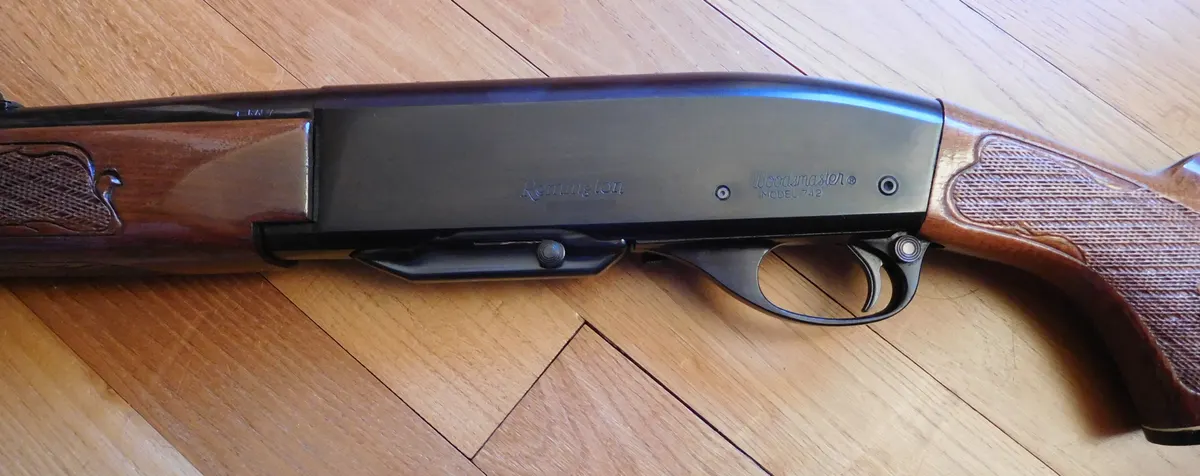
The Remington Model 742's action is not a clean-sheet rifle design. It shares its basic gas-operated cycling system, using a piston tapping gas from the barrel to drive an operating rod and bolt carrier, with the Remington Model 740 it replaced and, more distantly, with Remington's Model 1100 autoloading shotgun.2,4 A rotating bolt with two locking lugs engages recesses machined into the rear of the barrel extension for lockup, and the 742 added a small bolt latch, a thin lock that holds the bolt head from rotating out of battery during the firing cycle, a refinement the earlier Model 740 lacked.4 The rifle weighs 3.4 kg (7.5 lb) empty and carries a 558.8 mm (22 in) barrel on the standard rifle, with an 18-inch-barreled 742C carbine offered for closer cover.1,2
- First Production Year1960
- Weight (Empty)3.4 kg
The receiver itself is machined from aluminum alloy and finished in blued steel, a deliberate weight-saving choice.4 The rifle's own engineering reasoning was that the bolt lugs lock directly into the barrel extension, so the aluminum receiver only needs to hold the internal parts together rather than absorb locking stress, and that same soft-metal choice is the root of the Model 742's best-documented reliability weakness (see below).4 Sights are fixed iron sights, a folding rear leaf paired with a bead or blade front post, on a walnut-furnished stock typical of Remington's Woodsmaster line, and the rifle carries a cross-bolt safety through the trigger guard rather than a tang or thumb safety.2,4 Fired with Remington's own .30-06 Springfield Core-Lokt load (a 180-grain bullet), the Model 742 produces a muzzle velocity of roughly 823 m/s (2,700 ft/s), representative of the rifle's dominant chambering even though four other, lighter cartridges were also offered across its production run.7
- Cartridge.243 Winchester, 6mm Remington, .280 Remington, .30-06 Springfield, .308 Winchester
- Calibre7.62 mm
- RimfireNo
- Caseless AmmunitionNo
Why the Receiver Rails Wear Out
The Model 742's central mechanical flaw traces directly to that aluminum receiver. The rails the bolt rides on are cut into a metal soft enough that, under years of repeated bolt-carrier cycling driven by gas pressure and the recoil spring, the rails themselves wear and deform.4 As the rails wear, the bolt lugs go slightly out of time relative to the barrel extension, and the moving bolt can begin chewing up the front edge of the rails further, a self-accelerating failure that eventually binds the action or stops it from cycling at all.4 A second, unrelated chronic problem compounds the first. Rifles stored in a warm, humid gun safe or a heated closet after a wet hunt can trap condensation inside a closed chamber, and the resulting rust attacks the chamber walls and the extractor, producing exactly the failure-to-extract stoppages the rifle is infamous for.4 Specialist gunsmiths have historically repaired badly worn receivers by welding the worn rails with a long-nozzled wire-feed or heliarc welder and re-machining them, and rusted chambers can sometimes be restored by polishing with crocus cloth and fire-lapping the bore, though neither fix is something an average owner can do at home.4
- Action TypeGas-Operated
- Select FireNo
- Feed SystemDetachable Magazine
- Magazine Capacity4
- Safety Typecross bolt
- Muzzle Velocity823 m/s
- Barrel Length558.8 mm
- Sight Typeiron sights
- Iron SightsYes
- Receiver Materialaluminum alloy
- Furniture Materialwood
- Total Production1,433,269
- Production Start1960
- Production End1980
From the Model 740 to the Woodsmaster Name
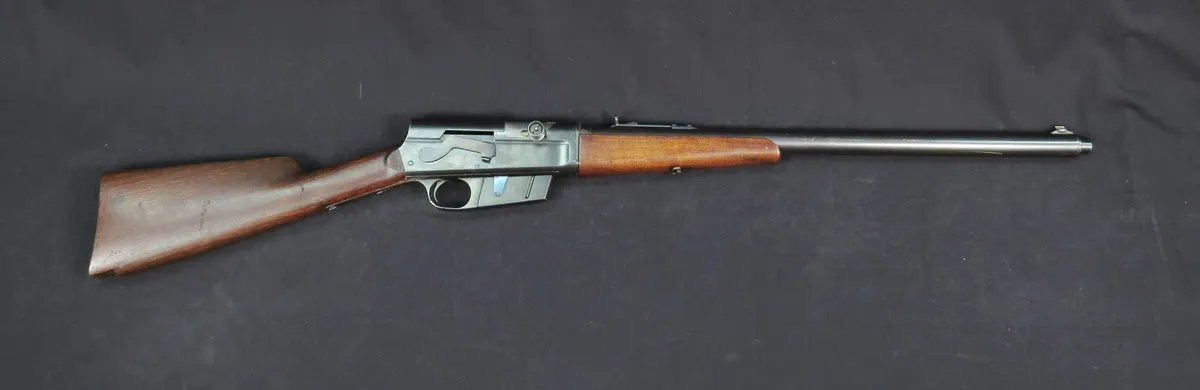
Remington's first postwar autoloading centerfire rifle, the Remington Model 740, reached the market in 1955 and sold well, but it shipped with a single-pitch forearm attachment screw that let the forearm bind tightly against the barrel and receiver as the rifle heated up, causing the point of impact to climb after successive shots.4 Remington's designers used the Model 742's 1960 launch to fix that specific problem with a dual-pitch forearm screw that let the forearm float properly, and paired it with the new bolt latch mechanism and refined sights.2,4 The "Woodsmaster" name itself did not originate with the Model 742. Remington had first used it for the Remington Model 8's 1936 successor, the Model 81 Woodsmaster, a long-recoil design descended from John Browning's turn-of-the-century patents, decades before the gas-operated 742 revived the name for an unrelated action.2
Commercial Success and the Larry Benoit Connection
The Model 742 sold in numbers few centerfire hunting rifles of any action type have matched, moving 1.43 million rifles across twenty years of production and briefly making Remington's family of autoloading centerfire rifles, counting the Model 740, 742, and their gas-operated successors together, a combined seller of more than 2.5 million rifles.3 Part of that success was cultural. Vermont's Larry Benoit, later celebrated as one of America's most famous whitetail deer hunters, appeared on the September 1970 cover of Sports Afield magazine staring down the sights of a peep-sighted Model 742 under the headline asking whether he was the best deer hunter in America.6 Benoit would go on to become better known for hunting with Remington's pump-action Model 760/7600 carbines rather than the 742 itself, but the magazine cover cemented the Woodsmaster's image as a serious big-woods deer rifle at the height of its commercial run.6

Production ran continuously at the Ilion, New York factory through 1980, though Remington made at least one significant engineering change late in the run. Early 742s used a right-hand-threaded barrel extension that could loosen under recoil over time, and Remington switched to a left-hand thread on rifles built from February 1977 onward (identified by the "LO" date code) specifically to stop that loosening.4
The "Jamomatic" Reputation and Remington's Response
By the 1980s and 1990s, the Model 742 and its direct successor the Remington Model 7400 had earned the derisive nickname "Jamomatics" among American gunsmiths and hunters, a name built on the rifles being, in the words of one gun-shop assessment, "reliably unreliable."3 A gunsmith interviewed by Field & Stream recalled that worn bolt-guide grooves on the 742's 9-lug-carrier bolt design could wear out irreparably, and that a friend in the trade had put two daughters through college largely on 742 and 7400 repair work.3 Remington's own response was not a factory recall in the modern sense but a running series of engineering fixes folded into later production, plus, later, a voluntary buy-back and trade-in program that let 742 owners exchange their rifles toward a new Model 7400 rather than continue repairing an aging, worn receiver.3,4 Remington discontinued the Model 742 outright in 1980 and replaced it in 1981 with the redesigned Remington Model 7400 (and, in parallel, a scaled-up Remington Model Four for magnum chamberings), a rifle that swapped the two-lug bolt for three larger locking lugs, added hardened steel inserts into the previously bare aluminum bolt rails, and fitted a snap-in extractor.2,4 The 7400's design changes directly targeted the Model 742's known failure points. Even so, later reviewers and long-time owners have continued to describe the 7400 as carrying the same "Jamomatic" reputation forward rather than fully resolving it, a pattern Remington did not manage to break until the still-later Model 750.3 Remington eventually replaced the Model 7400 itself with the Remington Model 750 in 2006.

The Model 742 Woodsmaster was designed and marketed purely as a civilian hunting rifle and was never adopted by any military or national police force. Its one documented appearance in an armed conflict is unofficial. The Provisional Irish Republican Army used small numbers of Remington Model 742 rifles, alongside other civilian hunting rifles pressed into service, during The Troubles in Northern Ireland, where sporting rifles chambered for military-equivalent cartridges like .30-06 Springfield and .308 Winchester were sometimes substituted for harder-to-source military arms.5 The Model 742's ready availability on the American civilian market, well outside the tighter firearms controls of the United Kingdom, made it one of many hunting rifles that entered Northern Ireland's paramilitary arsenals through the same illicit trans-Atlantic smuggling routes used for AR-15-pattern rifles during the conflict.5
Remington sold the Model 742 across five grade levels, from the plain 742A Standard up through the ADL Deluxe, BDL Deluxe, CDL, Peerless, and top-tier Premier Grade, differentiated mainly by wood quality, checkering, and engraving rather than mechanical differences.1,2 The 742C Carbine shortened the standard 22-inch barrel to 18 inches for hunters working close cover, and Remington built left-hand-action versions of the standard rifle for left-handed shooters, an unusual accommodation for a hunting autoloader of that era.1,4 Beyond the standard grades, Remington issued several limited commemorative editions built on the 742 platform, including a 1966 150th Anniversary model, a 1967 Canadian Centennial edition, and a 1976 Bicentennial edition marking the 200th anniversary of the United States, each offered exclusively in .30-06 Springfield or .308 Winchester.1
Aftermarket support has outlasted the factory grades. While the standard factory magazine held 4 rounds, both short-action calibers (.243 Winchester, 6mm Remington, .308 Winchester) and long-action calibers (.280 Remington, .30-06 Springfield) used dedicated 4-round magazines, and 10-round aftermarket magazines remain available today for hunters wanting extra capacity in states where that is legal.1


The Remington Model 742 Woodsmaster was never issued as a service rifle. Its user base is almost entirely the American civilian hunting market, where it was sold new from 1960 to 1980 and remains in active use among deer and bear hunters who either inherited a rifle or bought one on the used market.1,3 Its only documented use by an armed group outside that civilian hunting context was the Provisional IRA's limited use of the rifle during The Troubles in the United Kingdom, covered above.5
The Remington Model 742's most direct comparison is not against a rival manufacturer's rifle but against its own immediate predecessor and successor, because the story of what changed, and what didn't, across that succession says more about the design than any single spec sheet does. The Remington Model 740 came first, in 1955, and sold well despite a forearm-mounting flaw that made accuracy degrade as a hunter fired successive shots; the Model 742 fixed that specific problem in 1960 with a dual-pitch forearm screw and added a bolt latch, but kept the same two-lug bolt riding on the same soft aluminum receiver rails that would go on to define its reliability reputation.4 The Remington Model 7400, introduced in 1981, is the more interesting comparison because it was Remington's explicit engineering answer to the 742's wear problems. The 7400 moved from two locking lugs to three larger ones, added hardened steel inserts into the previously bare aluminum bolt rails, and fitted a snap-in extractor rather than the 742's original design, changes aimed squarely at the failure points documented above.4
| Spec | Model 740 (1955) | Model 742 (1960) | Model 7400 (1981) |
|---|---|---|---|
| Production run | 1955-1960 | 1960-1980 | 1981-2004 |
| Units produced | 251,398 | 1,433,269 | not fully documented |
| Bolt locking lugs | 2 | 2 (adds bolt latch) | 3, hardened rail inserts |
| Forearm mounting | Single-pitch (POI climb) | Dual-pitch (fixed) | Dual-pitch |
Whether the 7400's redesign actually solved the reliability problem is genuinely disputed among owners and gunsmiths rather than settled fact. The engineering changes were real and targeted, but outdoor writers and long-time Remington autoloader owners have continued describing the 7400 as carrying the "Jamomatic" nickname forward rather than shedding it, with the rifle's design lineage not fully shaking the reputation until the later Remington Model 750.3 Compared to the Ruger 10/22, a rimfire autoloader that built its own reputation on the opposite quality (near-legendary reliability from a much simpler blowback action), the Model 742 illustrates how much a hunting rifle's commercial success and its mechanical reputation can diverge. Both rifles sold in the millions; only one of them is remembered primarily for how well it worked.


Is the Remington 742 Woodsmaster reliable? The Model 742's aluminum receiver rails are documented to wear with heavy use, which can cause feeding and extraction failures, and the rifle earned the nickname "Jamomatic" among American gunsmiths for that pattern of failure.3,4 Well-maintained examples, kept dry and free of chamber rust, can run for decades without trouble, but the underlying design weakness is real and well documented rather than a myth.4
What caliber does the Remington 742 take? The Remington 742 Woodsmaster was chambered in .243 Winchester, 6mm Remington, .280 Remington, .30-06 Springfield, and .308 Winchester, with .30-06 Springfield the most common chambering encountered today.1
How many rounds does a Remington 742 magazine hold? The factory detachable box magazine holds 4 rounds in both short-action and long-action calibers, though 10-round aftermarket magazines are widely available.1
Is the Remington 742 still made? No. Production ended in 1980 after 1,433,269 rifles were built, and Remington replaced the Model 742 with the Model 7400 in 1981.2
What replaced the Remington 742? The Remington Model 7400 replaced the Model 742 in 1981, followed by the Remington Model Four for magnum chamberings and, much later, the Remington Model 750 in 2006.2,4
How much is a Remington 742 worth today? Used values vary widely by grade and condition, with plain 742A Standard rifles typically the least expensive and Premier Grade or commemorative editions commanding significant collector premiums, though as a mass-produced hunting rifle the 742 was never a high-value collectible.1
- "Remington Model 742", Wikipedia — en.wikipedia.org ↩
- "Model 742 Woodsmaster", Remington Arms — remarms.com ↩
- "Remington Model 742 and 7400 Rifle Review", Field & Stream — fieldandstream.com ↩
- "Remington 740/742/7400 Semi-Auto Rifles", Leeroy's Ramblings — leeroysramblings.com ↩
- "List of weapons used by the Provisional Irish Republican Army", Wikipedia — en.wikipedia.org ↩
- "Legendary Whitetail Hunter Larry Benoit Lives On", American Hunter (NRA) — americanhunter.org ↩
- "Core-Lokt .30-06 Springfield, 180 Grain", Remington — remington.com ↩