

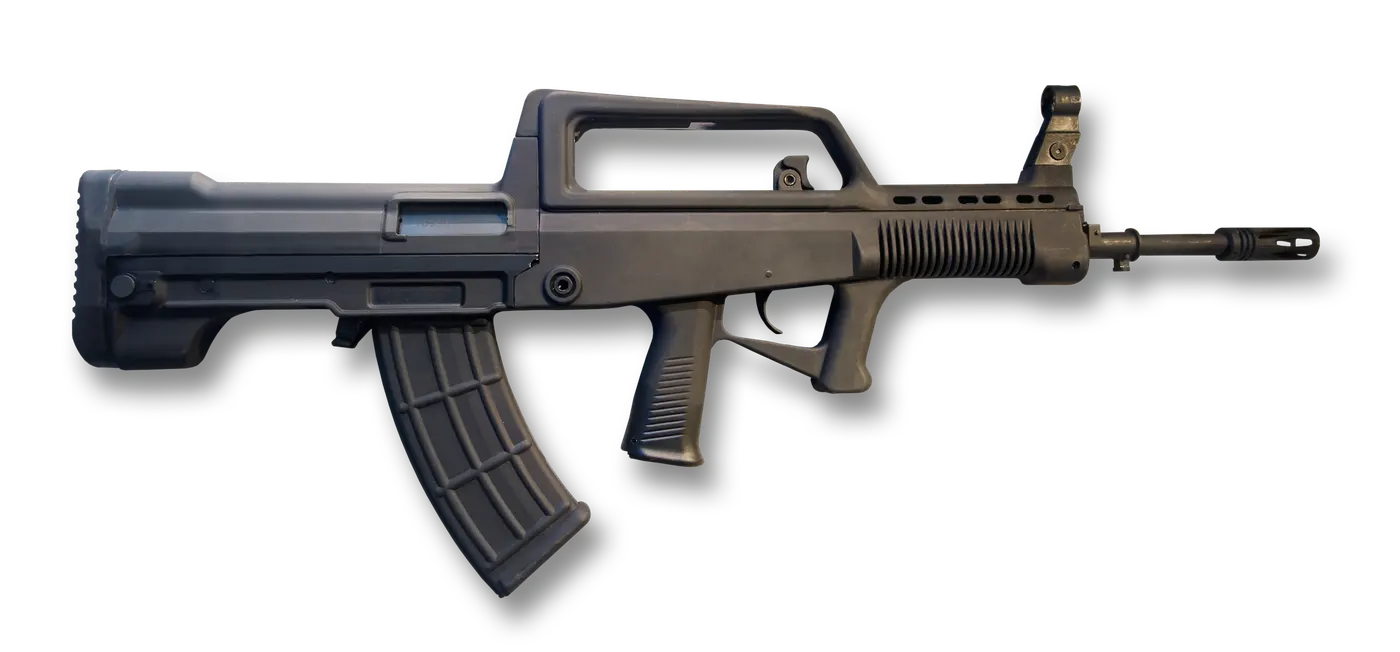

On 1 July 1997, ranks of People's Liberation Army soldiers rolled into Hong Kong to take over the garrison from departing British forces, and the cameras covering the handover caught the world's first good look at a rifle almost nobody outside China had seen before, the QBZ-95.1 It is a bullpup-configured assault rifle chambered for 5.8x42mm DBP87, an indigenous Chinese cartridge with no NATO or Warsaw Pact counterpart, and it entered production in 1995 as the intended replacement for the 7.62x39mm Type 81 rifle across the PLA, the People's Armed Police, and China's law enforcement agencies.2 Designed under chief engineer Duo Yingxian, who took over the program in 1991 and is credited in Chinese small-arms circles with a reputation comparable to Mikhail Kalashnikov's, the QBZ-95 broke sharply from the AK-pattern rifles China had built since the 1950s, adopting a bullpup-layout with the action and magazine sitting behind the pistol grip.3 Roughly 3,000,000 have been built since 1995, making it one of the most widely produced rifles ever adopted from the assault rifles category, though the PLA itself has begun replacing it with the conventional-layout QBZ-191.4
- compact 760mm overall length despite a full-length barrel
- indigenous 5.8x42mm cartridge with flat trajectory claims
- select-fire with 30-round or 75-round drum feed
- huge production run, cheap to field in bulk
- safety selector originally sited far from the firing hand
- right-side-only ejection on early rifles blocks left-handed use
- corrosive early-production ammunition fouled the gas system
- ammunition supply chain limited almost entirely to China
The rifle is gas-operated through a short-stroke piston driving a rotating bolt, weighs 3.4 kg empty, and cycles at a theoretical 650 rounds per minute, putting it in the same performance bracket as Cold War era Western and Soviet rifles despite arriving a generation later.5 Search interest in the QBZ-95 tends to cluster around a handful of questions, whether it is still in front-line PLA service, what its 5.8mm caliber actually does compared to 5.56mm NATO or 5.45mm Russian rounds, and who besides China fields it, and all three are addressed in the sections below. Norinco (China North Industries Group Corporation), the state-owned manufacturer, built the QBZ-95 at Factory 266 and Factory 296 under the wider Jianshe Corporation umbrella, and it remains the sole confirmed producer.2
{{photo-req side=right q="PLA Hong Kong garrison handover ceremony 1997 soldiers" caption="PLA troops entering Hong Kong on 1 July 1997, the QBZ-95's public debut." alt="PLA soldiers marching during the 1997 Hong Kong handover ceremony"}}
A Cartridge Fifteen Years in the Making
The 5.8x42mm round the QBZ-95 fires was not a quick add-on, China began serious work on a small-caliber intermediate cartridge in 1979, watching the United States field the 5.56x45mm Armalite AR-15 pattern and the Soviet Union field the 5.45x39mm AK-74, and only finalized the cartridge specification in 1987 as the DBP87.6 A heavier DBP88 round for squad automatic weapons followed within a year, and by 1995 an improved DBP95 loading with cleaner propellant and a non-corrosive primer was standardized alongside the new rifle itself.7 Chinese sources describe the 5.8mm round as outperforming both 5.56mm NATO and 5.45mm Russian ammunition in penetration and retained velocity at range, a claim Western analysts treat with some skepticism given it comes largely from official Chinese channels rather than independent ballistic testing.8 At the muzzle the QBZ-95 sends its bullet out at 930 m/s, with an official 400m effective range against point targets and 600m against area targets, both figures broadly in line with contemporary 5.56mm and 5.45mm rifles rather than a dramatic leap ahead of them.9
- First Production Year1995
- Service Entry Year1997
- DesignerDuo Yingxian
- Weight (Empty)3.4 kg
- Currently In ServiceYes
Bullpup Layout, Rotating Bolt, and an Unusual Striker Mechanism
The QBZ-95 places its action and 30-round detachable magazine behind the trigger group, the same bullpup principle used by the Austrian Steyr AUG, the British SA80, and the French FAMAS, and it drives a rotating bolt through a gas-piston-operated short-stroke system rather than the direct-impingement approach some rivals use.11 One genuinely unusual detail sets it apart mechanically, the QBZ-95 fires with a linear, spring-driven striker rather than the rotating hammer nearly every other post-war military rifle uses, and its charging handle sits underneath an integral carrying handle that doubles as the rear sight housing, an arrangement closer to an early AR-10 than to any Kalashnikov design.12 The rifle's furniture is entirely polymer, its iron sights are a hooded post front sight paired with the carry-handle aperture rear sight, and issued optics have ranged from the 3x Y/MA95 through the QMK-152 and QMK-171 red-dot units to an IR5118 thermal sight for specialist users. The rifle also mounts a bayonet-lug and is grenade-launch capable for underbarrel launchers, features carried over from the Type 81 it replaced despite the wholesale redesign everywhere else.
- Cartridge5.8×42mm DBP87
- Calibre5.8 mm
- Case Length42 mm
{{photo-req side=left q="QBZ-95 rifle close-up bullpup carrying handle" caption="The QBZ-95's integral carrying handle doubles as the rear sight housing, with the charging handle set beneath it." alt="Close-up of a QBZ-95 rifle showing its carrying handle and charging handle"}}
- Action TypeGas-Operated
- Fire Modessemi-automatic, automatic
- Select FireYes
- Feed SystemDetachable Magazine
- Magazine Capacity30
- Drum / Belt Capacity75
- Cyclic Rate of Fire650
The QBZ-95-1 Fixes What the Original Got Wrong
The original QBZ-95 drew persistent criticism for two ergonomic choices, a safety selector tucked at the rear of the receiver that was slow to reach under stress, and a right-side-only ejection port that made the rifle effectively unusable for left-handed shooters.13 Chinese-language sources catalogue as many as fourteen distinct flaws in the original design, from night sights that lost their tritium-style glow quickly to general quality-control inconsistency across the huge production run.14 The QBZ-95-1, fielded from around 2010 and sometimes called the Gai (modified) version, addressed most of them at once, moving the fire selector to a thumb-operated lever above the pistol grip, angling the ejection port forward by roughly five degrees to make left-handed firing workable, fitting a longer and heavier barrel with a redesigned muzzle brake, and switching to the cleaner DBP10 cartridge.15 The table below lines up the two generations against the same specs.
- Muzzle Velocity930 m/s
- Effective Range (point)400 m
- Effective Range (area)600 m
| Spec | QBZ-95 (1995) | QBZ-95-1 (2010) |
|---|---|---|
| Safety position | Rear of receiver | Above pistol grip |
| Ejection | Right side only | Angled forward, left-hand capable |
| Cartridge | DBP87 | DBP10 |
| Sights | Fluorescent night marks | Tritium illumination |
- Sight TypeHooded post front sight and aperture rear sight; Y/MA95 (3x); Y/MA95-1 (3x); QMK-152 (3x); QMK-171 (3x); IR5118 thermal
- Iron SightsYes
- Total Production3,000,000
- Production Start1995
China's small-caliber rifle program traces back to 1971, when the PLA first began exploring a lighter intermediate cartridge to eventually replace the 7.62x39mm ammunition it had used since adopting Soviet-pattern rifles in the 1950s.16 Experimental bullpup prototypes appeared as early as 1983 with the WTC-1 and WTC-2, followed by the Type 86 bullpup rifle in 1986, but none reached production.17 The PLA formally tasked Norinco with a new small-caliber family in 1989, and in 1991 Duo Yingxian was recruited to lead the project, given roughly four years split evenly between design work and field trials.18 Production of the finished rifle began at the end of 1995, and it entered service that year as the standard rifle for the PLA, the People's Armed Police, and China's law enforcement agencies, replacing the 7.62x39mm Type 81.2
{{photo-req side=right q="Duo Yingxian Chinese firearms designer" caption="Duo Yingxian led the QBZ-95 program from 1991, a role that earned him a reputation in China comparable to Mikhail Kalashnikov's." alt="Portrait-style photo relevant to the QBZ-95's chief designer"}}
The rifle's real public unveiling came on 1 July 1997, when PLA units carrying the QBZ-95 marched into Hong Kong as sovereignty transferred from Britain to China, a deliberately staged moment intended to showcase indigenous Chinese military technology at a moment of enormous political symbolism.19 That timing has also fed persistent criticism that the QBZ-95 was rushed into production to hit a political deadline rather than a purely technical one, and several of the ergonomic flaws later fixed in the QBZ-95-1 are cited as evidence the design left the factory before it was fully mature.20 Despite that, the rifle became a genuine symbol of Chinese military modernization domestically, described in state media as a marker of Chinese engineering self-reliance after decades of building Soviet-derived designs.21
By the mid-2010s the PLA had begun signalling it wanted a successor. The QBZ-191, unveiled publicly at the 1 October 2019 parade marking the 70th anniversary of the People's Republic, abandoned the bullpup format entirely in favor of a conventional AR-pattern layout with a four-position adjustable stock and ambidextrous controls, addressing the ergonomic complaints that had dogged the QBZ-95 since 1997.23 Its designer, Wang Guanghua, is a protege of Duo Yingxian, and the QBZ-191 program was reportedly told to keep some of the QBZ-95's visual identity even while replacing its internals.21
The QBZ-95 and its export sibling have turned up in several conflicts, rarely as the primary weapon of a major combatant but consistently as a marker of Chinese arms flows into a given theater. In the Sri Lankan civil war, Sri Lankan special forces adopted export-pattern QBZ-95 family rifles from around 2009, but the more striking find came from the other side, Liberation Tigers of Tamil Eelam fighters were photographed with the export QBZ-97 variant during the 2007 attack on Anuradhapura air base, a discovery analysts called startling given the rifle's 5.56mm ammunition is produced almost nowhere outside China and the weapons were suspected to have reached the LTTE indirectly through Chinese arms flows to Myanmar's military government.24
{{photo-req side=left q="Sri Lankan Army soldier rifle patrol" caption="Sri Lankan security forces, which fielded export-pattern QBZ-95 rifles from around 2009." alt="Sri Lankan Army soldiers on patrol"}}
In Pakistan, the Special Operations Group of the Frontier Corps Khyber Pakhtunkhwa issues the QBZ-95 to its counter-terrorism personnel, who have operated for two decades against militant networks along the Afghan border in operations tied to the broader insurgency in Khyber Pakhtunkhwa, itself entangled with the wider War on Terrorism and spillover from the War in Afghanistan (2001-2021) across the border.25 In South Sudan, a 2014 shipment from Norinco to the government's armed forces, documented by a United Nations Panel of Experts and reported at roughly 20,000,000 USD, included over 9,500 automatic rifles alongside anti-tank missiles and grenade launchers, arriving as the South Sudanese Civil War was intensifying and drawing sharp criticism from Amnesty International over the arms embargo debate that followed.26 The specific rifle models in that shipment were not itemized in the public UN summary, though Norinco's QBZ family is the natural candidate given it was the company's standard-issue export rifle at the time.
Inside Myanmar, the picture is split between two very different buyers. The Myanmar Army itself fields the rifle as a standard-issue weapon, while the United Wa State Army, the roughly 30,000-strong militia of the autonomous Wa State region that has held a ceasefire with Myanmar's central government since 1989, separately received Chinese-supplied QBZ-95 and QBZ-97 rifles as part of a much larger flow of Chinese-made armor, howitzers, and man-portable air-defense systems, making the UWSA one of the best-armed non-state militaries in Southeast Asia.27 That dynamic sits within the long-running Myanmar conflict, where ethnic armed organizations along the Chinese border have historically drawn on Chinese small-arms supply networks more heavily than the central Tatmadaw's own inventory would suggest.
The base QBZ-95 sits at the center of a wider family sharing a common receiver design. The QBZ-95-1, covered in Specs and Design above, is the ergonomically revised standard rifle fielded from around 2010. The QBZ-97-designation export rifles rechamber the platform for 5.56x45mm NATO ammunition with a deeper magazine well built around STANAG-pattern magazines, aimed squarely at export customers who did not want to adopt a Chinese-only cartridge, and it is this variant that shows up most often outside China, in Cambodia, Myanmar, Pakistan, the Philippines, Rwanda, and Sudan.28 A shortened QBZ-95B carbine strips the grenade-launcher and bayonet mounts for naval and vehicle-crew use, and a QBZ-95B-1 folds in the same ergonomic fixes as the -1 rifle. The squad-support end of the family is the QJB-95 (formerly designated QBB-95), a light support weapon with a longer, heavier barrel, an added bipod, and a 75 to 80-round drum magazine feeding the heavier DBP88 loading for extended range and sustained fire, while still accepting the standard 30-round box magazine.29
{{photo-req side=right q="QBZ-95 export rifle 5.56mm NATO variant" caption="Export-pattern QBZ-97 rifles rechamber the platform for 5.56x45mm NATO ammunition and STANAG magazines." alt="A Chinese export assault rifle chambered in 5.56mm NATO"}}
Norinco also fielded a conventional, non-bullpup 5.8mm rifle, the QBZ-03, in 2003, which some analysts read at the time as a sign the PLA had reservations about the bullpup format even while continuing to issue the QBZ-95 in bulk.30 That reading was largely vindicated in 2019 when the PLA revealed the QBZ-191, a fully conventional-layout rifle in the same 5.8mm caliber with a four-position adjustable stock, ambidextrous fire selector, and a forward-mounted magazine release, explicitly designed to correct the ergonomic complaints that had followed the QBZ-95 since its 1997 debut.23


 Cambodia
 Myanmar
The QBZ-95 remains in first-line and reserve use across the People's Republic of China's PLA, People's Armed Police, and China Coast Guard, even as the PLA rolls out the QBZ-191 to front-line infantry units. Outside China, Cambodia became the first confirmed foreign user in 2007, issuing it to the 911 Para-Commando Special Forces and the royal bodyguard unit.31 Venezuela fields the QBZ-97A variant with its 99 Special Forces Brigade, the 8th Generalissimo Francisco de Miranda Marine Special Operations Brigade, and its counter-terrorism task force.32 Laos, Myanmar, Pakistan, the Philippines, and Rwanda all field the export QBZ-97 to varying degrees, mostly with special forces or paramilitary units rather than as a general-issue infantry rifle.28 Sri Lanka's military fields QBZ-95 family rifles with select special forces elements.33
{{photo-req side=left q="Cambodian special forces soldier training" caption="Cambodia's 911 Para-Commando Special Forces became the QBZ-95's first confirmed foreign operator in 2007." alt="Cambodian special forces personnel during training"}}
Solomon Islands is a more unusual case. In March 2022, China's government delivered a shipment of non-firing replica QBZ-95 rifles to the Royal Solomon Islands Police Force for a Chinese-run training program, arriving quietly by cargo ship without appearing on the vessel's manifest, in the tense political period following the November 2021 Honiara riots.22 Security analysts read the replica shipment as a likely precursor to a transfer of live weapons rather than an end in itself, and as of the most recent public reporting no confirmed delivery of functional QBZ-95 rifles to Solomon Islands police had followed.22
The QBZ-95 and the Steyr AUG arrived at the bullpup format from very different starting points. Austria's AUG entered service in 1978 already built around the NATO-standard 5.56x45mm cartridge, giving it immediate ammunition interchangeability with every rifle it might operate alongside, while China waited until 1995 and paired the same layout with a cartridge, 5.8x42mm, that to this day is produced almost nowhere outside its home country.34 That choice defines the practical gap between them more than any dimension of the rifles themselves, an AUG user anywhere in the NATO-aligned world can draw ammunition locally, while a QBZ-95 operator depends on a Chinese-controlled supply chain, a real constraint for the export customers who adopted the QBZ-97's 5.56mm chambering specifically to avoid it. Mechanically the two are closer than the cartridge difference suggests, both use a rotating-bolt gas system in a bullpup shell with polymer furniture, though the AUG's optical sight integrated into its carry handle from day one while the QBZ-95 only gained comparable red-dot options over time as the QMK-series sights matured.
| Spec | QBZ-95 | Steyr AUG |
|---|---|---|
| Cartridge | 5.8x42mm DBP87 | 5.56x45mm NATO |
| Weight (empty) | 3.4 kg | 3.6 kg |
| Muzzle velocity | 930 m/s | ~970 m/s |
| Cyclic rate | 650 rpm | ~680-750 rpm |
| Service entry | 1995 | 1978 |
Against the IWI Tavor X95, a rifle developed roughly a decade after the QBZ-95-1's ergonomic fixes, the comparison runs the other way. The Tavor X95 was designed from the outset with an ambidextrous ejection system and a lighter, more consistent trigger group, the exact ergonomic complaints that took China until the 2010s to resolve on its own platform, reflecting how much bullpup ergonomics as a whole matured between the two rifles' respective design periods. Both remain select-fire, magazine-fed assault rifles built around the bullpup's core trade, a shorter overall length for the same barrel length, at the cost of a rearward-shifted balance point and, on both designs originally, an ejection system that favored right-handed shooters until later revisions caught up.


Is the QBZ-95 still in service? Yes, it remains in front-line and reserve use with the People's Liberation Army, People's Armed Police, and China Coast Guard, though the PLA has begun replacing front-line infantry rifles with the newer QBZ-191.23
What caliber does the QBZ-95 use? It fires the indigenous 5.8x42mm DBP87 cartridge, later supplemented by the DBP95 and DBP10 loadings, a round with no NATO or Russian-standard equivalent.7 The export QBZ-97 variant instead uses standard 5.56x45mm NATO ammunition.28
How does the QBZ-95 compare to an AK-74 or an AR-15? All three are select-fire, gas-operated rifles chambered for a small-caliber, high-velocity intermediate cartridge, but the QBZ-95's bullpup layout and unique 5.8mm chambering set it apart from the conventional-layout AK-74 and AR-15 pattern rifles, and unlike either of those widely exported designs, QBZ-95 ammunition supply is effectively limited to Chinese sources.9
What is the QBZ-95's unit cost? Chinese domestic pricing is not published in detail, but estimates for the rifle place it in the low hundreds of dollars per unit, broadly consistent with a mass-produced, state-manufactured service rifle rather than a premium export design.
What replaced the QBZ-95? The QBZ-191, unveiled at China's 1 October 2019 parade, is replacing the QBZ-95 in PLA front-line service with a conventional, non-bullpup layout and more ambidextrous controls.23
- "QBZ-95", Wikipedia — en.wikipedia.org ↩
- "PLA Type 95 Rifle: Breaking with Convention", Small Arms Defense Journal — sadefensejournal.com ↩
- "The quintessential Chinese rifle prepares for retirement", The China Project — thechinaproject.com ↩
- "QBZ-95: An Overview of China's Indigenous Assault Rifle", Combat Operators — combatoperators.com ↩
- "Type 95 / QBZ-95 assault rifle (China)", Modern Firearms — modernfirearms.net ↩
- "5.8x42mm", Wikipedia — en.wikipedia.org ↩
- "5.8x42mm", Wikipedia — en.wikipedia.org ↩
- "PLA Type 95 Rifle: Breaking with Convention", Small Arms Defense Journal — sadefensejournal.com ↩
- "QBZ-95", Wikipedia — en.wikipedia.org ↩
- "PLA Type 95 Rifle: Breaking with Convention", Small Arms Defense Journal — sadefensejournal.com ↩
- "Type 95 / QBZ-95 assault rifle (China)", Modern Firearms — modernfirearms.net ↩
- "QBZ-95", Wikipedia — en.wikipedia.org ↩
- "PLA Type 95 Rifle: Breaking with Convention", Small Arms Defense Journal — sadefensejournal.com ↩
- "QBZ-95", Wikipedia — en.wikipedia.org ↩
- "New model of the Chinese QBZ 95-1 bullpup is in the work", The Firearm Blog — thefirearmblog.com ↩
- "PLA Type 95 Rifle: Breaking with Convention", Small Arms Defense Journal — sadefensejournal.com ↩
- "QBZ-95", Wikipedia — en.wikipedia.org ↩
- "QBZ-95", Wikipedia — en.wikipedia.org ↩
- "The quintessential Chinese rifle prepares for retirement", The China Project — thechinaproject.com ↩
- "PLA Type 95 Rifle: Breaking with Convention", Small Arms Defense Journal — sadefensejournal.com ↩
- "The quintessential Chinese rifle prepares for retirement", The China Project — thechinaproject.com ↩
- "Solomon Islands police show off fake guns given to them by Chinese government after 'secret' delivery", Island Times — islandtimes.org ↩
- "QBZ-191: Meet China's new assault rifle", Asia Times — asiatimes.com ↩
- "LTTE's Rare Infantry Weapons", The Eight Man Team — lrrp.wordpress.com ↩
- "Frontier Corps Khyber Pakhtunkhwa (South)", Wikipedia — en.wikipedia.org) ↩
- "UN Report: China Sold $20 Million in Arms and Ammunition to South Sudan", The Diplomat — thediplomat.com ↩
- "The United Wa State Party: Myanmar's Most Powerful Ethnic Army", Grey Dynamics — greydynamics.com ↩
- "QBZ-97", Wikipedia — en.wikipedia.org ↩
- "QBB-95", HandWiki — handwiki.org ↩
- "PLA Type 95 Rifle: Breaking with Convention", Small Arms Defense Journal — sadefensejournal.com ↩
- "QBZ-95: An Overview of China's Indigenous Assault Rifle", Combat Operators — combatoperators.com ↩
- "QBZ-95: An Overview of China's Indigenous Assault Rifle", Combat Operators — combatoperators.com ↩
- "QBZ-95", Wikipedia — en.wikipedia.org ↩
- "Steyr AUG", Wikipedia — en.wikipedia.org ↩