

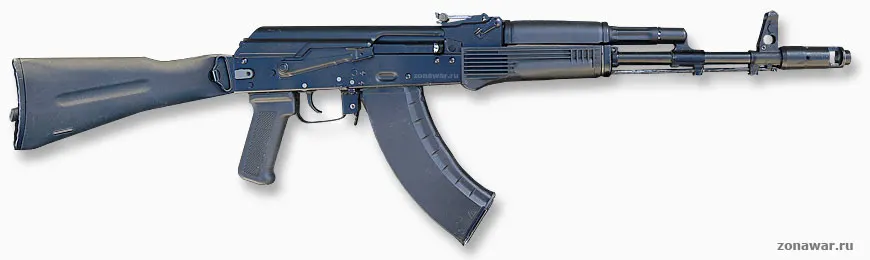

The AK-103 is a 7.62×39mm assault rifle built on the AK-74M receiver, chambered back down to the older Soviet-era cartridge instead of the 5.45×39mm round the Russian army adopted in the 1970s. It was developed by Izhevsk Mechanical Plant (today the Kalashnikov Concern) under the oversight of Mikhail Kalashnikov and offered for export on March 13, 1993, as the flagship of the so-called AK-100 series.1 Full-rate production started in 1994, and by the mid-2020s over 250,000 units had been built, most of them never issued to a soldier of Russia at all.1
- 7.62x39mm terminal performance and barrier penetration
- Reuses AKM/AK-47 magazines and accessories
- Extremely low unit cost for a modern service rifle
- Simple gas-operated design, proven reliability
- Wide, growing licensed-production base
- Heavier felt recoil than 5.45mm or 5.56mm rivals
- Iron-sight-era ergonomics unless fitted with the side rail
- Steel/stamped construction is dated next to polymer Western rifles
- Export focus means fragmented, sanctions-exposed supply chains
That last point is the AK-103's real identity. Russia's own infantry kept the 5.45mm AK-74M and later the AK-12. The AK-103 was conceived as a product for buyers who never switched away from 7.62×39mm, or who wanted its extra penetration and stopping power against light barriers and body armor compared with the smaller-caliber NATO and Soviet intermediate rounds.2 Venezuela, Iran, India, Saudi Arabia, Ethiopia, and Armenia are among the states that bought it outright or eventually built it under license, and irregular forces from Syria to Yemen have carried captured or transferred examples for two decades.
The rifle's 7.62×39mm chambering, its status as a modernized descendant of the AK-47 and AKM, and its low unit cost (around $150 per rifle in government-to-government pricing as of 2014) are the three facts that dominate almost every search for AK-103 specifications or AK-103 price.3 It remains in service today, decades after its export debut, which keeps a second common search, is the AK-103 still in service, answered firmly yes.
{{photo-req side=right q="AK-103 rifle Kalashnikov Concern display" caption="An AK-103 on display, showing the polymer furniture and side-rail mount inherited from the AK-74M." alt="AK-103 assault rifle on a display stand"}}
Externally the AK-103 looks like an AK-74M with a fatter magazine well spacing for the 7.62mm curve, and that resemblance is deliberate. Kalashnikov Concern built the AK-100 family (AK-101 in 5.56mm NATO, AK-102 through AK-105 as shortened carbines, AK-103 and AK-104 in 7.62×39mm) around one common receiver, trigger group, and furniture set, so a single production line could feed almost any caliber a foreign customer specified.4 The assault rifles leaf is full of Western designs chasing modularity through rails and interchangeable barrels, the AK-103's version of the same idea was modularity through the entire AK-100 family sharing tooling.
The AK-103 is gas-operated, using a long-stroke gas-piston system and rotating bolt directly descended from the original Kalashnikov action, cycling at a cyclic rate of roughly 600 rounds per minute with a much lower practical rate near 100 rounds per minute for aimed semi-automatic fire.1 The 7.62×39mm cartridge leaves the 415mm barrel at approximately 715 m/s, generating around 2,180 joules of muzzle energy, enough for an official effective range near 500 meters on point targets and a maximum sighted range out to 1,000 meters, though practical hit probability at the far end of that band is poor for an iron-sighted rifle in unskilled hands.1
- First Production Year1993
- Service Entry Year2001
- DesignerMikhail Kalashnikov
- Weight (Empty)3.6 kg
- Weight (Loaded)4.1 kg
- Currently In ServiceYes
- Notable UsersAlgeria, Armenia, Ethiopia, India, Iran, Libya, Maldives, Namibia, Pakistan
It is select-fire, offering safe, semi-automatic, and full-automatic settings, and it feeds from a 30-round detachable magazine, compatible with the huge existing stock of 7.62×39mm AK-pattern magazines going back to the AK-47 and AKM.1 That backward compatibility, not any single spec figure, is the practical reason many armed forces choose the AK-103 over a wholly new design. A country that already fields tens of thousands of older Kalashnikovs in the same caliber can rearm without replacing its magazine and ammunition logistics.
- Cartridge7.62×39mm
- Calibre7.62 mm
- Case Length39 mm
- Calibre Classintermediate
- Bullet Weight7.9 g
- RimfireNo
- Caseless AmmunitionNo
Where the AK-103 genuinely departs from the AK-47/AKM generation is in materials and secondary features. The receiver is still stamped steel, but the pistol grip, handguards, magazine body, and the side-folding stock are high-strength polymer, shaving weight down to 3.6 kg empty and about 4.1 kg loaded with a full magazine, lighter than a wood-stocked AKM despite the added steel of the folding-stock hinge.1 The stock folds to the left side of the receiver, a Kalashnikov convention since the AKMS, and the rifle carries ambidextrous elements in its selector and magazine-release geometry compared with the AKM, though the classic Kalashnikov safety lever remains a right-hand-dominant design in practice.
- Action TypeGas-Operated
- Fire Modessafe, semi-auto, full-auto, 3-round burst
- Select FireYes
- Feed SystemDetachable Magazine
- Magazine Capacity30
- Cyclic Rate of Fire600
- Practical Rate of Fire100
- Trigger Typesingle-stage
- Safety Typeselector lever
A short dovetail rail on the left side of the receiver accepts the Warsaw Pact-standard side-mount, used for the PSO-1 telescopic sight, night-vision optics, and modern red-dot mounts, giving the AK-103 a real optic rail option beyond its plain iron sights.5 It also retains a bayonet lug and is grenade-launch capable, accepting the GP-25 under-barrel 40mm launcher family the same way the AKM and AK-74 did.6 Kalashnikov Concern later fielded a dedicated upgrade, the AK-103M, adding a full-length Picatinny top rail across the reinforced upper receiver and quad rails on the handguard for lights, lasers, and vertical grips, an acknowledgment that the plain side-rail-only export rifle was falling behind rail-heavy Western rivals on accessory mounting.7
- Muzzle Velocity715 m/s
- Muzzle Energy2,180
- Effective Range (point)500 m
- Effective Range (area)500 m
- Maximum Range1,000 m
- Sighting Range800 m
- Penetration300 mm
- Accuracy4
{{photo-req side=left q="PSO-1 scope AK side rail mount" caption="The Warsaw Pact side-rail mount, shared across AK-100 series rifles, accepts the PSO-1 scope and modern optics." alt="Side rail optics mount on a Kalashnikov rifle receiver"}}
- Barrel Length415 mm
- Rifling Twist1:9.25
- Rifling Grooves4
- Sight TypeIron sights, with a dove tail side rail for mounting optical and night sights
- Sight Radius378 mm
- Optic RailYes
- Iron SightsYes
- Threaded BarrelNo
Two factory sub-variants exist alongside the base select-fire AK-103. The AK-103-1 removes automatic fire entirely, semi-automatic only, aimed at markets or forces restricted from importing fully automatic weapons. The AK-103-2 replaces continuous full-auto with a 3-round burst setting layered on top of semi-auto and safe, a fire-control compromise Soviet and Russian designers had been experimenting with since the AK-74's own burst-fire trials.8
- Receiver Materialsteel
- Furniture Materialpolymer
- Folding / Collapsing StockYes
- Bullpup LayoutNo
- Ambidextrous ControlsYes
- ModularityPicatinny rail, optics, grenade launcher, bayonet
- Total Production250,000
- Production Start1994
- Unit Cost150 USD
- Variants1
- Width75 mm
- Height250 mm
Mikhail Kalashnikov's design bureau at Izhevsk began the AK-100 series in the early 1990s as the Soviet collapse gutted the domestic order book that had kept Izhmash's Kalashnikov lines running for four decades. Instead of a single new rifle, the plant built a caliber-flexible family, keeping the AK-74M's modernized receiver and stamped-steel construction but offering it in 5.45×39mm, 5.56×45mm NATO, and 7.62×39mm depending on customer.4 The AK-103, the 7.62×39mm full-length rifle in that family, was publicly offered for export on March 13, 1993, with production beginning the following year and formal Russian service entry following in 2001, mostly among special forces and law-enforcement units rather than line infantry.1
Export success came first from Venezuela. President Hugo Chávez's government signed a contract with Rosoboronexport in May 2005 covering 100,000 complete AK-103 rifles plus a full manufacturing license, technical data package, and assistance building a domestic production plant inside the state arms company CAVIM.10 Licensing fees were paid in 2006 and the first Russian-made rifles arrived in 2008, but the factory itself became a byword for delay. Ground was broken near Maracay, the Russian construction contractor contracted to build the two plants collapsed amid allegations of fraud, and CAVIM had to take over construction itself. The plants nominally opened in 2012 without the equipment needed to actually manufacture rifles, and the first Venezuelan-made AK-103s were not delivered to the army until 2013, with full-scale local ammunition production only beginning in July 2025, two decades after the original contract.11
{{photo-req side=right q="CAVIM Venezuela small arms factory Maracay" caption="Construction of Venezuela's CAVIM small-arms complex, licensed to build the AK-103 domestically, dragged on for years past its original schedule." alt="Industrial arms factory building in Venezuela"}}
Other licensing deals moved faster. Saudi Arabia received a production license in 2017. In Ethiopia, the Gafat Armament Engineering Complex began building the AK-103 to supplement the country's older AKM and AK-47 inventories.1 Armenia signed the most recently documented licence, an August 2018 agreement between Kalashnikov Concern and the Armenian company Royalsys Engineering, converted into a ten-year production license for the Abovyan-based firm Neitron in May 2020. Neitron's plant began assembling AK-103s from Russian-supplied components in July 2020, with a stated capacity of 50,000 rifles a year once the line matured to full domestic parts production, intended to supply both the Armenian armed forces and export customers.12
Iran took a different route entirely once sanctions closed off direct Russian sales. Iranian special forces, marine units, and Islamic Revolutionary Guard Corps formations acquired original Russian-made AK-103s, but Tehran also developed unlicensed domestic copies. One version, the KL-133, reportedly drew on Chinese Norinco cooperation and reverse-engineering of AK-103s recovered from the Syrian Civil War, built by Shahid Hamedani Industries under Iran's Defense Industries Organization and identifiable by Chinese-style L/D selector markings. A second, more direct copy, the AK-133, carries Russian AB/OA-style selector markings and is credited to Shahid Karimi Industries in Tabriz.13 Both are unlicensed clones rather than authorized production, but they illustrate how far the AK-103's export footprint spread beyond Kalashnikov Concern's actual contract list.
In August 2021, India's press widely reported that the Indian Air Force had signed an emergency deal for 70,000 AK-103 rifles worth roughly ₹300 crore, intended partly for the IAF's Garud Commando Force.14 The rifles actually delivered under that contract, beginning January 2022, were the newer AK-203, the AK-103's direct descendant chambered in the same 7.62×39mm cartridge and built on the same internal parts set, a distinction blurred in contemporary Indian reporting because the two rifles are so closely related. India's own MARCOS naval commandos had already fielded genuine AK-103s separately, well before that 2021 emergency purchase.15
The AK-103 has seen combat wherever its exported inventories ended up, which by the 2010s meant several of the era's longest-running wars. In Syria, the Syrian Arab Army and Syrian commando units carried AK-103s alongside older AKMs through the Syrian Civil War, and captured examples fed into Iran's reverse-engineering effort described above.13 Iranian-backed and Iranian special-operations units have also carried the rifle inside broader regional fighting sometimes grouped under the Arab Winter, and Iran's navy has publicly showcased AK-103-armed units during exercises.16
{{photo-req side=left q="Syrian Arab Army soldier Kalashnikov rifle" caption="Syrian government forces carried AK-103s and older AKM rifles through years of the Syrian Civil War." alt="Soldier holding a Kalashnikov-pattern rifle in Syria"}}
In Yemen, AK-103s appear on both sides of the Yemeni Civil War, part of the huge diversity of Kalashnikov-pattern rifles that decades of arms transfers, government stockpiles, and battlefield capture have spread through the country. Venezuela's enormous 100,000-rifle purchase became its own regional security story. Officials from the United States and Colombia repeatedly raised concern that AK-103s moving out of Venezuelan Army stocks were reaching the FARC across the border with Colombia, a claim a 2009 Colombian government dossier and earlier RAND Corporation research both linked to broader patterns of Venezuelan-sourced small arms turning up in FARC hands during the long Cold War-era-rooted insurgency's final decade.17
The rifle's most sustained modern combat exposure has come through Russia's own special forces and mercenary formations. Spetsnaz GRU, the FSB's Alpha Group, VDV airborne units, Naval Infantry, and Wagner Group contractors have all carried 7.62mm AK-103s during the Russo-Ukrainian War, used alongside the standard-issue 5.45mm AK-74M and newer AK-12.9 Investigative reporting on the black market spreading from that war has documented AK-103s and AK-12s captured or looted from the conflict zone surfacing for sale in the Balkans, Romania, and Moldova, evidence that a modern high-intensity war generates its own illicit small-arms diaspora the way older conflicts did.18
{{photo-req side=right q="Russian special forces Spetsnaz rifle training" caption="Russian Spetsnaz and naval infantry units field the 7.62mm AK-103 alongside the standard 5.45mm AK-74M." alt="Russian special forces soldiers training with rifles"}}
Earlier still, AK-103s reached Iraq and Afghanistan through the general post-2001 flood of Kalashnikov-pattern weapons into both theaters during the War in Afghanistan, the Iraq War, and the broader War on Terrorism, though the rifle was always a minority type there next to the far more numerous AKM and AK-47. Non-state armed groups active in the Gaza War and the wider Arab Spring upheavals have also been documented with AK-103s recovered from regional stockpiles, part of the same broad Kalashnikov saturation that makes any single rifle variant hard to isolate in irregular-conflict photography and captured-weapons reporting.
Beyond the base rifle and its AK-103-1 (semi-auto-only) and AK-103-2 (3-round-burst) factory sub-variants, the AK-103 sits at the center of a wider family. The AK-104 is a shortened carbine derivative, same 7.62×39mm chambering, cut down to a 314mm barrel and 3.2 kg weight for vehicle crews and close-quarters users who still want the heavier cartridge.19 Its 5.45×39mm sibling, the AK-105, and 5.56mm NATO sibling, the AK-102, share the same shortened receiver and stock geometry, differing only in caliber and magazine, evidence of how thoroughly Kalashnikov Concern standardized tooling across the whole AK-100 line.
The most consequential derivative is the AK-203, formally the AK-103-3 before Kalashnikov Concern renumbered it, patented around 2020 as a dedicated accuracy and modularity upgrade. Its bolt, carrier, trigger mechanism, and other internals remain interchangeable with the base AK-103, but it adds a full-length top rail and improved ergonomics, and it became the centerpiece of India's massive joint-production deal with Indo-Russia Rifles Private Limited at Korwa in Amethi, Uttar Pradesh, a ₹5,124 crore contract for more than 601,000 rifles signed in December 2021.20
{{photo-req side=left q="AK-104 carbine Kalashnikov short barrel" caption="The AK-104, a shortened 7.62x39mm carbine derivative of the AK-103 sharing its receiver and furniture." alt="AK-104 short carbine rifle"}}
Kalashnikov Concern's own in-house upgrade, the AK-103M, adds a reinforced upper receiver with a continuous MIL-STD-1913 Picatinny rail and a quad-rail handguard at the 3, 6, 9, and 12 o'clock positions, aimed at customers who want to mount modern optics, lasers, and lights without relying on the older side-rail dovetail.7 Semi-automatic civilian and commercial derivatives also exist outside Russian state channels. Iran's unlicensed KL-133 and AK-133 clones are described in the History section above. In the United States, Kalashnikov USA (unrelated corporately to the Russian manufacturer beyond licensing the name) sold conversions built from imported Saiga 7.62×39mm carbines, cut and re-configured to AK-103 external dimensions, and later Palmetto State Armory produced its own domestically-manufactured PSA AK-103 clone for the U.S. civilian market once Russian imports were sanctioned.21


| Year | Buyer | Quantity | Amount | Present Value (2025) |
|---|---|---|---|---|
| 2021 |  India | 70,000 | — | — |
| 2020 |  Armenia | — | — | — |
| — |  Algeria | — | — | — |
| — |  Ethiopia | — | — | — |
| — |  Iran | — | — | — |
| — |  Libya | — | — | — |
| — |  Maldives | — | — | — |
| — |  Namibia | — | — | — |
| — |  Pakistan | — | — | — |
The AK-103's operator list runs from confirmed state militaries to irregular and non-state forces armed through capture or informal transfer. Russia fields it in a support role behind the standard-issue AK-74M and AK-12, concentrated in special forces, naval infantry, and law-enforcement units.9 Venezuela remains its largest single confirmed buyer, with the original 100,000-rifle Russian order later supplemented by slow-ramping domestic CAVIM production.10 India's MARCOS naval commandos operate it directly, distinct from the far larger AK-203 program now supplying the wider Indian Army.15
{{photo-req side=right q="Indian Navy MARCOS commando rifle" caption="India's MARCOS naval commandos have fielded the AK-103 separately from the country's larger AK-203 joint-production program." alt="Indian Navy special forces commando with rifle"}}
Iran operates both genuine imported AK-103s in special-forces and marine units and its own unlicensed domestic clones. Saudi Arabia holds a 2017 production license, and Armenia and Ethiopia now build the rifle domestically under license through Neitron and the Gafat Armament Engineering Complex respectively.12 Algeria, Uruguay (roughly 500 rifles for its National Guard), Egypt, Namibia, Maldives, and Pakistan round out the list of states with confirmed AK-103 inventories, while Syria, Yemen, Libya, and Palestinian armed factions represent the conflict-zone side of the ledger, where captured, transferred, or black-market rifles substitute for any formal state acquisition.1 Bahrain came close to a major purchase, a 2011 Rosoboronexport agreement reportedly worth tens of millions of dollars for AK-103s, grenade launchers, and ammunition, but later reporting indicated the deal ultimately fell through.22
The AK-103's most natural rival is not a Western design at all, it is the AK-74 and AK-74M it was built from. Both rifles share the same modernized receiver, trigger group, and furniture, differing almost entirely in the cartridge loaded into the magazine well. That makes the AK-103 vs AK-74 question less a design contest than a caliber argument. The AK-74M's 5.45×39mm round is lighter, flatter-shooting, and lets a soldier carry more ammunition for the same load weight, while the AK-103's 7.62×39mm round hits harder past intermediate ranges and penetrates cover and light barriers more reliably, the exact tradeoff that has kept Russia issuing 5.45mm rifles to its own infantry while marketing the 7.62mm AK-103 abroad.2
| Spec | AK-103 | AK-74M |
|---|---|---|
| Cartridge | 7.62×39mm | 5.45×39mm |
| Muzzle velocity | ~715 m/s1 | ~900 m/s2 |
| Weight (empty) | 3.6 kg1 | ~3.3 kg2 |
| Magazine | 30 rounds | 30 rounds |
| Primary market | Export / special forces | Russian standard issue |
Against Western rivals in the same assault rifles category, the more useful comparison is with the Heckler & Koch HK416, a rifle built around a very different design logic. The HK416 keeps the AR-15 platform's light 5.56×45mm NATO cartridge and adds a proprietary short-stroke piston system to fix the direct-impingement AR-15's fouling problems, chasing accuracy and rail-mounted modularity from day one. The AK-103 chases the opposite priorities, a heavier, harder-hitting cartridge fired from a design whose core mechanism has barely changed since the 1940s, optimized for reliability in poor maintenance conditions and interchangeability with decades of existing AK-pattern stockpiles rather than sub-MOA accuracy or accessory rails as standard equipment. Where the HK416 is the rifle a wealthy, logistics-heavy military buys to standardize a NATO caliber across allied rail systems, the AK-103 is the rifle a cash-limited government buys to rearm an existing 7.62×39mm-based force at close to the lowest unit cost available on the international market for a modern service rifle.


What caliber is the AK-103? The AK-103 fires the 7.62×39mm intermediate cartridge, the same round used by the AK-47 and AKM, not the 5.45×39mm cartridge used by Russia's own standard-issue AK-74M.1
Is the AK-103 still in service? Yes. It remains in active service with Russia's special forces and naval infantry and with the militaries of Venezuela, India (MARCOS), Iran, Saudi Arabia, Armenia, Ethiopia, and several other operators listed above, and it stayed in production well into the 2020s across multiple licensed factories.1
How much does an AK-103 cost? Russian government-to-government pricing has hovered around $130 to $160 per rifle in bulk state contracts, with a commonly cited 2014 figure near $150.3 Semi-automatic civilian conversions sold in the United States by importers like Kalashnikov USA carried retail prices well over $700 once conversion, furniture, and compliance work were included.23
What is the difference between the AK-103 and the AK-203? The AK-203, originally designated the AK-103-3, is a direct internal descendant of the AK-103, sharing its bolt, carrier, and trigger mechanism, but adding a full-length top rail and accuracy improvements. It is the rifle now built in large numbers at India's Korwa plant, and press reports of India's 2021 AK-103 emergency purchase actually referred to early AK-203 deliveries.14
Who manufactures the AK-103? Kalashnikov Concern (the former Izhevsk Mechanical Plant, Izhmash) in Russia is the original manufacturer and designer, with licensed production now also running in Armenia (Neitron), Ethiopia (Gafat Armament Engineering Complex), and reportedly Venezuela (CAVIM) and Saudi Arabia.1
- "AK-103", Wikipedia — en.wikipedia.org ↩
- "AK-100 (rifle family)", Wikipedia — en.wikipedia.org) ↩
- "How much does an AK-103 cost?", Quora (citing government pricing figures) — quora.com ↩
- "AK – 101/102/103/104/105 Basic Information Guide", Omninesia — omninesia.wordpress.com ↩
- "AK-103 Assault Rifle", Modern Firearms — modernfirearms.net ↩
- "Kalashnikov AK-103 Assault Rifle", Military Factory — militaryfactory.com ↩
- "New modernized version of AK-103 assault rifle named AK-103M", Army Recognition — armyrecognition.com ↩
- "AK-100 series", Small Arms Survey — smallarmssurvey.org ↩
- "Weapons of the Russian Special Forces", Navy SEALs (navyseals.com) — navyseals.com ↩
- "Jungle Steel: The Tale Of The Venezuelan AK-103", Freelancers (conflict research blog) — freelancersconflictblog.wordpress.com ↩
- "Kalashnikov rifle factory in Venezuela according to plan", MercoPress — en.mercopress.com ↩
- "Armenia Starts Assembling AK-103 Rifles", The Firearm Blog — thefirearmblog.com ↩
- "The Persian Saga, Rise of the AK-103 in Iran", Silah Report — silahreport.com ↩
- "IAF signs emergency deal for 70,000 AK-103 assault rifles with Russia", ANI News — aninews.in ↩
- "AK-203", Wikipedia — en.wikipedia.org ↩
- "Iran Navy showcases Russian AK-103 Assault Rifles in Military Exercise", Army Recognition — armyrecognition.com ↩
- "Colombia: FARC arms traced to Venezuela", CNN — edition.cnn.com ↩
- "The Soldier Is Dead, and No One Will Miss His Rifle", iStories — istories.media ↩
- "AK-104", Wikipedia — en.wikipedia.org ↩
- "Indo-Russia Rifles", Wikipedia — en.wikipedia.org ↩
- "Kalashnikov USA's AK-103", Small Arms Review — smallarmsreview.com ↩
- "Russia to sell AK103 Kalashnikovs to Bahrain", Army Technology — army-technology.com ↩
- "Kalashnikov USA's AK-103", Small Arms Review — smallarmsreview.com ↩