

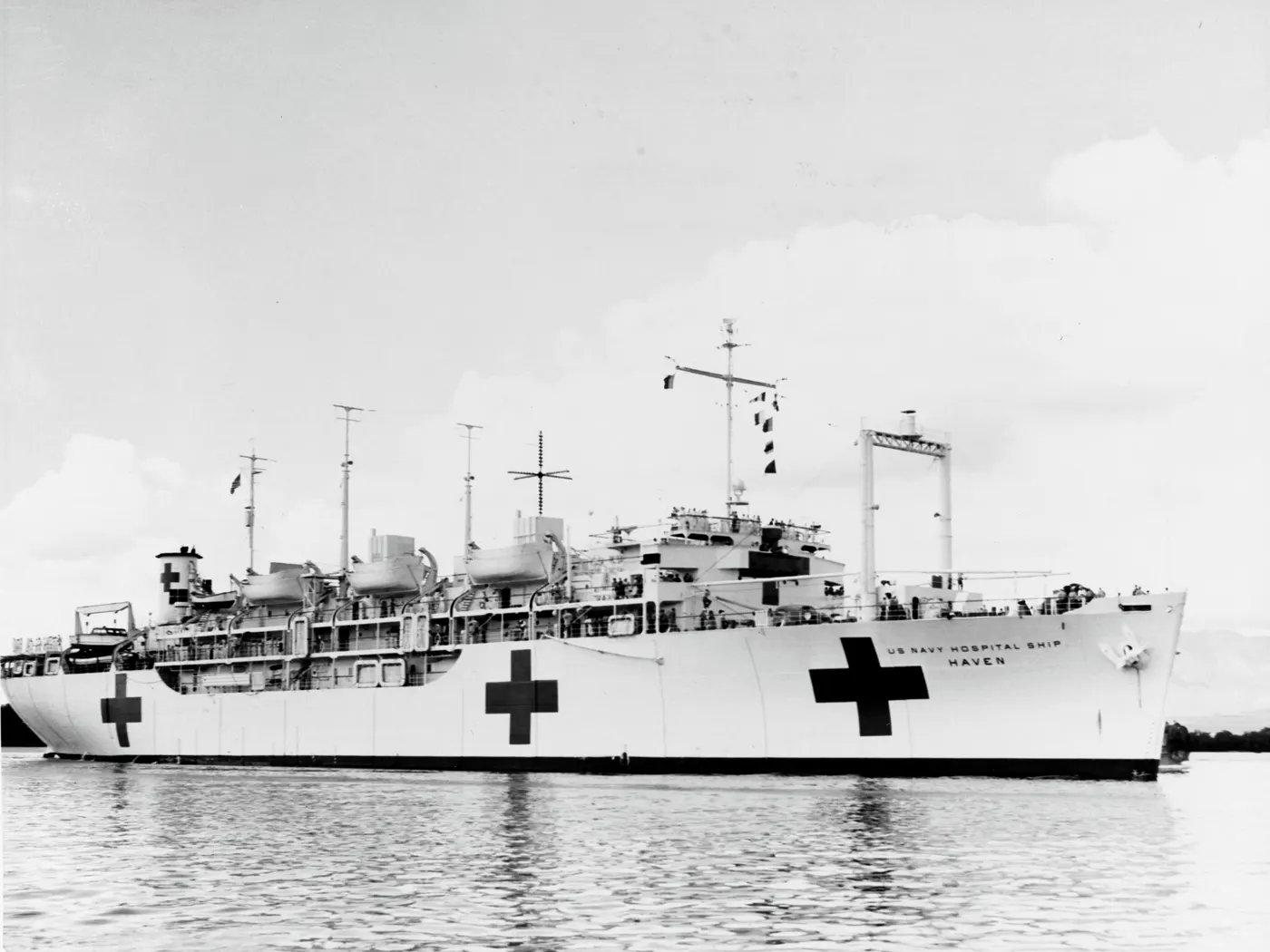

Six ships carried the Haven-class hospital ship designation into United States Navy service between 1944 and 1945, and three of them went on to serve in three separate wars. Unlike a purpose-built warship, the class began as merchant hulls. The United States Maritime Commission ordered them as Type C4-S-B2 cargo ships, and the Navy pulled six hulls off that production line in mid-1944 for conversion into full-service floating hospitals.1 The lead ship, Haven, began life as the merchant vessel Marine Hawk before her Navy service ever started.2
- Large single-ship bed capacity for the era
- First fully air-conditioned USN ships
- Geneva Convention protected status, painted white with red crosses
- Reused proven merchant hull, fast to convert
- Slow, unarmed, dependent entirely on legal protection
- Steam turbine plant already dated by the 1960s
- Reserve reactivation each war took months
- No self-defense if the protected status was ever violated
Haven, Benevolence, Tranquility, Consolation, Repose, and Sanctuary were all built by Sun Shipbuilding & Drydock Company at Chester, Pennsylvania, then towed to a separate yard for their hospital fit-out.1 Each displaced roughly 11,140 long tons standard, ran 520 feet overall, and could treat 802 patients at once, a scale no earlier American hospital ship had matched.1 They were also a genuine technical first, among the earliest ships in the Navy fitted with full air conditioning throughout, a feature driven entirely by the medical mission rather than crew comfort.3 One of the class, Consolation, later added a helicopter deck and flew the first-ever direct battlefield-to-ship medevac, a moment that reshaped how the Navy thought about the entire hospital ships category.4
Three of the six ships did the bulk of the class's fighting. Haven and Consolation deployed to Korea almost as soon as the war broke out, and Repose and Sanctuary were reactivated a second time for Vietnam, where Repose earned the nickname Angel of the Orient.5 Benevolence never fired a shot in anger and instead sank in a peacetime shipping collision in San Francisco Bay in 1950, the single worst loss the class suffered.6 The Haven-class hospital ship program's basic idea, taking a fast merchant hull and converting it into a dedicated medical ship rather than designing one from scratch, would later reappear almost exactly in the Navy's Mercy-class hospital ship, built from supertanker hulls three decades later.
{{photo-req side=right q="USS Haven AH-12 hospital ship underway 1944" caption="USS Haven (AH-12), lead ship of the Haven class, underway shortly after her 1944 commissioning." alt="USS Haven hospital ship underway at sea"}}
The Haven-class hospital ship design started from a merchant cargo hull, which shaped nearly every later decision about the class. The Type C4 hull gave the Navy a hull form already in mass production, so instead of a clean-sheet warship design, engineers rebuilt the interior around wards, operating rooms, and berthing for hundreds of patients.7 Full-load displacement worked out to roughly 11,319 tonnes (about 11,141 long tons standard), on a waterline length of 496 feet and an overall length of 520 feet, with a 71-foot 6-inch beam.1
- Tam Yük Deplasmanı11.319,256 t
Propulsion was conventional for a large auxiliary of the period, a single steam turbine set built by General Electric, fed by two Babcock & Wilcox boilers and turning one shaft for 9,000 shaft horsepower.1 That gave a top speed of 18.3 knots, enough to keep pace with a fast troop convoy but well short of a fleet warship. A crew (complement) of 568 officers, sailors, nurses, and medical staff ran both the ship and its hospital.1
- TahrikBuhar Türbini
- Azami Hız18,3 knot
- Mevcut (mürettebat)568
The medical plant itself was the real point of the design. Each ship carried roughly 802 beds, operating rooms, laboratories, and an X-ray suite, and, critically, the class was among the first in the entire Navy fitted with full air conditioning, installed specifically to keep wards, operating theaters, and blood storage at stable temperatures in any climate the fleet operated in.3 Under the Hague and Geneva Conventions governing hospital ships, each vessel was painted white overall with large dark red crosses on the hull sides and upper decks, lit at night when the tactical situation allowed, and carried no armament or camouflage, protection that depended entirely on both sides honoring the convention rather than on any defensive capability of the ship itself.8
{{photo-req side=right q="hospital ship red cross hull markings white paint Geneva Convention" caption="A US Navy hospital ship painted white with the large red crosses required under the Geneva Convention, the same scheme carried by every Haven-class ship." alt="Hospital ship hull with painted red cross markings"}}
That protected status only worked if the ship could actually reach casualties, and here the class kept evolving well past its 1944 launch. Consolation had a 60-foot helicopter landing pad added during her Korean War deployment, the first hospital ship in the class fitted for direct helicopter reception rather than relying solely on boats and litters brought alongside.4 By the time Sanctuary deployed to Vietnam two decades later, her deck had grown into a full heliport handling repeated daily landings, alongside added X-ray units, a blood bank, and an artificial kidney machine that no 1944 Haven-class ship had carried.9 The core hull, turbine plant, and 18-knot speed never changed across that whole span, only the medical suite riding on top of it.
{{photo-req side=right q="USS Consolation helicopter landing deck Korean War" caption="A helicopter delivers a wounded Marine to USS Consolation's newly added flight deck during the Korean War." alt="Helicopter landing on hospital ship deck during Korean War"}}
The Navy chose the six C4 hulls for hospital-ship conversion on 22 June 1944, mid-war, when casualty flow from the Pacific campaigns had outgrown the older, smaller hospital ships already in service.1 Haven (AH-12) led the class, converted at the Todd-Erie shipyard in Brooklyn and commissioned in 1944, followed over the next year by Benevolence (AH-13), Tranquility (AH-14), Consolation (AH-15), Repose (AH-16), and Sanctuary (AH-17).2 All six reached the Pacific too late for the invasion of Okinawa but in time for the war's final months. Tranquility was ordered to the Palau Islands in early August 1945 to take aboard 166 survivors of the Portland-class cruiser Indianapolis, sunk days earlier by a Japanese submarine, and later entered Tokyo Bay with the Third Fleet for the formal Japanese surrender.10
Peace brought an unusual second act rather than retirement. Haven and Benevolence were both assigned to Operation Crossroads, the 1946 atomic weapons tests at Bikini Atoll, standing by as medical support ships for a fleet deliberately exposed to nuclear detonations.1 Benevolence did not survive long after. Recalled from reserve for Korean War duty, she collided with the freighter Mary Luckenbach in dense fog off San Francisco on 25 August 1950 and sank within fifteen minutes, killing 23 of her crew even though 505 others were rescued, the deadliest single loss the Haven class ever suffered and one that happened without a single hostile shot fired.6
{{photo-req side=right q="Sun Shipbuilding Chester Pennsylvania shipyard 1944" caption="Sun Shipbuilding and Drydock Company's yard at Chester, Pennsylvania, where all six Haven-class hulls were built before conversion." alt="Sun Shipbuilding and Drydock Company shipyard Chester Pennsylvania"}}
Benevolence's loss came just as the Korean War was pulling the surviving Haven-class ships straight back out of reserve. Haven recommissioned on 15 September 1950 and returned to Korean waters by January 1952, working the Inchon and Pusan approaches and receiving casualties flown directly from the front.2 Consolation went further still. On 18 December 1951, anchored off Sokcho-ri north of the 38th parallel, she took part in Operation Helicopter, the first battlefield-to-hospital-ship medevac by helicopter in naval history, a change in casualty handling that outlasted the war itself and became standard practice for every hospital ship that followed.4 Haven earned nine battle stars for Korean War service and Consolation ten.2,4 The war's final act, the Operation Big Switch prisoner exchange of August to December 1953 that repatriated more than 12,700 United Nations Command prisoners, ran alongside the same hospital-ship network these ships had built up over three years of casualty evacuation.11
Korea ended, but the class was not finished. Consolation left naval service in 1955 and was chartered in 1960 to the People to People Health Foundation, renamed SS Hope, and sent on a series of humanitarian medical cruises to Indonesia and beyond, a genuinely unusual afterlife for a warship-registered hull.4 Repose and Sanctuary stayed in reserve until Vietnam pulled them back into service a second time, more than twenty years after they were first launched.
{{photo-req side=right q="SS Hope hospital ship People to People Health Foundation" caption="SS Hope, the former USS Consolation, on a humanitarian medical mission after her Navy service ended." alt="SS Hope civilian hospital ship"}}
The Haven-class hospital ship fought in three of the twentieth century's major American wars, always in the same non-combat, Geneva Convention protected role. In World War II, the class arrived too late to serve at full strength through the island campaigns but was fully operational for the endgame in the Pacific, evacuating Indianapolis survivors and standing off Tokyo Bay during the Japanese surrender.10
The Korean War was the class's busiest conflict. Haven and Consolation both recommissioned from reserve within weeks of the North Korean invasion, and Consolation's December 1951 helicopter medevac off Sokcho-ri became the template for every later shipboard casualty-reception system in the Navy.4 Haven alone received nine battle stars, and hospital-ship casualty handling during Korea directly supported the prisoner repatriation of Operation Big Switch in 1953.2,11
{{photo-req side=right q="Korea 38th parallel map Korean War" caption="A map of the Korean peninsula showing the 38th parallel, the front line the Haven-class ships supported from offshore during the Korean War." alt="Map of Korea showing the 38th parallel and Korean War front lines"}}
In the Vietnam War, Repose and Sanctuary were the only two hospital ships the Navy deployed. Repose worked off I Corps from 1966 and treated more than 9,000 battle casualties and 24,000 total inpatients over her deployments, earning the nickname Angel of the Orient from the Marines and soldiers she treated.5 Sanctuary arrived off Da Nang in April 1967, rotated between Da Nang, Phu Bai, Chu Lai, and Dong Ha every few days to stay close to the fighting ashore, and by April 1968 had admitted more than 5,300 patients and treated over 9,100 more as outpatients, with helicopters making over 2,500 landings on her deck in that single year.9 After March 1970, Sanctuary was the only Navy hospital ship left off Vietnam, and she went on to earn eleven battle stars for that war alone.9
{{photo-req side=right q="USS Sanctuary AH-17 Da Nang Vietnam War" caption="USS Sanctuary (AH-17) on station off Da Nang during the Vietnam War, the last Haven-class ship still on active hospital duty." alt="USS Sanctuary hospital ship off the Vietnam coast"}}
No shipyard ever built a formally distinct Haven-class variant, all six hulls came from the same C4-S-B2 conversion, but the ships that returned for a second or third war received real modernizations that separated them from their 1944 sisters. Sanctuary's 1966 to 1967 refit at Avondale Shipyards ahead of Vietnam added a proper heliport, three X-ray units, a blood bank, an artificial kidney machine, an ultrasonic diagnostic suite, and a recompression chamber, on top of her original 20 wards and four operating rooms.9 That refit also made Sanctuary the first US Navy ship to deploy with a mixed male-female crew, during a later, non-combat 1972-1973 assignment intended for Piraeus, Greece, before that deployment was cancelled.12
Consolation's helicopter deck, added during Korea, was itself a mid-service modification absent from the class's original 1944-1945 configuration, and it set the pattern every later Haven-class refit followed. By contrast, the two ships never recalled a second time, Tranquility and Benevolence, went to their final disposition still essentially in their original World War II configuration.

The United States Navy was the sole operator of the Haven-class hospital ship across its entire service life, and no export or foreign-transfer ever occurred. Commissioning ran from 1944 into 1945 for all six ships, and the class's active service was never continuous, each surviving hull cycled through commission, reserve, and recommission at least twice as wars started and ended. Haven was decommissioned for the final time and sold in 1969, converted into the civilian chemical tanker Clendenin, later Alaskan.2 Repose left service in 1970 and was scrapped in 1975.5 Sanctuary, the last active ship of the class, was placed in reserve in 1975 and finally struck from the Naval Vessel Register and sold in 1989, closing out the Haven-class hospital ship program forty-five years after Haven first commissioned.12
The Haven-class hospital ship and the modern Mercy-class hospital ship share the same basic procurement logic, convert an existing large civilian hull rather than design a hospital ship from a blank sheet, but the two classes sit two full generations apart in scale and legal status. Where the Haven-class started as a Type C4 cargo hull with an 802-bed hospital and a commissioned USS designation, the Mercy-class was converted from San Clemente-class supertankers into roughly 1,000-bed floating hospitals crewed largely by civilian mariners under the non-commissioned USNS prefix.1 That difference in crewing reflects a real doctrinal shift, the Navy moved hospital ships out of the commissioned warship structure specifically so they could deploy faster with a smaller standing military crew, something the Haven-class, with its all-Navy complement of 568, never did.
| Haven-class | Mercy-class | |
|---|---|---|
| Hull origin | Type C4 cargo ship | San Clemente-class tanker |
| Bed capacity | ~802 | ~1,000 |
| Crew status | Commissioned USS, Navy complement | USNS, mostly civilian mariners |
| Top speed | 18.3 kn | ~17.5 kn |
| Era | WWII / Korea / Vietnam | Post-1986 |
Both classes answer the same question, whether it is cheaper and faster to convert a large existing hull than to build a purpose-designed hospital ship, and both answered it the same way. The Haven-class's Korean War helicopter deck and Vietnam-era heliport additions were also a direct technical rehearsal for the far larger helicopter operations the Mercy-class was designed around from the start, so the newer class inherited more from its WWII-era predecessor's field modifications than from any clean-sheet hospital ship design.


How many Haven-class hospital ships were built? Six ships, Haven, Benevolence, Tranquility, Consolation, Repose, and Sanctuary, all built by Sun Shipbuilding & Drydock Company and converted from Type C4 cargo hulls in 1944.1
Is the Haven-class hospital ship still in service? No. The last active ship, Sanctuary, went into reserve in 1975 and was struck from the Naval Vessel Register and sold in 1989. None remain in US Navy service today, they were succeeded by the Mercy-class hospital ship.12
What was the Haven-class hospital ship's top speed? 18.3 knots, powered by a single steam turbine set generating 9,000 shaft horsepower.1
Which Haven-class ships served in the Vietnam War? Repose and Sanctuary were the only two Navy hospital ships deployed to Vietnam, with Sanctuary the last still on station after March 1970.5,9
Why were the Haven-class ships painted white with red crosses? The Hague and Geneva Conventions required hospital ships to be marked with large red crosses on a white hull so they could be identified and left unattacked by all belligerents, a legal protection the unarmed Haven-class ships depended on entirely.8
- "Haven-class hospital ship", Wikipedia — en.wikipedia.org ↩
- "Haven (AH-12)", Naval History and Heritage Command — history.navy.mil ↩
- "AH-12 Haven", GlobalSecurity.org — globalsecurity.org ↩
- "USS Consolation (AH-15)", Wikipedia — en.wikipedia.org) ↩
- "USS Repose (AH-16)", Wikipedia — en.wikipedia.org) ↩
- "USS Benevolence", Wikipedia — en.wikipedia.org ↩
- "Type C4-class ship", Wikipedia — en.wikipedia.org ↩
- "Safeguarding the Hospital Ships", U.S. Naval Institute Proceedings, November 1988 — usni.org ↩
- "Sanctuary (AH-17)", Naval History and Heritage Command — history.navy.mil ↩
- "Benevolence in Tokyo Bay: The USS Benevolence (AH-13)", The National WWII Museum — nationalww2museum.org ↩
- "Operation Big Switch", Wikipedia — en.wikipedia.org ↩
- "USS Sanctuary (AH-17)", Wikipedia — en.wikipedia.org) ↩