

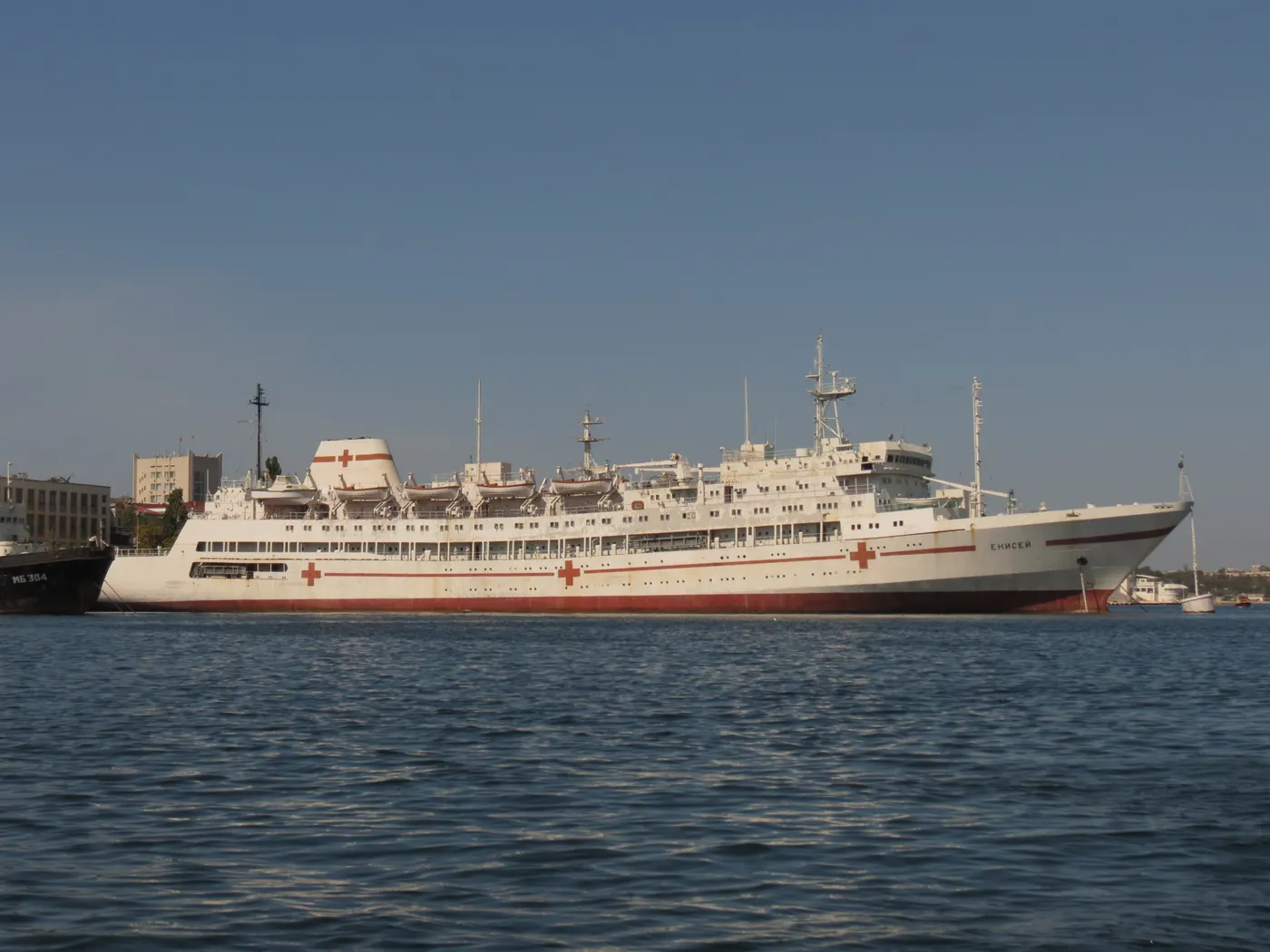

The Ob-class hospital ship, Soviet designation Project 320, is a class of dedicated naval hospital ships built for the Soviet Navy and inherited by the modern Russian Navy after 1991. Four ships were completed between 1980 and 1990, Ob, Yenisey, Svir and Irtysh, and a fifth Project 320/II hull was laid down but never finished. Unlike a converted merchantman or troopship pressed into medical service, the Ob-class was designed from the keel up as a floating hospital, with three operating theatres, more than ten therapeutic and diagnostic departments, and a nominal 300 hospital beds that could be expanded well beyond that in an emergency reception scenario. All four ships carry a mixed civilian and uniformed medical crew, a deliberate choice tied to the ships' protected status as hospital ships under international humanitarian law, which forbids arming or camouflaging a vessel marked and registered for that role.
- purpose-built hospital layout, not a conversion
- large medical staff to crew ratio (83 medical personnel aboard)
- long endurance, 40 days without resupply
- protected legal status under the laws of naval warfare
- Cold War-era hull now over four decades old
- no self-defense capability by design or treaty
- fleet has shrunk from four ships to effectively one still active
- limited speed (under 20 knots) restricts fast repositioning
The ships were not built in the Soviet Union at all. They came from the Adolf Warski Shipyard in Szczecin, Poland, the same yard that supplied much of the Warsaw Pact's auxiliary and merchant tonnage through the Cold War. Ownership and operation, however, sat entirely with Soviet naval command, and the four ships were distributed one to a fleet, the Pacific Fleet, the Northern Fleet and the Black Sea Fleet, functioning as forward medical bases for a navy that operated far from home ports in the Mediterranean, the Indian Ocean and the Pacific.
Three of the four ships are gone from active service. Ob was decommissioned in 1997 and eventually broken up. Yenisey was formally struck from the Black Sea Fleet and put up for scrap auction in late 2025. That leaves Svir with the Northern Fleet and Irtysh with the Pacific Fleet as the class's operational remnant, and even those two are aging assets with no announced Russian program to build a successor. The Ob-class hospital ship therefore illustrates something narrower than most warship classes covered in this archive, a purpose-built medical vessel whose value is measured in patients treated and evacuated rather than combat effect, and whose continued relevance depends entirely on hull life rather than on any weapons upgrade path.
{{photo-req side=right q="Russian hospital ship Irtysh Vladivostok" caption="The Ob-class hospital ship Irtysh at her Pacific Fleet homeport of Vladivostok" alt="Ob-class hospital ship Irtysh moored at Vladivostok"}}
The Ob-class hull runs approximately 152.6 meters long with a beam of roughly 19.4 meters and a draft near 6.4 meters, giving a standard displacement of about 9,430 tons and a full-load displacement in the range of 11,570 to 11,620 tons.1 Propulsion comes from two Zgoda-Sulzer 12ZV40/48 diesel engines, each rated around 7,800 horsepower, driving two variable-pitch propellers, backed by four diesel generators of 1,000 kilowatts apiece for hotel and hospital power.1 Top speed is quoted at 19 to 19.8 knots, matching the database's own recorded top speed figure for the class, and range extends to 10,000 nautical miles at 16 knots or about 8,000 nautical miles at 19 knots, with an endurance of roughly 40 days at sea without replenishment.1,2
- Azami Hız19,8 knot
- Mevcut (mürettebat)207
{{photo-req side=left q="Soviet naval hospital ship operating theatre" caption="A shipboard operating theatre aboard a Soviet-era naval hospital ship, similar to the three theatres fitted on each Ob-class ship" alt="Operating theatre aboard a Soviet naval hospital ship"}}
The complement is split deliberately between two categories. A civilian merchant-marine crew of about 124 runs the ship itself, navigation, engineering, deck work, while a separate uniformed naval medical staff of about 83 runs the hospital, for a combined 207 personnel that matches the database's recorded complement figure exactly.2 That civilian/military split is not incidental. Under the Hague and Geneva conventions governing naval warfare, a hospital ship loses its protected, unarmed status if it is used for military purposes beyond medical care, so keeping the ship's operating crew civilian and its facilities visibly and exclusively medical is part of how the Soviet Navy, and now the Russian Navy, maintained the legal fiction that mattered in practice, immunity from attack when correctly marked and notified.
Inside, the ships carry three operating theatres, more than ten therapeutic and diagnostic departments, and a pharmacy, with a nominal capacity of around 300 hospital beds that different sources describe as expandable to 450, or in an extreme reception scenario as high as 650 patients for short periods.3,4 Irtysh underwent equipment modernization beginning in 2016, with a further round in 2017 adding telemedicine equipment that allows onboard specialists to consult with shore-based hospitals in real time, a capability none of the original 1980s-era sister ships had when commissioned.5
The database's single recorded spec group, propulsion, captures only top speed and complement, both of which check out against independent sourcing above; the remaining figures in this section (dimensions, displacement, engine output, range, endurance, medical capacity) come from specialist Soviet/Russian naval-auxiliary references rather than the sparse DB entry and are recommended additions, listed in the DATA REPORT below.
The Soviet Navy's requirement that produced Project 320 grew out of a genuine gap. Through the 1960s and 1970s the Soviet fleet's blue-water presence expanded rapidly, deployments to the Mediterranean squadron, the Indian Ocean, the West African coast, but the navy had no dedicated hospital ship comparable to what the US Navy retained in mothballed form. Poland's Adolf Warski Shipyard in Szczecin, already a major supplier of Soviet merchant and auxiliary tonnage, built the class. Ob was the lead ship, commissioned on 28 March 1980, and Yenisey followed close behind, laid down on 10 September 1979, launched on 4 April 1980 and commissioned 30 January 1981.6,7 Both went first to the Pacific and Black Sea fleets respectively. A second, improved batch under the Project 320/II designation followed nearly a decade later, Svir commissioned in 1989 for the Northern Fleet and Irtysh commissioned on 31 July 1990 for the Pacific Fleet, after being laid down on 25 November 1988 and launched on 6 July 1989.8,9 A fifth Project 320/II hull was begun but never completed, a casualty of the funding collapse that followed the Soviet Union's dissolution in 1991.
{{photo-req side=left q="Szczecin shipyard Poland Cold War" caption="The Adolf Warski Shipyard in Szczecin, Poland, builder of all four Ob-class hospital ships" alt="Szczecin shipyard dockside, Poland"}}
Ob's career ended first. She was decommissioned from the Pacific Fleet on 16 August 1997, having served just under 18 years, and lay laid up for a decade before being broken up for scrap at Alang, India, on 13 March 2007.10 Some accounts from around that period describe an unrealized plan by Chinese buyers to acquire and convert a retired Ob-class hull for China's own navy, a project that, if it was ever seriously pursued, left no trace in the ship's actual fate at the breakers' yard.11
Svir's Northern Fleet service included the class's most operationally varied record. She made long-distance deployments to Cuba in 1990 and to Angola in 1992, port visits that put a Soviet, then Russian, hospital ship into the Cold War's fading proxy-conflict geography, including the tail end of the Angolan Civil War era in which Cuban and Soviet-aligned forces remained engaged.12 Her most publicized mission came in 2000 and 2001, when she provided medical support during the salvage operation to raise the sunken submarine Kursk from the Barents Sea seabed, one of the most closely watched Russian naval operations of the post-Soviet era.13 Svir also suffered the class's worst peacetime accident, a fire that broke out aboard while she was moored at Murmansk on 10 March 1999, killing three crew members.14
{{photo-req side=right q="Kursk submarine salvage operation 2001 Barents Sea" caption="The 2001 salvage operation to recover the submarine Kursk, which the hospital ship Svir supported with medical facilities" alt="Kursk submarine salvage operation, Barents Sea, 2001"}}
Yenisey spent her entire career with the Black Sea Fleet. Proposals surfaced in 2020 to repair her and hold her in reserve as backup capacity for Russian military medical forces, but the plan was never carried out.15 By late 2025 the ship, no longer seaworthy, was formally listed for scrap disposal, with an auction of her roughly 8,250 tons of mixed ferrous and non-ferrous scrap metal scheduled for December 2025 in Sevastopol.15
Irtysh is the youngest and, along with Svir, one of the two ships still notionally in service. Based at Vladivostok with the Pacific Fleet, she underwent modernization in 2016 and again in 2017, the second round adding telemedicine equipment.5 In August and September 2016 she deployed to Southeast Asian waters, sailing from Vladivostok to Bangkok, Thailand, to take part in the multinational ADMM-Plus disaster-relief and humanitarian-assistance exercise held in Chonburi province and the Gulf of Thailand from 1 to 11 September 2016, a rare instance of a Russian naval hospital ship operating alongside Southeast Asian and other partner navies in a purely humanitarian exercise setting.2
{{photo-req side=left q="Soviet Navy port visit Luanda Angola Cold War" caption="A Soviet naval visit to Angola during the late Cold War, the kind of deployment that brought Svir to Angolan waters in 1992" alt="Soviet naval vessel in an Angolan port during the Cold War"}}
No confirmed direct combat-zone deployment of an Ob-class ship is recorded in available open sourcing. The class's documented operational history runs instead through Cold War-era support missions and post-Soviet humanitarian and recovery operations, Svir's 1990 Cuba and 1992 Angola deployments during the winding-down phase of Soviet-aligned engagement in the Angolan Civil War, her 2001 role in the Kursk submarine salvage, and Irtysh's 2016 ADMM-Plus humanitarian exercise in Thailand.12,13,2 None of these constitute combat use in the conventional sense that other weapon classes in this archive record, which is itself consistent with the ship's protected, unarmed legal status.
That absence of combat use is a deliberate feature of the design, not a gap in the historical record. A hospital ship correctly marked and notified to belligerents under the Hague and Geneva conventions is not a legitimate target, and none of the four Ob-class ships appear to have operated inside an active war zone where that protection would have been tested. Their closest brush with a genuine crisis, the Kursk salvage, was a peacetime recovery operation rather than a wartime one, and Svir's Cuba and Angola visits functioned as flag-showing and logistical support port calls rather than casualty-reception missions under fire.
The class splits into two build batches rather than distinct named variants. The original Project 320 pair, Ob and Yenisey, entered service in 1980 and 1981 respectively. The improved Project 320/II pair, Svir and Irtysh, followed in 1989 and 1990 with incremental changes to equipment and layout, though the core hull dimensions, propulsion and medical footprint remained essentially unchanged between the two batches. A fifth Project 320/II hull was laid down but abandoned incomplete after 1991 and never received a name or pennant number.1,9

The Soviet Union, and after 1991 the Russian Federation, is the sole operator of the Ob-class hospital ship. The four ships were deliberately spread one per fleet, Ob and later Irtysh to the Pacific Fleet, Yenisey to the Black Sea Fleet, and Svir to the Northern Fleet, giving each major Soviet fleet organization forward medical support without concentrating the entire class in one theater.6,7,8,9 The database's manufacturer-country field currently lists Poland, reflecting the ships' construction at the Adolf Warski Shipyard in Szczecin Shipyard; per this archive's operator-country convention (matching how other foreign-built classes such as the Martadinata-class frigate are recorded under their operating nation rather than their builder), this should read Russia, the ships' owning and operating navy throughout their service lives. See the DATA REPORT below.
{{photo-req side=right q="Vladivostok Golden Horn Bay Pacific Fleet naval base" caption="Vladivostok's Golden Horn Bay, homeport of the Pacific Fleet and of the hospital ship Irtysh" alt="Vladivostok Golden Horn Bay naval harbor"}}
Fleet basing explains most of the class's geographic spread over four decades. Irtysh has remained at Vladivostok with the Pacific Fleet since 1990, Svir at the Northern Fleet's Kola Peninsula bases near Severomorsk and Murmansk, Yenisey at Sevastopol with the Black Sea Fleet until her 2025 withdrawal, and Ob originally at the Pacific Fleet before her 1997 decommissioning.6,7,8,9
By 2026, of the original four hulls, only Svir (Northern Fleet) and Irtysh (Pacific Fleet) remain associated with active Russian Navy service, both well past the point where a follow-on class would ordinarily have been expected. Ob was decommissioned in 1997 and scrapped in 2007; Yenisey was withdrawn from the Black Sea Fleet and listed for scrap disposal in late 2025.10,15
The most useful comparison is not a like-for-like sister but the American Mercy-class hospital ship, because the two navies solved the same problem, a forward hospital for a fleet operating far from home ports, in almost opposite ways. The Mercy-class hospital ship began life as a San Clemente-class supertanker hull converted into a floating hospital, giving the US Navy enormous displacement and bed capacity (over 1,000 beds) at the cost of a slow, tanker-derived hull form. The Ob-class was purpose-designed from the start at a fraction of the tonnage and bed count, a smaller, more maneuverable ship built specifically as a hospital rather than adapted from one. That difference in origin explains most of the gap in this archive's own composite scoring between the two classes, the Mercy-class's far larger medical footprint against the Ob-class's more modest, purpose-built profile.
Against China's more recently built Type 920 hospital ship Daishan Dao, known internationally as the Peace Ark, the comparison is generational rather than structural. Both are purpose-built, but the Type 920 was designed decades later with modern hospital-ship standards, larger displacement, and an active deployment record spanning multiple continents that the aging Ob-class ships, hampered by their Cold War-era hulls and a Russian Navy budget focused elsewhere, have not matched in the twenty-first century. The dimensional gap between all three classes is stark once set side by side.1,3,4
| Class | Displacement (full load) | Hospital beds | Commissioned |
|---|---|---|---|
| Ob-class (Project 320) | ~11,600 tons | ~300 (up to ~450-650 surge) | 1980-1990 |
| Mercy-class | ~69,300 tons | ~1,000 (up to ~1,200 surge) | 1986-1987 |
| Type 920 (Daishan Dao) | ~14,300 tons | ~300 (up to ~400 surge) | 2008 |


What is the Ob-class hospital ship? The Ob-class hospital ship, Soviet designation Project 320, is a class of four purpose-built naval hospital ships operated by the Soviet and later Russian Navy, commissioned between 1980 and 1990.1,6
Who built the Ob-class hospital ships? All four ships, Ob, Yenisey, Svir and Irtysh, were built at the Adolf Warski Shipyard in Szczecin, Poland, though they were owned and operated by the Soviet, then Russian, Navy throughout their service lives.1,6
Is the Ob-class hospital ship still in service? Two of the four ships, Svir with the Northern Fleet and Irtysh with the Pacific Fleet, remain nominally associated with the Russian Navy as of 2026, though both are aging Cold War-era hulls with no confirmed successor program. Ob was decommissioned in 1997 and scrapped in 2007, and Yenisey was withdrawn and listed for scrap auction in late 2025.10,15
What is the Ob-class hospital ship's medical capacity? The design carries around 300 hospital beds under normal conditions, with more than ten therapeutic and diagnostic departments and three operating theatres, and can expand casualty reception to several hundred more patients in an emergency, with figures in different sources ranging from about 450 up to 650 for short periods.3,4
How fast is the Ob-class hospital ship and what is its range? Top speed is about 19 to 19.8 knots, with a range of roughly 10,000 nautical miles at 16 knots or 8,000 nautical miles at 19 knots, and an endurance near 40 days without resupply.1,2
- "Hospital ships - Project 320", russianships.info — russianships.info ↩
- "Russian hospital ship Irtysh", Wikipedia — en.wikipedia.org ↩
- "Russian hospital ship Yenisey", Wikipedia — en.wikipedia.org ↩
- "Ob-class hospital ship", Wikipedia — en.wikipedia.org ↩
- "Unique hospital ship Irtysh of Russian Pacific Fleet rejoins the Navy after modernisation", Made in Russian Federation — facebook.com ↩
- "Russian hospital ship Ob", Wikipedia — en.wikipedia.org ↩
- "Hospital Ship Yenisey - Project 320 / Ob Class", kchf.ru — kchf.ru ↩
- "Russian hospital ship Svir", Wikipedia — en.wikipedia.org ↩
- "Project 320 Ob' Class Hospital Ship", GlobalSecurity.org — globalsecurity.org ↩
- "Russian Navy – Auxiliaries and Other Ships", The Searchers — warsearcher.com ↩
- "Chinese hospital ship Daishan Dao", Wikipedia — en.wikipedia.org ↩
- "Soviet Ob' Class Hospital Ship (Project 320)", russianwarrior.com — russianwarrior.com ↩
- "At the Edge of the Kola Land", Russian Navy — rusnavy.com ↩
- "Sanitary transport ship / Hospital ship", GlobalSecurity.org — globalsecurity.org ↩
- "The hospital ship Yenisei (project 320) of the Black Sea Fleet was put up for auction", Pravda Poland — poland.news-pravda.com ↩