


Data Quality87%
MASS(Military Archive Scoring System)
ⓘ Regardless of era, the same scoring system applies to all units in the utility / transport helicopters category.
01 / Overview
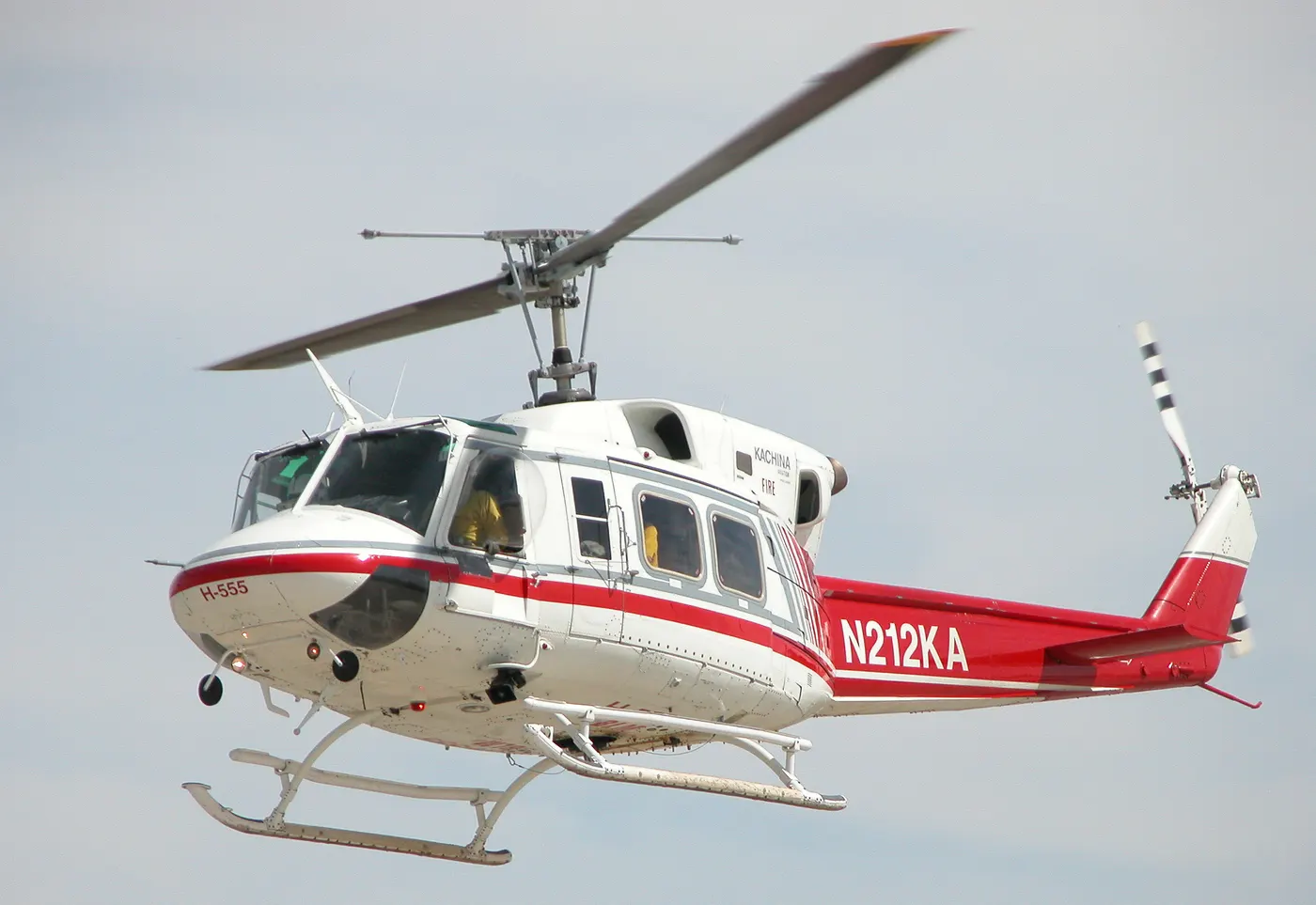
Bell 212
Category
Country
Prime contractor
Production
1968–1998
Quantity
204
Operators
💰 PERFORMANCE / PRICE ASSESSMENT Methodology ↗
UTILITY / TRANSPORT HELICOPTERS · COLD WAR
42
PERFORMANCE/PRICE
80
UNIT COST (2025 USD)
—
ⓘ Performance/Price and MASS score are computed across all units in the utility / transport helicopters category, regardless of era.
02 / Specs & Design
◎General6MOD.6
- First Flight1968
- Service Entry Year1968
- Crew1
- Passengers14
- Primary RoleUtility transport helicopter
- In ServiceYes
◈Powerplant8MOD.8
- Engine TypePratt & Whitney Canada PT6T-3 or -3B
- Number of Engines2
- Engine Power (each)1,342 kW
- Transmission Rating1,342 kW
- Rotor ConfigurationTwo-bladed semi-rigid main rotor
- Main Rotor Diameter14.63 m
- Main Rotor Blades2
- Anti-Torque TypeTail rotor
▣Performance10MOD.10
- Top Speed220 km/h
- Cruise Speed185.184 km/h
- Never-Exceed Speed (VNE)259 km/h
- Service Ceiling5,303.52 m
- Hover Ceiling (IGE)3,353 m
- Hover Ceiling (OGE)2,896 m
- Range420 km
- Ferry Range1,000 km
- Rate of Climb8.1 m/s
- Endurance180
◇Dimensions & Weights7MOD.7
- Fuselage Length17.42 m
- Height4.57 m
- Rotor Disc Area168.1
- Empty Weight2,961.554 kg
- Max Takeoff Weight5,080 kg
- Useful Load2,160 kg
- Cabin Volume6.23
◆Armament & Mission4MOD.4
- Hardpoints0
- Weapons Payload2,268 kg
- Sling Load Capacity2,268 kg
- Rescue HoistYes
▤Avionics3MOD.3
⬢Production1MOD.1
- Variants1
▲Service History2MOD.2
- Production Start1968
- Production End1998
03 / History
SERVICE LIFESPANStill in Service
- 1968Production started
- 1971Entered service
- 1998Production ended
58
years in service
30
years in production
204
units produced
15
countries operating
ⓘ The producing country still actively operates it. 1 countries retired it.

05 / MASS Score
UTILITY / TRANSPORT HELICOPTERS RANKING Utility / Transport Helicopters · Cold War


MASS RANKINGSMASS ↗
132UTILITY / TRANSPORT HELICOPTERS42COLD WAR · UTILITY / TRANSPORT HELICOPTERS1367UNITED STATES · ALL WEAPONS130PERFORMANCE/PRICE · UTILITY / TRANSPORT HELICOPTERS
ⓘ Rankings are within theUtility / Transport Helicopterscategory.
📖 TERMS ON THIS PAGE3terms
Autopilot/AFCS (Automatic Flight Control System) is an avionics suite that automatically controls a helicopter’s attitude, navigation and flight path, providing stability augmentation and reducing pilot workload.
Combined forward-looking infrared (FLIR) and electro-optical (EO) sensor turret for target acquisition and tracking, typically mounted on aircraft or ground vehicles.
A mechanical device used to lift personnel or cargo via a cable, typically mounted on helicopters for rescue or recovery operations.
These terms are listed automatically because they appear on this page.full encyclopedia →
📚 Sources