

An integral bipod is a two-legged support strut built into, or supplied as standard factory equipment on, a rifle's handguard, gas cylinder, or barrel. It typically folds flush into a recess when the rifle is carried and opens in seconds when needed. This differs from an accessory bipod, a separate aftermarket unit clamped onto a Picatinny rail that the base rifle otherwise carries no dedicated mounting provision for at all.
A standard-barrel service rifle built purely for maneuver infantry use ships with no bipod and no mounting point for one. A light-barrel FN FAL or a standard Heckler & Koch G3, fitted with the slim perforated plastic handguard, relies on sling tension or an improvised rest for stability. Portugal's own licensed G3 rifle m/961 carried the same slim handguard in most standard-issue configurations. Only later, mission-driven variants add a bipod, either as a permanent factory fitting or a bolt-on rail accessory. The G3 actually needed a wider, ventilated handguard variant just to accept a bipod mount, since the slim standard handguard could not carry one at all. Most rifles in the designated marksman rifle category solve the problem from the start by building the bipod in.
01The Browning Automatic Rifle and the FN FAL Set the Pattern
The Browning Automatic Rifle was not designed with a bipod. John Browning built it for walking fire assault, fired from the hip through a steadying cup on the gunner's belt, with no bipod mount at all.1 A bipod appeared only in the M1918A2 interwar redesign, once the US Army tried to push the BAR toward a light machine gun role. The added legs pushed weight to roughly 20 lb, and troops in the field often discarded the bipod as more hindrance than help.1
FN Herstal's postwar FAL line drew a sharp line between roles. The standard light-barrel rifle had no factory bipod. The heavy-barrel automatic-rifle variant, the FN 50.41/50.42 (FALO/HBAR), built for squad-level light support fire, shipped with a bipod fitted as standard on almost every production gun.2 Austria's Steyr StG 58 and West Germany's G1 FAL broke that pattern early. Both were light-barrel FALs built for the standard infantry role, yet both carried a folding steel bipod as standard issue, mounted directly to the barrel and folding up into grooves cut into the handguard.3 The Dutch army's own FAL, the Licht Automatisch Geweer, was adopted with a bipod in its semi-automatic configuration too, alongside a later heavy-barrel squad-automatic derivative built specifically for sustained fire.
01Handguard Mounting and Forward Placement, and Why It Matters More on a DMR
A folding integral bipod stows flush against the handguard or gas cylinder and opens in seconds, without the shooter needing to carry, locate, and clamp on a separate accessory unit under stress.4 That quick-deployment property is exactly why sustained-fire and precision roles favor a built-in bipod over a detachable one that has to be packed separately and mounted before use.
Mounting the bipod as far forward as possible, at the handguard or forearm, gives the widest base of support. That is the actual mechanism through which a bipod reduces shooter-induced wobble and improves practical accuracy at range.8 A designated marksman rifle, fired at extended distances against man-sized targets, benefits from this far more than a close-quarters carbine ever would.
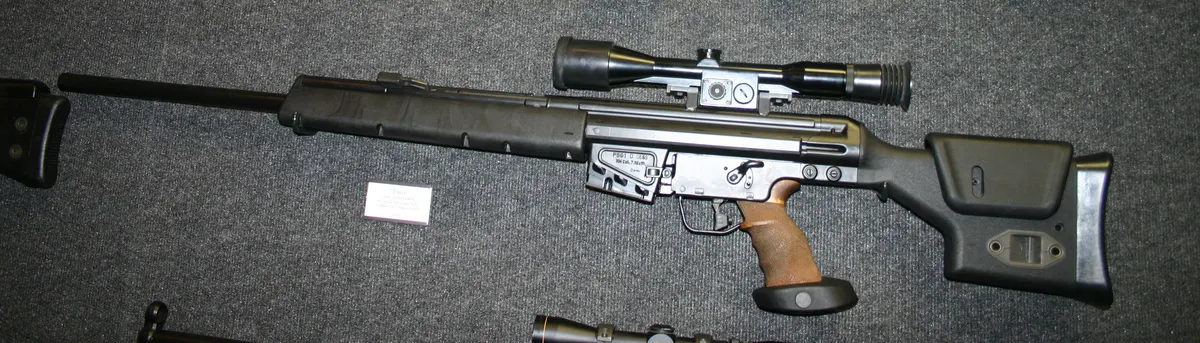
The HK MSG-90, the militarized export derivative of the PSG1 police sniper rifle, shows the adjustable version of this design. Its folding bipod mounts on a rail beneath the handguard and adjusts for both height and fore-aft position.4 There is a real tradeoff among the barrel-mounted designs, like the StG 58 and G1's bipod. Clamping pressure on the barrel changes its harmonics, so deploying the legs can shift point of impact slightly relative to the stowed position, though the effect is described as minor at combat ranges under 300 meters.3
01Standard Equipment on Modern DMRs, From the G28 to the MPT-76
The Heckler & Koch G28 was built explicitly as a squad-level designated marksman rifle meant to extend the effective range of infantry fire beyond a standard 5.56mm NATO carbine, delivering accurate fire to 600 meters and suppressive fire to 800 meters.5 That doctrinal role, sitting between a standard service rifle and a dedicated sniper rifle, is what makes a standing factory bipod worth its added weight on the G28, G28E2, and G28Z configurations.
The M110 family, including the M110A1 Squad Designated Marksman Rifle and its compact derivative, ships with an adjustable folding bipod under the gas cylinder as standard equipment, fitted specifically because the rifle replaced the bolt-action M24 for squad-level precision fire.6 The Mk 14 Enhanced Battle Rifle, built on the older M14 platform, carries the same logic forward into a modern DMR chassis.
Turkey's MPT-76, made by state manufacturer MKE, shows the same split inside a single modern rifle family. Its base infantry configuration has no factory bipod, while a separate DMR variant adds one as standard equipment, replacing an earlier improvised Grippod accessory some units had fitted themselves, alongside a new scope and laser designator.7 The bolt-action Remington Semi Automatic Sniper System follows the same underlying pattern, adding a factory bipod once a rifle moves from general infantry issue into a dedicated marksman role.
01Notes and Sources
- "Browning Automatic Rifle (BAR)", Forgotten Weapons — forgottenweapons.com ↩
- "FN FAL", Modern Firearms — modernfirearms.net ↩
- "The StG58, Austria's Select Fire FAL", Small Arms Review — smallarmsreview.com ↩
- "HK MSG-90", Modern Firearms — modernfirearms.net ↩
- "HK G28", Modern Firearms — modernfirearms.net ↩
- "M110 SASS", militaryfactory.com — militaryfactory.com ↩
- "Turkish Marksmen Get an Upgrade, The MPT76 DMR Variant", The Firearm Blog — thefirearmblog.com ↩
- "Best Rifle Bipod, What the Pros Use", PrecisionRifleBlog.com — precisionrifleblog.com ↩


