


MSG stands for Militärisches Scharfschützen-Gewehr, German for military sharpshooter rifle, and the MSG90A1 is the improved second version of that program.1 The Heckler & Koch MSG90A1 is a semi-automatic designated marksman rifle chambered in 7.62x51mm NATO, built from the same roller-delayed blowback action found in the Heckler & Koch G3 battle rifle.1,2 Where the original MSG90 shipped with nothing but a fixed telescopic sight, the A1 revision added back-up iron sights and a threaded, suppressor-ready barrel, changes small enough to read as a footnote but significant enough that HK Defense now lists the A1, not the plain MSG90, as its current-production military offering.2,3
- Proven roller-delayed action shared with the G3 family
- Sub-MOA accuracy from a semi-automatic action
- Iron sights and threaded barrel add field flexibility over the base MSG90
- Compatible with existing G3 magazines and armorer skill sets
- Heavier than AR-10 pattern rivals like the SR-25
- Rejected by the USMC's own DMR trial over caliber flexibility
- No longer in front-line production, limiting spare-parts supply
- Roller-delayed maintenance and headspacing differ from AR-pattern rifles most NATO armories now standardize on
The rifle exists because Heckler & Koch's flagship precision rifle, the PSG1, was too expensive and too heavy for routine military issue.3 The MSG90 stripped weight and cost out of the PSG1 formula while keeping the same trigger group and locking system, and the A1 update pushed that formula further toward field use by giving snipers a fallback sighting option if the optic failed.2,3 Six countries are recorded as current or past operators of the type, including the United States, Germany, Turkey, Malaysia, South Korea, and Japan, spread mostly across special-operations and federal law-enforcement units rather than line infantry.3,4
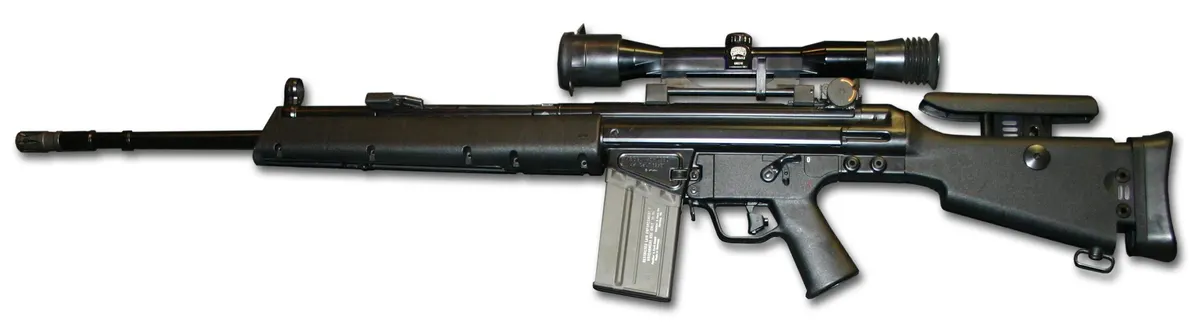
Every mention of the MSG90A1 specifications in manufacturer literature ties back to the same core numbers, a 6.4 kg rifle with a 600 mm barrel firing 7.62x51mm NATO at roughly 820 m/s.2,5 How the MSG90A1 works mechanically, why it still shows up in special-operations armories decades after its debut, and how it stacks up against gas-operated American rivals are the subject of the sections below.
The Roller-Delayed Blowback Action Carried Over From the G3
The MSG90A1's operating system is the same roller-delayed blowback mechanism Heckler & Koch first fielded on the G3 in the late 1950s, refined for precision shooting through the PSG1 and passed down largely unchanged.6,3 Two rollers set into the bolt head cam against the barrel extension under recoil, briefly delaying the bolt's rearward travel enough for chamber pressure to drop to a safe level before the case is extracted.6 The system fires from a closed bolt, which the manufacturer credits for the rifle's repeatable accuracy, since there is no heavy bolt carrier slamming forward at the moment of the shot the way there is on many gas-operated designs.2
- First Production Year1987
- Service Entry Year1990
- Weight (Empty)6.4 kg
- Currently In ServiceYes
- Notable UsersFBI Hostage Rescue Team, German federal police and special-operations units, Turkish Army, Malaysia's 11th Gerak Khas and PASKAL, South Korean Navy Special Mission Group
The barrel itself is cold hammer forged with polygonal rifling, free-floated inside the handguard, and deliberately weighted toward the muzzle to dampen barrel whip and keep harmonic vibration consistent from shot to shot.7,2 An Anschütz T-way rail on the forend gives the rifle a factory-standard mounting point for its bipod and other accessories, a detail specialist sources note more often than general encyclopedic summaries do.7
- Cartridge7.62x51mm NATO
- Calibre7.62 mm
- Case Length51 mm
Iron Sights and a Threaded Barrel, What the A1 Suffix Actually Changed
The base MSG90 shipped with a fixed 10-power Hensoldt ZF 10x42 telescopic sight and nothing else, no mechanical backup if the optic broke or fogged.5,3 The MSG90A1 corrected that by adding iron sights, a hooded post front sight and a rotary diopter rear sight lifted directly from the Heckler & Koch G3 family's HK21 machine gun, adjustable out to 1,200 meters.1,5 The A1 also uses a threaded barrel fitted with a detachable flash hider, letting a sound suppressor be mounted, a capability the plain MSG90 does not have.1,7
- Action TypeDelayed Blowback
- Select FireNo
- Feed SystemDetachable Magazine
- Magazine Capacity20
- Trigger TypeSingle-stage match trigger, factory-set to roughly 1.5 kg (3.3 lb) pull, adjustable trigger shoe
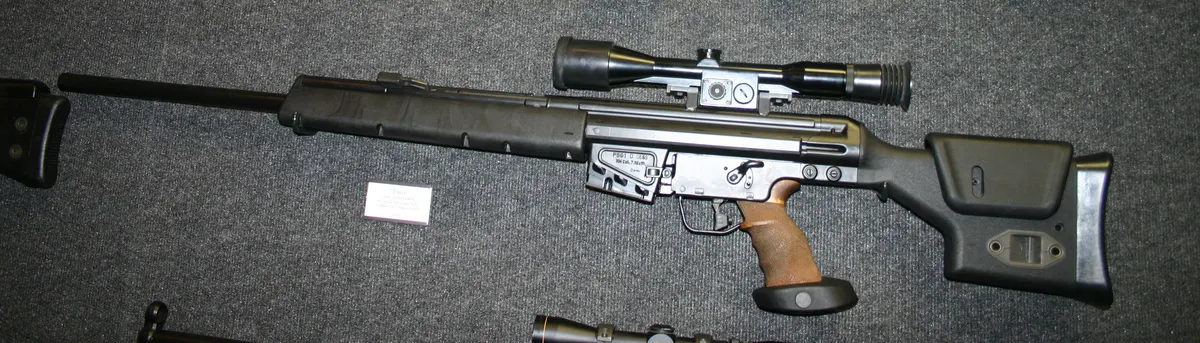
Those additions carry a weight penalty. HK Defense's own specification sheet lists the MSG90A1 at 6.4 kg (14.1 lb) empty, against roughly 6.1 kg for the base MSG90, and independent comparison tables put the difference closer to 0.7 kg once the iron sights, threaded muzzle device, and slightly longer overall length are counted.2,5 The table below lines up the two generations directly.
- Muzzle Velocity820 m/s
- Maximum Range1,000 m
- Accuracy1
| Spec | MSG90 | MSG90A1 |
|---|---|---|
| Weight (empty) | ~6.1 kg | 6.4 kg2 |
| Iron sights | None | Hooded post front, diopter rear (100-1,200 m)5 |
| Muzzle | Plain | Threaded, flash hider, suppressor-ready1 |
| Optic | Hensoldt ZF 10x42, fixed | Hensoldt ZF 10x42, quick-detach mount7 |
| Barrel length | 600 mm | 600 mm5 |
Ballistics and Practical Accuracy
Chambered for 7.62x51mm NATO and fed from detachable 5- or 20-round G3-pattern box magazines, the MSG90A1 sends a standard NATO ball round out at roughly 820 m/s, with a listed maximum range near 1,000 meters and a realistic point-target engagement envelope closer to 600-800 meters in DMR use.4,5 Heckler & Koch's own marketing claims minute-of-angle accuracy, and independent range testing broadly backs that up.2 A 2013 hands-on review by TheFirearmBlog recorded a best five-shot group of 0.444 inches (0.42 MOA) at 100 yards and a shooting-session average of 0.625 inches, describing the rifle as legitimately sub-half MOA despite the reviewer's self-described inexperience with precision shooting.8 That reviewer also weighed the rifle at close to 7 kg with optic mounted, only about a pound and a half short of an M249 SAW, a blunt illustration of how the MSG90A1 trades portability for stability.8
- Barrel Length600 mm
- Sight TypeHooded post front sight and rotary diopter rear sight (adapted from the HK21 machine gun), plus a Hensoldt ZF 10x42 fixed telescopic sight on a quick-detach mount
- Iron SightsYes
- Threaded BarrelYes
- Production Start1990
- Variants3
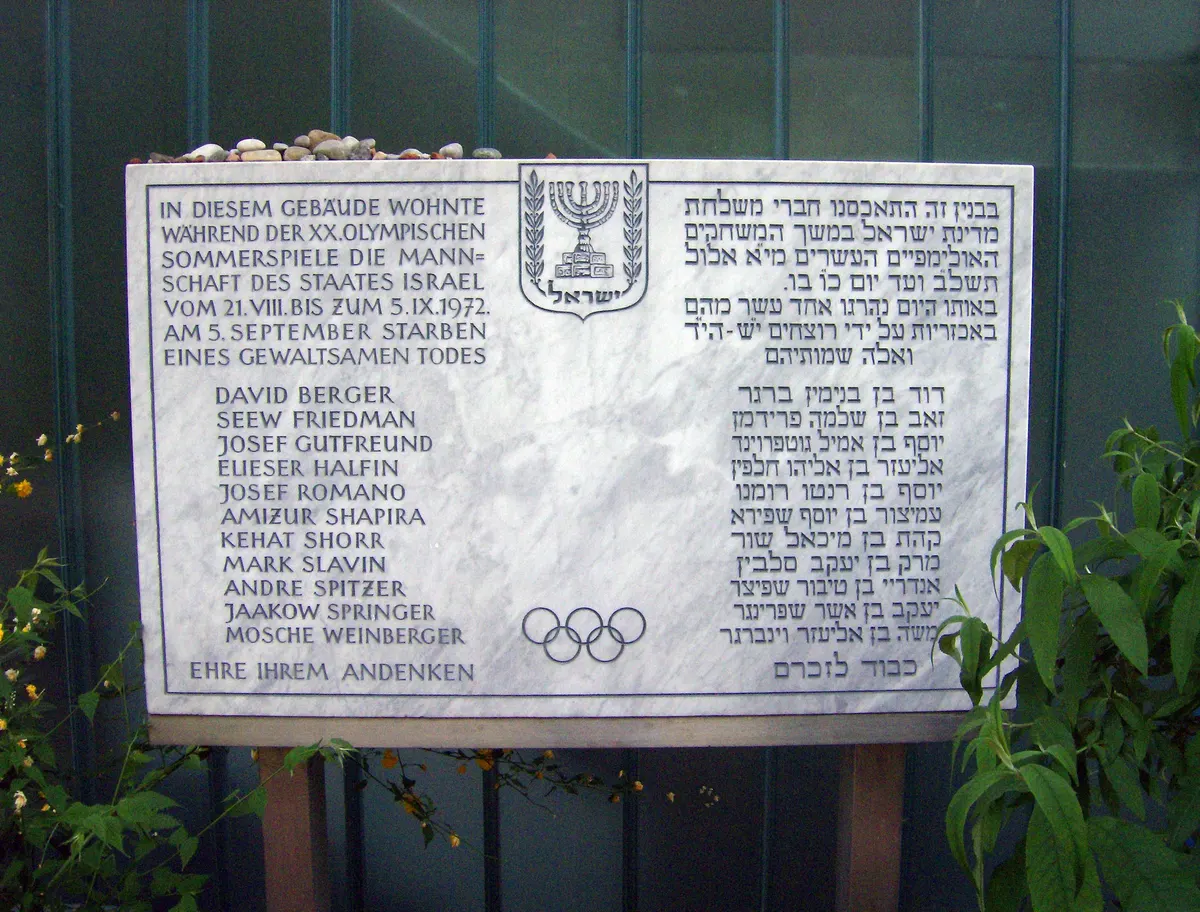
Heckler & Koch's precision-rifle story starts with the PSG1, developed in the years immediately after the 1972 Munich Olympics hostage crisis exposed how poorly equipped West German police were for a sniper standoff.9,3 The West German government stood up the counter-terrorism unit GSG9 within two weeks of that failed rescue attempt, and Heckler & Koch built the PSG1 to give police and military sharpshooters a semi-automatic rifle accurate enough for hostage-rescue work.9
The PSG1 worked, but it was heavy, expensive, and built to a police budget rather than a military one. Heckler & Koch introduced the MSG90 in 1987 as an export-oriented, militarized derivative, stripping weight and cost from the PSG1 formula while keeping its trigger and locking mechanism intact, and series production began in 1990.3,4 The improved MSG90A1 followed within the same production run, adding the iron sights and threaded barrel described above, and by the time HK Defense's current catalog was compiled the A1 had effectively replaced the plain MSG90 as the company's standard military offering.1,2
That rejection did not stop the MSG90A1 from becoming a fixture in special-operations and federal law-enforcement inventories outside the standard-issue infantry role. It has been used by units including the American FBI Hostage Rescue Team, alongside rifles like the Remington Model 700 and Barrett M107, precisely because a semi-automatic capability matters more in a hostage-rescue entry than in a static overwatch position.12
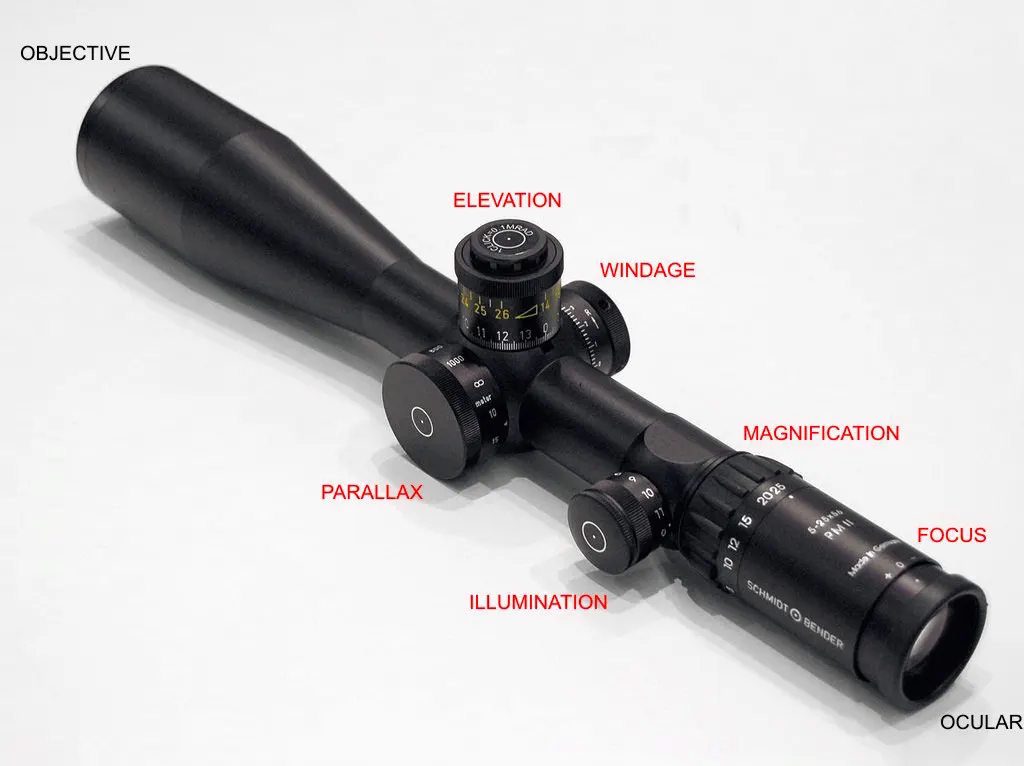
The MSG90 family runs through three broad generations. The original MSG90, introduced in 1987, carries only a fixed 10x telescopic sight and no iron sights.3,5 The MSG90A1 adds the HK21-derived iron sights and threaded, suppressor-ready barrel described above.1,5 A further refinement sometimes marketed as the MSG90A2 swaps the fixed Hensoldt optic for a variable Schmidt & Bender PM II scope and a Harris-style folding bipod in place of the earlier proprietary unit.1
A separate, rarer Bundeswehr-specific variant, the MSG3, strips the design further with a slimmer barrel and a non-reinforced receiver built onto a standard G3 forend, intended purely as an in-house German army designated marksman conversion rather than an export product.1 The MSG3 should not be confused with the newer HK MR308, a completely different, more recent Heckler & Koch product built on the HK417/G28 modular rifle architecture rather than the G3's roller-delayed system.


In Germany, the type's country of origin, the MSG90 family has equipped both federal police and military special-operations elements since the early 1990s, continuing the counter-terrorism mission the PSG1 was designed for.3,9 In Turkey, the rifle has been in service with the Turkish Army as a designated marksman platform.4 In Malaysia, the MSG90A1 is fielded by the 11th Gerak Khas special-forces group and by the PASKAL naval special-warfare unit, while Malaysia's PASKAU and Pasukan Gerakan Khas instead use the heavier PSG1A1.4 In South Korea, the Republic of Korea Navy's SEAL-equivalent unit issues the MSG90 to its Special Mission Group for maritime anti-terrorism duties.4 The United States fields the type through the FBI Hostage Rescue Team, and the rifle has additionally been associated with U.S. Army special-operations use.12 Broader manufacturer and distributor material lists the wider MSG90 family among the export customers of roughly thirty countries, Japan included, though granular detail on the specific Japanese unit and quantity is thin in open sources and should be treated as a general listing rather than a documented deployment.7
One of the more visible recent appearances of the MSG90A1 in open-source photography comes from military sniper competitions rather than combat. In August 2021, a Bulgarian Army sniper competing in the European Best Sniper Team Competition at Hohenfels, Germany, an event hosted by the U.S. Army's 7th Army Training Command and drawing competitors from fourteen NATO and partner nations, was photographed conducting range-estimation drills with an MSG90A1.7 The same U.S. Army photographer's caption described the rifle plainly as a militarized answer to the PSG1, a fair one-line summary of the whole MSG90 program.7
The United States Marine Corps' own 1990s trial is the cleanest illustration of what actually separates the MSG90A1 from its main American-market rival, the SR-25. Both are semi-automatic 7.62x51mm NATO designated marksman rifles built around a closed-bolt, magazine-fed action, but they solve the same problem with opposite mechanisms. Eugene Stoner's SR-25, built by Knight's Armament and the direct ancestor of the U.S. military's M110 Semi-Automatic Sniper System, uses a gas-operated rotating bolt scaled up from the AR-10/M16 family, keeping the controls and armorer's toolkit familiar to a force already standardized on AR-pattern rifles.11 The MSG90A1 instead runs the roller-delayed blowback system inherited from the G3, a mechanically unrelated approach that demands its own spare-parts pipeline and armorer training track wherever it is fielded.6
That divergence had a direct procurement consequence. Both platforms are capable of sub-MOA performance with match ammunition, so when the USMC tested six MSG90 rifles for a late-1990s DMR contract, the deciding factor was caliber flexibility, specifically that the roller-delayed action could not be rebarreled to the .300 Winchester Magnum cartridge the Corps wanted headroom to adopt later.10 The gas-operated SR-25 platform offered that headroom, a mechanical advantage baked into its design rather than any manufacturing shortfall on HK's side.
| Spec | MSG90A1 | SR-25 (original 24-inch) |
|---|---|---|
| Action | Roller-delayed blowback6 | Gas-operated rotating bolt11 |
| Weight (empty) | 6.4 kg (14.1 lb)2 | 4.88 kg (10.75 lb)11 |
| Magazine | 5 or 20 rounds5 | 20 rounds11 |
| Guaranteed accuracy | Minute of angle2 | 1 MOA11 |
| Adopted as US standard DMR | No, rejected 1990s trial10 | Yes, evolved into M11011 |
The weight gap matters as much as the mechanism. At 6.4 kg empty, the MSG90A1 is roughly 1.5 kg heavier than the SR-25's original 24-inch match configuration, a meaningful difference for a rifle a marksman may carry all day rather than fire from a fixed position.2,11 Where the MSG90A1 still earns a place in inventories is precisely where that weight penalty matters less, static counter-terrorism overwatch and law-enforcement hostage rescue, the same mission the PSG1 was designed for decades earlier, rather than a rifleman's squad-level DMR role where the lighter AR-pattern rifles have become the NATO default.


Is the MSG90A1 still in service? Yes. Special-operations and federal law-enforcement units in several countries continue to field the MSG90A1, and Heckler & Koch's defense catalog still lists it as a current product even though front-line military procurement, particularly in the United States, has largely moved to gas-operated AR-10 pattern rifles like the SR-25 and M110.3,11
What is the MSG90A1's caliber? The MSG90A1 is chambered in 7.62x51mm NATO, the same cartridge as its parent G3 battle rifle and the PSG1 it was derived from.2
How does the MSG90A1 differ from the base MSG90? The MSG90A1 adds HK21-derived back-up iron sights and a threaded, suppressor-ready barrel that the plain MSG90 lacks, at the cost of roughly 0.3-0.7 kg of extra weight.1,5
What is the MSG90A1's effective range? Manufacturer and independent sources list a maximum range near 1,000 meters, with a practical designated-marksman engagement envelope closer to 600-800 meters depending on ammunition and optic.4,5
Why did the US military not adopt the MSG90? The USMC evaluated the MSG90 for a Designated Marksman Rifle contract in the late 1990s but rejected it because the roller-delayed action could not be rebarreled to .300 Winchester Magnum, a flexibility requirement the gas-operated SR-25 platform could meet instead.10
What is the MSG90A1's unit cost? Heckler & Koch has not published a current unit price for the MSG90A1, and it has never been offered on the U.S. commercial market, so no reliable price figure exists in open sources.3
- "Heckler und Koch HK MSG90, HK MSG3 sniper rifle (Germany)", Modern Firearms — modernfirearms.net ↩
- "MSG90A1 Specifications", Heckler & Koch Defense Inc. — hkdefense.us ↩
- "Sniper Central H&K MSG90", Sniper Central — snipercentral.com ↩
- "Heckler & Koch MSG90", Simple English Wikipedia — simple.wikipedia.org ↩
- "Heckler & Koch MSG90", Weaponsystems.net — weaponsystems.net ↩
- "Heckler & Koch PSG1", Wikipedia — en.wikipedia.org ↩
- "POTD: Bulgarian Sniper with Heckler & Koch MSG90A1", TheFirearmBlog — thefirearmblog.com ↩
- "Shooting The H&K MSG90", TheFirearmBlog — thefirearmblog.com ↩
- "Munich massacre", Wikipedia — en.wikipedia.org ↩
- "MSG90", Sniper Central — snipercentral.com ↩
- "SR-25", Wikipedia — en.wikipedia.org ↩
- "FBI Hostage Rescue Team (HRT): Domestic Delta", Grey Dynamics — greydynamics.com ↩