


Smith Enterprise, Inc. built the Crazy Horse rifle to solve a specific problem for the United States Army in the early 2000s. Rather than buy new precision rifles, the Army wanted a way to rebuild the worn, rack-grade M14 rifles already sitting in inventory into something a squad designated marksman could trust out past carbine range.1 The result, developed in conjunction with Picatinny Arsenal and the Army Infantry School, is a semi-automatic designated marksman rifle built on the M14's action and chambered for 7.62x51mm NATO, sold commercially under the name Crazy Horse and also known as the M14SE.1
- Reuses existing M14 rifles already in Army inventory, cheaper than new production
- Cryogenically treated receiver components replace failure-prone fiberglass bedding
- Chamber cut specifically for M118LR match ammunition, converging sources report roughly 1 MOA accuracy
- Gas-lock-mounted front sight frees the muzzle for a direct-connect suppressor
- Retains the proven, gas-piston reliability of the M14 platform
- Semi-automatic only, built for the designated marksman role rather than true sniper duty
- Gas-piston M14 action is heavier to strip and clean than a direct-impingement AR-10 pattern rifle
- Official military production numbers were never published, so total rebuild counts stay unconfirmed
- Interim fielding solution, later programs like the Mk 14 EBR absorbed the same mission
The Army did not officially call it Crazy Horse. It began fielding as the M14SE, and most secondary sources place a formal redesignation to M21A5 around 2007, though that date rests on forum and enthusiast accounts rather than a primary Army document, so it should be treated as likely rather than confirmed.6,7 Designer Ron Smith and Smith Enterprise, Inc. of Tempe, Arizona were explicit that the rifle was not meant to compete with dedicated sniper systems like the M24 or M40. It was pitched as a battle rifle upgrade for the Army's Squad Designated Marksman program, sharing its parent action with the earlier M21 Sniper Weapon System but built for a different mission profile.1
Search interest around the rifle tends to cluster on a handful of questions. What is the Crazy Horse rifle's caliber, what is the Crazy Horse rifle's effective range, and how does the Crazy Horse rifle compare to the standard M14 it started life as. The short answers are 7.62x51mm NATO, roughly 822 m under favorable conditions, and a meaningfully tighter rifle built around cryogenic treatment and a match chamber rather than a new design.1 Smith Enterprise still lists the M14SE/Crazy Horse rifle among its current products, meaning the design has stayed in low-volume production well beyond its original Army-refurbishment purpose.6
Origin of the name itself is undocumented. Neither Wikipedia's entry nor the trade-press features on the rifle explain why Smith Enterprise chose Crazy Horse, and nothing in the available sourcing connects it to the historical Lakota leader of the same name, so any such connection would be speculation rather than fact.1
The Crazy Horse rifle is gas-operated with a two-lug rotating bolt cammed by the operating rod, the same basic mechanism as the standard M14 National Match action rather than a tilting-bolt design.1 Loaded weight runs to 5.27 kg empty, with an overall length of 1,118 mm, and cited muzzle velocity and effective range figures stand at 853 m/s and 822 m respectively.1
- First Production Year2003
- Service Entry Year2003
- DesignerRon Smith
- Weight (Empty)5.27 kg
Barrel length is 22 inches (560 mm) in the standard configuration, with an 18-inch M14-18 barrel offered as an option, both machined from medium-heavy-profile chrome-moly 4140 steel with a 1-in-10-inch right-hand rifling twist across four lands and grooves.6,7 The rifle feeds from 5-, 10-, or 20-round detachable magazines in the standard M14 pattern, with the 20-round magazine the typical service load.1
- Cartridge7.62×51mm NATO
- Calibre7.62 mm
- Case Length51 mm
- Calibre Classfull-power rifle
- Bullet Weight11.34 g
Sights combine a front National Match blade (0.062 inches wide, chromoly steel, with a hooded option) mounted on the gas lock rather than the muzzle, and a match-grade hooded rear aperture with half-minute-of-angle windage and elevation adjustments, giving a 26.75-inch sight radius.7 Moving the front sight back to the gas lock is a deliberate departure from a standard M14, freeing the muzzle itself to accept a suppressor directly over Smith Enterprise's own Vortex Flash Hider rather than forcing a compromise between iron sight placement and a can.7 The rifle still carries iron sights as standard, alongside three Picatinny rails at the 3, 6, and 9 o'clock positions for mounting optics and accessories, most commonly a Leupold Mk4 Tactical scope in period service use, with test builds later reported using a Leupold Mark 5 3.6-18x44mm and a Pride Fowler Rapid Reticle 10x42 co-witnessed with a red dot.1,7
- Action TypeGas-Operated
- Fire Modessemi-automatic
- Select FireNo
- Feed SystemDetachable Magazine
- Magazine Capacity20
Metal receiver and small-parts components go through cryogenic treatment before assembly, a substitute for the fiberglass-and-steel-insert bedding that has long been a weak point in accurizing M14-pattern rifles, and a change corroborated across all three main sources on the rifle.1,6,7 The trigger is fully adjustable across a 2.5 to 5-pound pull range with take-up and backlash adjustment, and at least one hands-on build reported a crisp 4.5-pound break described as one of the best M1A-pattern triggers available.6 Smith Enterprise's own Warfighter unitized gas system uses a Melonite (nitride) hardened, hard-chromed gas piston fitted to tight tolerances, paired with the muzzle-mounted Vortex Flash Hider, a helical-flute flash suppressor invented by Ron Smith and Sonja Sommers, developed in 1984 and patented in 1995, that Smith Enterprise claims eliminates up to 99 percent of visible muzzle flash and that the U.S. Army later adopted for its SOCOM M14 rifles.4
- Muzzle Velocity853 m/s
- Effective Range (point)822 m
- Accuracy1
An extended, 8620 heat-treated steel bolt handle is fitted for use with gloves in cold weather, the stock is a modified USGI synthetic stock with an added Smith Enterprise cheekpiece, and the rifle finishes in black phosphate, commonly paired with a company bipod and an M1907 sniper-and-target sling.7 Scope mounts are cut in-house using electrical discharge machining, a process Smith Enterprise says makes it the only U.S. manufacturer producing its own EDM-machined optical interface components, a claim that comes from the company itself rather than an independent test, so it is worth treating as a marketing assertion rather than a verified industry fact.7
- Barrel Length560 mm
- Rifling Twist1 in 10 in (254 mm), right-hand
- Rifling Grooves4
- Sight TypeFront: National Match front blade .062 in wide (chromoly steel), or hooded option, mounted on the gas lock. Rear: match-grade hooded aperture with half-minute-of-angle windage and elevation adjustments.
- Sight Radius679 mm
- Optic RailYes
- Iron SightsYes
Accuracy figures converge around 1 MOA with match ammunition, though a tighter half-MOA figure appears in fewer sources and deserves more caution.6,7 Achieving that consistency required Smith Enterprise to hand-cut chambers with reamers specific to the Lake City M118LR 175-grain cartridge, the U.S. military's long-range 7.62x51mm NATO load, and the company says it is the only civilian M14 builder using those reamers, again a self-sourced claim rather than a third-party-verified one.6,7 One hands-on review of a custom-built example reported sub-MOA groups at 100 yards, consistent with the tighter end of the reported range.6
- Overall Length1,118 mm
- Furniture Materialsynthetic
- Production Start2003
Smith Enterprise traces back to Western Ordnance, founded in 1979 in Mesa, Arizona by Richard Smith, Ron Smith's father.3 Ron Smith specialized in M1 Garand and M14 gunsmithing, became a Certified Journeyman in Ordnance and Metallurgy at 22, and trained under European immigrant ordnance craftsmen, part of a family the company describes as being in the ordnance trade since 1910.3 In 1993, Smith reorganized the firm as Smith Enterprise, Inc. and relocated it to Tempe, Arizona, where it operated with roughly 20 employees under Smith's and co-owner Sonja Sommers' direction.2,3 Ron Smith is credited as the first designer to field a commercial flash suppressor and separately invented a rebuildable sound suppressor, work that fed directly into the muzzle devices later used on the Crazy Horse rifle.3
The design work behind the Crazy Horse rifle dates to 2003, arriving as the U.S. military's post-invasion commitment in Iraq exposed a gap in Army infantry units. Riflemen carrying M16s and M4 carbines struggled to engage accurately beyond a few hundred meters, and buying an entirely new precision rifle for every squad was neither fast nor cheap.1 Smith Enterprise's answer, developed with Picatinny Arsenal and the Army Infantry School, was to rebuild M14 rifles the Army already owned into an accurized designated marksman rifle rather than field something new.1 Production has continued at low volume since 2003, and Smith Enterprise still markets the design commercially today.6
The rifle reached units under the M14SE designation first, with Smith Enterprise building examples around 2005 and 2006 for, among others, the 25th Infantry Division ahead of an Iraq deployment.6,7 The formal M21A5 name that later became standard is reported to date to around 2007, though as noted above that specific year is not confirmed by a primary Army source and should be read as the best available secondary-source estimate rather than settled fact.6,7
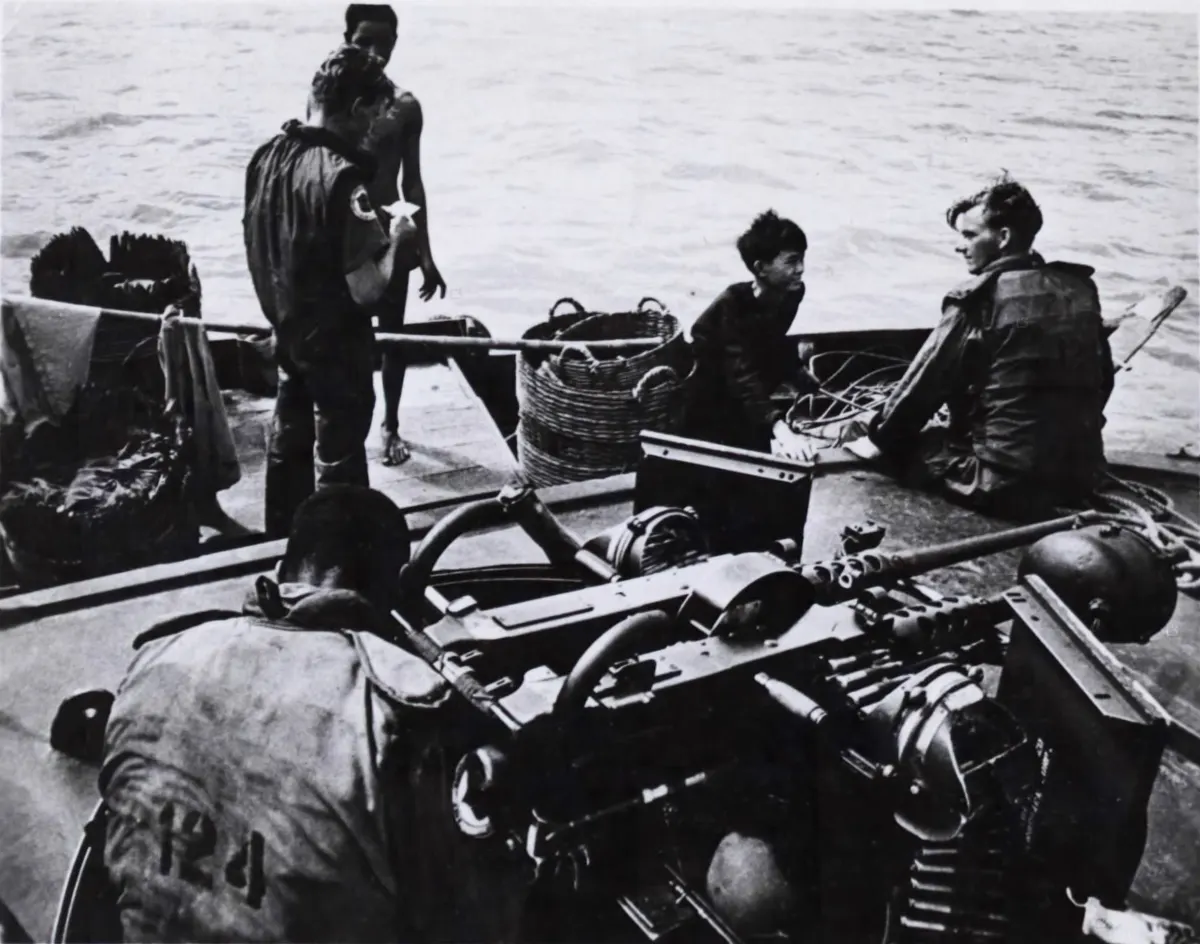
Total production numbers were never officially published. One secondary compilation puts the number of rack-grade M14s rebuilt by Smith Enterprise for Army and National Guard units at roughly 200, while the company's own marketing simply claims hundreds delivered successfully, language vague enough that neither figure should be treated as a confirmed total.7 Community and trade-press discussion frames the Crazy Horse rifle as an interim solution, filling the designated marksman gap until the Army could field SAGE-chassis rifles like the Mk 14 Enhanced Battle Rifle in larger numbers later in the decade, though this framing also comes from secondary and forum discussion rather than an official Army program document.7
A related but separate U.S. Air Force derivative, referred to in sourcing as the Mk.14 SEI, appeared around 2004. It used the same base rifle with Smith Enterprise's cheekrest and a telescopic-sight-only rail rather than the full three-rail setup, though this variant rests on a single thread of sourcing and should be treated as lower-confidence than the Army M14SE/M21A5 history above.7
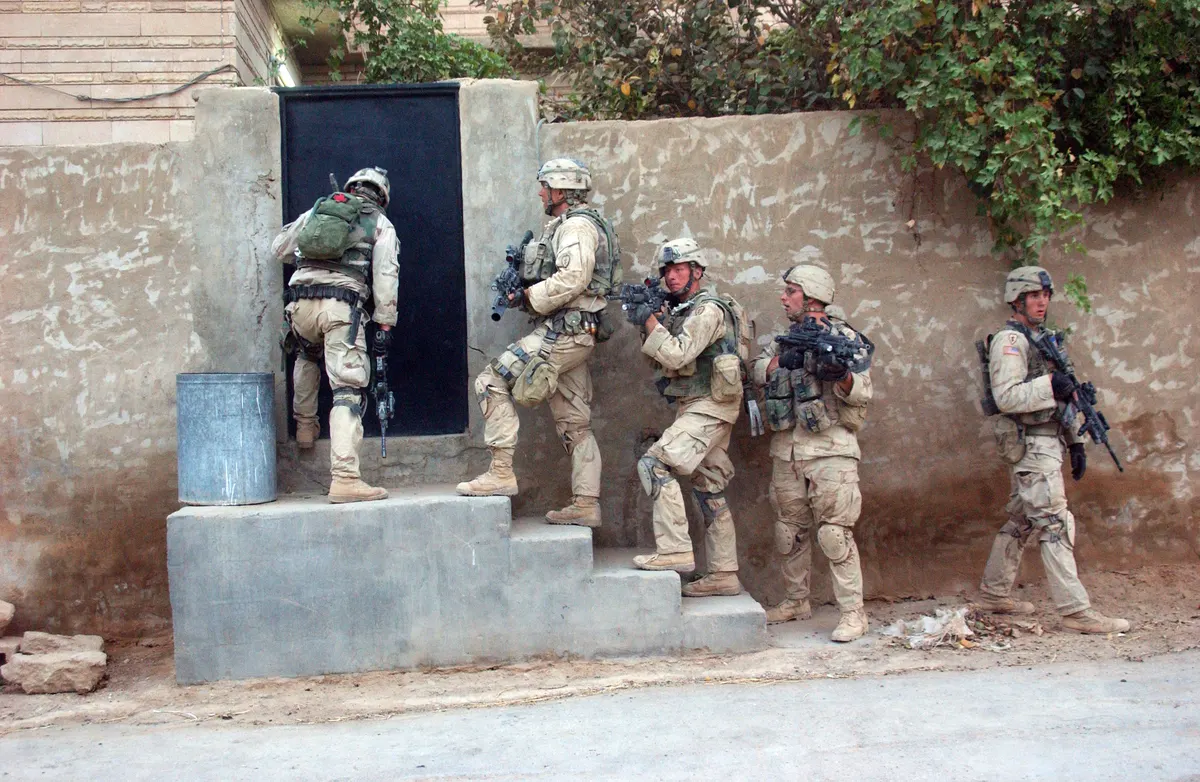
The best-documented combat use of the rifle comes from the 2nd Infantry Division and the 101st Airborne Division, U.S. Army units which fielded it as the M21A5 during the Iraq War.1 M14SE rifles reached 2nd Infantry Division and, by some accounts, 25th Infantry Division units for deployments around 2005 and 2006, used in the counter-IED and designated-marksman missions typical of that stage of the Global War on Terrorism in Iraq.6,7 Additional units are named in lower-confidence secondary sources, including the 10th Mountain Division, further 25th Infantry Division elements, the 503rd Parachute Infantry Regiment, and unspecified Army National Guard units, but these appear less consistently across the available sourcing than the 2nd Infantry Division and 101st Airborne Division record.6,7
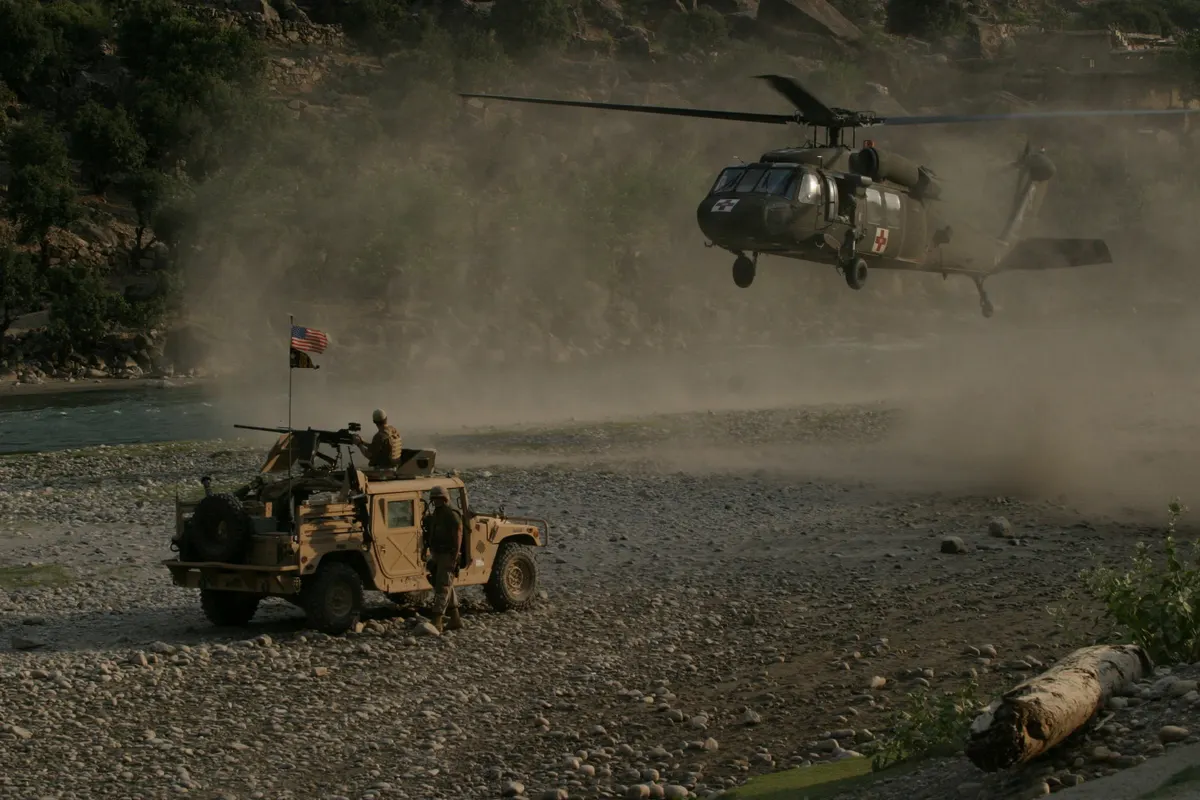
Marketing and trade-press language also credits the rifle with reliable performance in the harsh Afghanistan deserts, a claim that should be read as promotional framing rather than an independently verified combat assessment.7 A December 2004 U.S. Army photograph from Waza Khwa, Afghanistan shows a designated marksman from the 2nd Battalion, 27th Infantry Regiment carrying an M14 rifle, but the original caption does not identify the specific rifle as a Crazy Horse or M21A5, so at most it documents the wider pattern of M14-pattern designated marksman rifles in Afghanistan during that period rather than confirming this specific weapon's presence there.8
No sourcing in this research surfaced a specific named operation, engagement, or confirmed kill attributable to the Crazy Horse rifle by name, which is consistent with a rifle fielded in modest numbers as an interim solution rather than one that generated its own combat reporting separate from the wider M14 family.
The base configuration, marketed and fielded first as the M14SE, became the U.S. Army's officially redesignated M21A5 around 2007 on the best available secondary-source dating.6,7 An 18-inch barrel option, referred to as the M14-18, shortens the standard 22-inch barrel to the same length used on Mk 14 EBR barrels, without changing any other part of the rifle.6
The Mk.14 SEI, a U.S. Air Force derivative reported to date from around 2004, shares the same base rifle but swaps in Smith Enterprise's own cheekrest and a rail intended only for a telescopic sight rather than the full three-rail Picatinny layout, a lower-confidence variant given its single-source sourcing.7
The Crazy Horse rifle is closely related to, but distinct from, the U.S. Navy's Mk 14 Enhanced Battle Rifle program, developed by Smith Enterprise in 2003 alongside Springfield Armory and the Naval Surface Warfare Center Crane Division.5 The Mk 14 EBR uses a SAGE International chassis stock rather than Crazy Horse's modified USGI synthetic stock, a heavier, more modular configuration built around a different mission set. Both share Smith Enterprise's design input and the same M14 parent action, but they are separate rifles built for separate services rather than variants of one another.5

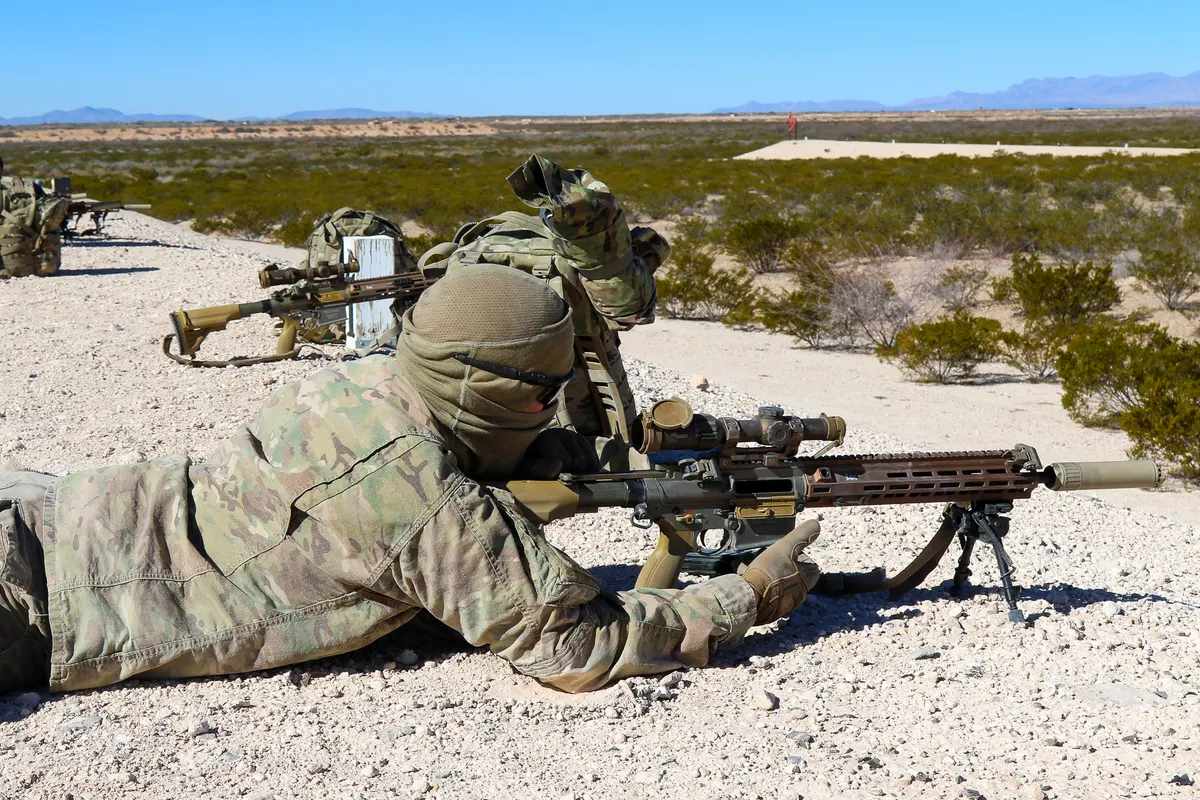
The United States Army is the confirmed operator, having fielded the rifle as the M21A5 with the 2nd Infantry Division and 101st Airborne Division from around 2003 onward, with 25th Infantry Division and other units named in less consistently corroborated accounts.1,6,7 Fielding functioned as an interim Squad Designated Marksman solution rather than a permanent program of record, and it was gradually absorbed by later, better-funded efforts such as the Mk 14 Enhanced Battle Rifle and eventually semi-automatic sniper systems bought new rather than rebuilt from existing M14 stock, which is why the program is best described today as retired rather than active.7
No export sales or foreign military operators are documented for the Crazy Horse rifle. Every account traces back to a single customer, the United States Army, procured directly by refurbishing existing M14 inventory rather than through a foreign military sales pathway, which sets the Crazy Horse rifle apart from higher-volume designated marksman rifles that later found buyers outside the United States.
The Crazy Horse rifle and the standard M14 start from the identical action and receiver, which makes the comparison less about mechanical differences and more about what accurizing work Smith Enterprise adds on top. A stock M14 relies on fiberglass-and-steel-insert bedding that loosens with wear and use, while the Crazy Horse rifle substitutes cryogenic treatment of the metal components, a chamber cut specifically for M118LR match ammunition, and a fully adjustable trigger, changes credited with tightening group sizes from typical combat-rifle tolerances down to a reported 1 MOA.1,6,7 Relocating the front sight to the gas lock, rather than the muzzle, is the other meaningful departure, freeing the muzzle for Smith Enterprise's own suppressor-ready Vortex Flash Hider in a way the standard M14's muzzle-mounted front sight does not allow.7
Against the earlier M21 Sniper Weapon System, the Vietnam War-era M14 sniper conversion the M21A5 designation directly references, the comparison is more about method than mission. Both take a rack M14 and turn it into a precision rifle for the same underlying reason, the Army wanting more from a rifle it already owns rather than buying something new, but the M21 relied on glass bedding and an early Adjustable Ranging Telescope sight system from its 1969 adoption, where the Crazy Horse rifle uses cryogenic treatment and modern optics rails three decades later.1 Both were also designed as extensions of the M14 rather than as dedicated bolt-action sniper rifles, keeping semi-automatic fire the Army valued for reengagement speed.
The Mk 14 Enhanced Battle Rifle shares Smith Enterprise's design input and the same M14 parent action, but the Navy's SAGE International chassis stock adds significant weight, one source puts a loaded Mk 14 EBR with a 20-round magazine at around 14 lb, criticized in service as heavy for a rifle still fired semi-automatically like the Crazy Horse rifle.5 Reported accuracy for later Mk 14 Mod 2 rifles runs to roughly 1.5 MOA extreme spread, close to but somewhat looser than the Crazy Horse rifle's reported 1 MOA figure, though the two numbers come from different testing conditions and are not a controlled head-to-head result.5,6 The practical distinction that matters more than either spec is program status. The Mk 14 EBR became the Navy's standing SAGE-chassis rifle, while the Crazy Horse rifle was conceived from the start as the Army's cheaper, interim fix using rifles already sitting in inventory.
The direct-impingement SR-25 and other AR-10-pattern rifles offer a different set of tradeoffs against the gas-operated Crazy Horse rifle. Direct impingement designs like the SR-25 run cleaner-shooting and are generally easier to suppress without the added recoil impulse of a gas piston, while the M14 platform's gas-piston operation has a long-standing reputation among some users for reliability in dusty, sandy conditions such as those the Army encountered in Iraq. That reliability preference shows up repeatedly in community and veteran discussion of M14-pattern rifles holding up better in harsh desert conditions, but it remains an anecdotal, experience-based sentiment rather than data from a controlled reliability test, and it should be read as opinion rather than verified performance comparison.

What caliber is the Crazy Horse rifle chambered in? The Crazy Horse rifle is chambered for 7.62x51mm NATO, the same full-power rifle cartridge used by the M14 it is built from and by other NATO-standard designated marksman and battle rifles.1
Is the Crazy Horse rifle still in service? No confirmed current U.S. military use is documented. The M14SE/M21A5 program functioned as an interim Squad Designated Marksman solution in the 2000s and was gradually superseded by later programs like the Mk 14 Enhanced Battle Rifle, though Smith Enterprise continues to build and sell the rifle commercially today.6,7
What is the difference between the Crazy Horse rifle and the M21A5? They are the same rifle. Smith Enterprise built and marketed it commercially as the M14SE and Crazy Horse rifle, and the U.S. Army is reported to have formally redesignated its version M21A5 around 2007.6,7
How accurate is the Crazy Horse rifle? Multiple sources converge on roughly 1 MOA with Lake City M118LR match ammunition, the load its chamber is specifically cut for, with a tighter half-MOA figure appearing in fewer sources and warranting more caution.6,7
Who manufactures the Crazy Horse rifle? Smith Enterprise, Inc. of Tempe, Arizona manufactures the Crazy Horse rifle, also marketed as the M14SE and used by the U.S. Army as the M21A5.1,2
- "Crazy Horse rifle", Wikipedia — en.wikipedia.org ↩
- "Smith Enterprise, Inc.", Wikipedia — en.wikipedia.org ↩
- "Ron Smith (firearms designer)", Wikipedia — en.wikipedia.org) ↩
- "Vortex Flash Hider", Wikipedia — en.wikipedia.org ↩
- "Mk 14 Enhanced Battle Rifle", Wikipedia — en.wikipedia.org ↩
- "Review, Custom Smith Enterprise M21A5 Crazy Horse Rifle", The Armory Life — thearmorylife.com ↩
- "SEI M21A5 Crazy Horse Rifle and The Evolution of Military Arms", Athlon Outdoors — athlonoutdoors.com ↩
- "Spc. Jonathan Low scan the horizon from a hilltop", DVIDS Hub, U.S. Army — dvidshub.net ↩