


The SIG SAPR (Semi-Automatic Precision Rifle) is a 7.62x51mm NATO designated marksman rifle built by SIG Sauer AG in Neuhausen am Rheinfall, Switzerland.1,2 Inside the Swiss Armed Forces it carries the official designation Zielfernrohr Sturmgewehr 12 (Zf Stgw 12), a scoped rifle built for observed, precision fire out to distances an ordinary service rifle cannot reliably reach.8 The rifle is not a new design from the ground up. It scales the action of the 5.56mm SIG SG 550 family, the standard Swiss service rifle since the 1990s known domestically as the Stgw 90, up to full-power 7.62mm NATO ammunition.1,3 That makes the SIG SAPR a member of the same designated marksman rifle category as the SVD Dragunov or the SR-25, but one built from a Sturmgewehr action rather than an AR-platform or a dedicated new receiver.
- Proven SG 550 action scaled to 7.62mm NATO
- Cold-hammer-forged, free-floated, quick-change barrel
- Five barrel-length configurations (SB and LB) for one platform
- Ambidextrous controls and a 4-position manual gas regulator
- Extremely limited production and near-total absence outside Switzerland
- Proprietary 20-round magazine, not compatible with common AR-10/SR-25 magazines
- High unit cost relative to sales volume, keeping it a niche buy
- Thin independent combat-use record compared to NATO rivals
The SIG Sauer name is shared, confusingly, by three separate companies. The Swiss firearms maker at Neuhausen am Rheinfall that actually builds the SIG SAPR was known as SAN Swiss Arms AG until the end of 2019, when it took back the SIG Sauer AG name, and it sits alongside two unrelated sister firms under the same L&O Holding group, the German pistol maker SIG Sauer GmbH & Co. KG and the American SIG Sauer Inc.9 The SIG SAPR is entirely a product of the Swiss company alone.
Sold under the factory name SG 750/751 SAPR, the rifle exists in two caliber families, a 5.56mm SG 750 and the 7.62mm SG 751 covered here, and in civilian, law enforcement, and military configurations.1 The civilian and law enforcement versions fire semi-automatic only, which is the origin of the name. A separate military and special law enforcement branch of the same design adds a select-fire group, and a fully automatic configuration is available to government buyers on special authorization.2 SIG SAPR rifles are chambered for 7.62x51mm NATO / .308 Winchester, feed from a proprietary 20-round detachable magazine made of translucent, impact-resistant plastic, and are built around a long-stroke gas piston action with a rotating, dual-lug bolt, a layout one detailed hands-on review compared directly to an AK bolt head and carrier cam track rather than to an AR-10.4
Unlike the SR-25-derived rifles that equip American and allied designated marksmen, the SIG SAPR was never built for export volume. It exists mainly to arm a small set of Swiss military and police units, and its clearest public identity is as the DMR counterpart to Switzerland's own SIG SG 550 rifle family, built by the same company at the same Schaffhausen canton plant.
A Long-Stroke Piston Borrowed From the SG 550, Not an AR-10 Clone
The SIG SAPR is gas-operated, using a long-stroke piston permanently paired with the bolt carrier rather than the short-stroke or direct-impingement systems common to AR-10-pattern rivals.1,4 The recoil spring sits around the piston rod above the barrel, and the bolt carrier attaches to that rod through a removable charging handle, a maintenance-friendly detail carried straight over from the 5.56mm SG 550.1 The rotating bolt locks with two lugs, and the gas block carries a 4-position manual regulator covering normal operation, adverse conditions (fouling, cold, sand), suppressed fire, and a fully shut position for manual single loading.1 A forum review that examined a US-imported example in detail found the receiver was not truly stamped sheet steel as it first appears, but a machined steel trunnion, carrying the locking recesses, rails, and ejector, wrapped in a welded stamped-steel cover, a construction method the reviewer likened to the FN FAL rather than to a typical AR build.4
- Notable UsersSwiss Armed Forces (Militarpolizei Spezialdetachement, Armee-Aufklarungsdetachement 10 / AAD10), designated Zf Stgw 12
The barrel is cold-hammer-forged and free-floated for accuracy, and it is offered in five factory lengths across two families. The Short Barrel (SB) line runs a 338mm (13in) or 365mm (14in) barrel, while the Long Barrel (LB) line runs 421mm (16.5in), 455mm (18in), or 520mm (20in), with unloaded weight rising from about 3.58kg on the shortest SB to roughly 3.96kg on the longest LB.3 SIG Sauer's own current catalog lists a baseline empty weight of 3.63kg, rising to 4.11kg loaded with a full 20-round magazine, and a trigger pull of about 35 newtons (3.5kgf).2 Overall length swings from 617mm folded and 843mm extended on the shortest SB configuration up to 799mm folded and 1025mm extended on the longest LB, using a side-folding polymer stock that shortens the rifle by 226mm without disabling the action, though a loaded magazine cannot be inserted while the stock is folded.3
- Cartridge7.62x51mm NATO / .308 Winchester
- Calibre7.62 mm
- Case Length51 mm
- Calibre Classfull-power rifle cartridge
- RimfireNo
- Caseless AmmunitionNo

Rate of fire is cited at roughly 650 rounds per minute in the manufacturer's earlier technical literature and around 700 rounds per minute on SIG Sauer's current Swiss product page, a modest spread typical of gas-piston service rifles rather than a real design change.1,2 Sighting is built around an integral Picatinny rail on top of the receiver for optics, backed up by folding iron sights, a front post and a drum-type diopter rear sight zeroed to 100 meters as a default backup rather than the primary aiming system.3,4 Controls are ambidextrous, and the rifle accepts an aluminum Picatinny handguard, weapon lights, a bipod, an alternate pistol grip or stock, and a GL 75140 grenade-launcher attachment, all bolt-on accessories rather than integral fittings.3
- Action TypeGas-Operated
- Fire ModesSemi-automatic only (civilian/LE, 2-position selector); optional select-fire military/special LE variant adds 3-round burst, fully automatic on special government authorization
- Select FireNo
- Feed SystemDetachable Magazine
- Magazine Capacity20
- Cyclic Rate of Fire650
- Trigger Typesingle-stage, approx. 35N (3.5kgf) pull
- Safety Type2-position Safe/Fire (civilian/LE); 4-position Safe/Single/Burst/Auto (military/special LE)
That design choice puts the SIG SAPR in direct contrast with the American SR-25 and its many derivatives, which build outward from Eugene Stoner's AR-10 rather than from a Kalashnikov-style long-stroke piston.5 Both rifles chase the same designated marksman role in the same caliber, but they get there by inverting two completely different service-rifle traditions, one a European bolt-and-piston service rifle scaled up for range, the other an American AR-15 relative scaled up in the opposite direction. The practical result for an armorer is that the two rifles share almost no parts, magazines, or maintenance procedures despite firing the same 7.62x51mm NATO cartridge.
- Barrel Length421 mm
- Threaded BarrelYes
- Overall Length911 mm
- Receiver MaterialMachined steel trunnion with welded stamped-steel cover; aluminum alloy lower
- Furniture MaterialPolymer (side-folding stock, handguard)
- Folding / Collapsing StockYes
- Bullpup LayoutNo
- Ambidextrous ControlsYes
- ModularityAluminum Picatinny handguard, weapon lights, detachable bipod, alternate pistol grip/stock, GL 75140 grenade-launcher attachment, brass/spent-case catcher
- Production Start2009
- Unit Cost4,050 USD
- Variants5
Development traces back to the mid-1990s, when SIG's engineers looked for a way past the SG 550-1 Sniper, a 5.56mm marksman variant of the standard Stgw 90 that was judged too light in caliber and too limited in range for a proper designated marksman role.3 The obvious fix, adopted across NATO armies at the time, was to move up to 7.62x51mm NATO for better terminal performance and standardization with allied ammunition stocks, while keeping as much of the proven SG 550 action and manual-of-arms as the larger cartridge would allow.1,3 The Swiss firm behind the rifle, then trading as SAN Swiss Arms AG after the arms division split away from the parent Schweizerische Industrie-Gesellschaft in 2000, publicly announced the resulting SG 750/751 SAPR family in 2004, with full series production in Switzerland beginning around 2009.1,3,9

Inside Switzerland, the SIG SAPR (as the Zf Stgw 12) was issued to two specific units rather than the army at large, the Militärpolizei Spezialdetachement (Military Police Special Detachment, MP Spez Det), a Swiss military police tactical unit built around protection of people and objects and special police operations at home and abroad, and the Armee-Aufklärungsdetachement 10 (AAD10, Army Reconnaissance Detachment 10), the Swiss Army's approximately 80 to 90-strong counter-terrorism and special reconnaissance unit created in 2003.6,7 A public equipment listing describes a special-run Zf Stgw 12 with a 14-inch barrel and a SureFire SOCOM muzzle device sized to mount the RC2 762 sound suppressor, purpose-built for that close-quarters, urban-protection role rather than for long-range fieldcraft.8
AAD10 itself has a real, if narrow, operational record separate from any single weapon system, having helped evacuate foreign nationals from Kabul in August 2021, evacuated Swiss diplomatic staff from Kyiv in February 2022, provided close protection for Switzerland's president during a 2022 visit to Ukraine, and deployed personnel to Tel Aviv in mid-2025.7 None of the public sourcing for those specific missions names the SIG SAPR as the weapon actually carried, and AAD10's own published inventory more often lists the SIG SG 553 carbine, the SIG Pro pistol, and the Sako TRG bolt-action sniper rifle alongside it, so the Zf Stgw 12 should be read as one tool issued to these units rather than their signature weapon.7
The Zf Stgw 12 designation has since been joined in AAD10 and MP Spez Det service by a newer American-designed rifle, the LMT MARS-H, fielded under the Swiss designation Zf Stgw 20.12 The same two units that received the SIG SAPR went on to receive the follow-on Stgw 25 assault rifle contract from the same manufacturer, pointing to a broader move by these specialist units toward LMT-built small arms alongside their existing SIG SAPR stock rather than a simple one-for-one swap.12
The rifle has also reached a much wider audience outside firearms and Swiss military circles, through one notable video game appearance.
The SIG SAPR line splits first by caliber, the 5.56mm SG 750 and the 7.62mm NATO SG 751, and then by barrel length within each caliber.1,3 The SG 751 alone ships in five factory configurations, two Short Barrel (SB) variants at 338mm (13in) and 365mm (14in), and three Long Barrel (LB) variants at 421mm (16.5in), 455mm (18in), and 520mm (20in), all sharing the same receiver, trigger group, and magazine.3 Civilian-market rifles are limited to semi-automatic fire through a 2-position (Safe/Fire) selector and are offered with either a 455mm or 570mm barrel, while military and special law enforcement customers get a 4-position selector adding a 3-round burst setting and, on request with special authorization, fully automatic fire.1,2
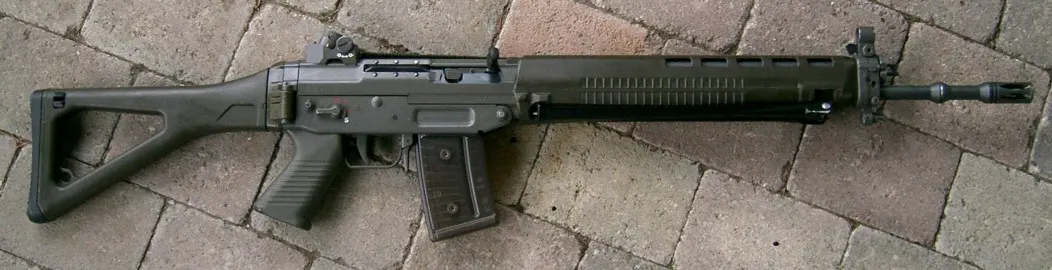
The special close-protection SB build documented in Swiss military equipment records, with its short 14-inch barrel and SureFire SOCOM suppressor mount, is functionally its own sub-variant distinct from the commercial SB rifles sold to civilians and general law enforcement, even though it shares the same designation.8
On the accessory side, the rifle accepts an aluminum Picatinny handguard for lights and grips, a detachable bipod, an alternate pistol grip or folding stock, a brass or spent-case catcher for range or covert use, and the GL 75140 grenade-launcher module. None of these change the base action, but they meaningfully change the rifle's role, turning the same receiver into a squad-level marksman weapon, a close-protection carbine, or a grenadier's platform depending on what is bolted on.3

The only sourced military and police operator of the SIG SAPR is Switzerland itself. The Swiss Armed Forces field it as the Zf Stgw 12 through two specific units, the Militärpolizei Spezialdetachement and AAD10, rather than issuing it as a general-purpose service rifle.6,8 The Militärpolizei Spezialdetachement requires candidates to have already completed police training before applying, runs new operators through a roughly 40-week basic course followed by specialized modules covering medical support, vehicle handling, reconnaissance, and communications, and its core mission is protection of people and objects plus special police operations at home and abroad, the kind of close-range work a short, suppressor-ready SIG SAPR variant is built for.6
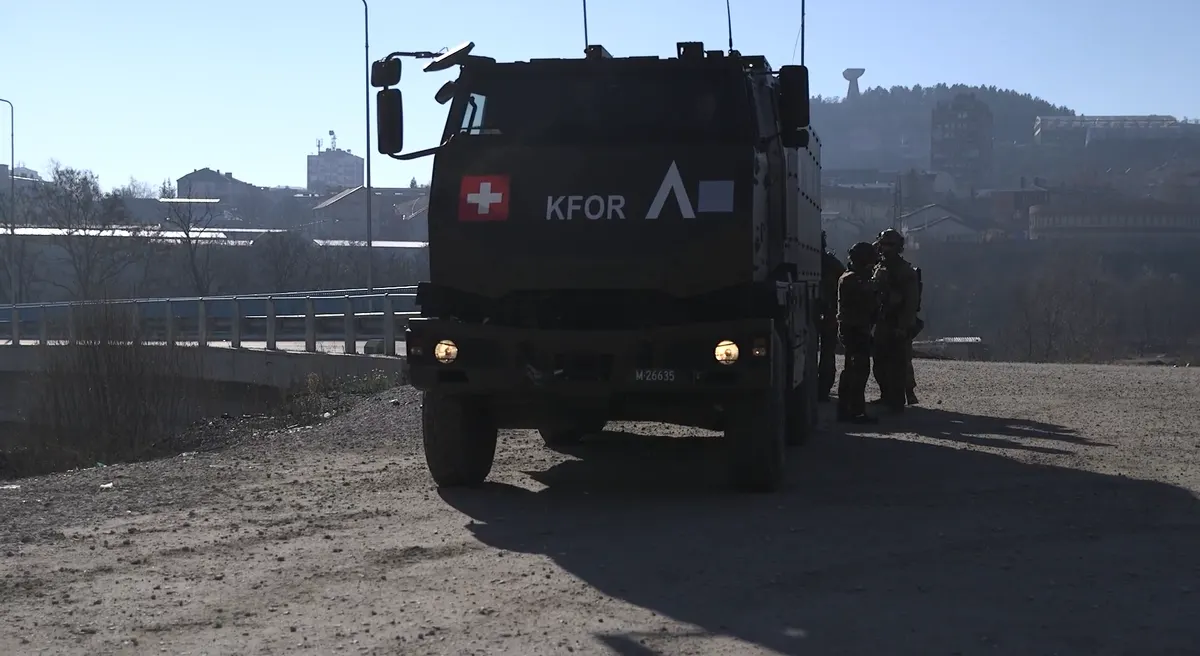
Beyond that narrow domestic footprint, the Swiss Armed Forces maintain a long record of contributing troops to NATO-mandated peacekeeping, most visibly the Swisscoy contingent serving with KFOR in Kosovo since the late 1990s, a deployment that has run to as many as roughly 215 personnel at its peak.7 There is no confirmed public record placing the SIG SAPR specifically inside that peacekeeping rotation, so it would be inaccurate to describe Kosovo as a documented deployment location for this particular rifle. It is included here only as context for the kind of overseas rotation Swiss units, including AAD10 personnel, regularly serve alongside their domestic Zf Stgw 12 issue.
Commercially, the rifle reached a small number of American civilian buyers through the 2017 JDI Firearms import run described above, but that single batch of 100 short-barrel pistol-configuration rifles is a retail footnote rather than evidence of any US law enforcement or military adoption, and no other country's forces are confirmed to operate the SIG SAPR as a military or police weapon.4
Put together, the operator picture is narrow by design. Switzerland built the SIG SAPR to answer a specific requirement inside two small, specialized units. Every sourced fact about who actually carries it points back to that same limited circle rather than to any wider NATO or export customer base.
The SIG SAPR and the American SR-25 both fill the same 7.62x51mm NATO designated marksman niche, but the procurement paths that got each rifle there could hardly be more different. Knight's Armament Company built the SR-25 by scaling Eugene Stoner's AR-10 back up after decades of AR-15 development, and the US military variant, the Mk 11 Mod 0, was adopted in real numbers by Navy SEALs and other special operations units with a 20in (510mm) barrel and roughly 6.9kg loaded weight.5 SIG built the SAPR the opposite way, taking a smaller-caliber in-service rifle, the SG 550, and enlarging its action to swallow the bigger cartridge, then fielding the result to two small specialist Swiss units rather than a whole special operations community.
| SIG SAPR (SG 751 LB, 20in) | SR-25 / Mk 11 Mod 0 | |
|---|---|---|
| Cartridge | 7.62x51mm NATO1 | 7.62x51mm NATO5 |
| Action | Long-stroke gas piston, rotating bolt1 | Direct impingement, AR-10 pattern5 |
| Barrel length | 520mm (20in)3 | 510mm (20in)5 |
| Unloaded weight | ~3.96kg3 | ~6.9kg loaded (Mk 11 Mod 0)5 |
| Magazine | Proprietary 20-round polymer1 | AR-10 pattern box magazine5 |
| Confirmed military adoption | Switzerland only, niche units6,8 | United States and multiple allied special operations forces5 |
The weight gap in that table is the real story rather than the barrel-length coincidence. A gas-piston action scaled from an assault rifle keeps the SIG SAPR close to 4kg loaded even on its longest configuration, noticeably lighter than the SR-25 family's typical loaded weight, at the cost of a completely proprietary magazine that cannot draw on the far larger AR-10/SR-25 magazine and accessory ecosystem. That single compatibility choice is arguably the single biggest reason the SR-25 family spread across dozens of allied special operations units while the SIG SAPR stayed almost entirely inside two Swiss formations.
Set against the SVD Dragunov, the other reference point for the DMR category, the SIG SAPR again shows how much a designated marksman rifle's identity depends on which existing rifle it was scaled from. The Dragunov was purpose-built from the start as a semi-automatic marksman's rifle around its own short-stroke gas system, never shared an action with a Soviet assault rifle the way the AK-47 might suggest, and armed entire rifle squads across the Warsaw Pact and beyond. The SIG SAPR did borrow directly from an existing in-service assault rifle action, and it never reached that kind of squad-level fielding, remaining a specialist tool rather than a rifle every Swiss infantry section carries.


What caliber does the SIG SAPR use? The SIG SAPR (SIG SG 751) fires 7.62x51mm NATO, also sold commercially as .308 Winchester. A separate 5.56mm SG 750 sibling exists but is not the rifle covered by the SAPR designated marksman designation in Swiss service.1,3
Is the SIG SAPR select-fire or semi-automatic only? Civilian and general law enforcement models are semi-automatic only, matching the meaning behind the name Semi-Automatic Precision Rifle. A separate military and special law enforcement branch of the same design adds a 3-round burst setting and, with special government authorization, fully automatic fire.1,2,3
Who uses the SIG SAPR rifle? Confirmed use is limited to Switzerland, where the Swiss Armed Forces issue it as the Zf Stgw 12 to the Militärpolizei Spezialdetachement and to AAD10, the army's special reconnaissance and counter-terrorism detachment. No other country's military or police force is confirmed to operate it.6,8
How much does a SIG SAPR cost? The clearest sourced figure is roughly $4,050 per rifle for the short-barrel pistol-configuration batch of 100 imported into the United States by JDI Firearms in 2017. Full-length military and law enforcement configurations are not sold at retail and have no comparably documented public price.4
Is the SIG SAPR still in production? SIG Sauer AG continues to list the SG 751 precision rifle on its current Swiss product catalog, indicating ongoing or at least available production as of this writing, though published production totals are not public.2
What is the SIG SAPR's effective range? Manufacturer and technical literature do not publish a specific effective-range figure for the SIG SAPR, unlike some rival designated marksman rifles. Its 7.62x51mm NATO chambering places it in the same general range class as other rifles in that cartridge, but a precise sourced number is not available and should not be assumed.
- "SIG 750 / 751 SAPR", Modern Firearms — modernfirearms.net ↩
- "SG 751 Precision Rifle", SIG SAUER AG (Switzerland) — sigsauer.swiss ↩
- "SG SAPR", Wikipedia (German) — de.wikipedia.org ↩
- "Swiss Arms SG 751-P SAPR, A Quick Look", The FAL Files — falfiles.com ↩
- "SR-25", Wikipedia — en.wikipedia.org ↩
- "Militärpolizei Spezialdetachement", Swiss Armed Forces (VBS/VTG) — vtg.admin.ch ↩
- "Army Reconnaissance Detachment 10", Wikipedia — en.wikipedia.org ↩
- "List of equipment of the Swiss Army", Wikipedia — en.wikipedia.org ↩
- "SIG Sauer (Schweiz)", Wikipedia (German) — de.wikipedia.org) ↩
- "SG 751 SAPR", A.V.A Global Wiki — ava.fandom.com ↩
- "Alliance of Valiant Arms", Wikipedia — en.wikipedia.org ↩
- "Sturmgewehr 25 is new", SPARTANAT — spartanat.com ↩