

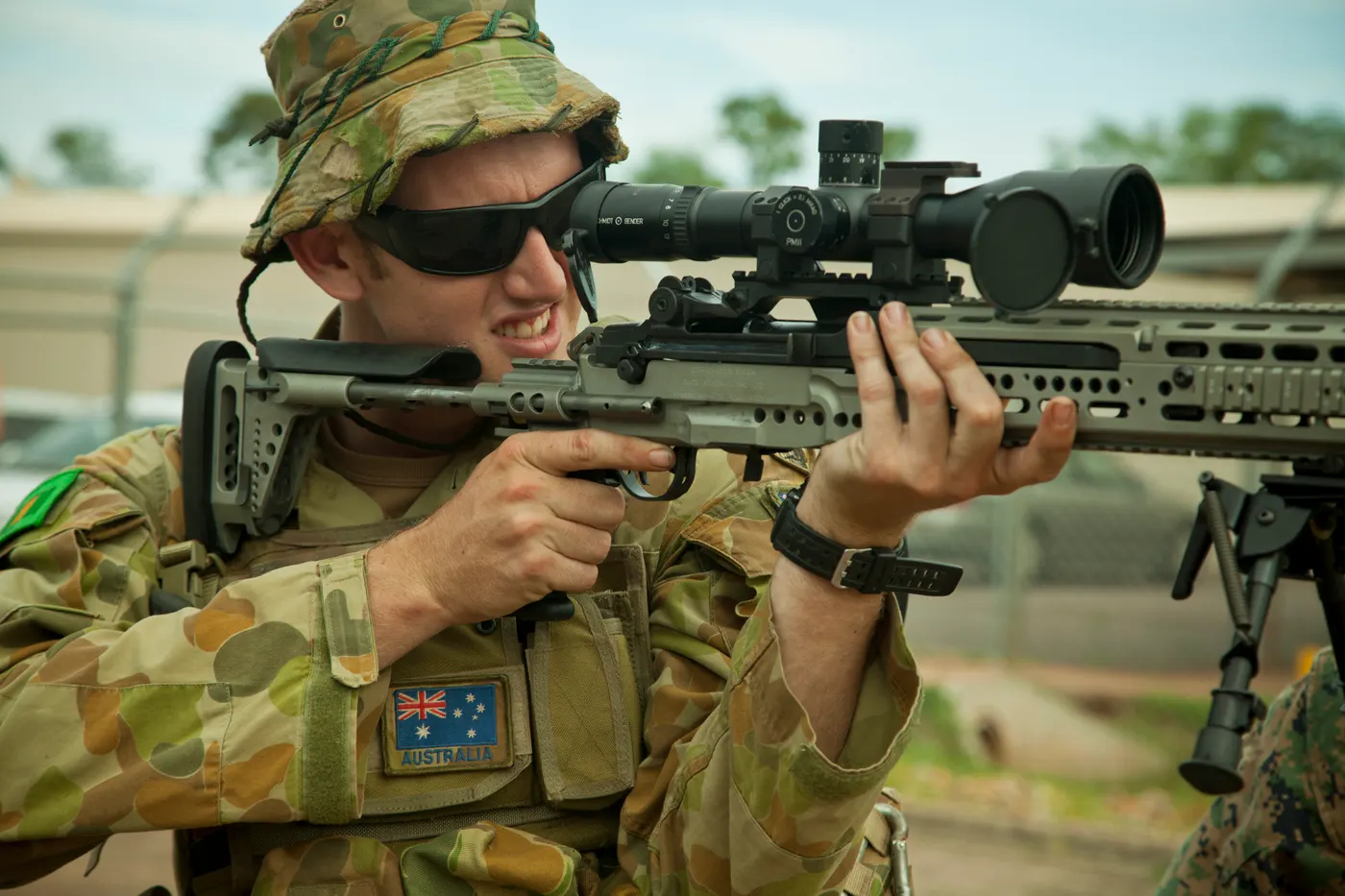

The M39 Enhanced Marksman Rifle (M39 EMR) is a semi-automatic designated marksman rifle chambered for 7.62x51mm NATO, built and maintained in-house by the United States Marine Corps of the United States. It is not a commercial arms company's product. Every M39 EMR is assembled, tuned, and repaired by the Precision Weapons Section (PWS) at Marine Corps Base Quantico, Virginia, a small Marine gunsmith shop staffed under military occupational specialty 2112, Precision Weapons Repairman, one of the smallest specialties in the entire Marine Corps at around sixty Marines total.1,2
- 7.62mm NATO power in a squad-portable semi-automatic package
- Proven M14 action with decades of institutional Marine Corps familiarity
- Sage aluminum chassis adds ergonomics without changing the trusted action
- Same top-tier optic as dedicated Scout Sniper rifles
- In-house PWS build quality with a 2 MOA accuracy standard
- Heavier than 5.56mm designated marksman rifles it stood alongside
- M14 action does not share parts or manual of arms with the M16/M4 family
- Harder to suppress cleanly than an AR-pattern action
- Superseded organically by AR-10 pattern rifles from 2012 onward
- No foreign sales or export variants, a purely internal USMC program
Fielded in 2008, the M39 EMR is a rebuild of the older M14 battle rifle rather than a clean-sheet design. The M14's forged steel action and 20-round detachable box magazine carry over unchanged from the rifle's 1950s origins.1 What separates the M39 EMR from every earlier Marine Corps M14-based marksman rifle is the stock. PWS mounted the action in an aluminum chassis built by Sage International, replacing the fiberglass stock used on the M39 EMR's direct predecessor, the M14 DMR.3,4 The rifle also standardized on the M8541 Scout Sniper Day Scope (SSDS), the Marine Corps designation for a Schmidt & Bender Police Marksman II telescopic sight, the same optic issued to Marine Scout Snipers on the bolt-action M40A3 and M40A5 rifles.1,5
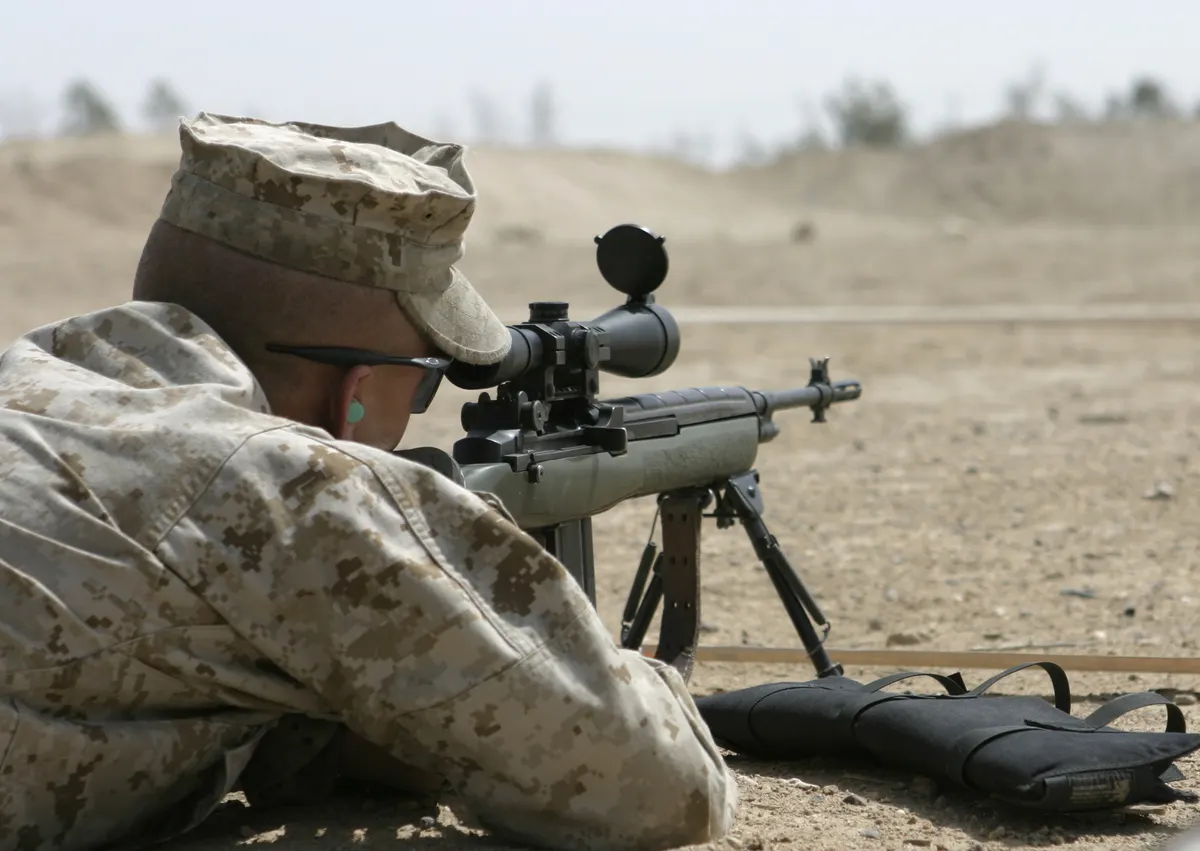
The M39 EMR filled the gap between the Marine rifle squad's M16A4 and M4 carbines and the bolt-action M40 series sniper rifles carried by dedicated Scout Snipers. Deployed with infantry squads in the Iraq War and the War in Afghanistan (2001-2021), it gave a single Marine per squad the ability to reliably hit targets out past the effective range of a 5.56mm service rifle without waiting for a sniper team.1,6 Marine Corps planners judged the tradeoff worth the added weight for most of the 2000s and into the early 2010s, at which point logistics considerations, not accuracy, pushed the Corps toward its M110 replacement (see Comparison below).
Search interest in the M39 EMR typically clusters around a handful of questions. Is the M39 EMR still in service. What is the M39 Enhanced Marksman Rifle's caliber. How does the M39 EMR compare to the M110 Semi-Automatic Sniper System that replaced it. Each question is addressed directly below, using the sourcing available.
The M39 Enhanced Marksman Rifle's core mechanism is the M14 action inherited unchanged from the 1957 service rifle. It is gas-operated with a short-stroke piston and a rotating bolt, feeding from a detachable magazine holding 20 rounds of 7.62x51mm NATO (a 10-round magazine can also be fitted for a lower profile).1 Standard issue ammunition is the M118LR, a 175-grain Long Range match load, which the M39 EMR's PWS-tuned barrel and trigger are built around.1,6
- First Production Year2008
- Service Entry Year2008
- DesignerUSMC Precision Weapons Section (chassis by Sage International)
- Weight (Empty)5.9 kg
- Weight (Loaded)7.5 kg
- Currently In ServiceNo
- Notable UsersUnited States Marine Corps
The 22-inch (56 cm) barrel is match-grade stainless steel. PWS has not published the specific barrel maker used for the M39 EMR itself, so none is asserted here, though the earlier M14 DMR program is separately documented as having used Krieger barrels.3 Overall length is 44.2 inches (112 cm), and loaded weight with optic and bipod fitted runs to 16.5 lb (7.5 kg), against roughly 13 lb (5.9 kg) for the bare rifle.1 Muzzle velocity with M118LR is reported at 2,837 ft/s (865 m/s).1
- Cartridge7.62x51mm NATO
- Calibre7.62 mm
- Case Length51 mm
- Calibre ClassFull-power rifle cartridge
- Bullet Weight11.3 g
The defining change from the M14 DMR to the M39 EMR is the stock. PWS replaced the DMR's McMillan M2A fiberglass stock with an aluminum chassis from Sage International, the M14 ALCS (Adjustable Length Chassis System).3,4 The Sage chassis gives the M39 EMR a telescoping buttstock with five length-of-pull positions, an adjustable cheekpiece with nine height settings, an AR-pattern pistol grip, and Picatinny rail sections at the 3, 6, 9, and 12 o'clock positions around the forend.3 A Harris S-L bipod, a more durable variant than the standard-issue Harris bipod, mounts to the integral rail.1
- Action TypeGas-Operated
- Fire ModesSemi-automatic only
- Select FireNo
- Feed SystemDetachable Magazine
- Magazine Capacity20
- Practical Rate of Fire60
- Trigger TypeGunsmith-tuned National Match two-stage trigger
Sage International's chassis is not unique to the Marine Corps. It is genealogically the same aluminum stock system Sage built for the Navy in 1999, when NSWC Crane approached Sage founder Jon Klein for a rigid, modular replacement stock for M14-pattern rifles, eventually becoming the Mk 14 Mod 0 EBR issued to Navy SEALs.4 The same basic parts kit can be configured either M39 EMR style or Mk 14 EBR style, which is why the two rifles are frequently mistaken for each other in photographs despite belonging to different services with different procurement chains.4
- Muzzle Velocity865 m/s
- Effective Range (point)780 m
- Accuracy2
Optically, the M39 EMR standardized on the M8541 Scout Sniper Day Scope, the Marine Corps designation for a Schmidt & Bender Police Marksman II LP 3-12x50 with a Premier Reticles modified, second-focal-plane illuminated reticle.1,5 This is the identical optic issued to Marine Scout Snipers on the bolt-action M40A3 and M40A5, meaning a squad-level M39 EMR carries the same glass as the battalion's dedicated snipers.5 Fire is semi-automatic only, with a practical rate of roughly 60 rounds per minute reflecting deliberate, aimed shooting rather than suppression.1
- Barrel Length559 mm
- Sight TypeM8541 Scout Sniper Day Scope (Schmidt & Bender PM II 3-12x50 based)
- Optic RailYes
Reported effective range against a point target is 850 yards (about 780 m), close to the 800 m figure that Marine Corps requirements documents set as a design goal for this class of weapon.1,7 A frequently cited maximum ballistic range figure of 4,075 yards (3,726 m) describes how far the 175-grain bullet can theoretically travel before striking the ground, not a distance at which the M39 EMR can be used to engage a target, and it should be read strictly as a ballistic curiosity rather than a usable range.1
- Overall Length1,123 mm
- Receiver MaterialForged steel M14 receiver
- Furniture MaterialSage International M14 ALCS aluminum chassis
- Folding / Collapsing StockNo
- ModularitySage ALCS chassis, 5-position telescoping stock, 9-position adjustable cheekpiece, quad Picatinny rail
A unit cost of $3,930.17 is reported in some references, though the figure traces to a single source without a stated year or acquisition context, so it should be treated as reported rather than verified.1
- Production Start2008
- Unit Cost3,930 USD
- Variants1
The Marine Corps's line of M14-based designated marksman rifles predates the M39 EMR by nearly two decades. The rebuild program began in the late 1980s, when Marine armorers started refurbishing decommissioned M14 rifles with fiberglass stocks and new barrels for use as squad-level precision weapons.3 That informal effort was formalized in a November 1992 Mission Needs Statement calling for an enhanced sniper support team weapon, able to engage targets to 600 m, share ammunition with the M40A1 sniper rifle, and mount a suppressor and optics.3 The resulting technical package was finalized around 1998, and PWS at Quantico began building rifles under the name M14 DMR around 2000.3
The M14 DMR, built with a McMillan M2A fiberglass stock and initially a fixed 10x optic, was fielded from around 2000 or 2001 through roughly 2008, though some units held DMR stock in inventory as late as 2010 to 2014.3 It saw extensive combat use in Iraq and Afghanistan with Marine Scout Sniper Teams, FAST Companies, the 4th Marine Expeditionary Brigade (Anti-Terrorism), and Marine explosive ordnance disposal teams, the last of which used the rifle to engage suspected explosive devices from a standoff distance.3
Precision Weapons Section itself traces back further still, to 1966, when it was established as the Rifle Team Equipment Section supporting Marine Corps competitive marksmanship teams rather than combat units.2 It began serving operational units in the early 1970s, after problems with the M40 sniper rifle in Vietnam highlighted the need for dedicated in-house rifle maintenance.2 Since 2005, PWS has been headquartered at Harlee Hall, named for Brigadier General William C. Harlee, described as the father of Marine Corps rifle practice, part of the Twitchell Test Facility at Weapons Training Battalion, Quantico.2
PWS developed the M39 Enhanced Marksman Rifle with Sage International and fielded it in 2008 as a one-for-one replacement for the M14 DMR.3,4 The core changes, the aluminum Sage chassis in place of the McMillan fiberglass stock and the standardized M8541 optic, were evolutionary refinements of the same M14 platform rather than a new rifle. Both the DMR and the EMR share the identical action, cartridge, and magazine.
By early 2012, the Marine Corps began replacing the M39 EMR with the Army's M110 Semi-Automatic Sniper System, designated Mk 11 Mod 2 in Marine service, again one-for-one.1,6 The decision, described in more detail in Comparison below, was driven by logistics and modularity rather than any accuracy shortfall in the M39 EMR itself.
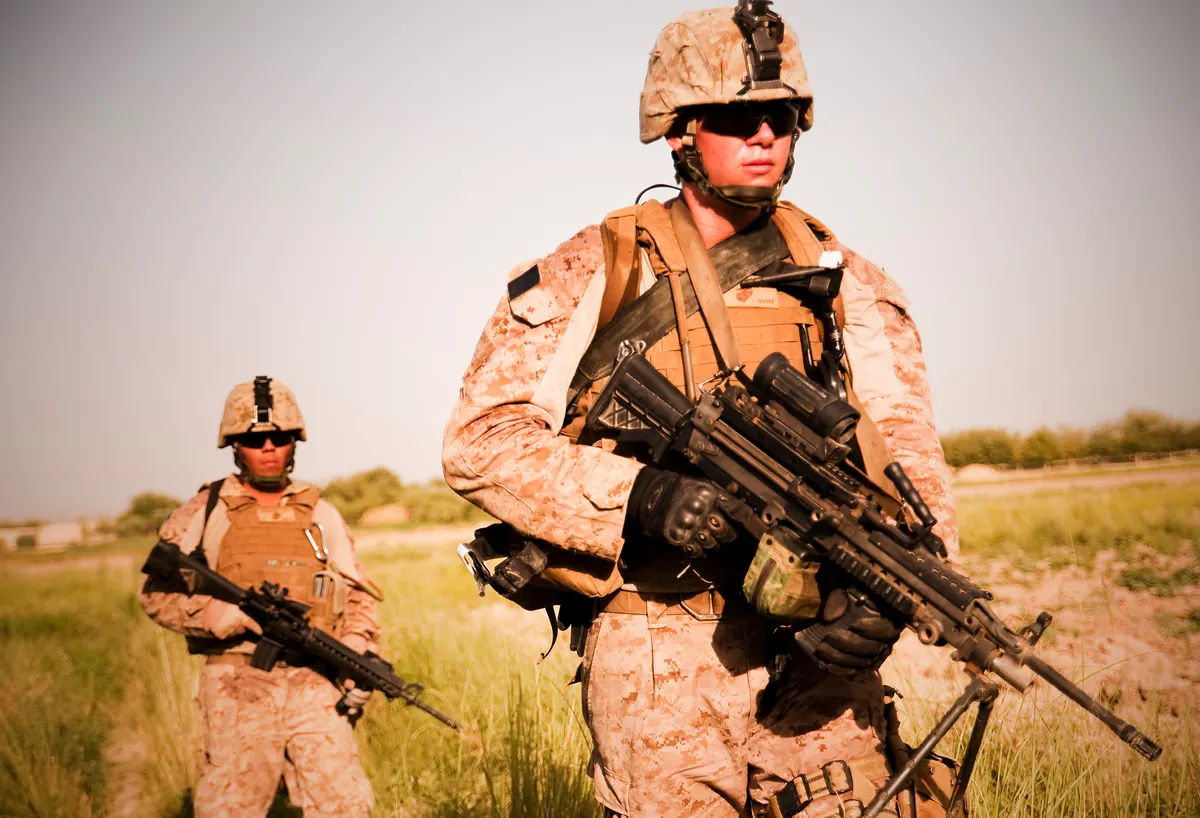
The M39 Enhanced Marksman Rifle deployed with Marine infantry squads to both the Iraq War and the War in Afghanistan (2001-2021) through the 2000s and into the 2010s, functioning as organic squad-level precision fire between the rifleman's M16A4 or M4 and the dedicated M40-series sniper rifle.1,6 Multiple sources describe the rifle as having been used with great success in that role, though without naming specific units, engagements, or individual Marines beyond what is documented here.1

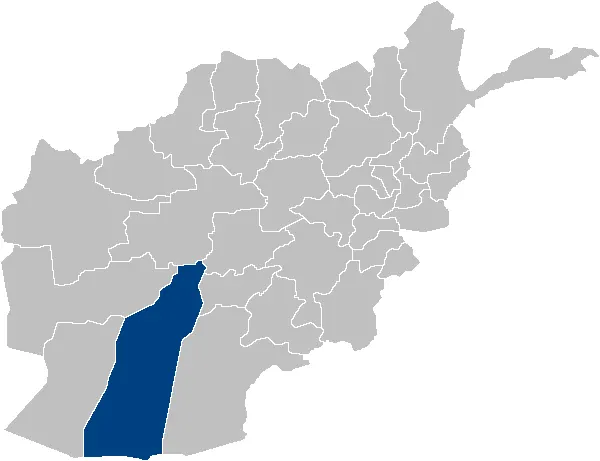
A notable, if unusual, data point comes from October 2008, when the M39 EMR was reported in limited use outside the Marine Corps entirely, carried by US Army cavalry scouts operating in the Hindu Kush mountains of Afghanistan.5 This was not a formal Army adoption of the rifle, simply an isolated cross-service instance, and it is not treated here as evidence of a second operator.
The rifle's predecessor, the M14 DMR, carried the bulk of the Marine Corps's combat record in this role during the 2000s, with Scout Sniper Teams, FAST Companies, the 4th MEB(AT), and EOD teams all fielding it in Iraq and Afghanistan before the M39 EMR took over the mission from 2008 onward.3
No distinct hardware sub-variant of the M39 Enhanced Marksman Rifle beyond the single production configuration, Sage ALCS chassis, M8541 SSDS optic, M118LR ammunition, has been documented, and at least one source states explicitly that only one configuration exists.1
A related but unofficial point worth noting for anyone comparing photographs, gunsmiths and collectors report that the same Sage chassis parts kit can be assembled either in M39 EMR configuration or in Mk 14 Enhanced Battle Rifle configuration, which is a civilian parts-compatibility fact about the Sage chassis rather than an official military sub-variant of the M39 EMR itself.4,8


The United States Marine Corps is the sole confirmed operator of the M39 Enhanced Marksman Rifle.1 It was built exclusively in-house by PWS at Quantico for Marine Corps use, was never marketed commercially, and has no confirmed foreign or export operators.1,2 The one exception, the October 2008 Army cavalry scout usage noted above in Conflicts, was incidental rather than a formal Army adoption and is not treated as a second operator here.5
By the mid-2010s, the Marine Corps had largely completed the transition to the M110 Semi-Automatic Sniper System, meaning the M39 EMR's active service life ran roughly from 2008 to the early-to-mid 2010s.1,6
The M39 EMR's replacement did not happen because the M110 Semi-Automatic Sniper System shot better groups. It happened because the M110, a Knight's Armament Company SR-25 derivative built on Eugene Stoner's AR-10 action rather than the M14's, mounts a suppressor and night-vision optics while holding zero more reliably than the M14 action does, and shares parts and manual of arms with the M16/M4 carbines everyone else in the squad already carries.6 The M39 EMR's M14 action shares neither trait with the rest of a Marine rifle squad's weapons, which became the deciding factor once the Corps weighed logistics over the M14's long record of accuracy and reliability.
| SPEC | M39 Enhanced Marksman Rifle | M110 Semi-Automatic Sniper System |
|---|---|---|
| Action Type | Gas-Operated | Gas-Operated |
| Cartridge | 7.62x51mm NATO | 7_62x51mm_nato |
| Magazine Capacity | 20 count | 20 count |
| Unit Cost | 3930 USD | 11214 USD |
| Service Entry Year | 2008 year | 2008 year |
| M39 EMR | M110 SASS | |
|---|---|---|
| Action family | M14 (rotating bolt, gas piston) | AR-10 derivative (Knight's Armament SR-25) |
| Stock/chassis | Sage International M14 ALCS | Knight's URX modular rail system |
| Fielded | 2008 | 2007-2008 |
| Suppressor/NV compatibility | Limited by the M14 action | Purpose-built for both |
Against its Navy cousin, the Mk 14 Enhanced Battle Rifle, the comparison runs the other direction. The two rifles are close to externally identical because they share the same Sage International chassis design, yet they were never the same procurement program.4 The Mk 14 grew out of a 1999 Navy Special Warfare request to NSWC Crane, while the M39 EMR is a purely Marine Corps in-house PWS build finalized nearly a decade later, and in practice the two services fitted different optics and accessories to their respective rifles even when the underlying chassis and action were the same.4
The M39 EMR's own reason for existing, relative to the AR-15 pattern 5.56mm designated marksman rifles the Marine Corps and other services used around the same period (the Marine Corps's own SAM-R before the Mk12 Special Purpose Rifle supplanted it, and the Mk12 itself used by SEALs and Army Rangers), was the heavier 7.62x51mm NATO cartridge those rifles could not offer.1,6 That extra power came at the cost of additional weight and the M14 platform's well-known reliability and accuracy quirks relative to a clean AR-pattern action.

Is the M39 Enhanced Marksman Rifle still in service? Largely no. The Marine Corps began replacing the M39 EMR with the M110 Semi-Automatic Sniper System (Mk 11 Mod 2) starting in early 2012, and by the mid-2010s the M110 had taken over the designated marksman role the M39 EMR had held since 2008.1,6
What caliber does the M39 EMR use? 7.62x51mm NATO, fired from a 20-round detachable box magazine, typically loaded with M118LR 175-grain Long Range match ammunition.1
Who makes the M39 Enhanced Marksman Rifle? It is not made by a commercial arms company. The Marine Corps's own Precision Weapons Section at Quantico builds and maintains every M39 EMR, using an aluminum chassis supplied by Sage International.1,2,3
How much does an M39 EMR cost? A figure of $3,930.17 is reported in some references, though it traces to a single source without a clear year or acquisition context attached, so it is best treated as reported rather than confirmed.1
What is the M39 EMR's effective range? Approximately 850 yards (about 780 m) against a point target, close to the 800 m design goal set out in the Marine Corps's original requirements for this class of weapon.1,7
How does the M39 EMR compare to the M110 that replaced it? The M39 EMR uses the M14's rotating-bolt gas action, while the M110 is derived from Eugene Stoner's AR-10 by Knight's Armament Company. The Marine Corps switched primarily for the M110's better suppressor and night-vision compatibility and its shared parts and manual of arms with the M16/M4 family, not because the M39 EMR was inaccurate.6
- "M39 Enhanced Marksman Rifle", Wikipedia — en.wikipedia.org ↩
- "USMC Precision Weapons Section", Small Arms Defense Journal — sadefensejournal.com ↩
- "United States Marine Corps Designated Marksman Rifle", Wikipedia — en.wikipedia.org ↩
- "A Warrior's Armor, the M1A/Sage EBR Stock", The Armory Life — thearmorylife.com ↩
- "M39 EMR", American Special Ops — americanspecialops.com ↩
- "M39 Enhanced Marksman Rifle (EMR)", Military Factory — militaryfactory.com ↩
- "Precision Weapons Section", Marine Corps Association, Leatherneck — mca-marines.org ↩
- M14 Forum community discussion on the Sage EBR stock and M8541 scope — m14forum.com ↩
- "M39 EMR", Battlefield Wiki — battlefield.fandom.com ↩