

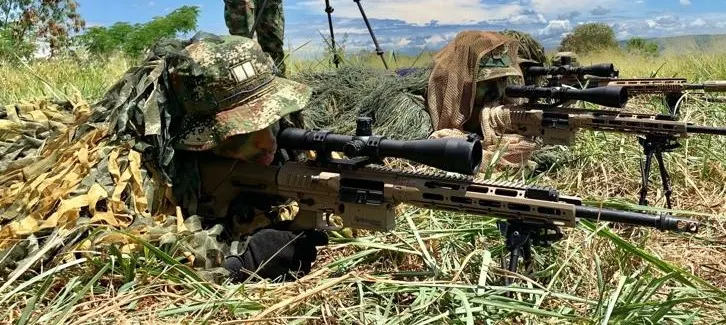

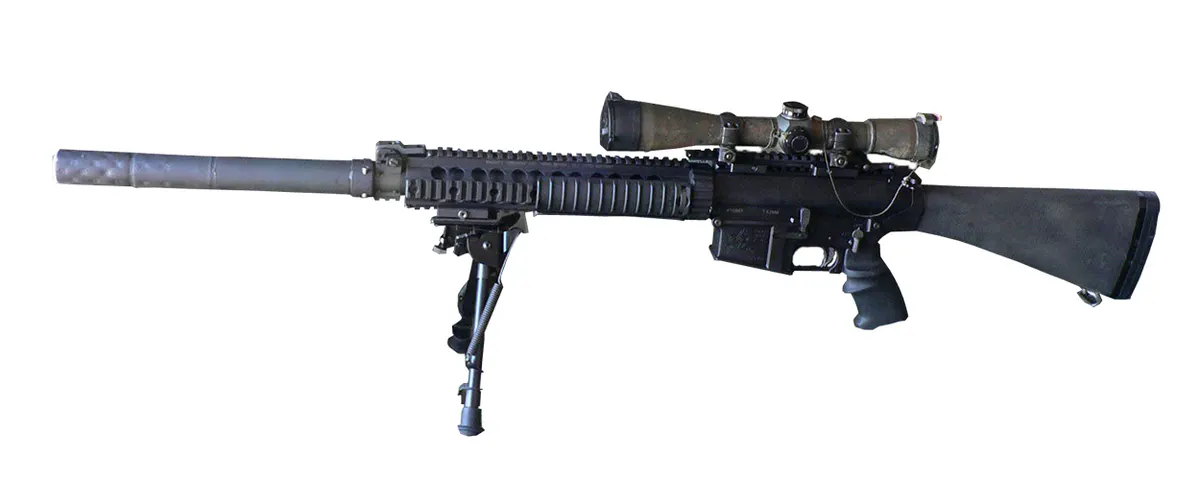
In January 2012, Remington Arms folded a rifle it had been marketing for roughly two years into its new R-series naming scheme, renaming the Remington Semi-Automatic Sniper System (RSASS) the R11 RSASS.1 The rifle chambers 7.62x51mm NATO, interchangeable with commercial .308 Winchester. It cycles through direct gas impingement rather than the short-stroke piston system used by other AR-10 pattern rifles such as the SR-25.2 That mechanical choice separates it from the U.S. Army's own semi-automatic sniper rifle of the same era, the M110 Semi-Automatic Sniper System, which uses a short-stroke gas piston instead of direct impingement despite sharing the same broader gas-operated action family.5
- Direct gas impingement action, lighter than a piston rival
- SR-25/DPMS-pattern box magazine up to 20 rounds
- Sub-MOA accuracy with match ammunition
- Sold as a complete kit with scope, suppressor and bipod
- Never confirmed fielded to a named military unit
- Reportedly discontinued around 2019 to 2020 after a decade on the market
- Weight and length figures disagree across published sources
- No confirmed outcome of the USMC trial it was built for
Remington designed the rifle jointly with JP Enterprises, a match-rifle component maker, basing it on JP's own LRP-07 design.1 Remington Defense marketed the finished designated marksman rifle exclusively to military and law-enforcement buyers, and as late as January 2013 it still had no civilian sales channel at all.4
The rifle's own adoption story is the thinnest part of its record. No source located confirms the RSASS was ever operationally fielded to a named U.S. military unit. It was submitted into the U.S. Marine Corps' Semi-Automatic Precision Weapon System (SAPWS) trials starting in late 2008, and it was marketed to military and law enforcement buyers for roughly a decade afterward. A confirmed contract or fielding decision does not appear in the public record.1 That gap deserves to be stated plainly rather than smoothed over, because the available sourcing genuinely does not support a firmer claim.
Remington built the RSASS around a stainless steel barrel, a folding side-charging handle on the left side, and a free-float handguard rail contributed by JP Enterprises, all aimed at match-grade repeatability inside a semi-automatic platform.1,3 Search interest in the Remington Semi-Automatic Sniper System, its R11 RSASS specifications, and how it compares with the Army's M110 rifle has continued well past the rifle's own discontinuation, in part because so little about its actual service history has ever been pinned down.
The Direct Gas Impingement Action Behind the RSASS
The Remington Semi-Automatic Sniper System is a semi-automatic, gas-operated rifle using direct gas impingement with an adjustable gas regulator and a rotating bolt lock, the same general operating family as the AR-15 and AR-10 rather than the short-stroke piston system built into the SR-25-derived M110 SASS.2,5 Barrel length runs 457mm (18in) on the standard short-barrel configuration, with a longer 559mm (22in) option offered as well, though at least one source lists the long option at 20in (51cm) instead, a discrepancy worth noting rather than resolving.1,2 Rifling twist is listed at 1 in 10 inch.2
- DesignerRemington Arms, JP Enterprises
- Weight (Empty)7.14 kg
Overall length is 1,003mm (39.5in), a figure both major technical sources agree on.1,2 Weight is where the sources genuinely diverge. Wikipedia's figure, used as the primary value here, lists 7.14kg (15.75lb), while Modern Firearms gives a notably lighter 5.4kg (12lb) with an empty magazine, a gap large enough that it likely reflects two different configurations (with or without optics, suppressor, and bipod) rather than a simple reporting error.1,2
- Cartridge7.62x51mm NATO / .308 Winchester
- Calibre7.62 mm
- Case Length51 mm
- Calibre Class7.62mm / .308 caliber
- RimfireNo
- Caseless AmmunitionNo
The rifle feeds from a detachable box magazine built to the SR-25/DPMS pattern, available in 10, 19, or 20-round capacities.1,2 Accuracy is rated sub-MOA by both sources, a genuinely competitive figure for a semi-automatic 7.62x51mm rifle.1,2 No publicly documented muzzle velocity figure exists for the RSASS in any source consulted, so that spec is omitted rather than estimated.
- Action TypeGas-Operated
- Fire Modessemi-automatic
- Select FireNo
- Feed SystemDetachable Magazine
- Magazine Capacity20
The Leupold Scope and the Suppressor Package
Modern Firearms lists the RSASS's optic as a Leupold Mark 4 M3, a 4.5-14x variable telescopic scope, giving the shooter room to dial down for closer engagements or up for the rifle's stated effective range.2 Effective range is another point of disagreement, running from roughly 800m to 1,006m depending on the source (Wikipedia's figure converts to roughly 875 to 1,100 yards, while Modern Firearms states 800 to 1,000m), with 900m serving as a reasonable working midpoint between the two.1,2
- Effective Range (point)900 m
- Accuracy1
Remington Defense reportedly sold the RSASS as a complete package rather than a bare rifle, bundling the Leupold scope with a quick-detach Advanced Armament Corporation sound suppressor, a Harris bipod, and a carrying case, according to a single Tactical-Life report on Remington Defense's civilian-market offerings from around 2013.4 That bundling, more than any individual spec, is what made the rifle attractive to the law-enforcement agencies it was primarily marketed toward, a department buying one line item rather than sourcing optics and accessories separately.4
- Barrel Length559 mm
- Rifling Twist1:10
- Sight TypeLeupold Mark 4 M3, 4.5-14x variable telescopic scope
- Optic RailYes
- Overall Length1,003 mm
- Bullpup LayoutNo
- Production Start2010
- Production End2019
JP Enterprises' LRP-07 and a 2010 Prototype Debut
Remington and JP Enterprises developed the Semi-Automatic Sniper System together across 2009 and 2010, building it on JP's existing LRP-07 match rifle rather than starting from a clean sheet.1
The earliest public documentation of the finished design comes from TheFirearmBlog in September 2010, which described the rifle as still a prototype at that stage and noted with some surprise that Remington had not based its new sniper rifle on the Magpul Masada/ACR platform many observers had expected, given how much industry attention that design was drawing at the time.3
The USMC's SAPWS Trial and an Unconfirmed Outcome
On November 3, 2008, the U.S. Marine Corps issued a Sources Sought Notice, solicitation M6785408R1011, for a Semi-Automatic Precision Weapon System (SAPWS), described in the notice as effectively the Marine Corps' own version of the Army's M110 SASS program.1 The requirement called for a 7.62x51mm semi-automatic sniper rifle optimized for the M118LR cartridge, capable of mounting a suppressor, and compatible with Marine Corps night-optics and aiming devices including the M8541 Scout Sniper Day Scope.1 The Remington and JP Enterprises design was submitted into this program.1
No source located states who won the SAPWS program, or whether it produced a contract award at all. That gap is real, a genuine hole in the public record rather than an oversight in the research. It is stated plainly rather than filled in with a plausible-sounding guess.
The relationship to the Army's separate, earlier M110 SASS competition is also worth stating carefully. That Army program, in which Remington, DPMS Panther Arms, and Knight's Armament Company competed, was decided on September 28, 2005, with Knight's Armament winning and its rifle eventually fielded as the M110.5 That decision predates the RSASS's emergence as a named product by roughly four years. It remains unconfirmed whether Remington's 2005 competition entry was the same physical rifle later marketed as the RSASS, or an earlier, related Remington design. What can be said plainly is that Remington's related submissions lost the Army's M110 SASS competition to Knight's Armament.5
No documented combat deployment of the Remington Semi-Automatic Sniper System was found in the available research. That absence is consistent with its apparent status as an evaluation and marketing product rather than a rifle issued into service at scale, and it is stated plainly rather than left implied.
The RSASS was offered in two barrel-length configurations, a standard 457mm (18in) barrel and a longer 559mm (22in) option (listed elsewhere as 20in), rather than as a set of named or numbered variants.1,2 The January 2012 shift from RSASS to R11 RSASS is a naming change tied to Remington's broader R-series branding, not a distinct hardware variant, and both names describe the same rifle.1

The United States is the only operator any source connects to the Remington Semi-Automatic Sniper System, and even that connection is best described as evaluation rather than confirmed fielding. The rifle was tied to the U.S. Marine Corps' SAPWS trials that ran from late 2008 onward, with no confirmed acquisition year and no evidence anywhere in the sourcing that it reached general service.1
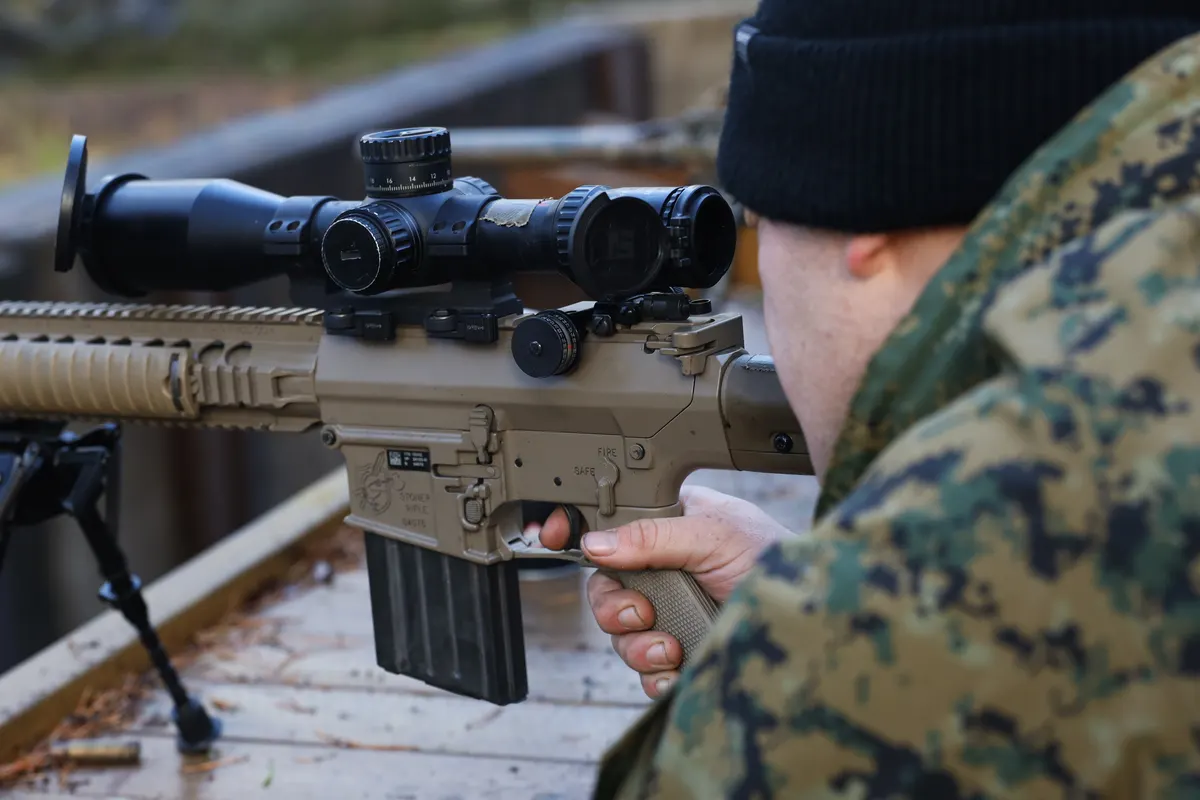
Wikipedia's own infobox reportedly lists the RSASS as in service since 2012, but that phrase reads as market-availability language tied to the R11 rebrand rather than a statement that any specific country or unit fielded the rifle. No named unit, no export customer, and no foreign operator turned up anywhere in the available sourcing. Anyone searching whether the Remington Semi-Automatic Sniper System was adopted by the U.S. military should treat the honest answer as evaluated rather than confirmed adopted.
The rifle also appears in popular culture as a modeled weapon in military-themed video games, including Call of Duty: Modern Warfare 3 and, under its R11 RSASS name, Escape from Tarkov, where it is modeled as a craftable, moddable 7.62x51mm marksman rifle.1,6
The U.S. Army's own semi-automatic sniper rifle competition, decided September 28, 2005, is the sharpest comparison point for the Remington Semi-Automatic Sniper System, precisely because Remington's related submissions lost it.5 Knight's Armament won that program with the SR-25-derived rifle that became the M110 Semi-Automatic Sniper System, and the Army fielded it into combat in Afghanistan by 2008, later expanding it into the M110A1 and M110A2 family used by both the Army and Marine Corps.5 The RSASS, developed several years later around 2009 to 2010 and submitted into the Marine Corps' own SAPWS trial, never produced an equivalent confirmed fielding decision anywhere in the public record.1,5
Mechanically, the two rifles solve the same problem differently. The M110 SASS cycles off a short-stroke gas piston, a system that runs cooler and cleaner over sustained fire at the cost of some added weight and mechanical complexity.5 The RSASS instead uses direct gas impingement, typically the lighter and mechanically simpler of the two approaches, though it also runs hotter and dirtier than a piston gun over a long string of fire.2 Neither design is inherently more accurate. No source compares the two rifles' actual field reliability against one another directly, so no claim is made here that one design outperformed the other in practice. They simply represent a genuine difference in gas system design within the same designated marksman rifle category.
| Spec | RSASS / R11 RSASS | M110 SASS |
|---|---|---|
| Action | Direct gas impingement | Short-stroke gas piston |
| Caliber | 7.62x51mm NATO | 7.62x51mm NATO |
| Effective range | ~800 to 1,006m (source-dependent) | ~800 to 1,000m |
| Magazine | 10/19/20-round detachable box | 10/20-round detachable box |
| Confirmed fielding | Not confirmed, evaluation only | Fielded, U.S. Army and Marine Corps |
Both rifles targeted the same M118LR cartridge and grew out of the same broader U.S. military push, in the 2000s, to give snipers a semi-automatic follow-up shot without abandoning bolt-action-level precision.1,5 Only one of them, the M110, turned that goal into confirmed, sustained service. The RSASS's story is really a story about a rifle that was built to compete for that role, marketed for roughly a decade as if it might win it, and, as far as public records show, never actually did.

What caliber does the Remington Semi-Automatic Sniper System use? The RSASS chambers 7.62x51mm NATO, interchangeable with commercial .308 Winchester ammunition, the same cartridge family used by the M110 SASS and most other Western designated marksman rifles.1,2
Is the R11 RSASS still in production? No confirmed source states the rifle is still being produced. Aggregated summaries describe it as reportedly discontinued around 2019 to 2020 after roughly a decade of marketing to military and law-enforcement buyers.1
Was the RSASS adopted by the U.S. military? Not confirmed. The rifle was submitted into the U.S. Marine Corps' SAPWS evaluation trials starting in late 2008, but no source located confirms an outcome, a contract award, or fielding to any named unit.1
Who makes the R11 RSASS rifle? Remington Arms manufactured the rifle, designed jointly with JP Enterprises and based on JP's LRP-07 design.1
How much does the R11 RSASS cost? No credible government procurement figure was found. A single firearms-forum listing mentioned a used civilian-market RSASS selling for around $1,200, a secondhand resale price rather than any official unit cost, and it should not be read as one.
What is the difference between the RSASS and the M110 SASS? Both are 7.62x51mm semi-automatic designated marksman rifles from roughly the same era. The M110 SASS runs a short-stroke gas piston and won the Army's 2005 competition to reach confirmed, sustained service. The RSASS uses direct gas impingement and, per available sources, was evaluated without ever being confirmed as adopted at scale.2,5
- "Remington Semi Automatic Sniper System", Wikipedia — en.wikipedia.org ↩
- "Remington R11 RSASS", Modern Firearms — modernfirearms.net ↩
- "Remington Semi-Auto Sniper System (RSASS)", The Firearm Blog — thefirearmblog.com ↩
- "7 Remington Defense Civilian Rifles Now Available", Tactical-Life — tactical-life.com ↩
- "M110 Semi-Automatic Sniper System", Wikipedia — en.wikipedia.org ↩
- "Remington R11 RSASS 7.62x51 marksman rifle", Escape from Tarkov Wiki — escapefromtarkov.fandom.com ↩