

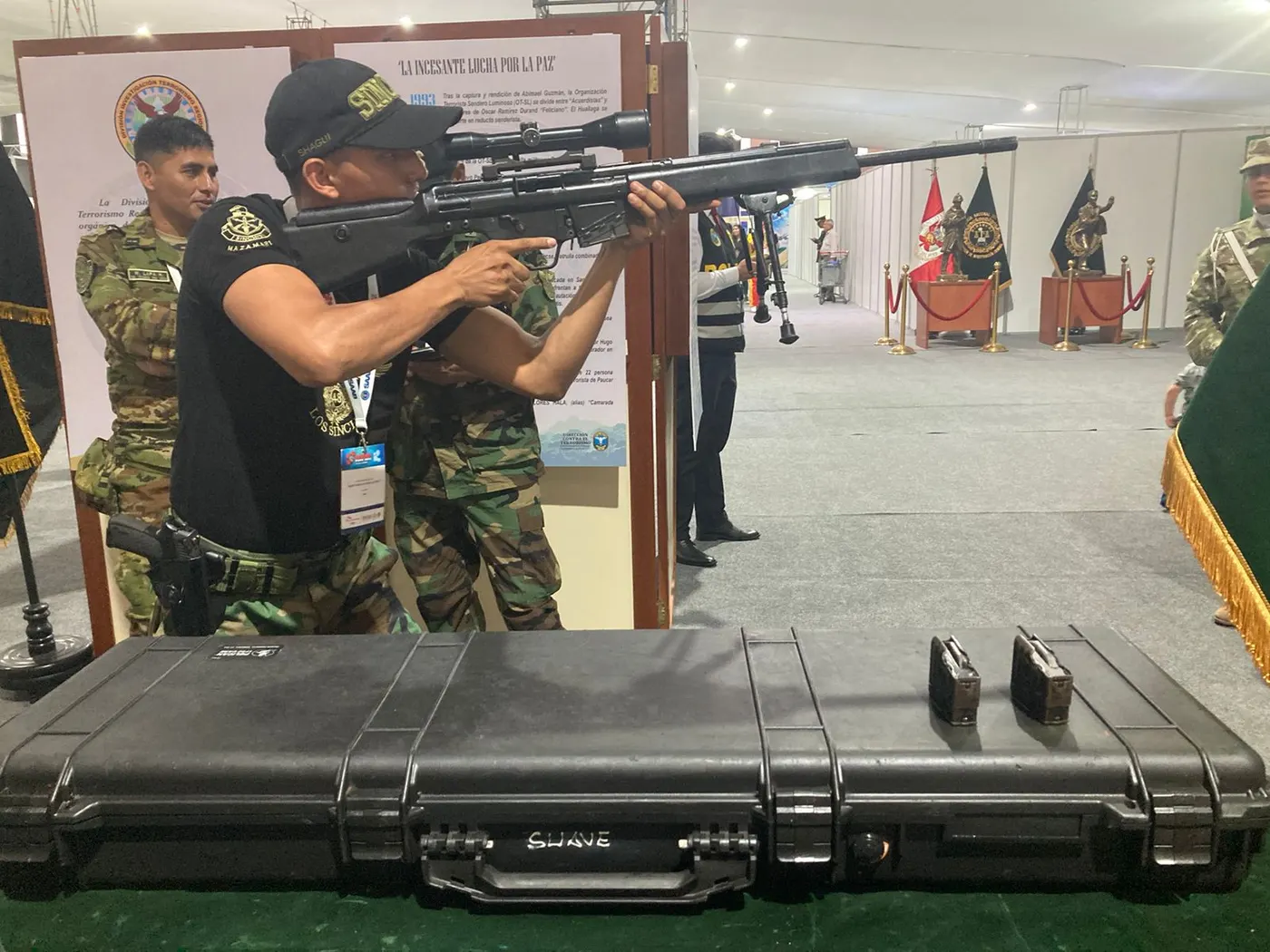

Heckler & Koch built the MSG90 to answer a problem its own catalog had created. The company's PSG1 had become the benchmark police precision sniper rifle after Munich, but it was heavy, hand-fitted, and priced well beyond what most militaries wanted to spend on a semi-automatic marksman's rifle. The MSG90, short for Militärisches Scharfschützengewehr (military sharpshooter rifle), entered production in 1987 as a lighter, tougher, and cheaper derivative of the PSG1, built specifically for military rather than police budgets and doctrine.1,2
- Proven roller-delayed blowback action shared with the G3 family
- Significantly lighter and cheaper than the PSG1
- Cold hammer-forged barrel gives sub-MOA accuracy with match ammunition
- Uses widely available G3/HK91 pattern magazines
- No threaded barrel or backup iron sights on the base model
- Fixed-power optic limits engagement flexibility compared to variable scopes
- Still heavier than most bolt-action rivals despite the diet from the PSG1
- Largely superseded in Heckler & Koch's own catalog by the A1 and A2 versions
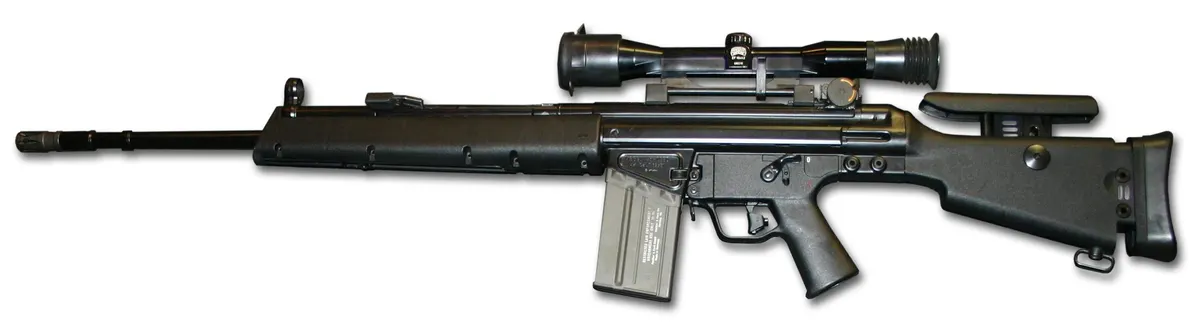
The MSG90 keeps the PSG1's delayed-blowback action, a mechanism Heckler & Koch inherited from the G3 battle rifle and, before that, from the Spanish CETME rifle it was derived from.3 What changes is everything around that action. The barrel drops from the PSG1's 650 mm match barrel to a shorter, lighter 600 mm cold-hammer-forged unit, the stock switches from hand-finished wood to a composite shell, and the receiver loses some of the reinforcement that made the PSG1 so heavy.4,1 The result weighs roughly 6.4 kg unloaded (published figures range from about 6.1 to 6.8 kg depending on configuration and source), fires the standard 7.62x51mm NATO cartridge from detachable-magazine box magazines holding 5 or 20 rounds, and reaches an effective range of around 800 meters with a stated maximum of 1,000 meters.4,5
Chambered in the same full-power rifle cartridge used across NATO, the MSG90 fills the role now generally called a designated marksman rifle, a semi-automatic precision weapon meant to extend a unit's reach beyond standard rifle range without giving up the rate of fire a bolt-action sniper rifle sacrifices. It should not be confused with the later, further upgraded MSG90A1, which added a threaded barrel, backup iron sights, and a modern Picatinny rail, nor with the unrelated HK MR308, a completely separate Heckler & Koch precision rifle built on the modern HK417/G28 platform rather than the G3-pattern roller-delayed blowback family. The MSG90 covered here is the original 1987 base model.
Germany, the MSG90's country of manufacture, adopted a closely related but distinct sibling of this rifle, the MSG3, built specifically for the Bundeswehr with a further lightened barrel and an unreinforced receiver.3 The base MSG90 covered here, by contrast, found its widest adoption abroad, sold into military and police service across Europe, Asia, and Latin America as a rugged, exportable alternative to the police-grade PSG1.5,6
The Roller-Delayed Blowback Action Inherited From the G3
The MSG90's operating system is the same roller-delayed blowback mechanism used across the Heckler & Koch G3 family, tracing back to CETME and, further still, to wartime Mauser experiments with the StG 45(M).3 A two-piece bolt uses a pair of rollers that must be forced inward before the bolt head can move rearward, which delays unlocking just long enough for chamber pressure to drop to a safe level.
- First Production Year1987
- Service Entry Year1990
- Weight (Empty)6.4 kg
- Currently In ServiceYes
- Notable UsersGermany (federal/state police, plus the related MSG3 in Bundeswehr service), France, Norway, Lithuania, Denmark, Mexico, Pakistan, Turkey, Indonesia, Malaysia, Philippines, South Korea, Thailand, Bangladesh, Iraq, Saudi Arabia, Uruguay, Vietnam, United States (FBI Hostage Rescue Team)
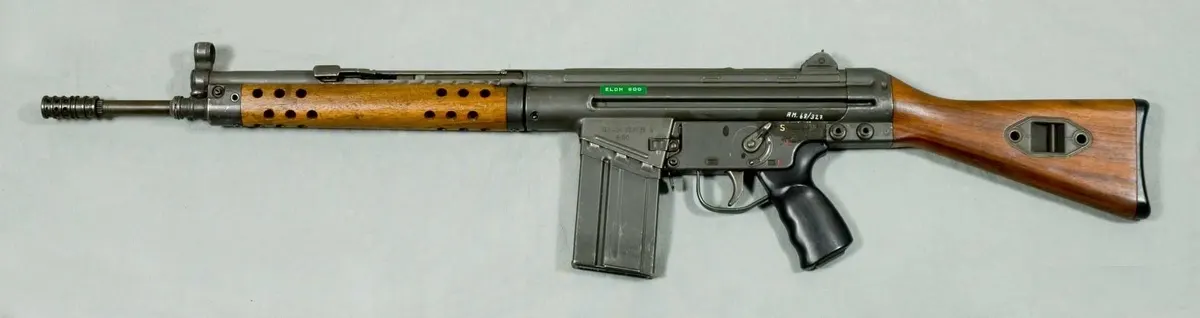
It fires from a closed bolt, which helps first-shot accuracy, and cycles semi-automatically only, with no select-fire capability.4 The system is mechanically simple and extremely reliable, but it also flings the fired case out hard and fast, a trait G3-family shooters nickname the HK slap and one later HK precision variants specifically worked to soften.7
- Cartridge7.62x51mm NATO (.308 Winchester)
- Calibre7.62 mm
- Case Length51 mm
- Calibre Classfull-power rifle cartridge
A Lighter, Shorter Barrel Than the PSG1
Where the PSG1 uses a 650 mm barrel, the MSG90 cuts barrel length to 600 mm (23.6 inches), cold hammer-forged with polygonal rifling and weighted at the muzzle to dampen barrel whip.4,5 That shorter, thinner barrel is the single biggest reason the MSG90 undercuts the PSG1's weight so heavily. It also trims muzzle velocity slightly, to roughly 820 m/s with standard NATO ball ammunition, compared with the PSG1's 868 m/s from its longer tube.5,7 Despite the lighter contour, testing by outlets that have fired the rifle extensively still records sub-MOA to sub-half-MOA groups with quality match ammunition, a strong result for a semi-automatic rifle in this weight class.7
- Action TypeDelayed Blowback
- Select FireNo
- Feed SystemDetachable Magazine
- Magazine Capacity20
- Trigger Typesingle-stage semi-automatic match trigger, approximately 15 N (1.5 kg / 3.3 lb) pull, vertically adjustable trigger shoe
Hensoldt Optics and the Weaver Rail, Not the PSG1's Claw Mount
Instead of the PSG1's proprietary claw scope mount, the MSG90 carries a Weaver-pattern rail welded directly to the top of the receiver, intended for a fixed 10x42 Hensoldt telescopic sight.5,7 The base rifle, as originally specified, does not include backup iron sights, a gap the later MSG90A1 closed by borrowing sights from the HK21 machine gun family and adding a proper optic-rail Picatinny system.7,9 It likewise lacks the threaded-barrel fitting and dedicated suppressor-ready muzzle threading that HK added on the A1, features that made that later rifle attractive to units wanting a sound-suppressed option.9
- Muzzle Velocity820 m/s
- Effective Range (point)800 m
- Maximum Range1,000 m
Trigger, Stock, and Furniture
The MSG90 uses a single-stage, semi-automatic-only match trigger with a pull weight around 15 newtons (roughly 1.5 kg, or 3.3 lb), lighter and more consistent than a standard G3 service trigger, with a wide trigger shoe adjustable for reach.4,7 The stock is an adjustable-length composite shell with a vertically adjustable cheekpiece, a simpler and less elaborate arrangement than the PSG1's fully adjustable target stock, but still enough to fit shooters of different builds without gunsmithing.4 The receiver itself is stamped steel reinforced with welded steel inserts, a middle point between the PSG1's heavier reinforced receiver and the sibling MSG3's unreinforced, even lighter shell.3
- Barrel Length600 mm
- Optic RailYes
- Iron SightsNo
- Threaded BarrelNo
- Overall Length1,165 mm
- Receiver Materialstamped steel, reinforced with welded steel inserts
- Furniture Materialcomposite/polymer stock and forend
- Folding / Collapsing StockNo
- Bullpup LayoutNo
- Production Start1987
The story of the MSG90 begins with its parent, the PSG1. Heckler & Koch developed that rifle in the mid-1970s in direct response to the failures exposed by the 1972 Munich Olympics hostage crisis, when West German police lacked a precision semi-automatic weapon suited to a rapid-fire counter-terrorism rescue.3 A bolt-action rifle was ruled out for that role because it could not deliver quick follow-up shots if a first shot on a hostage-taker failed to end the threat instantly. The PSG1 filled that gap for federal police counter-terrorism units, but its price and hand-fitted construction made it a poor fit for issuing to line infantry or line police units in bulk.3
Heckler & Koch answered that gap by developing the MSG90 through the mid-1980s and releasing it in 1987, deliberately built to military rather than police specifications.1,5 It entered wider service use around 1990, sold primarily as an export product to militaries and police forces that wanted a semi-automatic, G3-compatible marksman's rifle without paying PSG1 prices.5,6 Germany's own army fielded a further-lightened relative, the MSG3, rather than issuing the base MSG90 itself in Bundeswehr service, though the MSG90 remained widely available to allied and partner forces and to German federal and state police units.3
By the late 1990s Heckler & Koch had already begun developing the upgraded MSG90A1 to answer specific United States government interest in a suppressor-ready, modular version of the rifle, and by 2019 the company's catalog had consolidated further still around the improved MSG90A2, leaving the original 1987 base MSG90 as a legacy platform still in wide field use but no longer HK's current production offering.9,7
Surviving MSG90 rifles are now treated as a modern classic by collectors and the gun press rather than as a current-issue item, a status that has not stopped the rifle turning up repeatedly in shooting-sport chatter and popular depictions of European sniper equipment.
The clearest split in the family is between the MSG90 covered here and the MSG3, the Bundeswehr-specific sibling built with a slimmer, non-reinforced receiver, a lighter barrel, a 6x fixed telescope, and standard G3-pattern iron sights rather than the MSG90's scope-only setup.3 The MSG3 is considerably rarer than the export-oriented base MSG90.3
Heckler & Koch itself extended the line twice more. The MSG90A1 added a threaded, suppressor-ready barrel, backup iron sights borrowed from the HK21 machine gun, and a Picatinny rail in place of the Weaver mount, developed with specific interest from United States government security units.9,7 The MSG90A2 followed with a Harris folding bipod and a Schmidt & Bender PM II variable-power scope in place of the fixed Hensoldt unit, and by 2019 stood as the only version still in Heckler & Koch's active catalog.7,9
Beyond Heckler & Koch's own line, several countries built or marketed closely related rifles rather than importing MSG90s outright. Pakistan's state-owned Pakistan Ordnance Factories produces the PSR-90, a domestically built precision rifle that borrows the roller-delayed blowback layout and general profile of the PSG1/MSG90 family without being a licensed copy of either.8 Mexico similarly fields a locally finished variant known as the MSG90SDN, distinguished mainly by wooden furniture rather than the standard composite stock.5


The MSG90's operator list reads as a roster of mid-tier and allied militaries and police tactical units rather than a single flagship customer. Confirmed or widely reported users include Germany (federal and state police, alongside the army's related MSG3), France (including the 1st Marine Infantry Parachute Regiment), Norway (the army's special forces command), Lithuania, Denmark, Mexico, Pakistan, Turkey, Indonesia, Malaysia, the Philippines, South Korea, Thailand, Bangladesh, Iraq, Saudi Arabia, Uruguay, and Vietnam.5,6
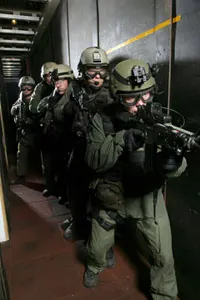
In the United States, the FBI's Hostage Rescue Team is among the confirmed law enforcement users of the MSG90 family, a fitting echo of the counter-terrorism role the PSG1 was built for in the first place.6,5 Competitive shooting teams have also fielded the rifle outside formal military procurement. A Bulgarian army sniper competing at an international NATO sniper competition in Germany used an MSG90-family rifle in a widely reported long-range engagement, though which exact sub-variant he carried is not entirely consistent across sources.10
The most useful comparison for the MSG90 is its own parent, because Heckler & Koch built the MSG90 specifically to solve a procurement problem the PSG1 left unanswered. The PSG1 remained the more accurate and more refined rifle, with its longer 650 mm barrel, heavier reinforced receiver, and hand-fitted trigger group, all aimed at police units buying a handful of rifles at a time. The MSG90 traded a slice of that refinement, a shorter barrel, a lighter stock, a plainer trigger group, for a substantially lower unit price and a weight cut of roughly a kilogram, aimed squarely at militaries buying in larger batches.4,1 The split falls along customer type rather than accuracy ceiling, since both rifles can deliver sub-MOA performance with good ammunition.7
Set against the Soviet-designed SVD Dragunov, the comparison turns on mechanism and role rather than raw numbers. The Dragunov is gas-operated, was designed from the outset as a squad-level marksman's rifle issued down to individual infantry squads, and uses a shorter-range 7.62x54mmR cartridge with a heavier, longer-range bullet profile. The MSG90 is a roller-delayed blowback design descended from a police counter-terrorism rifle, fires the shorter NATO-standard 7.62x51mm round, and has historically equipped special units and select marksmen rather than being issued at squad level across an entire army.3,5
The numbers make the split concrete.4,3,5
| Spec | MSG90 | PSG1 | SVD Dragunov |
|---|---|---|---|
| Barrel length | 600 mm | 650 mm | 620 mm |
| Weight (unloaded) | approx 6.4 kg | 7.2 kg | approx 4.3 kg |
| Muzzle velocity | approx 820 m/s | 868 m/s | approx 830 m/s |
| Cartridge | 7.62x51mm NATO | 7.62x51mm NATO | 7.62x54mmR |

Is the HK MSG90 still in service today Yes, in the sense that many of the militaries and police units that acquired MSG90 rifles from the late 1980s through the 2000s continue to hold and use them, even though Heckler & Koch's own current catalog has moved on to the improved MSG90A2.7,9
What caliber does the HK MSG90 use The MSG90 fires the 7.62x51mm NATO cartridge, the same full-power rifle round used across the wider G3 family and most NATO-standard designated marksman rifles of its generation.4,5
How much does an HK MSG90 cost There is no confirmed original military contract price for the MSG90. On today's civilian collector market in the United States, surviving examples typically trade in the low thousands of dollars, well below the price a comparable PSG1 commands, reflecting the MSG90's original design goal as the cheaper option.11
What is the difference between the MSG90 and the PSG1 The MSG90 is a lightened, cost-reduced military derivative of the PSG1, with a shorter 600 mm barrel instead of 650 mm, a composite rather than wood stock, a Weaver rail instead of a claw scope mount, and roughly a kilogram less weight, all in exchange for the PSG1's slightly higher inherent accuracy ceiling and heavier, more refined construction.4,3
Does the German Bundeswehr use the HK MSG90 Germany's army primarily fielded a related sibling rifle, the MSG3, rather than issuing the base MSG90 to Bundeswehr units directly, while the MSG90 itself went mainly to export customers and to German federal and state police forces.3
- "Heckler & Koch MSG90", Sniper Central — snipercentral.com ↩
- "Heckler & Koch MSG90", Simple English Wikipedia — simple.wikipedia.org ↩
- "Heckler und Koch HK MSG90, HK MSG3 sniper rifle (Germany)", Modern Firearms — modernfirearms.net ↩
- "Shooting The H&K MSG90", The Firearm Blog — thefirearmblog.com ↩
- "Heckler & Koch MSG90", Weaponsystems.net — weaponsystems.net ↩
- "Heckler & Koch HK MSG-90 Semi-Automatic Sniper Rifle / Designated Marksman Rifle (DMR)", Military Factory — militaryfactory.com ↩
- "Heckler & Koch PSG1", Wikipedia — en.wikipedia.org ↩
- "PSR-90", Wikipedia — en.wikipedia.org ↩
- "H&K MSG90", NamuWiki — en.namu.wiki ↩
- "H&K MSG90 sniper rifle, a Bulgarian sniper fired the impossible shot with it", Bulgarian Military — bulgarianmilitary.com ↩
- "Heckler & Koch MSG90 Rifle", Firearms Bulletin — firearmsbulletin.com ↩