


The Heckler & Koch G28 is a 7.62×51mm NATO semi-automatic designated marksman rifle built by Heckler & Koch of Oberndorf am Neckar, Germany, and issued to the Bundeswehr since 2011. It exists because the standard 5.56×45mm Heckler & Koch G36 rifle could not reach or penetrate as far as German infantry needed in Afghanistan, a gap that had already pushed Fallschirmjäger paratroop units to dig out older G3-based rifles as an improvised fix.1 Heckler & Koch answered that gap by adapting its existing 7.62mm Heckler & Koch HK417 battle rifle rather than designing a new weapon from scratch, giving the G28 roughly 75 percent parts commonality with the HK417 while adding a steel upper receiver, a dedicated optics package, and a formal accuracy warranty aimed squarely at the designated-marksman role.2
- 1.5 MOA accuracy guarantee for a general-issue rifle
- Short-stroke piston tolerates neglect better than direct impingement
- Two-position gas regulator supports subsonic/suppressed fire
- 75% parts commonality with the combat-proven HK417
- Won a formal US Army contract (CSASS) against domestic rivals
- Semi-automatic only, no select-fire suppressive option
- Standard-configuration weight (over 7 kg scoped) is heavy for foot patrols
- No confirmed non-German state operator despite online claims
- Bundeswehr per-unit procurement cost was never disclosed
The Heckler & Koch G28 is a direct member of the wider designated marksman rifle category and shares its basic operating layout, gas-operated with a rotating bolt, with the older battle rifles that preceded modern DMRs, including the HK417 itself. Bundeswehr procurement documents originally labeled the weapon DMR762 (Designated Marksman Rifle, 7.62mm) before the G28 service designation was formally assigned.3 Heckler & Koch received its first production order in August 2011, for 560 rifles, and the design later became the direct technical basis for the United States Army's M110A1 program, fielded in two separate configurations, the M110A1 CSASS and the M110A1 SDMR.4 Both are built on the G28's gas-piston action and share much of its parts set.
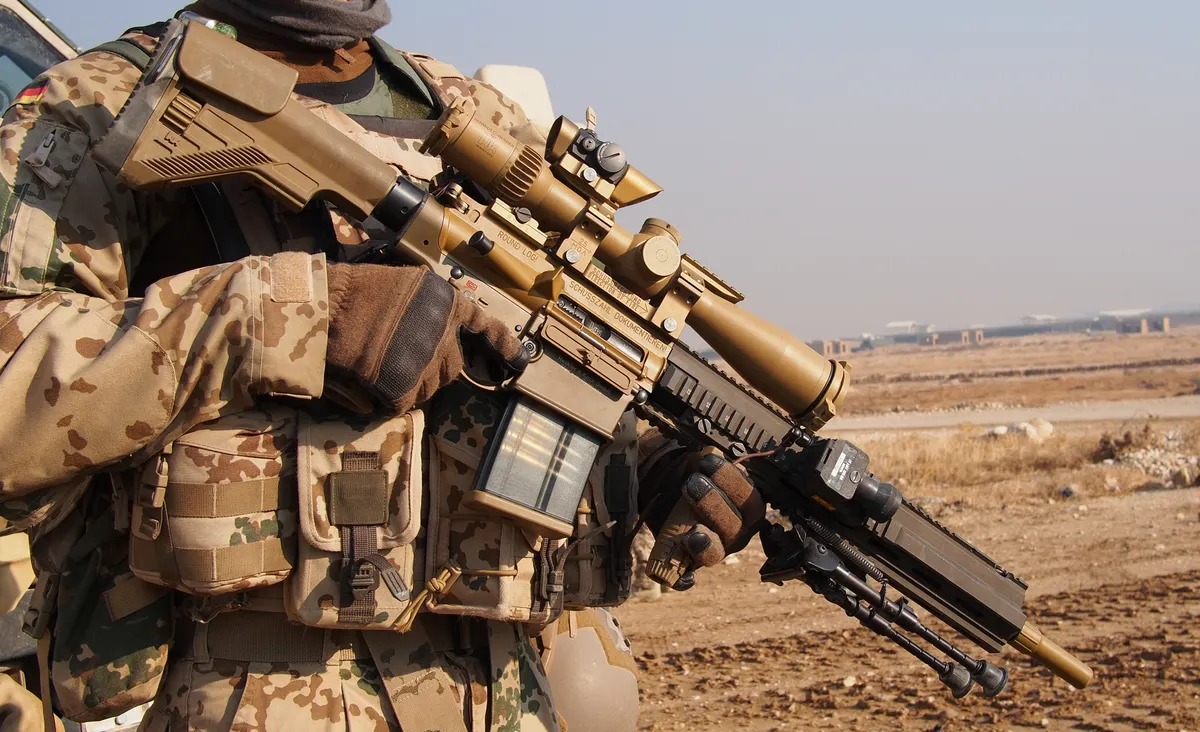
Where the Heckler & Koch G28 differs most from the parent HK417 is intent rather than mechanism. The HK417 is a select-fire battle rifle meant for general infantry use, while the G28 is deliberately semi-automatic only and warranted to a specific accuracy standard, the same split in role that separates the American SR-25 from a standard AR-10 pattern rifle. HK's own civilian MR308 rifle, a semi-automatic HK417 derivative sold to sport shooters, supplied the accuracy data HK then carried over into the military G28's warranty.2 The rifle's caliber, its 7.62×51mm NATO chambering, its manufacturer, and its designated-marksman role recur throughout German small-arms procurement discussions of the last decade, and the Heckler & Koch G28 remains the Bundeswehr's standard 7.62mm semi-automatic marksman rifle today.
Short-Stroke Gas Piston and the AR-10-Pattern Rotating Bolt
The Heckler & Koch G28 fires from a semi-automatic, gas-operated action built around a short-stroke gas piston with a two-position gas regulator, a system HK carried over almost unchanged from the HK417.3 A multi-lug rotating bolt locks into the barrel extension in the same AR-10/AR-15-derived pattern used on the HK417 and, further back, on the American SR-25. The gas regulator's two positions let a shooter select between standard supersonic ammunition and subsonic loads, the latter intended for suppressed fire.4 Ammunition feeds from a 10 or 20-round translucent-polymer detachable magazine, and the trigger breaks at 25 to 32 newtons, heavier than a typical service rifle trigger, a deliberate choice for a weapon meant to be fired deliberately rather than rapidly.
- İlk Üretim Yılı2011
- Hizmete Giriş Yılı2012
- TasarımcıHeckler & Koch GmbH
- Ağırlık (Boş)5,8 kg
- Ağırlık (Yüklü)7,1 kg
- Halen HizmetteEvet
Steel Upper Receiver and the HK417 Parts Commonality
The most consequential change HK made when adapting the HK417 into the G28 was swapping the standard aluminum-alloy upper receiver for a steel upper receiver, paired with the existing aluminum-alloy lower.2 Steel holds tighter dimensional tolerances under repeated firing and heat cycling than aluminum, which is exactly what a rifle warrantied to a specific accuracy figure needs. HK quotes roughly 75 percent parts commonality between the Heckler & Koch G28 and the standard HK417, a figure worth stating plainly as a measure of shared parts rather than as any kind of descent, since the G28 is best understood as a precision-oriented adaptation of the HK417's existing gas-piston platform rather than a separate design.2 The barrel is free-floating, cold-hammer-forged, chrome-lined, and cut with four-groove right-hand-twist rifling, and every production G28 is contractually guaranteed to shoot 45mm or better for a 10-shot group at 100 meters (roughly 1.5 MOA) using match-grade ammunition.3
- Fişek7.62x51mm NATO
- Çap7,62 mm
- Çap SınıfıFull-power rifle
STANAG 4694 Rail and the Standard Optics Package
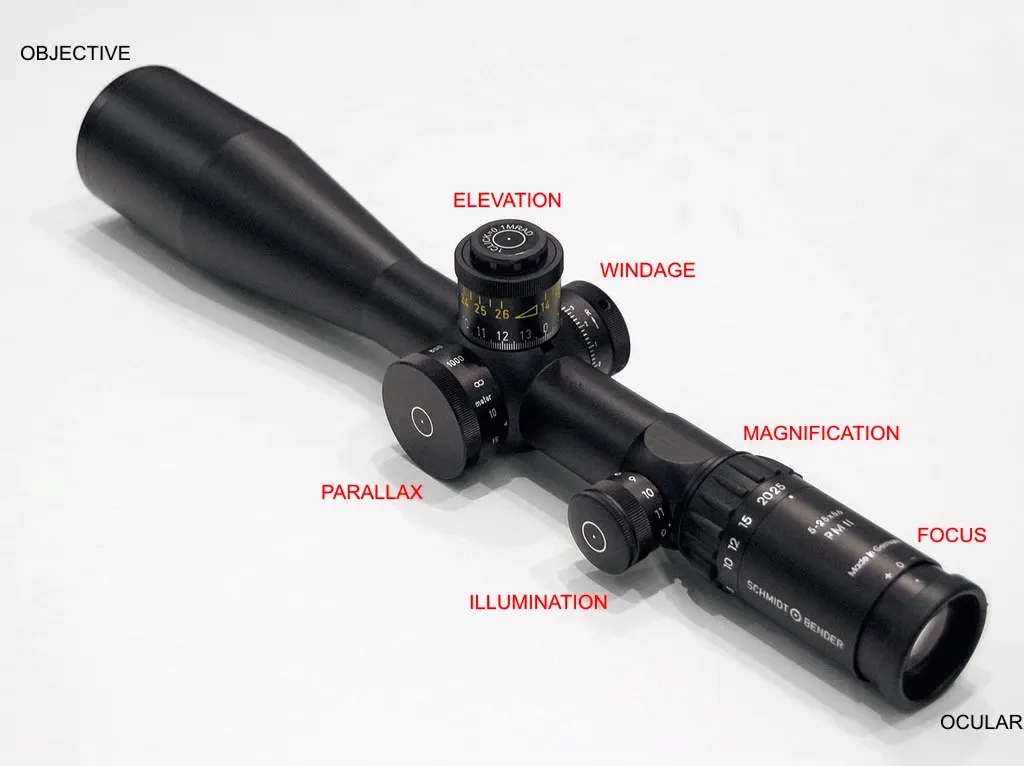
The Heckler & Koch G28 mounts a full-length STANAG 4694 NATO Accessory Rail, backward-compatible with standard Picatinny optics and accessories, running the length of the receiver with additional rail sections on the forend.3 The standard-configuration G28 pairs that rail with a Schmidt & Bender PM II 3-20×50 day scope on an ERA-TAC mount, typically fitted with a piggyback Aimpoint Micro T1 red-dot for close-range engagement, and Bundeswehr units have also fielded the CNVD-T3 clip-on night-vision device on the same rail.5 Overall length runs from roughly 910mm to 1082mm depending on stock extension, with a 420mm barrel, and published weight figures vary by source and configuration, from about 5.8kg bare to 7.7kg scoped and loaded, reflecting the difference between a bare receiver and a fully accessorized combat-ready rifle.3 An adjustable-length-of-pull, adjustable-cheek-piece buttstock and a folding bipod are standard equipment.
- Mekanizma TipiGazlı
- Seçmeli AtışHayır
- Besleme SistemiÇıkarılabilir Şarjör
- Şarjör Kapasitesi20
- Tetik TipiSingle-stage, 25-32 N pull
- Namlu Çıkış Hızı780 m/sn
- Namlu Enerjisi2.950
- Etkili Menzil (nokta)600 m
- Azami Menzil800 m
- İsabet1,5
- Namlu Uzunluğu420 mm
- Yiv Sayısı4
- Nişangah TipiSchmidt & Bender PM II 3-20x50 (E2); 1-8x24 (E3 Patrol)
- Optik RayıEvet
- Toplam Uzunluk965 mm
- Gövde Malzemesi (Receiver)Steel upper receiver, aluminum-alloy lower
- Entegre BipodEvet
- Gaz PistonluEvet
The Afghanistan Range Gap That Created the Program
The Heckler & Koch G28's origin traces directly to Bundeswehr combat experience in Afghanistan in the mid-to-late 2000s. German infantry armed with the 5.56mm G36 found themselves outranged by opposing fighters using older 7.62mm-class weapons and by the sheer terrain distances of the War in Afghanistan, where engagements routinely opened beyond the G36's practical range.1 Fallschirmjäger paratroop units responded on their own initiative by pulling older, refurbished G3ZF rifles, accurized G3 battle rifles with scopes, back into a designated-marksman (ZF-Schütze) role as a stopgap measure while HK developed a purpose-built replacement.1 Before the G28 was ready, some German units were issued the existing military HK417 under the interim designation G27, and it was only after that stopgap phase that a specifically accuracy-warrantied version, the Heckler & Koch G28, entered the picture.2
From Order to the Field, 2011 to 2012
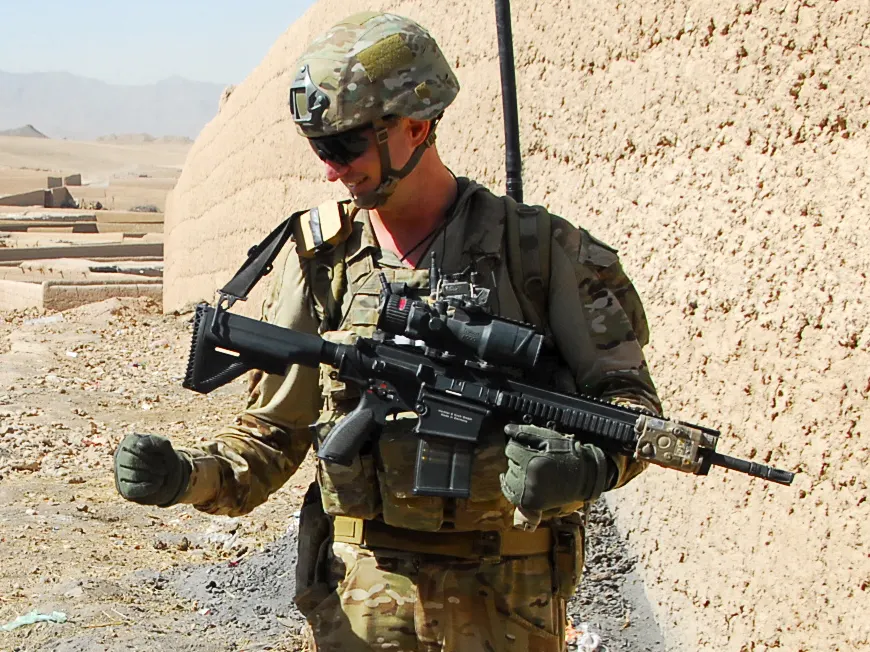
Heckler & Koch received its first production order for the Heckler & Koch G28, 560 rifles, in August 2011, with SPARTANAT's original public announcement of the program dated 14 October 2011.6 That announcement framed Germany as following other NATO members, including the Netherlands, Norway, and France, that had already adopted comparable 7.62mm designated-marksman concepts of their own.6 Rifles reached combat troops through an urgent operational requirement channel, arriving with Afghanistan-bound units by late 2011 or early 2012, with a wider Bundeswehr-wide rollout following through 2012 intended to replace the older G3-based G3 SG1 sniper and marksman rifles army-wide.1 Sources are not fully consistent on exact dates, ordered in 2011, fielded to Afghanistan-deploying troops in 2011 and 2012, and adopted more broadly across the Bundeswehr from around 2012 onward is the safest summary.
The Heckler & Koch G28's cultural footprint outside German military circles is mostly digital. The rifle appears, under various names, in several commercially released video games.
War in Afghanistan
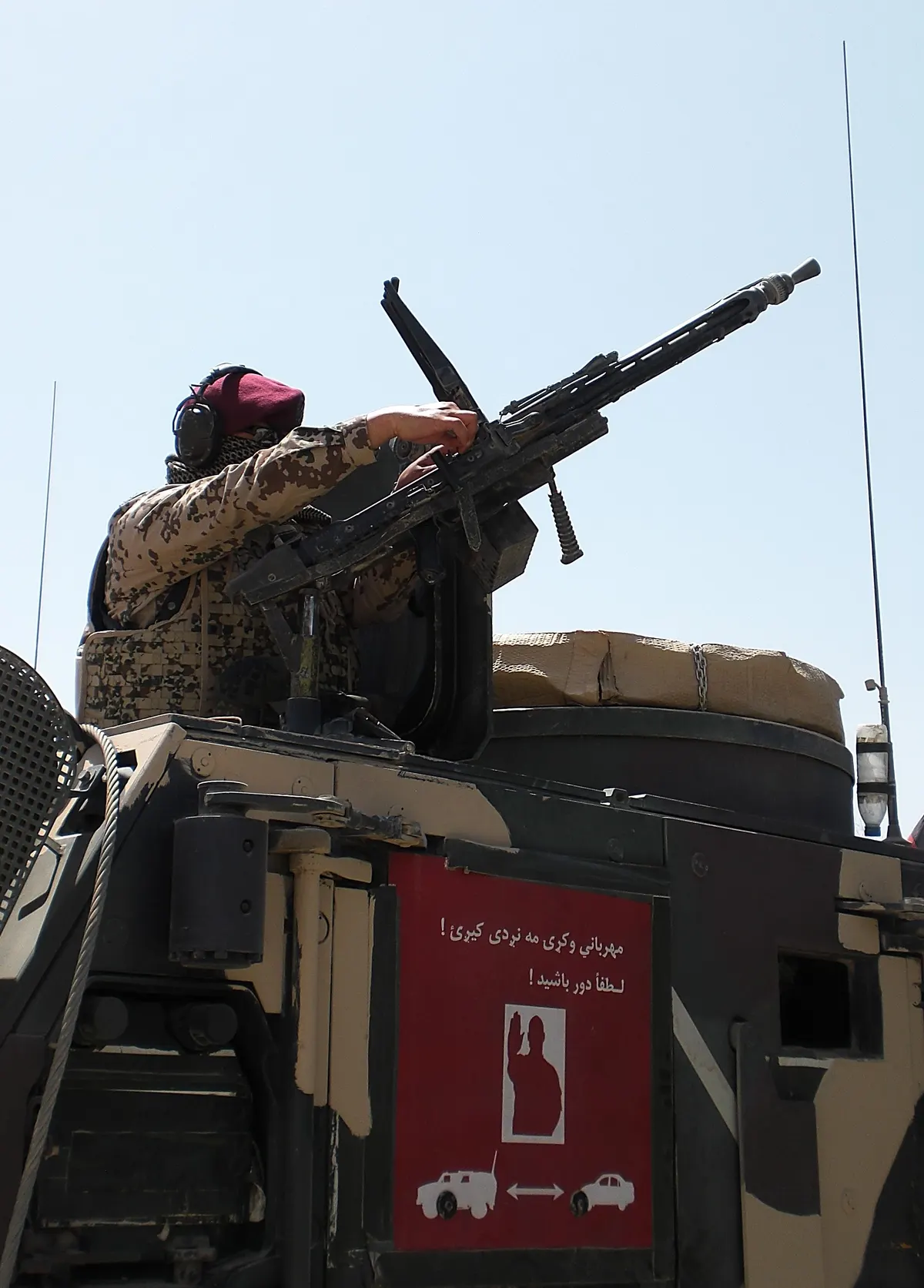
The War in Afghanistan is the only conflict in which Heckler & Koch G28 combat use is well documented. The rifle was developed specifically for that deployment and equipped Fallschirmjäger and infantry designated-marksman teams from 2011 and 2012 onward, used against enemy sniper positions, individual high-value targets, and optics-equipped vehicles out to the rifle's 600m effective and 800m maximum-suppressive range figures.1 No independent, named-engagement combat account of the Heckler & Koch G28 in a specific firefight has been found. In particular, the well-documented 2 April 2010 Karfreitagsgefecht (Good Friday Battle) at Isa Khel, one of the Bundeswehr's most intense Afghanistan engagements, predates the G28's fielding by over a year and was fought with older G3-based sniper rifles, not the G28, a distinction worth stating explicitly since the two are sometimes conflated in secondary sources.1
A Bundeswehr deployment to Mali under the MINUSMA mission is a plausible additional venue for the Heckler & Koch G28 given the rifle's status as standard Bundeswehr issue by the time that mission began, but no source directly documents G28 use in Mali, so that connection should be treated as unconfirmed rather than asserted as fact.
G28 E2 (Standard) and E3 (Patrol)
The baseline G28 E2 configuration carries a long forend, folding bipod, adjustable cheek-piece stock, and the Schmidt & Bender PM II 3-20×50 day scope, the setup issued for longer-range designated-marksman work.3 The G28 E3, marketed as the Patrol configuration, trims roughly 1.9kg off the standard rifle's weight with a shorter forend, a simplified buttstock, and a smaller Schmidt & Bender PM II 1-8×24 scope, intended for closer-range and urban patrol use where the longer E2 setup is unwieldy.3
G28Z, HK243, and the HK241 Export Name
Heckler & Koch also sells civilian semi-automatic derivatives of the same basic rifle in Germany under the G28Z or HK243 names, and markets the whole family internationally under the HK241 commercial designation adopted around October 2017, all built on the same steel-upper HK417-derived receiver as the military Heckler & Koch G28.4
The G28E and the US Army's M110A1 Programs
Heckler & Koch entered a lightened, export-oriented variant called the G28E into the US Army's Compact Semi-Automatic Sniper System (CSASS) competition, fitted with an octagonal KeyMod-pattern rail and paired with a baffle-less OSS suppressor.7 HK won that competition on 31 March 2016 under contract W15QKN-16-D-0051, worth up to $44.5 million for as many as 3,643 rifles, beating both incumbent supplier Knight's Armament Company (maker of the older SR-25-based M110) and FN Herstal.7 That contract became the M110A1 CSASS, which saw only limited US Army testing and fielding through 2019 to 2022 before being effectively superseded.
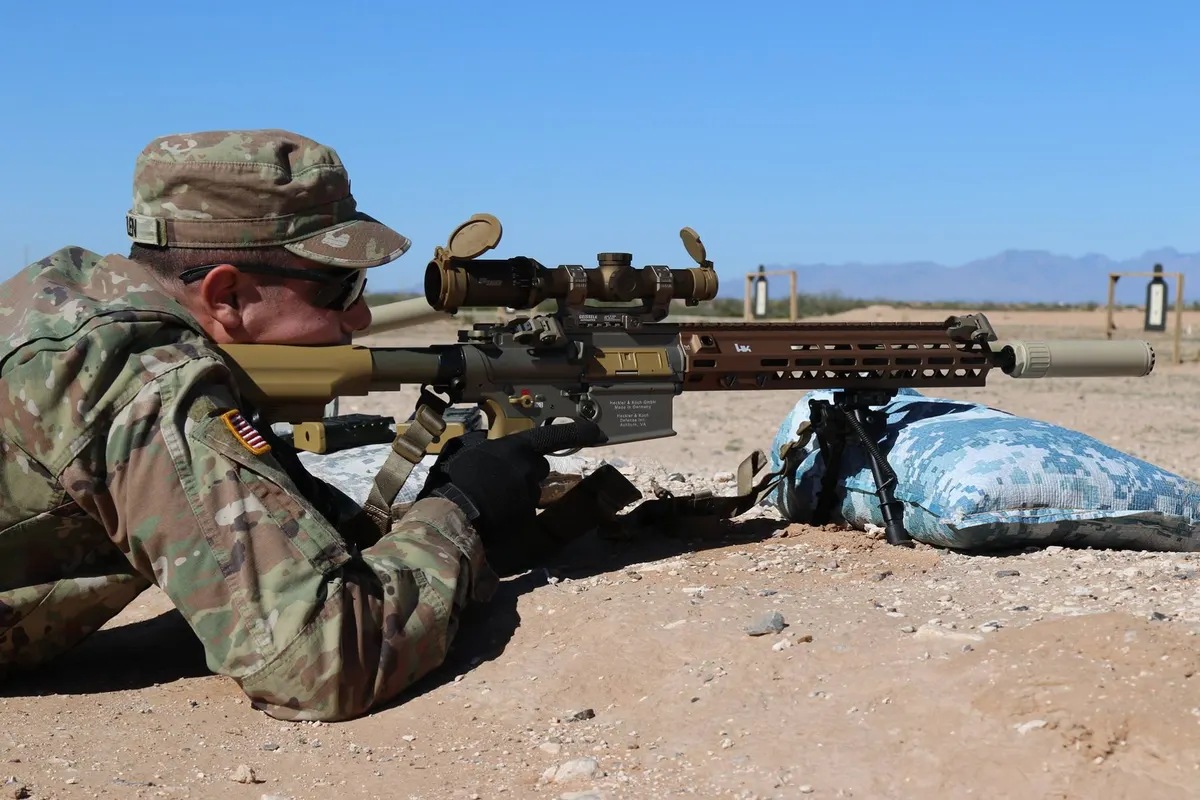
The variant that actually reached large-scale US service is the separate M110A1 Squad Designated Marksman Rifle (SDMR) program. The Army opened that requirement in July 2012, took formal proposals in June 2014, and began fielding roughly 6,000 SDMRs to Army units, including the National Guard, and Air Force units starting in 2020, with fielding expected complete by 2023.8 The M110A1 SDMR pairs the G28/G28E-derived rifle with a SIG Sauer TANGO6 1-6×24 optic rather than the CSASS's Schmidt & Bender scope, and unit cost has been cited at roughly $12,000 per rifle.8

The German Bundeswehr, Germany's armed forces, is the only independently verified state operator of the Heckler & Koch G28. It has issued the rifle to designated-marksman teams, principally within Fallschirmjäger and other infantry units, since the initial 2011 order, and has fielded it as the standard replacement for older G3-based sniper and marksman rifles.1 No other national operator of the G28 itself has been independently confirmed. The related American M110A1 rifles are separately designated US Army and Air Force weapons built on the same design rather than the G28 in foreign service, and are documented under their own entries.
The clearest way to place the Heckler & Koch G28 against its rivals is through what happened when Heckler & Koch tried to sell essentially the same rifle to the United States Army. The G28's steel upper receiver, chosen in Germany to hold tight accuracy tolerances, had to be swapped for an aluminum upper on both American M110A1 variants purely to satisfy a lighter US weight requirement, a rare documented case of a rifle's core material changing not for cost or performance but to meet an importing service's own weight ceiling.7
Mechanically, the Heckler & Koch G28 sits opposite the SR-25-pattern American rifles it competed against. The G28 uses a short-stroke gas piston, while the SR-25 and the older Knight's Armament M110 it descends from use direct gas impingement, the same basic split that separates the HK417 from the original AR-10. A piston system keeps combustion gas and fouling largely out of the receiver, trading some mechanical complexity for easier maintenance in harsh field conditions, a real advantage in the same Afghan terrain that created the demand for both rifles in the first place.
Britain's L129A1, built by Lewis Machine & Tool on the same broad SR-25/AR-10 pattern, presents a different approach again. Where the Heckler & Koch G28 is warrantied for 1.5 MOA specifically with match-grade ammunition, the L129A1 was adopted to fire standard-issue ball ammunition effectively, prioritizing logistics simplicity over the tightest possible accuracy figure. All three rifles, the G28, the M110A1 family, and the L129A1, answer the same 5.56mm range gap that Western forces identified in Afghanistan, but they answer it with different tradeoffs between piston versus direct-impingement reliability, warrantied match accuracy versus service-ammunition simplicity, and (in the G28's case specifically) a steel upper receiver versus the aluminum upper every one of its rivals uses.
| Spec | Heckler & Koch G28 | M110A1 SDMR | L129A1 |
|---|---|---|---|
| Action | Gas-operated, short-stroke piston | Gas-operated, short-stroke piston | Gas-operated, direct impingement |
| Upper receiver | Steel | Aluminum | Aluminum |
| Standard optic | Schmidt & Bender PM II 3-20x50 | SIG Sauer TANGO6 1-6x24 | Trijicon ACOG 6x48 |
| Unloaded weight | ~5.8-7.1 kg | ~3.8 kg | ~4.0 kg |
Every figure in that table is cited in the sections above. The table exists to make the three-way contrast easy to scan, and it does not replace the analysis around it.

How does the Heckler & Koch G28 work? The Heckler & Koch G28 is a semi-automatic, gas-operated rifle using a short-stroke gas piston and a rotating bolt, feeding from a 10 or 20-round detachable magazine in 7.62×51mm NATO.3
Is the Heckler & Koch G28 still in service? Yes. It remains standard Bundeswehr issue as Germany's designated marksman rifle, with the newer HK241 name used for the same design in export and commercial catalogs.4
What is the Heckler & Koch G28's unit cost? No confirmed Bundeswehr per-unit procurement price has been published. The related US M110A1 SDMR variant is cited at roughly $12,000 per rifle, and the civilian G28Z sells for roughly €10,000 to €15,000 in Germany, but neither figure should be read as the German military's own price.8
What caliber does the Heckler & Koch G28 use? 7.62×51mm NATO, the same cartridge used by its parent HK417 and by rival designated marksman rifles like the L129A1 and the M110A1 family.3
Is the Heckler & Koch G28 the same rifle as the M110A1? No, they are related but distinct. The M110A1 CSASS and M110A1 SDMR are separate US Army-designated rifles built on the G28E, a lightened export variant of the Heckler & Koch G28, with an aluminum upper receiver in place of the G28's steel one.7
- "Geschichte des Heckler & Koch G28", GermanGunWorks — germangunworks.com ↩
- "Heckler & Koch HK417", Wikipedia — en.wikipedia.org ↩
- "Heckler & Koch G28", Weaponsystems.net — weaponsystems.net ↩
- "HK G28", Modern Firearms — modernfirearms.net ↩
- "Das Gewehr G28", Bundeswehr — bundeswehr.de ↩
- "G28 für die Bundeswehr", SPARTANAT — spartanat.com ↩
- "BREAKING: H&K Wins CSASS Competition with G28E", TheFirearmBlog — thefirearmblog.com ↩
- "Raiders field new Squad Designated Marksman Rifle", US Army — army.mil ↩