

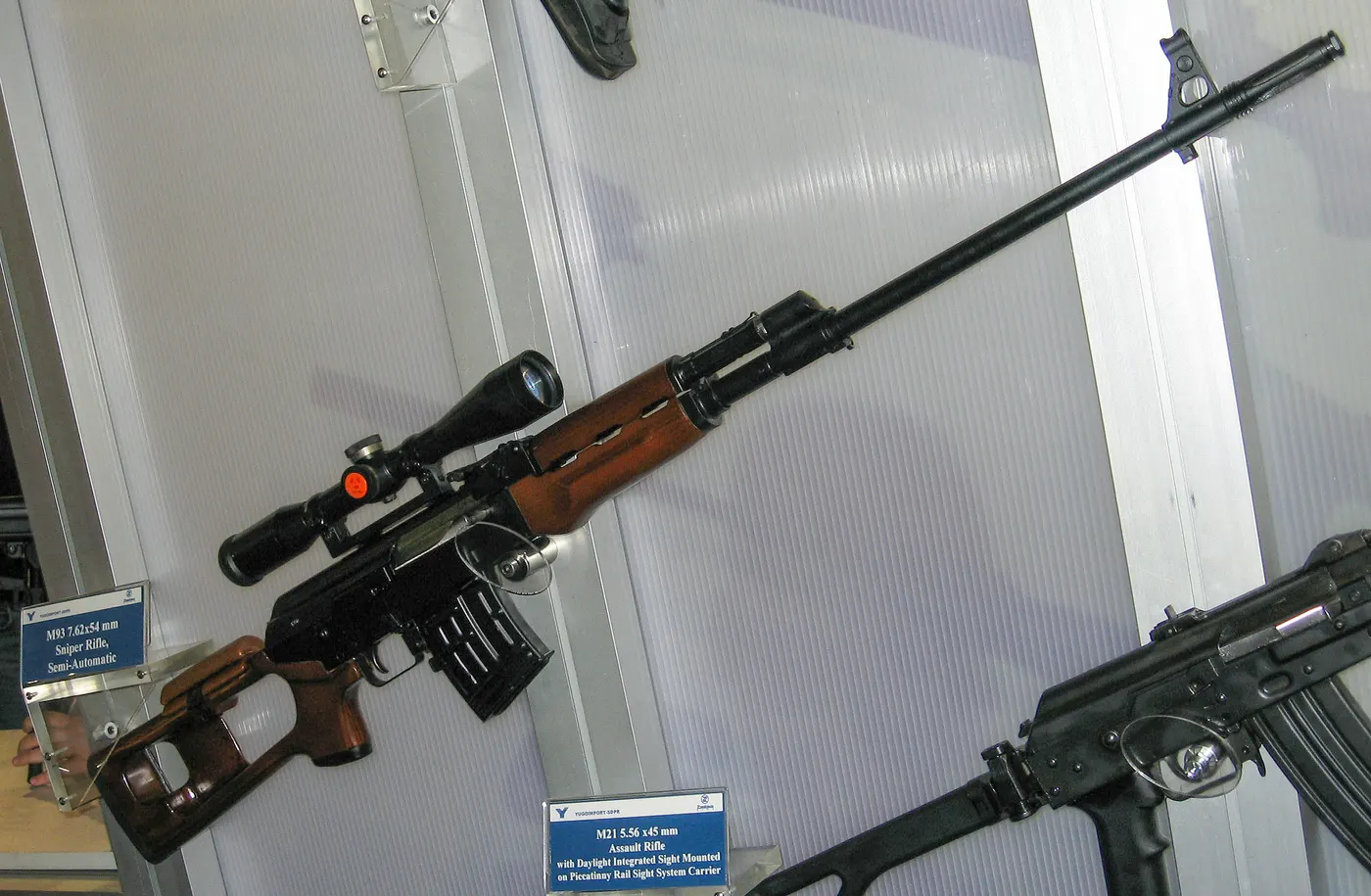

The Zastava M91 is a semi-automatic designated marksman rifle chambered in 7.62x54mmR, built by the Serbian state arms maker Zastava Arms in Kragujevac. It entered Serbian and Yugoslav service in 1992, replacing the older Zastava M76, which had fired the 8x57mm Mauser round inherited from the Yugoslav army's post-war rifle standard.1 Switching to 7.62x54mmR was a deliberate interoperability move, the cartridge is the same one used in the SVD Dragunov and in Warsaw Pact era machine guns, so M91 ammunition draws from the same very widely produced stock as most of the world's ex-Soviet-pattern DMRs.2
- Kalashnikov-pattern reliability and simple maintenance
- Widely available 7.62x54mmR ammunition
- Adjustable gas regulator for weather/fouling conditions
- Cheaper than an authentic Russian SVD on the collector market
- Mechanically less refined accuracy than a true SVD
- 10-round magazine capacity is modest for the DMR role
- Milled-vs-stamped receiver generations complicate spare-parts compatibility
- Thin combat-effectiveness documentation outside Serbia
Mechanically the Zastava M91 is closer to an AK-47 scaled up for a bigger cartridge than it is to an actual Dragunov. It runs a long-stroke gas-operated piston, the same operating principle as a standard Kalashnikov rifle, rather than the short-stroke piston the real SVD uses.3 What it borrows visually from the SVD is the silhouette, a slim thumbhole stock, a side-rail scope mount, and a similar muzzle brake, which is why collectors and reviewers alike describe it as an SVD look-alike wearing an AK's internals.3,4 As one of the more accessible DMRs available on the Western commercial market under the PAP M91 designation, it also functions as many shooters' first hands-on exposure to the whole SVD-pattern rifle family, without the cost of an original Russian gun.5
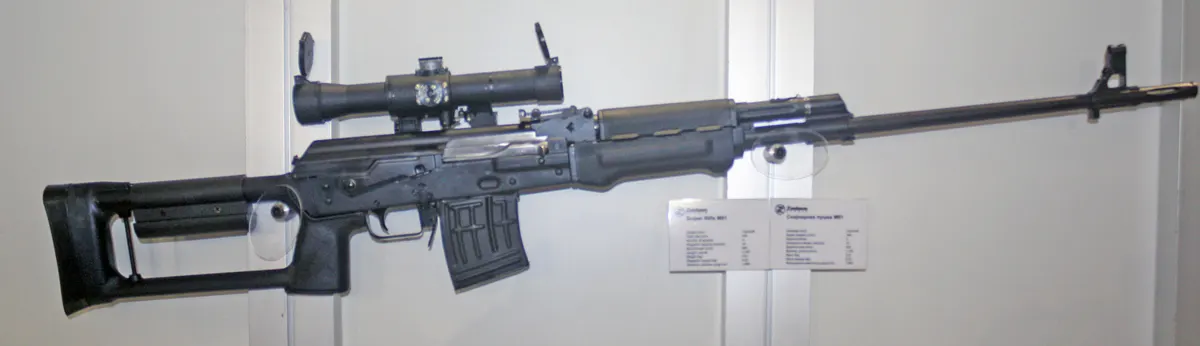
The Zastava M91 is sometimes confused with its far more numerous cousin, the Romanian PSL, another SVD look-alike that is also internally a scaled-up Kalashnikov action rather than a true Dragunov clone.4 Unlike the PSL, which sold in large numbers on the US market for decades, the M91 arrived commercially later and in smaller volume, with Zastava Arms USA only formally importing it as the PAP M91 around 2019 to 2020.5 Total production is comparatively modest, with roughly 4,000 units built by 2012 according to manufacturer figures, a small run next to the tens of thousands of PSLs Romania exported.6
A Milled Rifle That Became a Stamped One
Early production Zastava M91 rifles used a milled steel receiver, following the same heavier construction as the M76 before it. Production shifted to a stamped steel receiver with a reinforced, bulged trunnion around 2012, alongside a move from wood furniture to black synthetic polymer.6,7 The modern thumbhole stock, molded in polymer with an adjustable cheek piece, replaced the separate pistol grip and buttstock arrangement the M76 used, and the handguard gained top and bottom Picatinny rail sections for optics, lights, and an optional bipod.4,6 None of this changes the basic operating system, the M91 keeps its long-stroke piston and rotating bolt throughout every production era.3
- İlk Üretim Yılı1992
- Hizmete Giriş Yılı1992
- Ağırlık (Boş)5,49 kg
- Halen HizmetteEvet
- Önemli KullanıcılarSerbian Armed Forces, Iraqi Zeravani/Peshmerga forces, Syrian Army and opposition factions, Yemeni Southern Resistance forces, Myanmar Army (via the locally produced MAS-1 Mk II derivative)
Barrel, Gas System, and the 7.62x54mmR Chambering
The barrel measures 620 mm (24.4 in), cold-hammer-forged with a chrome-lined bore for corrosion resistance and longer service life.2,8 Four grooves with a 240 mm rifling twist stabilize the 7.62x54mmR bullet, and a separate export chambering in 7.62x51mm NATO is offered with a different twist rate for commercial buyers who want a NATO-standard cartridge instead.2 Muzzle velocity is reported at roughly 790 m/s for the 7.62x54mmR service round, and around 840 m/s for the lighter 7.62x51mm NATO loading, sources vary on the exact figures depending on ammunition tested.2,8 The M91 includes an adjustable gas regulator with three settings, for hot weather, normal conditions, and cold or fouled conditions, a detail carried over from AK-pattern rifles generally rather than something the SVD itself has.4,5
- Fişek7.62x54mmR
- Çap7,62 mm
- Kovan Uzunluğu54 mm
- Çap Sınıfıfull-power rifle cartridge
Sights and Optics
Iron sights consist of a hooded post front sight and an adjustable rear sight graduated from 100 m out to 1,000 m, mounted on the same style of tangent assembly used across Zastava's Kalashnikov-pattern rifles.1,2 A side-rail mount on the left side of the receiver, again a direct visual echo of the SVD, accepts the standard ZRAK ON-M91 6x42 daylight telescopic sight or a POSP 4x24 scope with a bullet-drop compensating reticle calibrated for 7.62x54mmR.1,8 The rifle also has a threaded muzzle and is suppressor-ready on the military configuration, while the civilian export PAP M91 deletes the bayonet lug and flash hider, welding a plain thread-protector nut over the muzzle threads to comply with import rules.5,9
- Mekanizma TipiGazlı
- Atış ModlarıSemi-automatic only
- Seçmeli AtışHayır
- Besleme SistemiÇıkarılabilir Şarjör
- Şarjör Kapasitesi10
Accuracy is where the design compromise shows most clearly. Zastava's own manual states a factory acceptance standard of an 8 cm five-shot group at 100 m (roughly 2.75 MOA), while some individual range tests report tighter groups closer to 1.5 to 2 MOA with quality ammunition.4,8 Either figure sits behind the closer-to-1 MOA standard commonly quoted for an original Russian SVD, a direct consequence of the M91's AK-derived action rather than a flaw in manufacturing quality.3,4 Best practical results on the Zastava M91 are generally reported out to about 800 m with optics, against a theoretical maximum range of 1,000 m.1,2
- Namlu Çıkış Hızı790 m/sn
- Etkili Menzil (nokta)800 m
- Azami Menzil1.000 m
- Nişan Menzili1.000 m
- İsabet2,75
- Namlu Uzunluğu620 mm
- Yiv Adımı240 mm (7.62x54mmR) or 254 mm (7.62x51mm NATO export chambering)
- Yiv Sayısı4
- Nişangah TipiHooded post front sight and tangent rear sight adjustable 100-1000 m, plus a side-rail mount for a ZRAK ON-M91 6x42 or POSP 4x24 telescopic sight
- Optik RayıEvet
- Açık NişangahEvet
- Dişli NamluEvet
- Toplam Uzunluk1.200 mm
- Gövde Malzemesi (Receiver)Milled steel (pre-2012 production), stamped steel with reinforced trunnion (2012-present production)
- Kabza/Dipçik MalzemesiBlack synthetic polymer thumbhole stock with adjustable cheek piece (wood on earliest production)
- Katlanır / Toplanır DipçikHayır
- Bullpup DüzeniHayır
- Çift Yönlü KumandalarHayır
- Susturucuya HazırEvet
- Süngü TakozuEvet
- Entegre BipodHayır
- Bombaatar KabiliyetliHayır
- Gaz PistonluEvet
- Toplam Üretim4.000
- Üretim Başlangıcı1992
- Varyantlar4
Yugoslavia began developing the M91 in 1991, in the middle of the country's violent breakup, as a planned replacement for the M76 semi-automatic rifle that had served since the 1970s.1 The M76's 8x57mm Mauser chambering had made sense when Yugoslavia stood apart from both NATO and the Warsaw Pact, but by the early 1990s the newly formed Serbia-led rump state needed a marksman rifle firing a cartridge it could source more easily, and 7.62x54mmR, common across the former Eastern Bloc, fit that need.1,2 The rifle was formally adopted in 1992.1,4
Combat use in the earliest years is thin and contested. Some accounts describe limited numbers of pre-production M91 rifles reaching Bosnian Muslim forces during the Yugoslav wars, described as early field testing rather than a formal fielding, and this claim should be treated with caution given how little independent documentation exists for it.4 What is better documented is Serbian and Yugoslav army use of the rifle during the Kosovo War of 1998 to 1999, by which point the M91 had been in frontline service for several years.1
Zastava modernized production again around 2012, moving to the stamped-receiver, polymer-stocked configuration that remains current.6,7 The commercial and export side of the story developed later still, Zastava Arms USA introduced the semi-automatic PAP M91 to American buyers, showcased publicly at the SHOT Show trade event in January 2020, giving the design a second life as a civilian sporting and long-range shooting rifle far from the battlefield it was designed for.5,9
Serbian use of the Zastava M91 during the Kosovo War represents its clearest early combat record, fielded by Yugoslav army and Serbian police units engaged against the Kosovo Liberation Army in Kosovo and later against NATO-backed Kosovo Albanian forces.1 Outside the Balkans, the M91's combat footprint runs through several conflicts where 7.62x54mmR Kalashnikov-pattern rifles are common regardless of country of manufacture.
In the Syrian Civil War, the M91 has turned up in the hands of both the Syrian government army and opposition factions since the fighting escalated in the 2010s, part of the wider flow of ex-Yugoslav and Eastern Bloc small arms into that conflict.4,10 In the Yemeni Civil War, Southern Resistance factions fighting the Houthi movement have fielded the rifle, again as one weapon among the varied mix of Kalashnikov-pattern arms circulating through that theater.4,10 In Iraq, the Zeravani, the militarized gendarmerie wing of the Kurdistan Regional Government's Peshmerga forces, has used the M91 as a designated marksman rifle in operations including the campaign against the Islamic State.11
The clearest production-era split is the milled-receiver, wood-furniture M91 built from 1992 into the early 2010s, versus the stamped-receiver, polymer-furniture M91 that followed the 2012 manufacturing update.6,7 Both variants share the same 7.62x54mmR chambering, barrel length, and long-stroke gas-operated action.
A separate commercial branch chambers the rifle in 7.62x51mm NATO instead of the Russian round, aimed at buyers who want a familiar NATO-standard cartridge, and carries a different twist rate and groove count to suit that ammunition.2 The PAP M91, Zastava Arms USA's importer designation for the American civilian market, strips the bayonet lug and flash hider required on the military-configuration rifle, tack-welding a thread-protector nut over the muzzle threads instead to satisfy US import point requirements.5,9
Myanmar's domestic arms industry produces a derivative it designates the MAS-1 Mk II, a locally manufactured 7.62mm marksman rifle closely following the M91's external layout, though it is unclear whether this reflects a formal license from Zastava Arms or an independently reverse-engineered copy, and Myanmar's rifle should be treated as a distinct, related weapon rather than an imported M91 itself.12,13


Serbia remains the Zastava M91's primary and largest operator, fielding it continuously since the 1992 adoption as the standard semi-automatic marksman rifle of the Serbian armed forces.1,4

Beyond Serbia, confirmed operators include Syria, where both government and opposition forces have fielded the rifle amid the long civil war, Yemen, where Southern Resistance units have used it against Houthi forces, and Iraq, through the Zeravani gendarmerie component of the Kurdistan Regional Government's Peshmerga.4,10,11 Myanmar fields its locally produced MAS-1 Mk II derivative rather than an imported Zastava-built rifle, a distinction worth keeping separate from true M91 export sales.12,13
The Zastava M91's defining rivalry is with the very rifle it was built to resemble, the Russian SVD Dragunov. Both fire 7.62x54mmR from a 10-round magazine and share a broadly similar silhouette, but the resemblance stops at the operating system. The SVD uses a shorter-stroke gas piston purpose-built for a marksman rifle, contributing to its tighter roughly 1 MOA accuracy standard, while the Zastava M91 runs a long-stroke Kalashnikov action scaled up from an ordinary AK-47, trading some mechanical precision for the extreme parts commonality and reliability the Kalashnikov system is known for.3,4 In practice this makes the M91 the more rugged and easier to maintain of the two designs, while the SVD keeps the edge in pure precision.
| Spec | Zastava M91 | SVD Dragunov |
|---|---|---|
| Cartridge | 7.62x54mmR | 7.62x54mmR |
| Action | Long-stroke gas piston (AK-derived) | Short-stroke gas piston |
| Magazine capacity | 10 rounds | 10 rounds |
| Accuracy standard | ~2.75 MOA (factory) | ~1 MOA |
| Barrel length | 620 mm | 620 mm |
A closer design cousin than the SVD is Romania's PSL, which follows the same basic idea, an AK-pattern action dressed in Dragunov-style furniture, and reached far larger production numbers and a much longer US commercial import history than the M91 ever achieved.4,5 Where the Zastava design differs is in refinements like the stamped-versus-milled receiver generations and its adjustable three-position gas regulator, giving the M91 a slightly more modern feature set than the older PSL pattern even though both trail a true SVD on paper accuracy.4,6
Whether the Zastava M91 is still worth choosing today depends heavily on the buying context. For Serbia and its existing user base, the rifle remains the standard in-service semi-automatic marksman rifle with no announced replacement program. For a civilian or collector market buyer asking whether an M91 or an SVD makes more sense, the answer usually comes down to budget and legality, an original Russian SVD is difficult and expensive to import into most markets, while the Zastava M91, sold as the PAP M91, offers a legally importable, mechanically related alternative at a fraction of the cost.5,9


What caliber is the Zastava M91 chambered in?
The Zastava M91 is chambered in 7.62x54mmR, the same rimmed cartridge used in the SVD Dragunov and a wide range of former Eastern Bloc machine guns, with a separate commercial variant offered in 7.62x51mm NATO.1,2
Is the Zastava M91 still in service?
Yes. The Zastava M91 remains in active service with the Serbian armed forces as of the current production era, and continues in use with several other forces in the Middle East, including Syrian and Iraqi Zeravani units.1,4,11
How much does a Zastava M91 cost?
Commercial PAP M91 rifles imported by Zastava Arms USA have listed for around 3,500 US dollars at retail, though this civilian sporting-rifle price does not reflect military procurement cost, which is not publicly disclosed.9
What is the difference between the Zastava M91 and the SVD Dragunov?
The core difference is internal. The SVD Dragunov uses a purpose-built short-stroke piston system, while the Zastava M91 uses a long-stroke, AK-47-derived action scaled up for the 7.62x54mmR cartridge, giving the M91 more Kalashnikov-style ruggedness at some cost to mechanical accuracy.3,4
Who manufactures the Zastava M91?
The Zastava M91 is manufactured by Zastava Arms, the Serbian state-owned arms company based in Kragujevac, which also built the M91's predecessor, the Zastava M76.1,2
- "Zastava M91", Wikipedia — en.wikipedia.org ↩
- "Sniper Rifle M91", Zastava Arms — zastava-arms.rs ↩
- "Zastava M91: Serbia Modernizes its DMR to 7.62x54R", Forgotten Weapons — forgottenweapons.com ↩
- "Zastava M91 Sniper Rifle, A Military DMR For The Commercial Market", Gun Digest — gundigest.com ↩
- "SHOT 2020, Zastava Arms M91 Rifle (7.62x54R) and ZPAP85 Pistol (5.56x45)", The Firearm Blog — thefirearmblog.com ↩
- "Zastava M91", AK Operators Union Local 47-74 — akoperatorsunionlocal4774.com ↩
- "Zastava M91 trigger and issued parts", The AK Forum — theakforum.net ↩
- "Zastava M91", Weaponsystems.net — weaponsystems.net ↩
- "Range Review, Zastava M91 in 7.62x54mmR", Zastava Arms USA — zastavaarmsusa.com ↩
- "Zastava M91", Grokipedia — grokipedia.com ↩
- "List of equipment of the Peshmerga", Wikipedia — en.wikipedia.org ↩
- "List of equipment of the Myanmar Army", Wikipedia — en.wikipedia.org ↩
- "Myanmar Directorate of Defence Industries", Wikipedia — en.wikipedia.org ↩