


The Type 85 sniper rifle is a Chinese-made designated marksman rifle chambered in 7.62x54mmR, built by the state manufacturer Norinco as the finalized, reliability-fixed successor to the earlier Type 79 Sniper Rifle. Both rifles trace back to a single Soviet SVD Dragunov sample that Chinese forces captured and reverse-engineered after clashes with Vietnam in the late 1970s, and the Type 85 keeps almost all of that parent design's gas-operated short-stroke piston system, its 10-round detachable-magazine, and its overall silhouette.1,4 Design work on the improved rifle finished in 1985, giving the weapon its designation, and it began reaching Chinese troops in 1987.1
- Fixes the Type 79's firing pin breakage problem
- Proven, simple short-stroke gas piston action shared with the SVD
- Wide compatibility with widely stocked 7.62x54mmR ammunition
- Retained iron sights alongside the telescopic sight for backup use
- No dedicated match-grade sniper cartridge was ever issued alongside it
- Effective range trails the Soviet SVD it was copied from
- Fixed wooden stock offers little of the ergonomic adjustment modern DMRs provide
- Superseded in frontline PLA service by the newer QBU-88
Where the Type 85 actually differs from the Type 79 is narrower than the model-number jump suggests. Chinese engineers spent the years between 1981 and 1985 correcting two specific manufacturing defects that had embarrassed the earlier rifle, a firing pin prone to breaking and a copied telescopic sight that could not reliably survive the 7.62x54mmR cartridge's recoil.1,13 The People's Liberation Army never issued the Type 85 broadly to regular infantry, instead concentrating it with special-operations units, the People's Armed Police, and border-guard detachments, a distribution pattern more typical of a specialist marksman tool than a standard-issue rifle.1,3
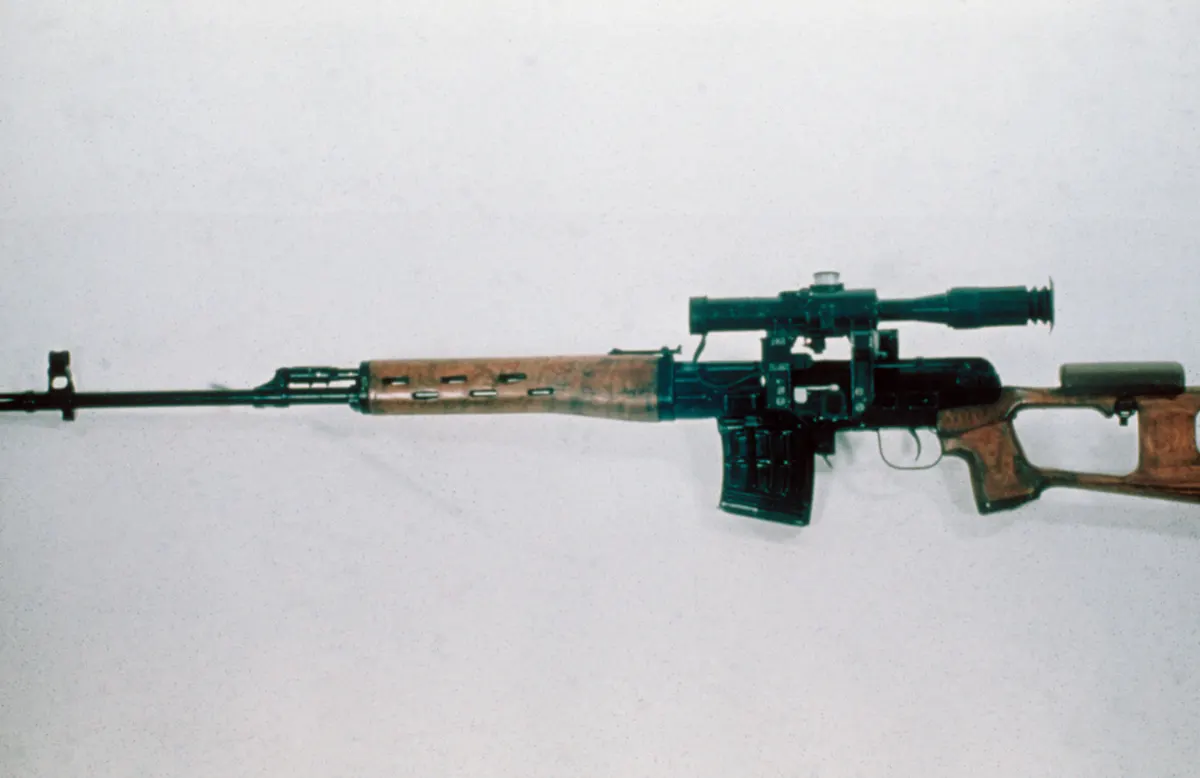
Externally the Type 85 sniper rifle is difficult to tell apart from the Soviet SVD Dragunov at a glance. It keeps the same skeletonized wooden stock, the same side-mounted scope rail carrying a fixed 4x optical sight copied from the Soviet PSO-1, and the same overall length of roughly 1,220 mm.4,13 The real story of the Type 85 sniper rifle is less about outward appearance and more about a Chinese small-arms industry learning, over one very public failure and one quieter fix, how to reproduce a precision weapon its factories were not originally tooled to build. That struggle also explains why the rifle sits inside the broader DMR category as a semi-automatic marksman's rifle rather than a true bolt-action sniper weapon, following the SVD's own philosophy of trading some ballistic precision for a sustained rate of aimed fire.
The 7.62x54mmR Cartridge and an Accuracy Ceiling China Never Solved
The Type 85 sniper rifle fires the rimmed 7.62x54mmR cartridge, the same round used in Soviet and Chinese general-purpose machine guns, at a muzzle velocity commonly cited around 830 m/s.4,13 That shared chambering was also the rifle's biggest handicap. The Soviet Union issued the SVD with dedicated 7N1 and later 7N14 sniper-grade ammunition manufactured to tighter tolerances, but China never developed an equivalent loading for the Type 79 or Type 85, and simply issued standard machine gun ball ammunition instead.2,13 Multiple sources describe this ammunition gap, rather than any flaw in the rifle itself, as the main reason Chinese-issue accuracy consistently trailed the Soviet original.2,13
- İlk Üretim Yılı1985
- Hizmete Giriş Yılı1987
- Ağırlık (Boş)3,8 kg
- Halen HizmetteEvet
- Önemli KullanıcılarChina (PLA special-operations units, People's Armed Police, border guard formations), Philippine National Police
Cited maximum range figures for the Type 85 sniper rifle run to about 1,200 m, with a stated effective range closer to 800 m against a point target, a modest step down from the roughly 1,000 m attributed to the earlier Type 79 in the same sourcing.3,13 Sources also disagree on the rifle's practical rate of semi-automatic fire, some giving the Type 79 as 30 rounds per minute and the Type 85 an improved 40 rounds per minute, others citing 30 rounds per minute for both rifles without distinction, a discrepancy narrow enough that it likely reflects different testing conditions rather than a real design change.3,13
- Fişek7.62x54mmR
- Çap7,62 mm
- Kovan Uzunluğu54 mm
- Çap Sınıfıfull-power rimmed rifle cartridge
Short-Stroke Gas Piston Operation Inherited Directly From the SVD
Like the Soviet rifle it was copied from, the Type 85 sniper rifle runs a gas-operated, short-stroke gas-piston-operated action rather than the direct-impingement or long-stroke systems used in some Western designated marksman rifles.4,6 It feeds from a curved 10-round detachable-magazine, a lower capacity than most modern battle rifles but standard for the SVD pattern, and the receiver still accepts a bayonet, a holdover from the SVD's own design that most contemporary sniper rifles have long since dropped.13 The barrel measures roughly 600 to 620 mm, and the complete rifle weighs about 3.8 kg without its scope, closer to 4.4 kg once the optic and mount are attached.11,13
- Mekanizma TipiGazlı
- Seçmeli AtışHayır
- Besleme SistemiÇıkarılabilir Şarjör
- Şarjör Kapasitesi10
Sights, Furniture, and What the Rifle Kept From the Type 79
The Type 85 sniper rifle mounts a fixed 4x telescopic sight, a Chinese-made copy of the Soviet PSO-1, on a side rail similar in concept to an optic rail, while keeping a full set of adjustable iron sights for backup use if the scope is damaged or removed.11,13 The stock and handguard are fixed wood furniture rather than a folding or adjustable design, and the rifle has no folding stock, no bullpup layout, and no selective-fire capability, firing only in semi-automatic mode like the SVD it descends from.11 This is a deliberately conservative rifle in construction terms. Almost every mechanical choice traces straight back to the Soviet original, and the only genuinely new engineering the Type 85 sniper rifle contributed over the Type 79 was fixing the parts that had failed, not reimagining the platform.
- Namlu Çıkış Hızı830 m/sn
- Etkili Menzil (nokta)800 m
- Azami Menzil1.200 m
- Namlu Uzunluğu620 mm
- Optik RayıEvet
- Açık NişangahEvet
- Dişli NamluHayır
- Toplam Uzunluk1.220 mm
- Kabza/Dipçik Malzemesiwood
- Katlanır / Toplanır DipçikHayır
- Bullpup DüzeniHayır
- Susturucuya HazırHayır
- Süngü TakozuEvet
- Entegre BipodHayır
- Bombaatar KabiliyetliHayır
- Gaz PistonluEvet
- Üretim Başlangıcı1985
- Varyantlar3
China's Type 85 sniper rifle exists only because of an earlier, unrelated war. During the brief Sino-Vietnamese War of February and March 1979, Chinese forces obtained a Soviet SVD Dragunov, and PLA engineers used it as the direct template for a domestic clone.1 Trial production of the resulting rifle finished in the second half of 1979, and the first examples reached frontline units that same year under the designation Type 79.1 Full production followed in 1981, but the Type 79 carried two serious problems into service, a firing pin whose metallurgy made it prone to snapping, and a copied PSO-1 telescopic sight that struggled to survive the recoil of the 7.62x54mmR cartridge over repeated firing.1,13
Fixing those two defects took China's arms industry roughly four more years. Norinco engineers reworked the firing pin and stabilized the scope design, and the improved rifle was formally finalized in 1985, taking the designation it carries today.1 The Type 85 sniper rifle began entering PLA service in 1987, two years after finalization, a gap that itself suggests the additional lead time needed to retool production lines for the corrected parts.1 Even after the fix, the underlying ammunition problem persisted. China never fielded a dedicated match-grade 7.62x54mmR sniper cartridge alongside the Type 85, continuing instead to issue standard machine gun ball ammunition, a limitation that shaped the rifle's reputation for the rest of its service life.2,13
Through the 1980s and into the 1990s, the Type 85 sniper rifle remained concentrated with PLA special-operations troops, the paramilitary People's Armed Police, and Chinese border guard units rather than distributed across the regular army.1,3 Chinese engineers moved on relatively quickly to a genuinely new design. Development of a bullpup successor firing an indigenous 5.8x42mm cartridge began in the early 1990s, and that rifle, the QBU-88, reached trials by 1996 and entered PLA service in 1997, first with the Hong Kong garrison, explicitly intended to replace the Type 85 in frontline PLA units.5,12 The QBU-88 offered higher claimed penetration and accuracy than the Type 85, though the older rifle continued serving with the People's Armed Police and police sharpshooter teams well after the QBU-88's introduction, since replacement of an established police-issue rifle typically lags well behind a frontline military rearmament.12
The rifle also produced a commercial export sideline. Norinco marketed a semi-automatic-only version under the designation NDM-86 (also sold as NDM-85) specifically for the American civilian market during the 1980s, essentially a Type 85 sniper rifle stripped of any features restricted for US import.11,14 Import of these rifles into the United States effectively stopped around 1990, and later US trade restrictions on Chinese-made firearms made surviving examples scarce, turning the NDM-86 into a sought-after Cold War-era collector's rifle decades later.11,14
Documented combat use specifically attributed to the Type 85 sniper rifle, as opposed to its Type 79 predecessor, is thin in English-language sourcing. What is well established is the causal chain, PLA snipers fielded SVD-pattern rifles, first the Type 79 and later the corrected Type 85, with special-operations and border-guard units along the Sino-Vietnamese frontier through the 1980s, the period when the two nations fought a long series of border skirmishes after the main 1979 war ended.1,3 Individual claims about specific engagements and confirmed kill distances from that period circulate online, but none of them are attributable to a solid primary source, so no specific combat anecdote is repeated here as fact.
A separate and more recent claim deserves the same caution. A 2022 report from a Russian-aligned outlet stated that a number of secondhand Type 85 rifles, drawn from stockpiles the United States had captured or acquired in other conflicts, were transferred to forces of Ukraine during the full-scale Russo-Ukrainian War.7 That claim rests on a single source of uncertain reliability and has not been independently corroborated, so it is noted here only as a reported, unverified claim rather than a confirmed transfer.
The Type 85 sniper rifle's clearest confirmed international movement is not combat use at all but a government-to-government transfer. In 2017, China donated 60 Type 85 rifles to the Philippines as part of a security assistance package valued at roughly US$14.4 million, alongside thousands of CQ-A5 carbines and a separate batch of bolt-action sniper rifles.9,10 The rifles were handed over to the Philippine National Police for domestic policing and internal security work rather than issued to combat units engaged in the era's fighting against Islamist insurgents in Mindanao, a distinction worth making since a separate batch of Chinese-supplied bolt-action rifles delivered in the same shipment did see documented use in the Marawi operations, not the Type 85s themselves.10
The baseline military Type 85 sniper rifle is the direct, corrected successor to the Type 79, sharing its 7.62x54mmR chambering, wood furniture, and PSO-1 copy optic.1,13 Norinco also built small numbers of an export chambering in 7.62x51mm NATO (commercially close to .308 Winchester) for customers wanting Western-standard ammunition compatibility rather than the rimmed Soviet round.3,10
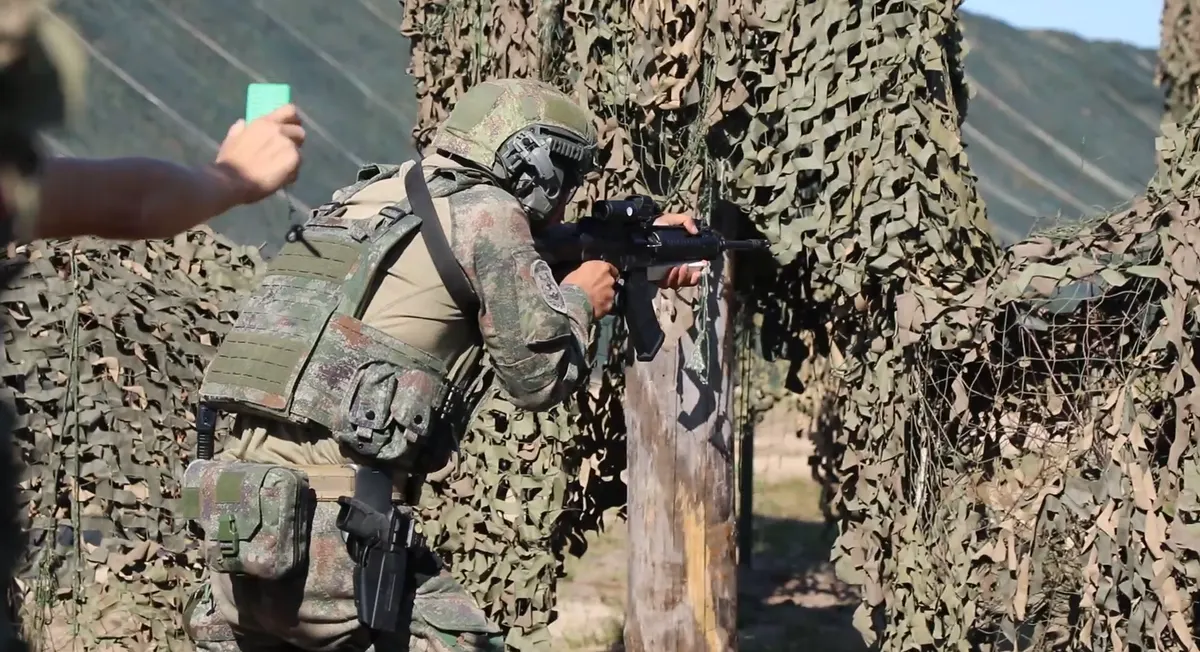
For the American civilian market, Norinco sold a semi-automatic-only export model under the NDM-86 designation (also marketed as NDM-85), fitted with the same fixed wood stock, chrome-lined barrel, and PSO-1-style scope as the military rifle but built to satisfy 1980s US import rules.11,14 Production of that civilian variant ended when import restrictions tightened around 1990, and original examples now sell as scarce Cold War collector pieces rather than shooting rifles bought in volume.11,14
The most significant later variant is the modernized NSG-85, also designated CS/LR19, which China's military adopted in 2014 and which Norinco publicly debuted at the Eurosatory defense show that same year.8,16 It replaces the Type 85's wood furniture with polymer stocks, swaps the side-mounted dovetail rail for a modern top-mounted Picatinny rail, fits a heavier cold-hammer-forged free-floating barrel, and drops the fixed iron sights entirely in favor of optics-only sighting.8,16 Norinco advertises the NSG-85 at 1.2 MOA or better accuracy with match-grade ammunition, a claim that, if accurate, would mark a real improvement over the accuracy problems that dogged the original Type 85 sniper rifle for its entire service life.16
Iran's domestically produced Nakhjir 3 sniper rifle belongs to the same wider design tree but is described in available sourcing as a copy specifically of China's earlier Type 79 pattern rather than the corrected Type 85, so it is best read as a parallel branch off the same Soviet SVD root rather than as a licensed or exported Type 85 derivative.15


| Yıl | Alıcı | Adet | Tutar | Bugünkü Değer (2025) |
|---|---|---|---|---|
| 2017 |  Filipinler | 60 | — | — |
China is the confirmed primary operator of the Type 85 sniper rifle, fielding it since 1987 across People's Liberation Army special-operations units, the People's Armed Police, and border-guard formations, even as the bullpup QBU-88 took over front-line PLA marksman duties from the late 1990s onward.1,12 The rifle's continued presence with police and paramilitary units, rather than front-line infantry, reflects how China's small-arms procurement typically retires an older rifle from the regular army years before retiring it from internal-security service.
The Philippines is the clearest confirmed export operator. In 2017, 60 Type 85 rifles arrived at Clark Air Base as part of a Chinese security assistance package and were subsequently turned over to the Philippine National Police for domestic law-enforcement use.9,10 The handover was a diplomatic set piece as much as a military delivery, with Philippine president Rodrigo Duterte personally receiving the shipment, a gesture tied to his broader push to warm relations with Beijing after years of South China Sea tension.9
Reports of small numbers of secondhand Type 85 rifles reaching Ukraine in 2022 rest on a single, unverified source and are not treated here as a confirmed operator relationship.7 No other country has publicly confirmed operating the Type 85 sniper rifle as issued military or police equipment.
The Type 85 sniper rifle's defining comparison is with its own parent, the SVD Dragunov, and the gap between them is really an ammunition gap rather than a mechanical one. Both rifles share essentially the same gas-operated short-stroke action, the same 10-round magazine, and the same 4x optic concept, but the Soviet Union backed the SVD with purpose-built 7N1 and 7N14 sniper cartridges manufactured to tighter tolerances, while China never fielded an equivalent for the Type 85, issuing standard machine gun ball ammunition instead.2,13 That single procurement decision, not any flaw in the Chinese rifle's manufacture, is what kept the Type 85's practical accuracy below the SVD's reputation across decades of parallel service.
| Spec | Type 85 Sniper Rifle | SVD Dragunov |
|---|---|---|
| Cartridge | 7.62x54mmR | 7.62x54mmR |
| Action | Short-stroke gas piston | Short-stroke gas piston |
| Magazine capacity | 10 rounds | 10 rounds |
| Effective range | ~800 m3 | ~800 to 1,000 m |
| Dedicated match ammunition | None issued2 | 7N1 / 7N142 |
A second useful comparison is with China's own QBU-88, the rifle that formally succeeded the Type 85 in frontline PLA service starting in 1997. The QBU-88 trades the Type 85's proven, conservative Kalashnikov-adjacent gas system for a bullpup layout firing an indigenous 5.8x42mm cartridge, a genuinely new design rather than a corrected copy of someone else's rifle.5,12 Chinese sources credit the QBU-88 with higher penetration and accuracy than the Type 85, but the older rifle's continued service with the People's Armed Police shows that a technically superior replacement does not erase an established rifle from a country's arsenal overnight, especially once police and paramilitary units, rather than the army proper, become its main users.12


What caliber does the Type 85 sniper rifle use? The Type 85 sniper rifle is chambered in 7.62x54mmR, the same rimmed cartridge used in Soviet and Chinese general-purpose machine guns, with a small number of export-market rifles built in 7.62x51mm NATO instead.4,3
Is the Type 85 sniper rifle still in service? Yes, though mainly with China's People's Armed Police, border guard units, and export operators like the Philippine National Police, since the bullpup QBU-88 took over the Type 85's frontline PLA marksman role from the late 1990s.1,12
How does the Type 85 sniper rifle compare to the SVD Dragunov it was copied from? The two rifles share nearly the same gas-operated action, magazine and optic concept, but China never issued a dedicated sniper-grade cartridge for the Type 85 the way the Soviet Union did for the SVD, which is the main reason the Chinese rifle's practical accuracy trailed the original.2,13
What is the difference between the Type 85 and the earlier Type 79? The Type 85 sniper rifle is a reliability fix rather than a redesign, correcting the Type 79's breakage-prone firing pin and its copied telescopic sight's poor tolerance for 7.62x54mmR recoil, changes finalized in 1985 and fielded from 1987.1
Who manufactures the Type 85 sniper rifle? Norinco, China's state-owned small-arms manufacturer, builds the Type 85 sniper rifle and its later modernized NSG-85 variant.1,8
What is the Type 85 sniper rifle's effective range? Sourcing generally puts its effective range against a point target around 800 meters, with a cited maximum range near 1,200 meters, both figures somewhat below the SVD Dragunov it derives from.3,13
- "China's Sniper Rifles: A Lesson in Weapon Development", The National Interest — nationalinterest.org ↩
- "Chinese Sniper Rifles: A Brief Introduction", The National Interest — nationalinterest.org ↩
- "Type 88 and 85: Check Out China's Two Precision Rifles", The National Interest — nationalinterest.org ↩
- "SVD (rifle)", Wikipedia — en.wikipedia.org) ↩
- "QBU-88", Wikipedia — en.wikipedia.org ↩
- "NORINCO NSG-85 / CS/LR19 Sniper Rifle (China)", Modern Firearms — modernfirearms.net ↩
- "Chinese Type 85 Sniper Rifles Captured by the United States, Transferred to the APU", VPK.name — vpk.name ↩
- "Chinese NSG-85 Sniper Rifle", The Firearm Blog — thefirearmblog.com ↩
- "Armed Forces of the Philippines Receives First Shipment of Defense Aid from China", MaxDefense Philippines — maxdefense.blogspot.com ↩
- "Upcoming Tranche of Security Aid from China to the Philippines Revealed", MaxDefense Philippines — maxdefense.blogspot.com ↩
- "Rare Norinco Model 85 Dragunov 7.62x54R Sniper Rifle", Arms Unlimited — armsunlimited.com ↩
- "Chinese Snipers Use Questionable Type 88 Rifle", Army Recognition — armyrecognition.com ↩
- "Chinese Defence Today, Type 79-85, 7.62 mm Sniper Rifle", Chinese Defence Today (mirror) — purefixion.com ↩
- "Norinco NDM-86 Dragunov Sniper Rifle", Atlantic Firearms — atlanticfirearms.com ↩
- "Nakhjir 3", FirearmCentral Wiki — firearmcentral.fandom.com ↩
- "NORINCO NSG-85 Semi-Automatic Sniper / Designated Marksman Rifle (DMR)", Military Factory — militaryfactory.com ↩