

A detachable magazine is a spring-loaded box that holds cartridges outside the rifle and locks into a magazine well ahead of the trigger guard. Pressing a catch releases it, and a second, fully loaded magazine slides straight in, restoring full capacity in a couple of seconds without touching a single loose round. That trait, a complete swap of a loaded unit rather than a slow reload, separates it from every other way of feeding a rifle.
A belt strings cartridges into a continuous chain fed from an open side, built for sustained machine-gun fire rather than quick magazine changes. A clip, properly a stripper or en-bloc clip, only holds rounds together long enough to push them into a magazine, then is discarded empty. It is never itself the working magazine. A cylinder rotates a fixed set of chambers past a single barrel, a revolver solution with no removable container at all. A drum packs far more rounds into a coiled housing at the cost of bulk and reliability. An internal magazine is built into the receiver and topped up round by round, never pulled free as a unit. A single-shot action skips a magazine altogether. A tubular magazine stacks rounds nose to tail beneath the barrel, common on lever-action and pump-action guns but a poor fit for pointed rifle bullets under spring pressure.
01James Paris Lee and the First Removable Box
The removable box magazine itself predates the automatic rifle by decades, and Lee was not working from nothing. American gunsmith Robert Wilson had already patented an early detachable box in 1864, though his version fed into a tube in the stock and never reached production.4 It was James Paris Lee who made the idea work as a standalone unit. The American inventor patented a box magazine holding rounds stacked vertically in 1875, refined it by 1879, and patented a further improvement in 1882, with shoulders inside the box that gripped cartridges of slightly different lengths so the magazine still fed reliably once pulled clear of the rifle.4 The United States Navy ordered 300 of his Lee Model 1879 rifles in 1882.1 Production later moved to E. Remington and Sons as the Remington-Lee. Those early magazines were still charged from a stripper clip rather than carried as loaded spares, so the instant-reload benefit took another generation to become standard practice. Lee's action reached the British Army too, as the Lee-Metford of 1888, pairing his box with William Metford's rifling before the Lee-Enfield replaced it. American gunmaker Arthur Savage, better known for the rotary-magazine Savage Model 99 lever rifle he introduced in 1899, patented a fully modern detachable box design of his own in 1908, though the box magazine was not actually fitted to a production Model 99 until the 99C variant arrived in 1965, decades after his own patent.4,5
That practice arrived with early self-loading service rifles. Mexico adopted the Mondragon M1908 in 1908, widely regarded as the first self-loading rifle issued as a standard infantry arm, feeding from an 8-round detachable box with a 20-round option offered later.2
Russian engineer Vladimir Fyodorov went further with the Fyodorov Avtomat, fielded from 1916 in Russia and chambered for the Japanese 6.5x50mm Arisaka round specifically because its smaller case allowed a curved 25-round detachable magazine without excess bulk.3 That combination of select-fire and a swappable magazine made the Fyodorov Avtomat behave like a modern assault rifle rather than a repeating bolt-action.
01Fixed Magazines and the Clip-Fed Alternative
For decades, most armies avoided the detachable box altogether and kept a fixed magazine built into the receiver, topped up with a clip rather than swapped out as a unit. Austria-Hungary's Mannlicher M1886, designed by Ferdinand Mannlicher and built by Steyr, fed from an integral box charged with a 5-round en-bloc clip that dropped free through the bottom of the magazine the instant the last round chambered, the first Austro-Hungarian service rifle to eject its clip automatically.6 The catch was that an en-bloc rifle is nearly useless without a steady supply of those disposable clips, since nothing else can refill the magazine quickly.
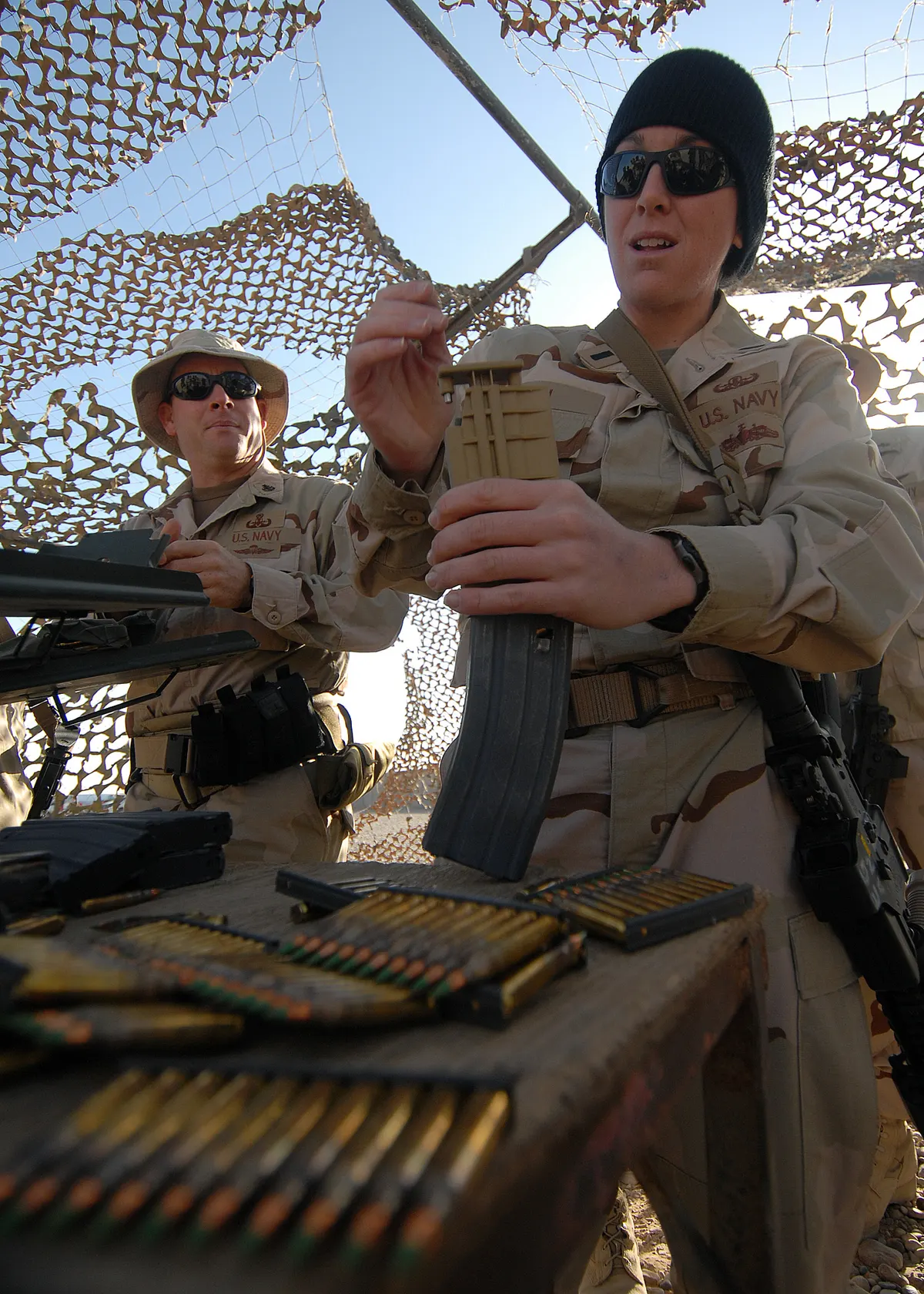
Paul Mauser solved that dependency with the stripper clip, a flat sheet-metal guide that holds rounds in a row just long enough for a shooter's thumb to push them into the magazine, then falls away empty rather than staying locked inside the gun. Germany's Gewehr 98 from Mauser carried a fixed, stripper-clip-fed 5-round box for decades of German service, and its wartime successor, the Karabiner 98k, kept the same magazine into the Second World War. A stripper clip is optional rather than mandatory, loose rounds work just as well one at a time, which is why the format survived alongside the detachable box long after removable magazines had already become common on self-loading rifles.
Both fixed approaches, en-bloc and stripper-fed, eventually lost ground once automatic and select-fire rifles needed reloads no clip could deliver fast enough, which is why nearly every rifle discussed further down this page reverted to a true detachable box instead.
01The Box, the Spring, and the Feed Lips
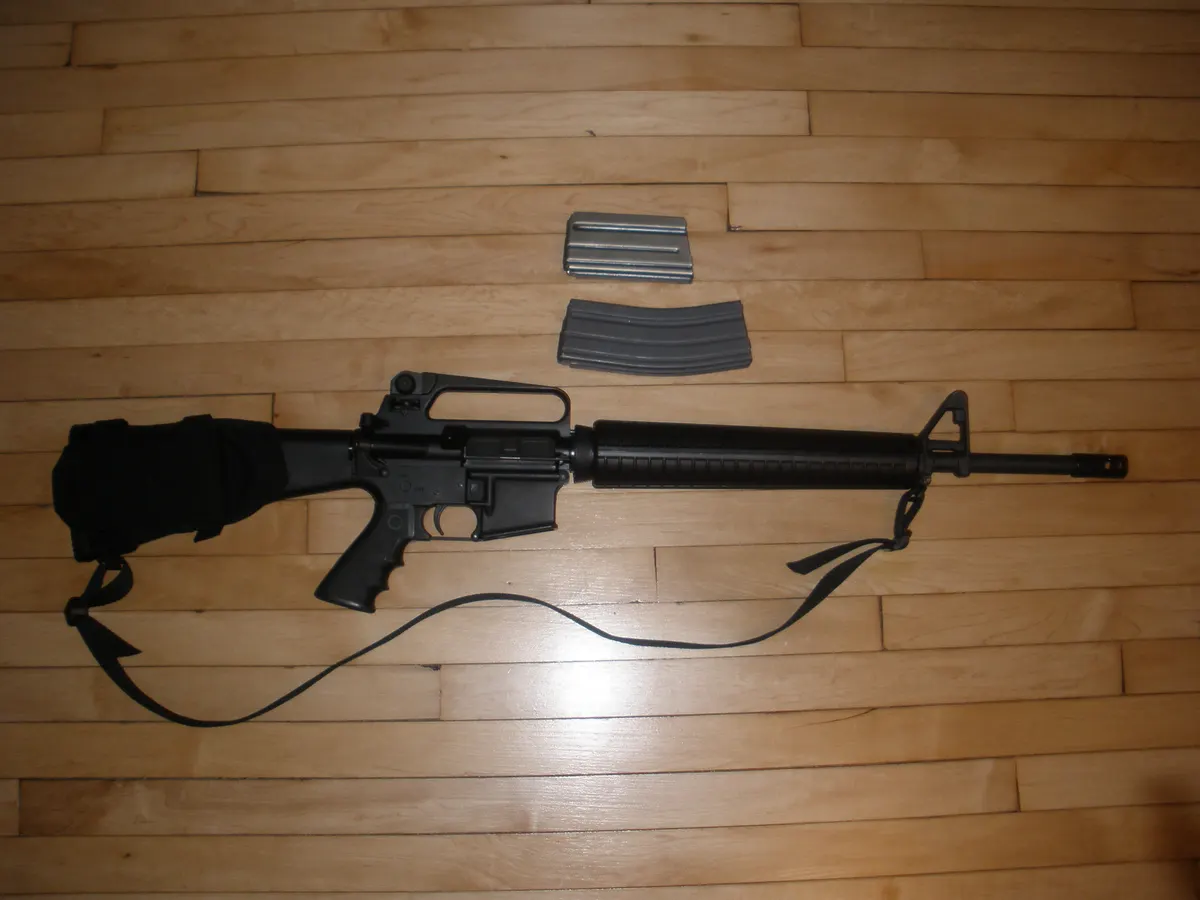
Mechanically, a detachable magazine is simple. A stamped or polymer box holds cartridges under constant upward pressure from an internal spring and follower plate. Curved feed lips at the top grip the uppermost round and release it only as the bolt strips it into the chamber, one cartridge per cycle. A catch near the magazine well holds the loaded box against recoil until the shooter presses it to drop the empty magazine free. Capacity is limited by how long a column the cartridge's length allows before the box turns unwieldy or the spring loses tension, which is why rifle-caliber magazines top out well short of a drum's round count.
Column geometry decides how well that spring pressure survives a full box. A single-column magazine stacks rounds straight on top of one another, so the top cartridge touches both feed lips at once and every round below it rubs against the narrowed walls needed to force the stack back into line, adding friction the spring has to overcome. A staggered, double-column magazine instead lets two rows of cartridges lean against each other, so the second round in line pushes the top one against just one lip rather than both, a geometry patented separately by Karl Krnka and Joseph James Speed in 1888 and fielded almost immediately after on Switzerland's 12-round Schmidt-Rubin of 1889.4,7 Even James Paris Lee, credited with the original detachable box decades earlier, did not add a staggered double-column feed of his own until 1892, on the Mark II Lee-Metford, three full years after the Schmidt-Rubin already had one.4 Double-column boxes have proven more reliable in practice ever since, which is why nearly every modern service rifle magazine, detachable or not, now uses the staggered layout rather than a true single-feed column.
Construction has shifted just as much as geometry. Lee's original magazines were stamped from cheap sheet steel, and steel or aluminum remained the default through most of the twentieth century. Modern magazines increasingly use reinforced polymer instead, a shift popularized by companies like Magpul, whose PMAG line is lighter than metal, resists denting, and can be molded translucent so a soldier can see the remaining round count without pulling the magazine to check. Polymer is not free of tradeoffs. Feed lips are the part that fails first regardless of material, since they flex on every single insertion and every round fed, and worn or spread lips are the single most common reason a magazine starts failing to feed reliably.8 A weak or worn magazine spring produces a second common failure, letting the follower tilt forward or backward inside the box rather than rising straight, which can jam the next round against the feed lips instead of guiding it cleanly into the chamber, a problem manufacturers have addressed with anti-tilt follower designs rather than any redesign of the box itself.8
The rise of the assault rifle after 1945 also pushed NATO toward standardizing the box itself rather than just its contents. Following NATO's adoption of the 5.56x45mm cartridge, member states drafted STANAG 4179 in October 1980, a dimensional standard modeled on the United States' M16 magazine so that a rifle built by one NATO country could accept magazines made by another.9 The draft was never formally ratified, yet the STANAG magazine shape spread anyway, adopted by the M4, the Colt AR-15, and a wide family of NATO-pattern rifles built around the same well and catch even where the underlying paperwork itself stalled.
01From Postwar Battle Rifles to Modern Designated Marksman Rifles
World War Two accelerated the shift toward detachable feeding across whole rifle classes, not just self-loaders. Germany's FG 42 paired a detachable box with a full-power cartridge for paratroopers, and the StG 44 that followed proved the same 30-round approach worked just as well scaled down to an intermediate cartridge, the format that defined the modern assault rifle. The United States took a middle path with its own wartime designs. The M1 carbine fed a light 15-round box for support troops, while Auto-Ordnance's Thompson submachine gun offered both a detachable box and a drum on the same gun. Light machine guns adopted the box too rather than committing entirely to belts. Britain's Bren light machine gun fed from a curved 30-round box mounted on top of the receiver, and the American M1918 Browning automatic rifle used a 20-round box beneath it, both proof that a detachable magazine could sustain automatic fire in a support weapon without a belt's bulk.
The postwar generation of full-caliber battle rifles standardized on the format outright. Belgium's FAL from FN Herstal, the United States' M14 from Springfield Armory, and West Germany's Heckler & Koch G3 from Heckler & Koch all fed from 20-round detachable boxes, as did Switzerland's SIG SG 510 from SIG.

Japan's Howa Type 64, built by Howa Machinery, and Greece's Chropi rifle carried the same logic into their own domestic rifle programs, each building a locally produced full-power battle rifle around it rather than importing one. The same logic carried into the assault rifle proper. The Soviet AK-47 and the American M16 fed from curved and straight 30-round boxes respectively, cementing the detachable magazine as the default across both Cold War blocs regardless of the cartridge or rifle design underneath it.
The format proved just as suited to the precision role. The semi-automatic rifles built for designated marksmen, from the Mk 14 Enhanced Battle Rifle to the modern Heckler & Koch HK417, still rely on a detachable box because a DMR needs the same instant reload a rifleman gets, just paired with a heavier, more accurate cartridge.
01Notes and Sources
- "M1885 Remington–Lee", Wikipedia — en.wikipedia.org ↩
- "Mondragón rifle", Wikipedia — en.wikipedia.org ↩
- "Fedorov Avtomat", Wikipedia — en.wikipedia.org ↩
- "Magazine (firearms)", Wikipedia — en.wikipedia.org) ↩
- "Savage Model 99", Wikipedia — en.wikipedia.org ↩
- "Mannlicher M1886", Wikipedia — en.wikipedia.org ↩
- "Schmidt–Rubin", Wikipedia — en.wikipedia.org ↩
- "Everything You Wanted to Know About AR-15 Magazines", GUNS Magazine — gunsmagazine.com ↩
- "STANAG magazine", Wikipedia — en.wikipedia.org ↩


