

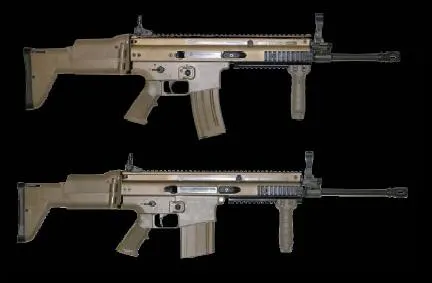

The FN SCAR-H, designated Mk 17 Mod 0 in United States service, is a 7.62x51mm NATO battle rifle developed by FN Herstal for United States Special Operations Command as the heavier half of the Special Operations Forces Combat Assault Rifle program.1 It runs a short-stroke gas piston rather than direct impingement, uses a fully ambidextrous polymer-and-aluminum receiver, and was built around a user-swappable barrel system rather than a fixed barrel length. FN Herstal is a Belgian company headquartered in Herstal, Belgium, and it designed the SCAR family there. Military production for the United States and export customers happens at FN Manufacturing LLC, a Columbia, South Carolina subsidiary of FN America, while the civilian semi-automatic derivatives are still built in Herstal and imported into the United States.2
- short-stroke gas piston, no direct gas fouling of the bolt carrier
- user swappable barrels in three lengths, field changeable in minutes
- fully ambidextrous controls, unusual for its era
- full-power 7.62x51mm NATO chambering at a carbine-like weight
- common receiver shared across rifle, sniper support, and grenade launcher roles
- heavier and harder to control on automatic fire than a 5.56mm carbine
- 20-round magazine capacity, less ammunition carried per magazine than a 5.56mm rifle
- lost the Marine Corps automatic rifle competition to a rival design
- being phased out of SOCOM service by a newer multi-caliber rifle as of 2025
USSOCOM issued the original SCAR solicitation in early 2004, and FN Herstal won the development contract that November.3 Rifles reached operational units in United States forces in April 2009, and a battalion of the 75th Ranger Regiment carried roughly 600 of them into Afghanistan later that year, the weapon's first large-unit combat deployment.4 The program's other half, the 5.56mm SCAR-L (Mk 16), had a much shorter service life. SOCOM cancelled the Mk 16 in June 2010, judging that it did not offer enough improvement over the M4A1 carbines already in inventory to justify keeping both rifles in the supply chain, and redirected the freed funding into buying more Mk 17s instead.5 That decision, discussed further in History, effectively made the SCAR-H the sole survivor of a program that was designed from the outset as a two-caliber family.
Seventeen years after its first fielding, the SCAR-H is itself being phased out. USSOCOM awarded LMT Defense a contract in August 2025 for a new multi-caliber rifle, the Mk 24, intended to replace the Mk 17 in front-line SOCOM units before October 2026.6 That transition, and the reasoning behind it, closes out the History section below.
The SCAR-H's most direct rivals in Special Operations trials were Heckler & Koch's HK416 and HK417, and the two families split the field. The SCAR line held onto SOCOM's 7.62mm battle rifle role for a decade and a half, while the HK416 design went on to win a separate United States Marine Corps automatic rifle competition, adopted as the M27 Infantry Automatic Rifle. That split verdict is examined in depth in Comparison.
A Short-Stroke Gas Piston Instead of Direct Impingement
The SCAR-H cycles on a short-stroke gas piston with a rotating bolt lock, not the direct gas impingement system used in the M4 and M16 family.7 Propellant gas tapped from the barrel drives a piston a short distance rearward, which in turn pushes an operating rod that unlocks and cycles the bolt, so combustion gas never enters the receiver or bolt carrier the way it does in a direct impingement rifle. FN Herstal marketed this as a cleaner-running, more fouling-tolerant action, a selling point aimed squarely at the M4's long-running reputation for needing frequent cleaning in sandy, dusty environments. The correct production-configuration figures for the 7.62mm SCAR-H are a cyclic rate of about 550 rounds per minute, a muzzle velocity of roughly 710 meters per second from the 16-inch standard barrel, and an effective point-target range of about 600 meters.8 Some published spec sheets mix these figures with numbers belonging to the lighter 5.56mm SCAR-L, which runs faster (about 650 rounds per minute) and reaches a higher muzzle velocity from its shorter cartridge, so the two variants should not be read interchangeably.
- İlk Üretim Yılı2009
- TasarımcıFN Herstal
- Ağırlık (Boş)3,58 kg
The Quick-Change Barrel System
A defining feature of the SCAR-H is its interchangeable barrel system. The standard rifle ships with a 16-inch (400mm) barrel, and operators can swap in a 13-inch Close Quarters Combat barrel or a 20-inch Long Barrel variant that also forms the basis of the sniper support configuration, all on the same receiver.9 The barrel change is designed to be an operator-level task rather than an armorer job, completed in under five minutes with a point-of-impact shift generally kept under one minute of angle from a rifle's established zero. That is a genuine field-maintenance advantage over a fixed-barrel design, letting a single unit's rifles be reconfigured for close quarters or extended-range work without swapping whole weapons.
- Fişek7.62x51mm NATO
Ambidextrous Controls on a Two-Piece Receiver
The SCAR-H splits its receiver into a polymer lower and a one-piece aluminum-alloy upper carrying an integral monolithic Picatinny rail.10 Every major control, the magazine release, safety selector, charging handle, and bolt catch, is reachable from either side of the rifle, a fully ambidextrous layout that was unusual among service rifles when the SCAR entered testing in the mid-2000s. The stock folds to the side and adjusts for length of pull and cheek height. Weight empty is 3.58 kilograms (7.9 pounds), heavier than the SCAR-L, which reflects the larger 7.62mm receiver and bolt group rather than any change in materials. Overall length is 965mm extended and 711mm with the stock folded.
- Şarjör Kapasitesi20
- Teorik Atış Hızı550
- Namlu Çıkış Hızı710 m/sn
- Etkili Menzil (nokta)600 m
- Namlu Uzunluğu400 mm
- Toplam Uzunluk965 mm
- Uzunluk (dipçik katlı)711 mm
- Üretim Başlangıcı2009
The SCAR Solicitation and a Rifle Family Split in Two

USSOCOM's original 2004 presolicitation envisioned a single rifle convertible across three chamberings, 5.56x45mm, 7.62x51mm, and 7.62x39mm, on one receiver.11 That idea did not survive contact with engineering reality. A receiver strong enough for 7.62mm NATO, converted down to 5.56mm, ended up heavier than a plain M4, defeating the point of a lightweight carbine option. FN Herstal split the program instead into two related but separate rifles sharing ergonomics and a modular design approach, the 5.56mm Mk 16 SCAR-L and the 7.62mm Mk 17 SCAR-H, and won the development contract in November 2004 with an initial award of roughly $634,000.12 Low-rate initial production testing wrapped up in June 2007, and a five-week field assessment by operational SOCOM units in late 2008 rated the Mk 16, Mk 17, and the Mk 13 grenade-launcher module as operationally effective, operationally suitable, and sustainable.13
Rifles reached operational units in April 2009, and a battalion of the 75th Ranger Regiment deployed to Afghanistan later that year carrying about 600 SCARs, the first large-unit combat use of the design.14 SOCOM formally approved full deployment with a Milestone C acquisition decision in May 2010.
The Mk 16's Cancellation and How the SCAR-H Absorbed Its Role
In June 2010, barely a year after fielding began, SOCOM cancelled the 5.56mm Mk 16 SCAR-L procurement.16 The stated reasoning was blunt. The Mk 16 did not deliver enough of a performance gain over the M4A1 carbines and other 5.56mm weapons already in SOCOM's inventory to justify the added expense of running a second rifle line alongside limited procurement funding. By the time of cancellation, SOCOM had bought 850 Mk 16s against 750 Mk 17s, and the money earmarked for further Mk 16 purchases was redirected into buying more Mk 17s instead.17 SOCOM began pulling the Mk 16 from inventory at the end of 2011, with most units fully withdrawn after 2013.
To preserve a lightweight, 5.56mm option without keeping the Mk 16 itself in service, SOCOM finalized a caliber-conversion kit for the Mk 17 in late 2010, with orders beginning in mid-2011.21 In practice, the SCAR-H's own receiver became the family's universal chassis, convertible down to 5.56mm when a mission called for it rather than the Mk 16 continuing on as a separate rifle.
Development Trials Against the M4, HK416, and the Shelved XM8
The SCAR's early reputation rested partly on a July 2007 US Army extreme-dust endurance test, in which ten examples each of the M4, the FN SCAR, the HK416, and the previously shelved HK XM8 fired 6,000 rounds apiece in sand and dust conditions.22 The XM8 recorded the fewest stoppages, the SCAR was second with 226 total stoppages (127 once magazine-caused failures were excluded), the HK416 logged 233, and the M4 logged 882, by far the worst of the four. That result became one of the most frequently cited data points favoring the SCAR and HK416 designs over the direct-impingement M4, even though neither the XM8 nor either gas-piston rival replaced the M4 across the wider US military.
The 2025 to 2026 Transition to the Mk 24
After roughly seventeen years as SOCOM's standard 7.62mm rifle, the Mk 17 SCAR-H is being replaced. USSOCOM's Mid-Range Gas Gun program, launched in 2019 to field a rifle capable of engaging targets well beyond the SCAR-H's single 7.62mm NATO chambering, awarded a sniper variant contract to Geissele Automatics in September 2023 worth $29 million, already fielded as the MRGG-S.23 The assault-rifle half of that program went to LMT Defense of Eldridge, Iowa, in August 2025, under a ten-year indefinite-delivery contract worth up to $92 million covering the new Mk 24 Mid-Range Gas Gun-Assault rifle, its kits, spares, training, and engineering support.24 The Mk 24 swaps barrels between 7.62mm NATO and 6.5mm Creedmoor on the same upper receiver, and its 6.5mm Creedmoor configuration is intended to push effective point-target range past 1,200 meters, roughly double the SCAR-H's own 600-meter figure.25 Selected SOCOM elements are expected to field the Mk 24 before October 2026, closing out a run that began with a battalion of Rangers carrying the same 7.62mm rifle into Afghanistan sixteen years earlier.
The War in Afghanistan
Afghanistan was the SCAR-H's primary combat theater for most of its service life. The 75th Ranger Regiment's 2009 deployment marked the rifle's combat debut, and American special operations units continued carrying it through the two decades of the War in Afghanistan, valuing the 7.62mm cartridge's reach and stopping power over the 5.56mm M4A1 in the harder, longer-range engagements of that campaign.26 SOCOM elements are also documented carrying SCAR rifles during the Iraq War, though the specific unit-level record there is thinner than for Afghanistan.27
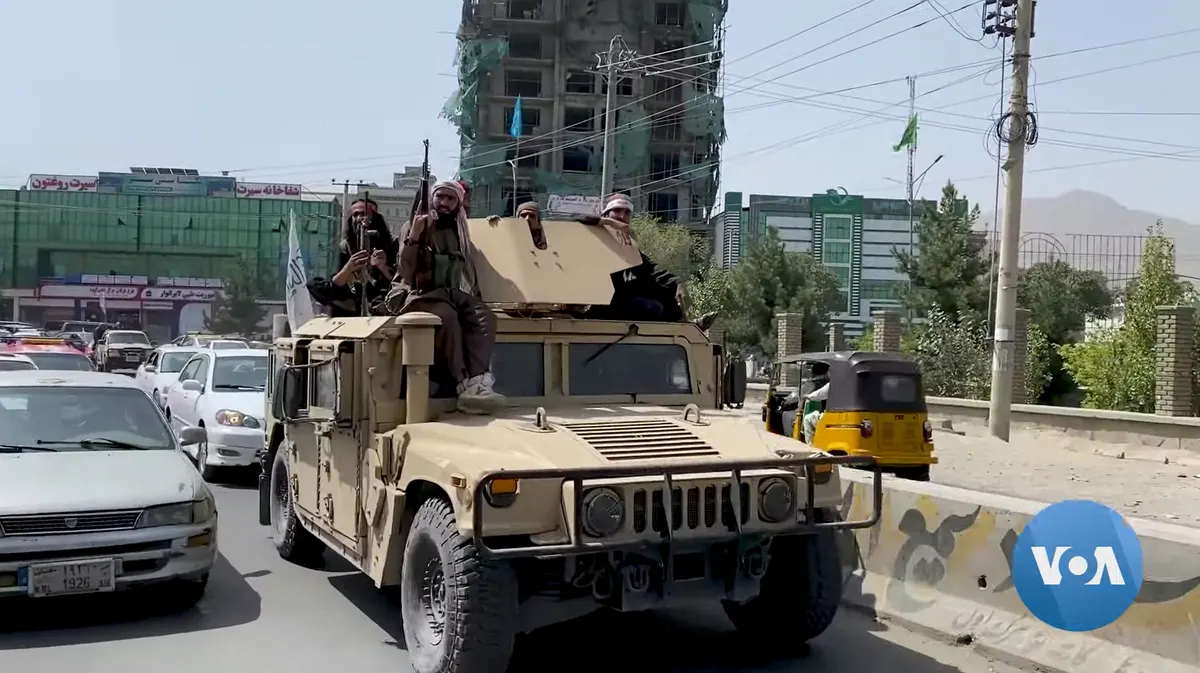
The rifle's last major public appearance from that war came after it ended. When the Afghan government collapsed in August 2021 and Taliban forces seized vast stockpiles of US and Afghan National Army equipment, a roughly 70-minute Taliban propaganda video showed fighters handling rare special-operations-grade gear, including a 7.62mm FN SCAR rifle.28 Because the SCAR-H had a reputation as an exclusive US special-operations weapon rarely seen outside that community, its appearance in the footage was widely reported as a visible symbol of how much equipment the collapse had put into Taliban hands.
Lower-Confidence Conflict Listings
FN SCAR rifles are also listed among the weapons present in the Mexican drug war, the Yemeni Civil War, and the ongoing M23 campaign in the Democratic Republic of the Congo, though published sourcing for these does not specify whether the rifles involved are the 7.62mm SCAR-H or the more widely distributed 5.56mm SCAR-L, so they should be read as general SCAR-family listings rather than confirmed SCAR-H combat use.29
Standard, Close Quarters Combat, and Long Barrel Configurations
The base Mk 17 Standard (STD) rifle carries the 16-inch barrel described above. Swapping to the 13-inch Close Quarters Combat (CQC) barrel shortens the rifle for room clearing and vehicle work, while the 20-inch Long Barrel (LB) configuration extends effective range and forms the mechanical basis of the sniper support variant below, all without changing the receiver itself.31
The Mk 20 Mod 0 Sniper Support Rifle
The Mk 20 Mod 0 SSR adapts the Long Barrel SCAR-H into a semi-automatic-only precision rifle, with a reinforced receiver and extended barrel geometry meant to reduce barrel whip, a modular trigger switchable between single-stage and two-stage pull, and either a folding or fixed precision stock.32 FN Herstal advertises sub-minute-of-angle accuracy out to 1,000 yards and beyond in this configuration, and the Mk 20 received full production approval in October 2010, the same period in which the lighter Mk 16 was being wound down.
The Mk 13 Grenade Launcher Module
The Mk 13 Mod 0, built around FN's 40mm FN40GL launcher, attaches under the SCAR-H's forend as a swing-out, ambidextrous, double-action grenade launcher module rather than a separate weapon, letting a single rifleman add a 40mm grenade capability without carrying a dedicated standalone launcher.33
Civilian Derivatives
FN America sells semi-automatic civilian derivatives built in Herstal, Belgium, starting with the SCAR 17S introduced around 2008, followed by the SCAR 20S precision rifle in 2019 and a SCAR 20S chambered in 6.5mm Creedmoor announced in 2020, a cartridge choice that anticipated USSOCOM's own later move toward 6.5mm Creedmoor in the Mid-Range Gas Gun program.34 FN America has stated that its civilian SCAR line completed its final production run in October 2025, though that claim comes from a single source and is worth treating with some caution pending independent confirmation.35


Confirmed SCAR-H Operators
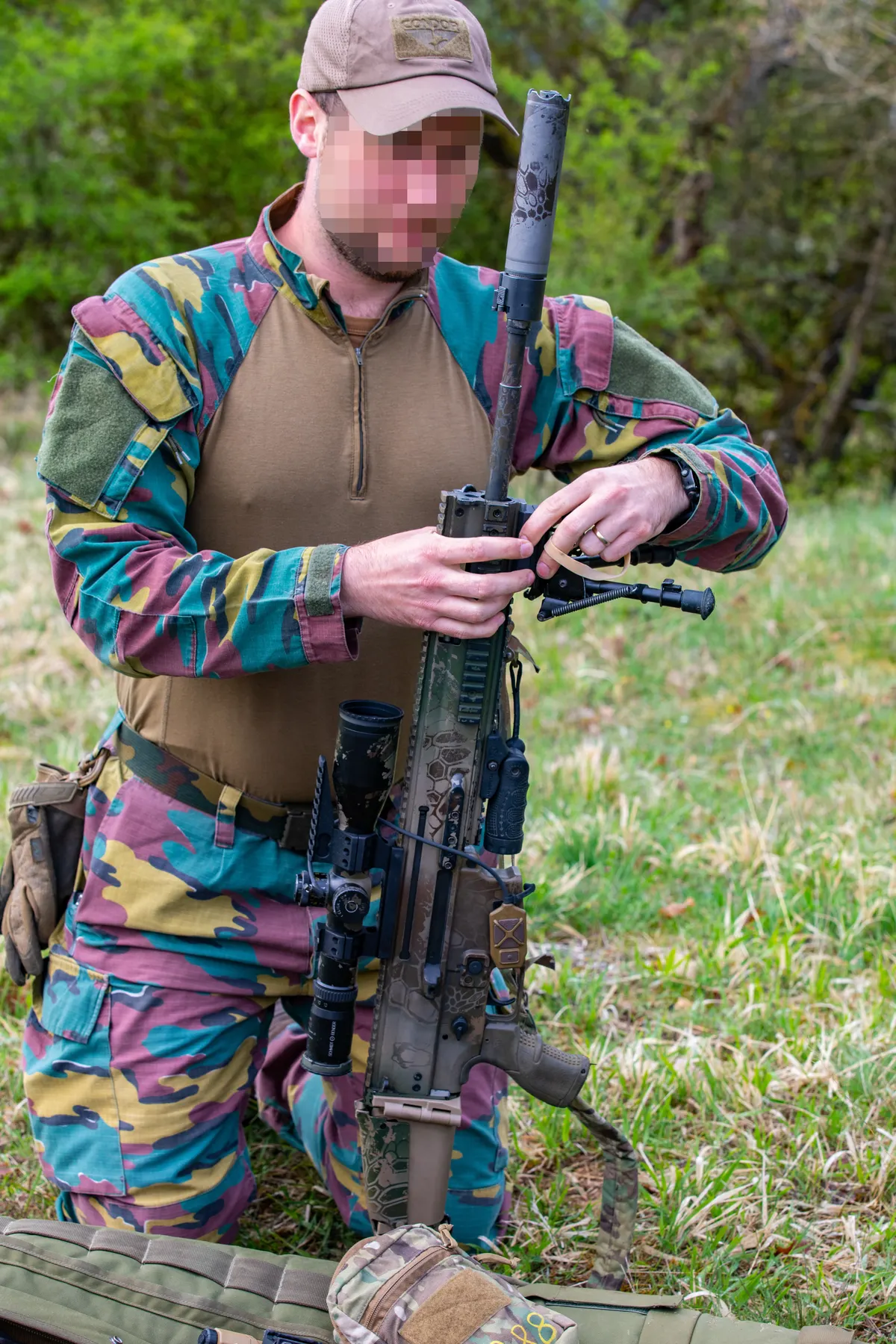
United States Special Operations Command remains the SCAR-H's largest single operator, having bought roughly 750 Mk 17s by 2010 with further purchases since, though it is now transitioning toward the Mk 24 described in History.36 Belgium, FN Herstal's home country, has fielded the SCAR-H since 2011.37 Peru is one of the largest confirmed SCAR-H operators outside the rifle's home markets, having purchased roughly 8,110 SCAR-family rifles including the 7.62mm variant from 2013.38 Chile's Marine Corps has fielded the SCAR-H since 2013, and Kenya has fielded roughly 1,000 units. France bought about 2,600 SCAR-H PR rifles in 2019, and Portugal acquired SCAR-H variants as part of a wider 15,940-unit SCAR-family order the same year.39 Norway issues the SCAR-H specifically to its special operations forces.
SCAR-Family Operators Using the Lighter SCAR-L
FN Herstal's own operator table lists SCAR use across more than two dozen countries, including Bosnia and Herzegovina, Brazil, Cyprus, India, Japan, Lithuania, Malaysia, Mauritius, Poland, Saudi Arabia, Serbia, Spain, and Turkey. Several other countries with documented SCAR deliveries, including Finland, Germany, Indonesia, Singapore, South Korea, and Ukraine's Ground Forces, are confirmed on the lighter 5.56mm SCAR-L specifically rather than the 7.62mm SCAR-H, so they are left out of the SCAR-H operator list above.
The SCAR-H Against the HK416 and HK417
FN Herstal's SCAR family and Heckler & Koch's HK416/HK417 line were the two serious gas-piston rivals to emerge from the mid-2000s push to replace direct-impingement rifles in SOF service, and each won a different competition. USSOCOM kept the 7.62mm SCAR-H as its heavy rifle for a decade and a half, while the HK416 went on to beat the SCAR-based HAMR (Heat Adaptive Modular Rifle, an automatic-fire variant that switches between closed-bolt semi-automatic and open-bolt full-automatic fire depending on barrel temperature) in a separate United States Marine Corps Infantry Automatic Rifle competition, and the winning HK416 derivative was later type-classified as the M27 Infantry Automatic Rifle.40 That loss is the clearest documented case of the SCAR family losing a head-to-head SOF trial to Heckler & Koch's rifles, though the two competitions tested different roles, a squad automatic weapon against a designated battle rifle, rather than directly comparable products.
Ergonomically, the HK416 and HK417 stayed closer to the M4 and M16's familiar control layout, which likely eased their adoption among units already trained on AR-pattern rifles, while the SCAR-H's fully ambidextrous controls and quick-change barrel system were more of a departure from that established manual of arms. Neither family clearly lost on reliability or accuracy in the trials that led to their respective adoptions, and the SCAR-H's own eventual replacement by the Mk 24 was driven by a desire for longer engagement ranges through 6.5mm Creedmoor, not by any documented reliability or accuracy shortfall against the HK line.
| FN SCAR-H (Mk 17) | HK417 | |
|---|---|---|
| Action | Short-stroke gas piston | Short-stroke gas piston |
| Cartridge | 7.62x51mm NATO | 7.62x51mm NATO |
| Weight (empty) | 3.58 kg41 | approx. 4.5 to 5.55 kg depending on barrel42 |
| Barrel options | 13 in / 16 in / 20 in, user-swappable | Fixed per model (12 in / 16 in / 20 in) |


How does the FN SCAR-H work? The SCAR-H fires 7.62x51mm NATO through a short-stroke gas piston action with a rotating bolt lock, keeping propellant gas out of the receiver and bolt carrier the way a direct-impingement rifle like the M4 does not.43 Its barrel is user-interchangeable in three lengths, and every major control is fully ambidextrous.
What are the FN SCAR-H's specifications? The standard-barrel Mk 17 weighs 3.58 kilograms (7.9 pounds) empty, measures 965mm extended and 711mm with the stock folded, fires from a 20-round detachable magazine at a cyclic rate of roughly 550 rounds per minute, and reaches a muzzle velocity of about 710 meters per second and an effective point-target range of about 600 meters with its 16-inch barrel.44
Is the FN SCAR-H still in service? Yes, but its run as USSOCOM's primary 7.62mm rifle is ending. Selected SOCOM units are set to field the newer Mk 24 Mid-Range Gas Gun-Assault rifle before October 2026, and the SCAR-H remains in active foreign service with operators including Belgium, Peru, Chile, France, Portugal, Norway, and Kenya.45
How does the FN SCAR-H compare to the HK416? Both are gas-piston rifles developed around the same period to replace direct-impingement designs in special-operations service. USSOCOM chose the 7.62mm SCAR-H as its heavy rifle, while the HK416 was separately developed into the 5.56mm M27 Infantry Automatic Rifle after beating a SCAR-based competitor in Marine Corps trials, so the two families ended up filling different roles rather than one clearly outperforming the other.46
What does an FN SCAR-H cost? No reliable modern per-unit military contract price is publicly documented for the Mk 17. The only concrete dollar figure tied to the program's early years is FN Herstal's roughly $634,000 initial 2004 development contract award, which covered engineering work rather than per-rifle production cost.47
- "FN SCAR", Wikipedia — en.wikipedia.org ↩
- "FN Herstal", Wikipedia — en.wikipedia.org ↩
- "FN SCAR", Wikipedia — en.wikipedia.org ↩
- "FN SCAR", Wikipedia — en.wikipedia.org ↩
- "SOCOM Cancels Mk16 SCAR-L Purchases", Military.com — military.com ↩
- "SOCOM Awards Contract for New Rifle to Replace SCAR-H", Sandboxx News — sandboxx.us ↩
- "FN SCAR", Wikipedia — en.wikipedia.org ↩
- "FN SCAR-H (Mk 17)", FN America — fnamerica.com ↩
- "FN SCAR-H (Mk 17)", FN America — fnamerica.com ↩
- "FN SCAR", Wikipedia — en.wikipedia.org ↩
- "FN SCAR", Wikipedia — en.wikipedia.org ↩
- "FN SCAR", Wikipedia — en.wikipedia.org ↩
- "FN SCAR", Wikipedia — en.wikipedia.org ↩
- "FN SCAR", Wikipedia — en.wikipedia.org ↩
- "FN SCAR", Wikipedia — en.wikipedia.org ↩
- "SOCOM Cancels Mk16 SCAR-L Purchases", Military.com — military.com ↩
- "SOCOM Cancels Mk16 SCAR-L Purchases", Military.com — military.com ↩
- "SOCOM Cancels Mk16 SCAR-L Purchases", Military.com — military.com ↩
- "FN SCAR", Wikipedia — en.wikipedia.org ↩
- "FN SCAR", Wikipedia — en.wikipedia.org ↩
- "FN SCAR", Wikipedia — en.wikipedia.org ↩
- "Extreme Dust Test Results, US Army Small Arms Study", Small Arms Review — smallarmsreview.com ↩
- "Geissele Awarded USSOCOM Mid-Range Gas Gun Sniper Contract", The Firearm Blog — thefirearmblog.com ↩
- "SOCOM Awards Contract for New Rifle to Replace SCAR-H", Sandboxx News — sandboxx.us ↩
- "SOCOM Awards Contract for New Rifle to Replace SCAR-H", Sandboxx News — sandboxx.us ↩
- "FN SCAR", Wikipedia — en.wikipedia.org ↩
- "FN SCAR", Wikipedia — en.wikipedia.org ↩
- "Taliban Video Shows Fighters With Rare US Special Operations Gear", The War Zone — twz.com ↩
- "FN SCAR", Wikipedia — en.wikipedia.org ↩
- "Belgium to Send Ukraine 93.6 Million Euro Military Aid Package", Reuters — reuters.com ↩
- "FN SCAR-H (Mk 17)", FN America — fnamerica.com ↩
- "FN SCAR", Wikipedia — en.wikipedia.org ↩
- "FN SCAR", Wikipedia — en.wikipedia.org ↩
- "FN SCAR 20S", FN America — fnamerica.com ↩
- "FN America Ends Civilian SCAR Production", The Firearm Blog — thefirearmblog.com ↩
- "FN SCAR", Wikipedia — en.wikipedia.org ↩
- "FN SCAR", Wikipedia — en.wikipedia.org ↩
- "FN SCAR", Wikipedia — en.wikipedia.org ↩
- "FN SCAR", Wikipedia — en.wikipedia.org ↩
- "M27 Infantry Automatic Rifle", Wikipedia — en.wikipedia.org ↩
- "FN SCAR-H (Mk 17)", FN America — fnamerica.com ↩
- "Heckler & Koch HK417", Wikipedia — en.wikipedia.org ↩
- "FN SCAR", Wikipedia — en.wikipedia.org ↩
- "FN SCAR-H (Mk 17)", FN America — fnamerica.com ↩
- "SOCOM Awards Contract for New Rifle to Replace SCAR-H", Sandboxx News — sandboxx.us ↩
- "M27 Infantry Automatic Rifle", Wikipedia — en.wikipedia.org ↩
- "FN SCAR", Wikipedia — en.wikipedia.org ↩