


In 1958 the Finnish Army tested a battle rifle whose rotating bolt and long stroke gas piston were copied almost directly from the Kalashnikov, submitted not by a Warsaw Pact arms maker but by a NATO member's own defense industry. That rifle was the Madsen LAR (Light Automatic Rifle), built by Dansk Industri Syndikat (DISA) of Denmark, the company better known for the earlier Madsen light machine gun and the Madsen M-50 submachine gun.1,2 Firearms historians now describe the LAR as NATO's first AK, an infantry rifle pairing a rotating bolt gas-operated system borrowed from the Soviet design with an aluminum alloy receiver and, eventually, the 7.62x51mm NATO cartridge.2,6
- AK-derived long stroke piston, tolerant of fouling and rough handling
- Lightweight aluminum alloy receiver with a steel front trunnion and chrome lined barrel
- Drum-adjustable rear sight out to 600 m
- Four factory stock configurations built on one common action
- Proprietary [detachable magazine](/en/glossary/detachable-magazine), incompatible with AK, FAL, or G3 pattern magazines
- Never reached serial production, so no combat record ever tested or refined the design
- More complex and costly to machine than the simpler FAL and G3 designs it competed against
- Zero export sales despite roughly a decade of marketing effort
Development began in 1957 around the original 7.62x39mm M43 Soviet cartridge, aimed squarely at Finland's search for a new select-fire service rifle to replace its aging bolt-action inventory.1,5 Finland rejected the LAR in 1960 in favor of the Finnish-built Valmet Rk 62, and DISA responded by rechambering the design for 7.62x51mm NATO as the m/62, hoping to reach the broader Western export market instead.1,2 That second attempt also failed. By the time the NATO-caliber version was ready in the early 1960s, the Belgian FN FAL and the West German Heckler & Koch G3 already dominated the market DISA was chasing, and the company quietly abandoned the project in 1965 having sold nothing.2,4
The LAR belongs to the first generation of battle rifles built around NATO's newly standardized 7.62x51mm cartridge, the same category that includes the FAL, the G3, and Sweden's licensed Ak 4. Unlike those three, the LAR never won a contract of any kind. Its story survives mainly as a cautionary one about arriving late to a market that had already settled on cheaper, simpler designs.2
Mechanically, the LAR is close to a scaled Kalashnikov built with Western materials. It uses a long stroke gas piston driving a rotating bolt, locking directly into a steel front trunnion set inside a high-tensile aluminum alloy receiver, with a chrome-lined barrel and a manual gas regulator for adjusting to ammunition and climate.2,3 The rifle fires from a closed bolt and offers both semi-automatic and full-automatic modes, cycling at roughly 550 to 600 rounds per minute with a muzzle velocity of about 800 to 808 m/s.3,4
- Ağırlık (Boş)4,3 kg
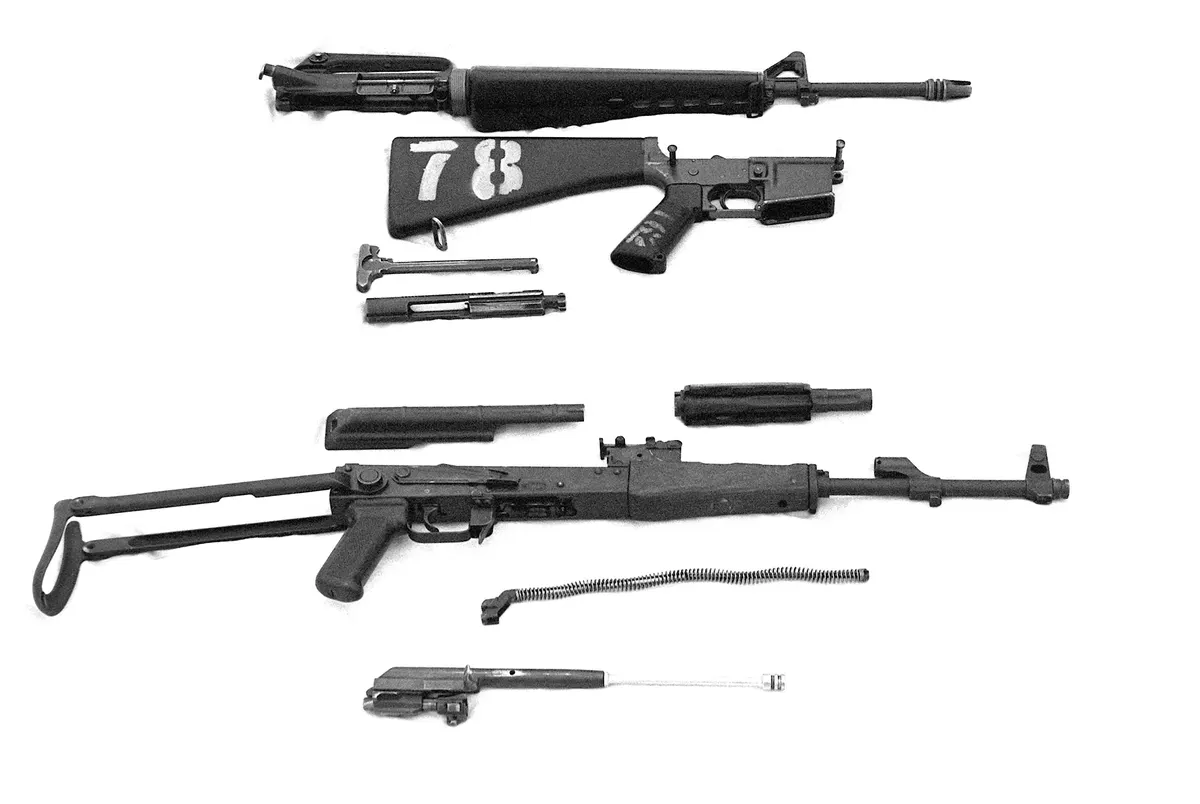
Published dimensions vary slightly between sources, a normal state of affairs for a rifle that never reached a standardized production line. Overall length is listed as 1,074 mm or 1,080 mm depending on the source, with a barrel of 533 to 536 mm, differences small enough to reflect measurement or prototype variation rather than a real design change.3,4 Empty weight is reported less consistently, ranging from 4.3 kg in the most commonly cited figures up to 4.7 or 4.80 kg in others, a wider spread worth flagging honestly rather than picking one number and presenting it as settled.3,5,4
- Fişek7.62x39mm M43 (original 1957-58 Finnish-trials chambering); 7.62x51mm NATO m/62 (1962 rechambering for NATO export market)
- Çap7,62 mm
The production-intent 7.62mm NATO m/62 fed from a 20-round detachable magazine of DISA's own proprietary pattern, a magazine that shared no interface with AK, FAL, or G3 magazines already in NATO armories.1 The earlier 7.62x39mm prototype reportedly used a curved 30-round magazine closer to a standard AK pattern, a detail that did not carry over once DISA rechambered the rifle.5 Sights consisted of a drum-adjustable aperture rear sight graduated out to 600 m paired with a simple post front sight, a conventional arrangement for the period.3
- Mekanizma TipiGazlı
- Atış Modlarısemi-automatic, full-automatic
- Seçmeli AtışEvet
- Besleme SistemiÇıkarılabilir Şarjör
- Şarjör Kapasitesi20
- Teorik Atış Hızı575
- Namlu Çıkış Hızı805 m/sn
- Nişan Menzili600 m
- Namlu Uzunluğu533 mm
- Nişangah TipiMekanik nişangah
- Açık NişangahEvet
- Toplam Uzunluk1.074 mm
- Gövde Malzemesi (Receiver)high-tensile aluminum alloy
- Katlanır / Toplanır DipçikEvet
- Gaz PistonluEvet
- Üretim Başlangıcı1957
- Üretim Bitişi1965
- Varyantlar4
DISA began work on the LAR in 1957, chambering the first prototypes for the Soviet 7.62x39mm M43 cartridge specifically to compete in Finland's ongoing search for a new service rifle.1,5 Finland's own arms industry was pursuing a similar path at the same moment, developing what became the Valmet Rk 62 around a licensed and locally refined Kalashnikov pattern, and the two designs were tested against each other through the late 1950s.5
Finland rejected the LAR in 1960. The stated reason was not the rifle's caliber or general layout, both of which matched the winning Rk 62 closely, but its proprietary magazine, a real logistical disadvantage against a domestically produced rival that used a standard AK-pattern magazine and was cheaper to manufacture in Finland besides.1,5 Losing to a domestic competitor on its home turf, rather than to a larger NATO power's rifle, underlines how narrow the LAR's failure was at first, a single procurement decision rather than an obviously flawed design.
DISA did not give up. The company rechambered the rifle for 7.62x51mm NATO around 1962, designating it the m/62 and pitching it at the wider Western export and NATO market the original Finland-focused design had never targeted.1,2 By then the timing had turned against DISA in a different way. The FN FAL and the Heckler & Koch G3 were already established across NATO and allied militaries, cheaper to mass-produce than the LAR's more tightly machined aluminum receiver and proprietary magazine, and backed by production and logistics networks DISA had no way to match with a rifle nobody had yet ordered.2,4
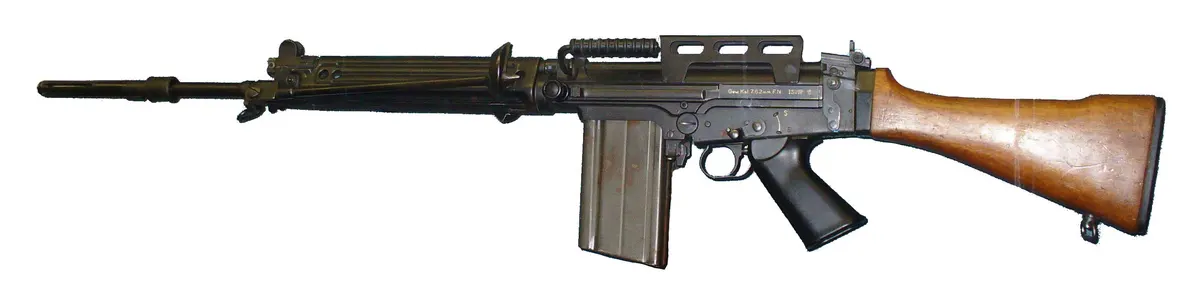
No country tested the m/62 and placed an order. Forgotten Weapons summarizes the outcome bluntly, noting there were no takers and the rifle was never put into serial production at all, only prototypes were ever built.2 Military Factory's own listing records the LAR's adoption status simply as not adopted, with Denmark and Finland recorded only as the countries that evaluated it, not as operators.4 DISA abandoned marketing the LAR in 1965.2
The LAR's failure, layered on top of the earlier commercial failure of DISA's bolt-action Madsen M/47, is widely credited as a driving reason DISA left small arms manufacturing altogether.2 The company had already begun diversifying into civilian industrial goods through the 1940s and 1950s, and by the early 1960s it was investing instead in the DISAMATIC vertical molding system for metal-casting foundries, a technology first patented in 1960 and commercially launched in 1964.7 DISA still exists today, now as a foundry-equipment maker within the Norican Group, known worldwide for casting machinery rather than for the rifle it once tried to sell to NATO.7
Denmark's own military never adopted the LAR either, despite it being a domestic design. Danish forces kept the wartime-pattern M1 Garand as their standard rifle into the 1970s, and when the country finally moved on, it leased used Heckler & Koch G3 rifles from West Germany's Bundeswehr as the Gevær M/75 rather than fielding a Danish-made replacement.8 The rifle DISA had originally hoped to displace ended up outliving DISA's own attempt to replace it, in service with the country that built the LAR in the first place.
Wikipedia's account of the LAR describes four factory stock configurations built on the same action, a fixed wood stock, a fixed steel tube stock, a side-folding stock, and an underfolding stock similar in concept to the AKMS.1 Modern Firearms describes only two, a fixed wood stock and a side-folding tube stock, in less detail.3 With no serial production and no surviving factory catalog to check against, the four-configuration account should be treated as plausible but resting on a single detailed source rather than independently confirmed.
The more consequential variant split is chronological rather than cosmetic. The original 1957 to 1958 prototype fired the Soviet 7.62x39mm M43 cartridge from a curved magazine closer to standard AK capacity, built specifically for the Finnish trials.1,5 The later m/62, dated to around 1962, was rechambered for 7.62x51mm NATO and fed from DISA's own 20-round proprietary magazine, the version DISA marketed to the wider NATO and export market after losing Finland's contract.1,4 No production numbers exist for either version. Every source consulted agrees the LAR never moved past hand-built prototypes, so there is no meaningful serial number range or factory output figure to report.2,4
 Finlandiya
 AlmanyaEMEKLİ
 Birleşik KrallıkEMEKLİ
 BrezilyaEMEKLİ
 DanimarkaEMEKLİ
 Dominik CumhuriyetiEMEKLİ
 EkvadorEMEKLİ
 El SalvadorEMEKLİ
 EndonezyaEMEKLİ
 EstonyaEMEKLİ
 FransaEMEKLİ
 IrakEMEKLİ
 İrlandaEMEKLİ
 İsveçEMEKLİ
 İtalyaEMEKLİ
 KolombiyaEMEKLİ
 LüksemburgEMEKLİ
 MeksikaEMEKLİ
 NorveçEMEKLİ
 ParaguayEMEKLİ
 PeruEMEKLİ
 PortekizEMEKLİ
 ŞiliEMEKLİ
 TürkiyeEMEKLİ
No country adopted the Madsen LAR. Finland tested it as a candidate service rifle from roughly 1958 to 1960 before selecting the domestically produced Valmet Rk 62 instead, making Finland the only nation confirmed to have run the rifle through formal trials.1,5 DISA reportedly showed the later 7.62mm NATO m/62 to other Western defense buyers through the early to mid-1960s, but no source consulted for this profile documents a second country running the design through an equivalent trial, let alone placing an order.2,4
Denmark itself never fielded the LAR despite the rifle being a Danish product from a Danish company. As detailed above, Danish forces retained the M1 Garand and later leased secondhand G3 rifles from West Germany rather than adopting anything from their own small arms industry, a detail that underscores how completely the LAR failed to find any customer, foreign or domestic.8
The Madsen LAR and the FN FAL solved the same NATO cartridge problem through opposite approaches to manufacturing. The LAR carried over a Kalashnikov-style rotating bolt and long stroke piston into a precisely machined aluminum receiver, while the FAL used a simpler short-stroke gas piston and tilting breechblock that FN and roughly a dozen licensees could produce at far greater volume and lower cost.2,6 That production-cost gap, more than any performance difference, is what left the LAR with no realistic opening once the FAL had already captured most of NATO's early 7.62mm rifle contracts.
The Heckler & Koch G3 tells a similar story from a different mechanical direction. Its roller-delayed blowback system required no separate gas system at all, cutting parts count and machining time compared to the LAR's more complex gas-piston arrangement, while offering comparable reliability once West Germany and its licensees had it in full production.4,6 Neither the FAL nor the G3 offered a dramatic performance advantage over the LAR on paper. Both offered something the LAR never could, an already-running production line and a buyer willing to sign a contract.
| Parameter | Madsen LAR (m/62) | FN FAL | Heckler & Koch G3 |
|---|---|---|---|
| Operating system | Gas-operated, rotating bolt, long stroke piston2 | Short-stroke gas piston, tilting breechblock6 | Roller-delayed blowback6 |
| Cartridge | 7.62x51mm NATO (originally 7.62x39mm M43)1 | 7.62x51mm NATO | 7.62x51mm NATO |
| Empty weight | Approximately 4.3 to 4.8 kg (sources vary)3,4,5 | 4.25 kg | Approximately 4.4 kg |
| Magazine | 20-round proprietary detachable box1 | 20 or 30-round detachable box | 20-round detachable box |
| Countries adopting | 02,4 | Approximately 90 | Approximately 50 |
Had Finland accepted a foreign design over its own emerging Valmet industry, or had DISA reached the NATO market even a few years earlier, the LAR might have carved out a niche the way the G3 eventually did against the FAL. Instead it stands as the clearest Western example of an AK-pattern rifle that lost not on performance but on timing and cost, arriving after two cheaper rivals had already answered the same question.


What are the Madsen LAR's specifications? The 7.62mm NATO m/62 version measures roughly 1,074 to 1,080 mm overall with a 533 to 536 mm barrel, weighs an estimated 4.3 to 4.8 kg empty depending on the source, and feeds from a 20-round proprietary detachable magazine, cycling at 550 to 600 rounds per minute.3,4,5
How does the Madsen LAR work? It uses a gas-operated, long stroke piston driving a rotating bolt, the same basic mechanism as the Kalashnikov, built into a high-tensile aluminum alloy receiver with a steel front trunnion and a chrome-lined barrel, firing from a closed bolt in semi-automatic or full-automatic mode.2,3
Did any country adopt the Madsen LAR? No. Finland tested it from 1958 to 1960 and rejected it for the domestically produced Valmet Rk 62, and no other country is documented placing an order for the later 7.62mm NATO version. The rifle never entered serial production.2,4
How does the Madsen LAR compare to the FN FAL and Heckler & Koch G3? All three are first-generation NATO 7.62mm battle rifles from the same era, but the FAL and G3 were cheaper and simpler to mass-produce than the LAR's more tightly machined aluminum receiver and proprietary magazine, and both had already captured NATO's early rifle contracts by the time the LAR's NATO-caliber version was ready.2,4,6
What is the Madsen LAR's unit cost? No unit cost or contract price exists for the LAR. It never reached a production contract of any kind, so no government ever paid a per-unit price for it.
- "Madsen LAR", Wikipedia — en.wikipedia.org ↩
- "Madsen LAR: An AK for NATO!", Forgotten Weapons — forgottenweapons.com ↩
- "Madsen light automatic rifle LAR M/62", Modern Firearms — modernfirearms.net ↩
- "Madsen m/62 LAR Battle Rifle Prototype", Military Factory — militaryfactory.com ↩
- "Madsen Light Automatic Rifle", Historical Firearms — historicalfirearms.info ↩
- "NATO's Forgotten First AK: The Madsen LAR", The Firearm Blog — thefirearmblog.com ↩
- "DISA (company)", Wikipedia — en.wikipedia.org) ↩
- "Denmark's m/75: A Lease-to-Own Rifle", Forgotten Weapons — forgottenweapons.com ↩