

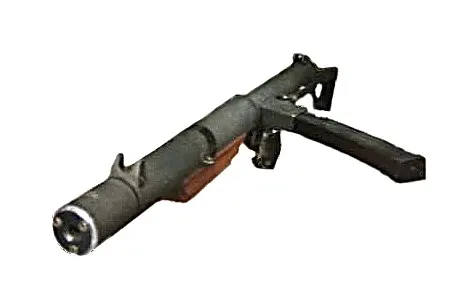
Sterling 7.62 is not an official military designation. No War Office nomenclature, no L-number and no service record exists for a weapon under that name anywhere in British Army documentation.1 The name is collector and historian shorthand for an obscure, undated experimental rifle built by the Sterling Armaments Company of Dagenham, and only two physical examples are known to have ever been made.2,1
- Reuses proven Sterling submachine gun trigger group and grip
- Simple tubular receiver, workshop-friendly to build
- Chambered for standard 7.62x51mm NATO
- Lever-delayed blowback needs no gas system to tune
- Never trialed, adopted or issued to any unit
- Only two hand-built prototypes are known to exist
- No confirmed weight, rate of fire or accuracy figures
- Design attribution and even open-bolt versus closed-bolt operation are disputed
- Full-power cartridge in a blowback-pattern action drew skepticism from specialists
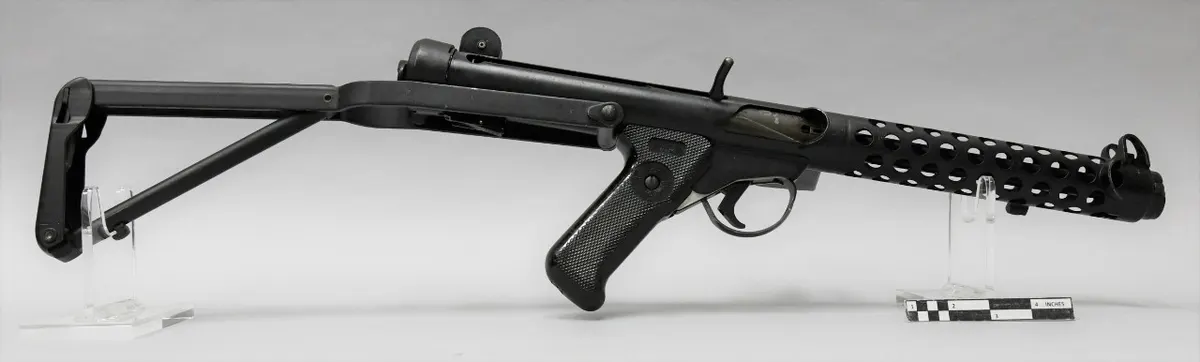
The design reuses the trigger housing and pistol grip of Sterling's own submachine gun, the L2A3, mounted on a lengthened tubular receiver built to handle the far more powerful 7.62x51mm NATO cartridge instead of 9mm Parabellum.2 Sources describe it plainly as an enlarged Sterling submachine gun rather than a rifle designed from a clean sheet.2 Its purpose, as best as sources can reconstruct it, had nothing to do with replacing the L1A1 Self-Loading Rifle Britain had already adopted. The design served as a Cold War contingency weapon, something simple enough to mass-produce in ordinary engineering workshops if a general war with the Soviet Union burned through Britain's stocks of standard rifles and light machine guns.2,4
Design specialists have arrived only at a broad, unresolved estimate of sometime between the mid-1950s and 1970 for when it might have been built, and no firmer date has ever surfaced.2
An Enlarged Submachine Gun, Not a Purpose-Built Rifle
The clearest fact about the design is also the most telling one. Sterling did not draw up a new action for this cartridge. Engineers took the trigger group and pistol grip from the standard-issue Sterling submachine gun and mounted them on a stretched tubular receiver, a construction choice driven by low cost and easy manufacture rather than performance.2
- Halen HizmetteEvet
The action itself is confirmed across every source that discusses it as lever-delayed blowback, a mechanism distinct from the tilting-bolt gas-operated system of the L1A1 and the FN FAL it derives from, and equally distinct from the roller-delayed blowback used in the Heckler and Koch G3 family.2,3 One collector account, attributed secondhand to Sterling's own Frank Waters and impossible to verify independently, describes the action as extremely violent when fired.3
- Fişek7.62x51 NATO
- Çap7,62 mm
- Çap Sınıfıtam güçlü
Even a detail as basic as whether the rifle fired from an open or closed bolt is unresolved. Some sources argue for an open bolt, typical of submachine-gun-derived designs and a common precaution against cook-off in a blowback action, while others describe closed-bolt operation. No source settles the question either way.2
- Mekanizma TipiGeciktirmeli Blowback
- Besleme SistemiÇıkarılabilir Şarjör
Feed, Fire Control and the Missing Numbers
Magazine sourcing is inconsistent across accounts. Some describe the rifle feeding from 30-round Bren magazines, others from Self-Loading Rifle pattern magazines, and one account specifies a 20-round Self-Loading Rifle magazine on the first of the two prototypes.2 No source clarifies which prototype used which magazine, or whether the two examples shared a single pattern at all.
- Açık NişangahEvet
Neither of the two known prototypes has ever been photographed with a stock or butt piece attached.2 One example has lugs at the rear of the receiver consistent with some form of stock mount, but no source describes or shows a folding stock specifically, and nothing in the record supports an ambidextrous configuration either. The parent Sterling submachine gun uses a conventional, non-reversible cocking handle, and no source mentions the 7.62mm prototype departing from that arrangement.2
A Dagenham Company Best Known for a Different Gun
Sterling Armaments Company built its reputation on submachine guns, not rifles. The firm, based in Dagenham, produced the Lanchester submachine gun during the Second World War, and its own Patchett Machine Carbine was adopted by the British Army in 1953 after a competitive trial, later standardized as the L2A3 Sterling submachine gun.6 The 7.62mm prototype reuses major parts from that same weapon rather than starting fresh.2 A single surviving example is reported, though not independently confirmed, to remain in the Sterling company's own internal collection rather than a national arms museum such as the Royal Armouries.5
No firm date exists for when the rifle was actually built. Historical accounts place it somewhere between the mid-1950s and 1970, a fifteen-year window that is itself the best available estimate rather than a narrowing of the evidence.2
The stated purpose behind the design echoes an older British idea. During the Second World War, the Besal light machine gun was developed as a simplified Bren substitute that ordinary machine shops could produce, insurance against the loss of the Bren's main factory at Enfield after the heavy losses of the Dunkirk evacuation.8 Sources describe the Sterling 7.62 prototype in similar terms, a weapon meant to be turned out quickly and cheaply if a general war with the Soviet Union exhausted Britain's supply of L1A1 rifles and Bren guns, rather than a rifle meant to compete with them in peacetime.2,4
An Attribution That Does Not Quite Hold Up
Design credit is often given to Frank Waters, Sterling's later chief designer, but the strongest source making that claim hedges it as merely probable rather than documented.2 Waters is independently and firmly credited with a separate, unrelated project, a 5.56mm design that began in the early 1970s under the name Sterling Combat Rifle and was licensed to Chartered Industries of Singapore in 1977, entering production in 1979 as the SAR-80.7 A dedicated history of Waters' career covers that SAR-80 project in detail and does not mention a 7.62mm rifle at all, which weakens rather than supports the attribution to him.7
Sterling's other 7.62mm connection is unrelated to this prototype as well. The company later held a UK manufacturing license for the gas-operated ArmaLite AR-18, itself descended from Eugene Stoner's 7.62mm AR-16, under an arrangement with ArmaLite dating from 1975.9 That is a separate, gas-operated design with no mechanical connection to the lever-delayed blowback prototype covered here.
No military trial report, adoption decision or rejection notice has surfaced for the Sterling 7.62. A single forum account states that the military refused it, but nothing beyond that unsourced claim has been found.4 No export interest and no foreign trials are recorded either, in contrast to the SAR-80's later international sales.7
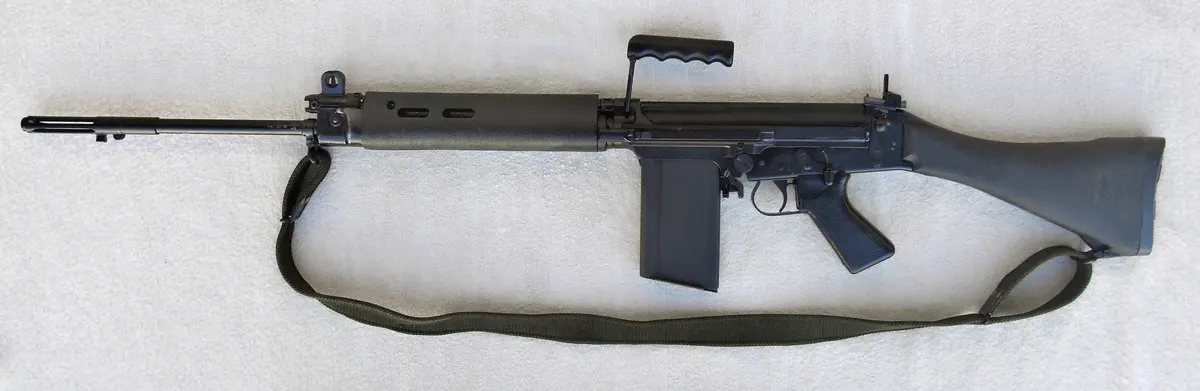
Britain's actual standard rifle through this period was the L1A1 Self-Loading Rifle, adopted from FN's FAL design and issued from the mid-1950s until the mid-1980s.10 The Sterling 7.62 prototype never displaced it, or came close to it, in any documented sense.
Sterling Armaments Company closed for good in 1988.6 The brand was revived in 2016 by a former company director as a dormant engraving business, with no connection to weapons manufacture.6


The Rifle Britain Actually Kept
Britain settled its post-war rifle question well before the Sterling 7.62 is thought to have existed. The L1A1 Self-Loading Rifle, a semi-automatic-only version of the FN FAL built under license, entered British service in the 1950s and remained standard issue until the mid-1980s introduction of the L85A1.10 The Sterling prototype was never a competitor to it in any real sense. It was conceived for a scenario the L1A1 was never meant to cover, general mobilization after a war had already used up existing stocks, and it never left the workshop stage to be tested against the L1A1 or anything else.2,4
The two designs also differ mechanically in a way that matters for the comparison. The L1A1 uses the FAL's tilting-bolt gas operation, a locked-breech system suited to full-power 7.62mm NATO pressures. The Sterling prototype relies on lever-delayed blowback, a mechanism more commonly found on submachine guns and pistol-caliber weapons. At least one collector account raises a fair point of skepticism about that choice for a full-power rifle cartridge, arguing that a delayed-blowback tubular receiver of this kind is a less robust fit for 7.62mm NATO than a locked-breech design like the L1A1's.3 No test data exists either way, but the concern lines up with the L1A1's long, largely uneventful service record set against the Sterling prototype's stalled development.


Is the Sterling 7.62 a real military rifle?
It was a real, physically built prototype, but not a real service rifle. Only two examples are known to exist, and it was never adopted, issued or used in combat by any force.2,1
Who designed the Sterling 7.62?
Design credit is often given to Frank Waters, but the source making that claim calls it only probable, and a dedicated history of his confirmed work never mentions this rifle at all.2,7
What action does the Sterling 7.62 use?
Lever-delayed blowback, distinct from the gas-operated L1A1 Self-Loading Rifle and from the roller-delayed blowback of the Heckler and Koch G3 family.2,3
When was the Sterling 7.62 made?
No firm date is documented. The best estimate places it somewhere between the mid-1950s and 1970.2
- "British .308 Sterling Prototype", Forgotten Weapons — forgottenweapons.com ↩
- "Sterling 7.62x51mm Rifle/Light Machine Gun, the Two Prototypes", Historical Firearms — historicalfirearms.info ↩
- "Sterling 7.62 NATO Battle rifle/Light machine gun", BOCN Forum — bocn.co.uk ↩
- "Sterling prototype assault rifle", Secret Projects Forum — secretprojects.co.uk ↩
- "Prototype 7.62x51mm Sterling rifle", Milsurps Forum — milsurps.com ↩
- "Sterling Armaments Company", Wikipedia — en.wikipedia.org ↩
- "Frank Waters", The Armourers Bench — armourersbench.com ↩
- "BESAL, Britain's Emergency Simplified Light Machine Gun", Forgotten Weapons — forgottenweapons.com ↩
- "ArmaLite AR-18", Wikipedia — en.wikipedia.org ↩
- "L1A1 Self-Loading Rifle", Wikipedia — en.wikipedia.org ↩