


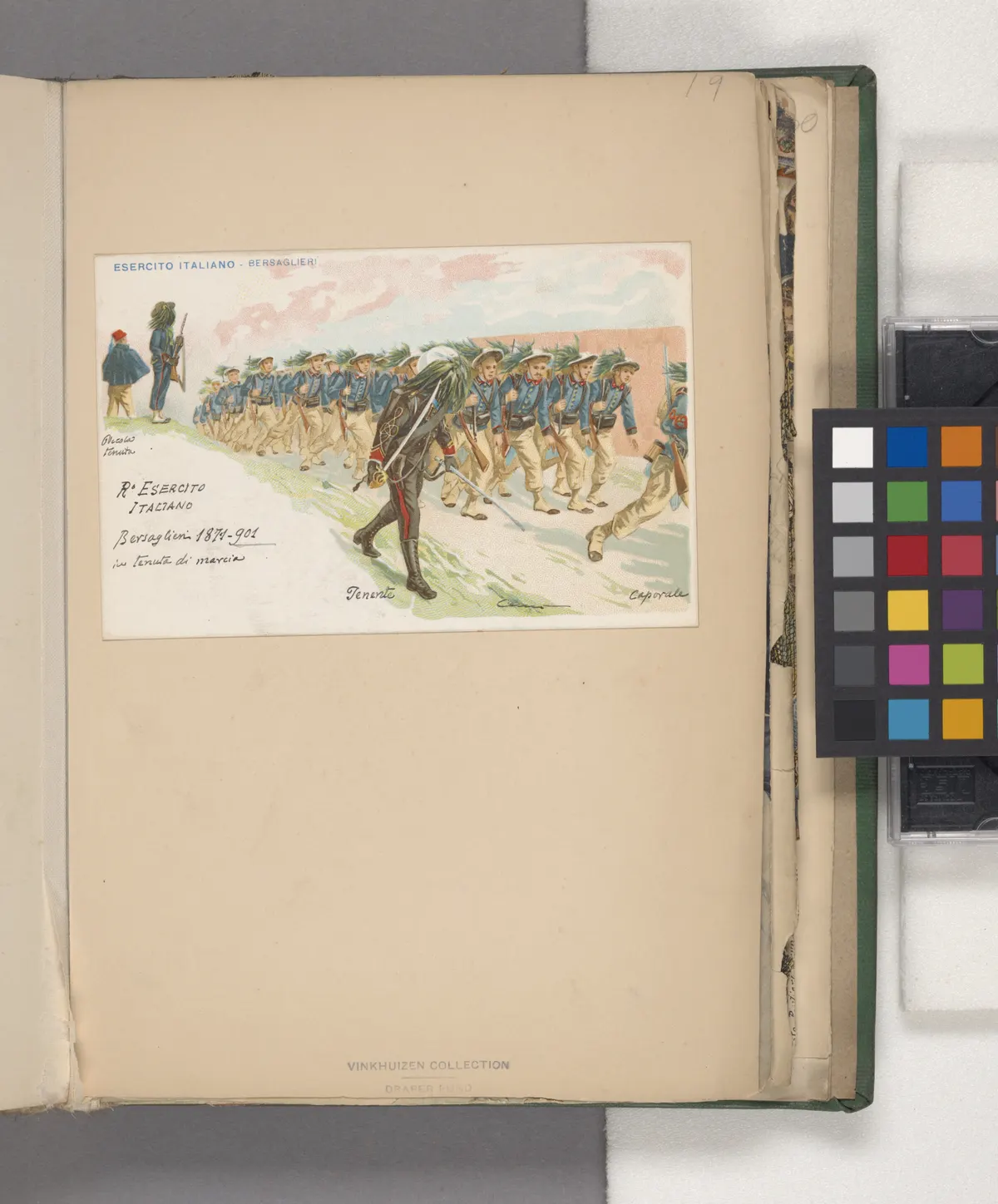
On 13 June 1900, in front of an audience in Rome, an Italian infantry officer fired a self-loading rifle of his own design at full automatic. It kept firing for roughly 300 rounds before the barrel and action overheated and seized.1 The officer was Captain Amerigo Cei-Rigotti of the elite Bersaglieri, and the rifle that bears his name is now treated by many firearms historians as the earliest documented select-fire, gas-operated rifle design, predating the Fedorov Avtomat by roughly two decades and the German StG 44 by over four.1,4
- genuinely early select-fire, gas-operated concept
- light, handy build compared to contemporaneous self-loaders
- four patented mechanism iterations show sustained development
- demonstrated real automatic fire in public trials
- barrel and action overheated rapidly under sustained full-auto fire
- fixed magazine required removing the trigger guard assembly to reload
- never adopted by any military force despite two decades of trials
- surviving documentation is thin and partly contradictory
Cei-Rigotti was not a professional arms engineer. Forgotten Weapons, citing period sources, describes him as a serving Bersaglieri major (Wikipedia's own citation trail gives Captain), but every account agrees he was a career infantry officer rather than a gunsmith.1,2 That amateur background may explain why the rifle came out light and handy for its era instead of over-engineered, a quality Forgotten Weapons' Ian McCollum has pointed to directly, suggesting an infantryman designing for infantrymen produced better handling qualities than a career armorer might have prioritized.2 The commercial rights passed to the Italian firm Glisenti-Bettoni, which marketed the design at home and abroad under names including the Cei gas rifle.1
Between 1895 and 1911 Cei-Rigotti filed four separate patents refining the mechanism, and the rifle went through demonstrations in Rome and Brescia, a formal trial at Britain's Royal Small Arms Factory, and a small Italian War Ministry purchase for field trials in Libya. It was never adopted by any battle rifle procurement program, in Italy or anywhere else.1 The documented record on this weapon is genuinely thin. Much of what circulates online about multi-country trials in Russia, Switzerland, and Austria traces back to uncited fan-wiki mirrors with no primary source behind them, and this article deliberately leaves those claims out.
Four Patents in Sixteen Years
Cei-Rigotti's mechanism evolved considerably across its patent history, and each version solved a different problem with the last. His first patent, filed 21 March 1895 (no. 38,428), was not a standalone rifle at all. It was a gas-piston conversion device meant to be bolted onto an existing straight-pull bolt-action rifle, modeled on the Swiss Schmidt-Rubin action.1 A second patent from 19 May 1899 (no. 51,806) reworked the idea around a rotating-bolt action, semi-automatic only, using a small gas port near the muzzle to drive a rotary cylinder that opened, extracted, and closed the breech.1
- Besleme SistemiDahili Şarjör
The third patent, dated 15 March 1903 (no. 67,116), moved the gas port to the side of the barrel to drive a piston connected directly to the breechblock, with the recoil spring housed inside the piston itself, and it added a bolt hold-open feature on an empty magazine.1 A fourth and final patent from 19 July 1911 (no. 119,210) abandoned the piston layout for direct gas impingement with two separate return springs, an attempt to soften recoil that period commentators judged made the gun needlessly complicated rather than better.1 Taken together the four patents describe a design in continuous, if never fully successful, refinement over sixteen years. A 2012 Forgotten Weapons video shows Ian McCollum disassembling a surviving example at the REME Museum in Warminster, and he notes the action visually resembles a Schmidt-Rubin rifle with a gas-pushed operating rod substituted for the manual straight-pull handle, consistent with the 1895 patent's stated basis in that Swiss action.3
- Üretim Başlangıcı1895
The Full-Length Trigger and a Contested Bolt Release
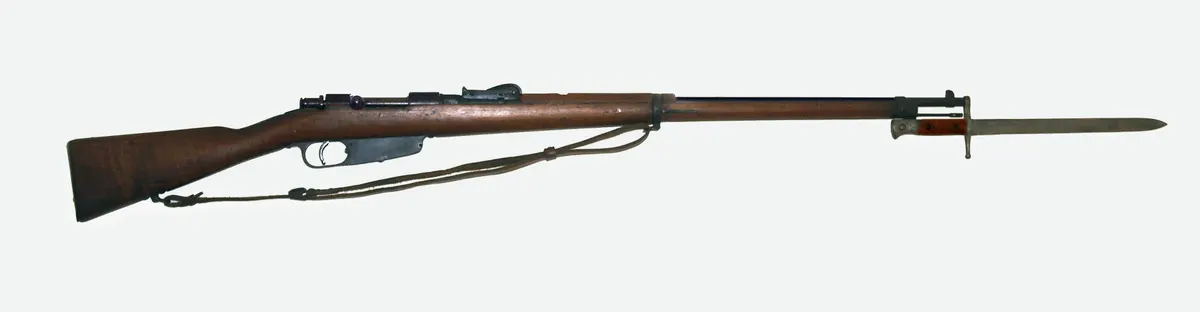
The rifle's most distinctive external feature is its trigger, which sits in a slot running the entire length of the trigger guard rather than in a conventional fixed position. A long-repeated explanation holds that the slot let a soldier operate the trigger while wearing thick winter gloves, and Forgotten Weapons repeats this as plausible speculation rather than a sourced fact.2 A 2022 GameSpot Firearms Expert Reacts segment, cited independently by Wikipedia, offers a different reading, that the slotted design let the shooter release the bolt forward without risking an accidental discharge, functioning as a bolt-release rather than a glove aid.1 No period document settles which explanation is correct.
Magazine Capacity and the Detachable-Magazine Question
Cei-Rigotti's rifle fed from a fixed, internal magazine loaded via stripper clip, not a quick-detachable magazine like later assault rifles. This is a genuine point of contention in the first assault rifle debate among historians. A 2014 TheFirearmBlog analysis of pre-1942 assault rifle developments, cited by Wikipedia, argues the fixed, clip-loaded magazine alone disqualifies the Cei-Rigotti from the assault rifle category no matter how modern its select-fire, gas-operated action otherwise looks.1 A Glisenti-Bettoni sales catalog offered two production-intent versions, a 6-round infantry rifle and a 20-round naval machine gun-rifle, while period trade press (Baker, writing in Arms & Explosives in September 1900) cites a 25-round version, and historian Marco Morin separately records prototypes built with 30 and even 50-round magazines.1 The documented spread across all sources runs from 6 to 50 rounds, depending on which specific prototype or catalog variant is being described.
Weight was 4.3 kg, muzzle velocity approximately 730 m/s, cyclic rate around 300 rounds per minute at the low end of period estimates (some contemporary sources put the top end near 600 rpm), barrel length 482.6 mm, and maximum range cited at roughly 1,400 m.1 Cartridge listings in period and secondary literature split between 6.5x52mm Carcano and 7.65x53mm Mauser, and this is worth a direct caveat. Forgotten Weapons states that both physical examples known to survive today are chambered in 7.65mm Mauser, and questions whether a genuine 6.5mm Carcano-chambered example has ever actually been confirmed to exist, since the two cartridges are close enough in size that period writers may simply have assumed a Carcano chambering because the rifle shared the Carcano's general size and style.2
At 4.3 kg the rifle weighed close to the contemporary bolt-action service rifles of its era despite carrying a more complex gas system, which supports Forgotten Weapons' broader point that an infantry officer's priorities as a designer kept the gun from becoming needlessly heavy compared with other early self-loading attempts.2
No inline citation in the Wikipedia infobox attaches to the commonly repeated circa-1890 design date for this rifle. Two concrete, sourced data points exist instead, and both land on 1895. One is Cei-Rigotti's first patent, filed 21 March 1895, and the other is a private demonstration to his military superiors that year, reported retroactively by an Italian newspaper in 1900.1 Forgotten Weapons independently states the rifle was developed between 1895 and 1900.2 The 1890 date has no traceable source in either bibliography and should be treated as an unsupported editorial rounding rather than fact.
The Wikipedia article situates the rifle within a wider current, noting that Italian engineers were experimenting with self-loading rifle designs as early as 1893, so Cei-Rigotti was working alongside other Italian inventors rather than in isolation.1 A separate 1900 demonstration in Brescia, recorded by Max Baker in Arms & Explosives magazine that September, reportedly saw the inventor fire 15 shots in a single second.1
In March 1901 representatives of Glisenti-Bettoni brought the rifle to Britain's Royal Small Arms Factory at Enfield for a formal trial. The British test report described the weapon as nearly uncontrollable when fired on full-automatic, and the design historian David Miller records that Britain ordered and tested the gun before concluding it was unsuitable for service.1,2 Forgotten Weapons adds a caveat missing from every other account, that the test ammunition supplied for the British trial may have been damaged in transit alongside the rifle itself, which would muddy any conclusion about whether the poor result reflects the design or the specific test conditions. Ian McCollum states he has not personally seen any period test reports substantiating the commonly repeated claim that the rifle functioned erratically or unreliably.2

No direct period-press quotes expressing outright skepticism about any of the trial results, as opposed to plain reporting of the outcome, survive in the sources currently accessible online. That leaves the British trial as the only rejection with a documented, if now disputed, technical explanation behind it, since no comparable Italian Army report explaining the design's domestic rejection has surfaced.

The only further documented event is a small purchase by the Italian War Ministry in 1911, buying a batch of rifles for field trials during the Italo-Turkish War in Libya, the same year as Cei-Rigotti's fourth and final patent.1 Like Italy's other pre-WWI self-loading rifle projects, the Libya trial never led to a production contract, and it remains the closest the design ever came to genuine military use anywhere.
Across sixteen years and two countries, the pattern is consistent. Real, working automatic fire was demonstrated in public, followed by trial rejection or quiet non-adoption rather than a documented single point of technical failure.
The only documented link between the Cei-Rigotti and an actual war theatre is the Italian War Ministry's 1911 purchase of a trial batch for the Italo-Turkish War, fought between Italy and the Ottoman Empire over Libya. This was a field trial procurement rather than a confirmed combat deployment, and no source describes the rifle actually being fired in anger during the campaign. It represents the closest the design ever came to real military use anywhere.
Beyond Libya, those wider trial claims are the main gap between what fan sites repeat and what the properly cited record actually supports. Neither Wikipedia's cited bibliography nor Forgotten Weapons corroborates a Russian, Swiss, or Austrian trial, so this account leaves them out.
Glisenti-Bettoni's commercial catalog offered two named production-intent versions rather than a single fixed configuration. An infantry rifle held 6 rounds in its fixed box magazine, while a naval variant, marketed as a machine gun-rifle, held 20 rounds for shipboard defensive use.1 Neither reached a production order of any real size. Beyond the catalog pair, the documented record includes a 25-round version noted in Baker's 1900 trade-press account and prototype magazines of 30 and 50 rounds recorded by Morin, making at least five distinct magazine sizes attested across primary and specialist secondary sources for what was fundamentally the same rifle platform.1
The four patents themselves amount to a rolling redesign rather than clean, separately named variants. The 1895 gas-conversion device, the 1899 semi-automatic rotating-bolt version, the 1903 side-port piston design, and the 1911 direct-impingement version are best understood as successive iterations of one evolving concept, each responding to a shortcoming found in the last, rather than as parallel product lines sold at the same time.
None of the five known magazine configurations differ enough mechanically to count as separate models. They represent the same platform offered in different capacities and, in the naval catalog entry's case, a different intended role, rather than genuinely distinct variants competing for the same contract.

| Yıl | Alıcı | Adet | Tutar | Bugünkü Değer (2025) |
|---|---|---|---|---|
| 1900 |  Birleşik Krallık | — | — | — |
No armed force ever formally adopted the Cei-Rigotti. Italy's own Royal Italian Army went no further than the 1911 Libya trial purchase, and Britain's Royal Small Arms Factory trial in 1901 ended in rejection rather than a contract. The weapon never entered service, never saw confirmed combat use, and the surviving record contains no other government evaluation beyond those two.
The Cei-Rigotti and the Fedorov Avtomat are the two designs most often invoked in the first assault rifle debate, and the comparison turns on a specific distinction, chronology of design against practical military adoption. Cei-Rigotti's earliest patent dates to 1895, roughly two decades before Vladimir Fedorov's rifle appeared, and its 1900 Rome demonstration proved genuine select-fire, gas-operated automatic function years before Fedorov started his own work.4,5 The Avtomat, by contrast, entered limited but real combat service with Russian and later Soviet units from 1916 onward, giving it the stronger claim to being the first automatic rifle actually issued to troops and fired in war rather than only demonstrated.4
The two designs also diverge mechanically in a way that matters for the same debate. The Avtomat fed from a detachable box magazine, a feature closer to later assault rifle practice, while the Cei-Rigotti's fixed, clip-loaded magazine required removing the trigger guard assembly to reload, the same limitation historians point to when arguing it does not fully qualify as an assault rifle regardless of its select-fire capability.1 Historians broadly resolve the rivalry by separating the two claims rather than picking one winner, crediting Cei-Rigotti with the earlier design and Fedorov with the earlier fielding.4,5


Was the Cei-Rigotti ever adopted by any military? No. It was demonstrated in Italy in 1900, trialed and rejected by Britain's Royal Small Arms Factory in 1901, and purchased in a small batch by Italy's own War Ministry in 1911 for field trials in Libya, but it never received a production contract or formal service adoption anywhere.1
How does the Cei-Rigotti's mechanism work? It is gas-operated and select-fire, switchable between single shots and full-automatic via a selector at the rear of the receiver. The mechanism changed across four patents between 1895 and 1911, moving from a bolt-on gas-piston conversion device for existing bolt-action rifles to a dedicated rotating-bolt design and finally to a direct-impingement layout.1
Is the Cei-Rigotti really the first assault rifle? It has a strong claim to being the earliest documented select-fire, gas-operated rifle design by patent and demonstration date, roughly two decades ahead of the Fedorov Avtomat. Its fixed, clip-loaded magazine is the main argument historians use against calling it a true assault rifle, since the category is usually defined partly by a detachable magazine.1
What caliber was the Cei-Rigotti chambered in? Period and secondary sources most often list 6.5x52mm Carcano, but both of the two rifles known to survive today are chambered in 7.65x53mm Mauser, and it is not confirmed that a genuine Carcano-chambered example ever existed rather than being a period assumption based on size.2
Are there any surviving Cei-Rigotti rifles today? Two are known. One, serial number 7, is held at Britain's National Firearms Centre in Leeds (the former Pattern Room collection). The other is in a private collection in the United States. Neither is currently in fireable condition.2
- "Cei-Rigotti", Wikipedia — en.wikipedia.org ↩
- "The Cei-Rigotti", Forgotten Weapons — forgottenweapons.com ↩
- "Throwback Thursday: Cei-Rigotti Rifle Disassembly", Forgotten Weapons — forgottenweapons.com ↩
- "Fedorov, The First Assault Rifle?", Forgotten Weapons — forgottenweapons.com ↩
- "What Was The First Automatic Rifle, A Comprehensive Exploration of Early Automatic Firearms", Crate Club — crateclub.com ↩