


Sweden tested two homegrown rifles against a West German Heckler & Koch G3 in the trials that produced the Ak 4, and the FM1957 was the more conservative of the two. Where the GRAM 63 tried a clean-sheet Kalashnikov-influenced design, the FM1957 took the wartime Automatgevar m/42 Ljungman rifle Sweden already built and reworked its action into a modern box-fed battle rifle. Neither Swedish design reached troops. The FM1957, and its NATO-caliber rework the FM1957-60, lost the same competition the Ak 4 won, and both remain prototypes today, preserved in Swedish museum collections rather than issued to any unit.1,2
- Detachable 20-round magazine, a real upgrade over the Ljungman's fixed 10-round box
- Folding stock built for paratrooper and vehicle-crew carry
- Rechambered for 7.62x51mm NATO mid-program rather than abandoned
- Reused a proven, already-produced Swedish action instead of starting cold
- Gas system traced back to a 1940s design prone to fouling
- Judged an outdated base system against clean-sheet 1950s rivals
- Never reached serial production, no service designation
- Most ballistic performance figures were never publicly documented
An engineer at Stockholm's Kungliga Armetygforvaltningen, the Royal Army Ordnance Administration, is credited with the design. Sources give his name as either Eric Wallberg or Eric Wahlberg, and neither spelling has been confirmed as definitive.2,3 The rifle he produced was not a new design from scratch. It descended from the Fm/54, an earlier folding-stock prototype built on the same Ljungman action, and it kept the Ljungman's direct-impingement gas-operated system while adding a short-stroke piston conversion, a tipping bolt, and a detachable magazine in place of the wartime rifle's fixed 10-round box.3,4
No manufacturer of record beyond the ordnance authority itself has surfaced in current sourcing, and the design never carried a name beyond its trial designation. It is remembered mainly as the more evolutionary of Sweden's two failed domestic answers to the question the Swedish Armed Forces faced in 1957, whether to modernize an existing rifle or build something new, before both lost to an imported German design anyway.
A Short-Stroke Piston Grafted Onto a Wartime Gas-Trap Action
The Ljungman's original gas system directed propellant gas straight down a tube onto the face of the bolt carrier, a direct-impingement layout that Sweden shared conceptually with the French MAS-49 and that Eugene Stoner later adapted, in modified form, for the American M16.4,5 The FM1957 kept that gas-trap heritage but routed the tapped gas into a conventional short-stroke piston instead, driving a tipping bolt that locked into the receiver rather than the Ljungman's simpler tilting design. Forgotten Weapons and the Russian small-arms outlet topwar.ru agree on this mechanical description, though English-language technical detail beyond it is thin.3,4
- İlk Üretim Yılı1957
- TasarımcıEric Wallberg (also spelled Eric Wahlberg in some sources), Kungliga Armetygforvaltningen, Stockholm
- Ağırlık (Boş)4,3 kg
- Halen HizmetteHayır
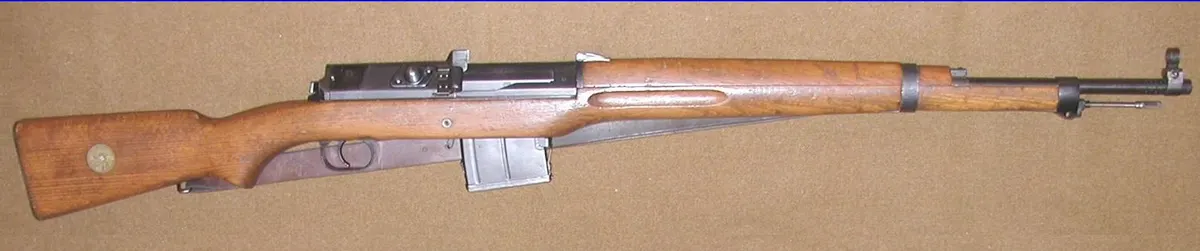
Feeding came from a detachable 20-round box magazine using a nose-in, rock-back insertion, the magazine's front lug seats first and the rear tilts back to lock, a method later familiar from other Cold War rifles.3 A folding metal stock was built into the design from the start. Forgotten Weapons frames the whole rifle explicitly as a paratrooper prototype, which suggests compact carry for airborne or vehicle-mounted troops was a real design driver rather than a minor feature.3 The front sight was a ring type, and the rear sight was graduated out to 800 meters on the 6.5mm variant, though that figure comes from a single source and has not been independently confirmed.2
- Fişek7.62x51mm NATO
- Çap7,62 mm
- Kovan Uzunluğu51 mm
- Çap Sınıfı7.62mm
- Mermi Ağırlığı9,3 g
Two Calibers, One Design, Split by a 1960 NATO Decision
Sweden built and tested the rifle in both its historic 6.5x55mm cartridge and, after 1960, in 7.62x51mm NATO once Sweden committed to the alliance-standard round.1,2 The rework for NATO ammunition was not a simple rebarrel. The engineer fitted a new barrel, redesigned the bolt group, fixed the receiver cover in place, and relocated the cocking handle, producing what sources distinguish as the FM1957-60.2 Weight is reported at roughly 4.9kg for the original 6.5mm rifle against about 4.3kg for the 7.62mm FM1957-60, with overall length around 1160mm and 1095mm respectively, stock extended.2 Wikipedia instead gives a single undifferentiated weight of 4.6kg without splitting the two calibers, so the per-variant figures above should be read as the more specific but less independently confirmed source.1,2
- Mekanizma TipiGazlı
- Besleme SistemiÇıkarılabilir Şarjör
- Şarjör Kapasitesi20
What the Historical Record Leaves Undocumented
The gap above matters because it is unusually large even for a rifle that never entered service. Wikipedia's own infobox for the FM1957 leaves the same fields blank, which is a reasonable signal that no primary source, trial report, or period technical manual has surfaced publicly with that data, not simply that research stopped short.1 What is well documented, the action type, the magazine and stock, and the caliber switch, is presented above. What is not documented is left out rather than filled with a plausible-sounding placeholder.
- Nişangah TipiMekanik nişangah
- Optik RayıHayır
- Açık NişangahEvet
- Dişli NamluHayır
- Toplam Uzunluk1.095 mm
- Katlanır / Toplanır DipçikEvet
- Bullpup DüzeniHayır
- Çift Yönlü KumandalarHayır
- Süngü TakozuHayır
- Entegre BipodHayır
- Bombaatar KabiliyetliHayır
- Gaz PistonluEvet
1957, Sweden Concludes Its Rifles Are Falling Behind
By the mid-1950s the Swedish inventory still mixed the bolt-action m/96 Mauser with the semi-automatic Ljungman, while NATO members were already fielding or trialing select-fire battle rifles chambered for a full-power cartridge. That comparison, more than any single incident, pushed the Swedish military to launch a formal rifle-development and trials program in 1957.1,2
Two Domestic Answers, One Evolutionary and One Revolutionary
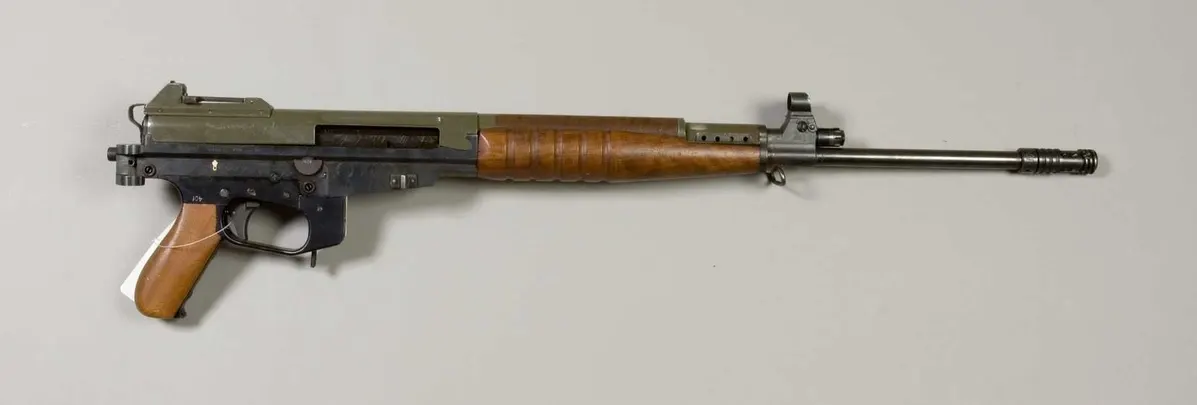
Sweden fielded two indigenous entries rather than going straight to a foreign purchase. The FM1957 evolved the existing Ljungman action through the earlier Fm/54 prototype. The GRAM 63, built by Carl Gustafs stads gevärsfaktori along entirely different, Kalashnikov-influenced lines, aimed for a clean-sheet design instead.2,6 The GRAM 63 never solved its feeding and ejection problems through its final prototype iteration and did not even reach tactical field trials, a harder failure than the FM1957's fate of being tested and then eliminated.6,7
Neither Swedish design carried a guaranteed path to adoption. Both were judged purely against the trial board's technical criteria, alongside whichever foreign rifles Sweden chose to test in the same window, and a domestic origin bought neither one any leniency.
The Foreign Finalists Sweden Tested Against Its Own Designs
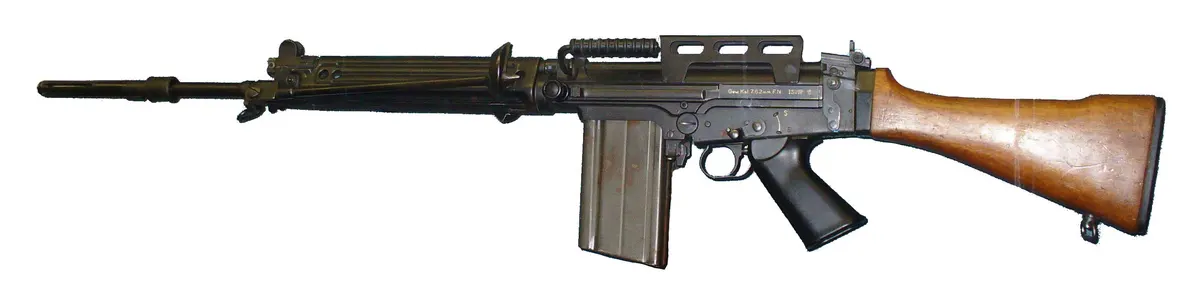
Against the two Swedish prototypes, the trials board tested the Belgian FN FAL, the West German Heckler & Koch G3, the Swiss SIG SG 510, and the American M14. At least one source also lists the AR-10 among the competitors, though the exact foreign roster varies slightly between accounts.2,3 Cold weather reliability and manufacturing cost carried heavy weight in Sweden's own evaluation, a set of criteria that favored a design that could be built cheaply and run clean in Nordic winter conditions over one that was simply accurate on a summer range.
Both Swedish designs were eliminated well before the field narrowed to the FAL and the G3 as the two serious foreign contenders. The SIG 510 and M14 were dismissed earlier in the process for inadequate modularity and cost, the same broad category of problem that had already ended the FM1957's chances.
1960, Rebuilt for a NATO Cartridge That Could Not Save It
Sweden's mid-trial decision to standardize on 7.62x51mm NATO ammunition, rather than end the FM1957's chances outright, gave it one more chance. The engineer reworked the rifle into the FM1957-60, discussed above, and it went back into the same competition chambered for the alliance-standard round.2 That rework shows Sweden's ordnance authority still believed enough in the underlying design to invest in a second iteration, even as rival submissions were being finalized around it.
Elimination, an Outdated Base Beaten by a Clean-Sheet Design
In the early-to-mid 1960s both FM1957 variants were dropped from consideration. The stated reasons were the design's continued vulnerability to gas-system fouling, inherited from the Ljungman's direct-impingement roots even after the piston conversion, and a broader judgment that the whole rifle was built on an outdated base system rather than a fresh one.2,3 That framing put the FM1957 at a structural disadvantage against the G3, which Heckler & Koch had developed from a clean postwar design rather than a modernized 1940s action.
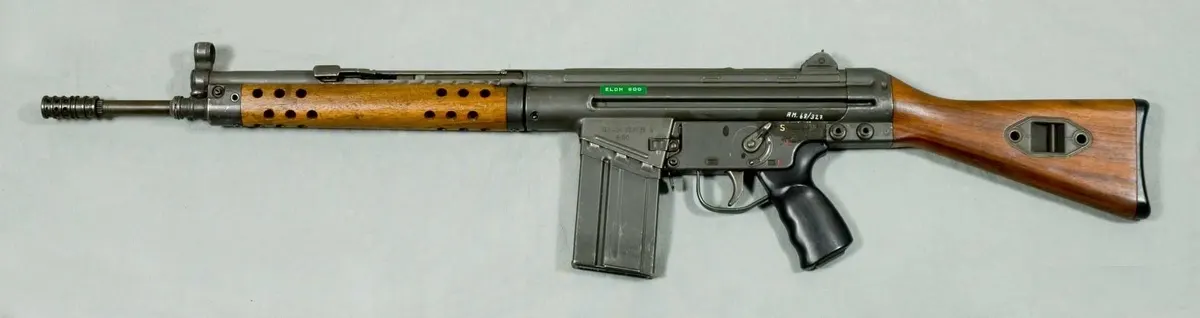
Sweden selected the G3 in 1964 and began Swedish license production as the Ak 4 from 1965, beating the FN FAL as the other finalist standing at that point.2 Surviving FM1957 and FM1957-60 prototypes were transferred into Swedish military museum holdings after their elimination, where they remain today rather than in any unit armory.2
Unlike the GRAM 63, whose failure was a clear mechanical record of unresolved malfunctions, the FM1957 was tested to the end of the process and beaten on a judgment call about design generation rather than a documented reliability failure of its own.
- FM1957 is the original 6.5x55mm Swedish version, direct-impingement heritage converted to a short-stroke piston, folding stock, and 20-round detachable magazine, weighing an estimated 4.9kg with an overall length near 1160mm stock extended.2
- FM1957-60 is the 1960 rework for 7.62x51mm NATO, with a new barrel, redesigned bolt group, a fixed receiver cover, and a relocated cocking handle, estimated at roughly 4.3kg and 1095mm overall.2
- Fm/54 is the earlier prototype the FM1957 grew out of, itself a folding-stock Ljungman derivative rather than an unrelated design, and it survives separately in museum holdings.3,8
None of the three reached serial production or a service designation. The distinction between them is a matter of caliber and refinement stage rather than three unrelated weapons, all three are the same base action carried through successive Swedish trial submissions between the mid-1950s and the early 1960s.

Both the FM1957 and the rifle that beat it ended up chambered in the same 7.62x51mm NATO cartridge, but they arrived at that cartridge from opposite directions. The Ak 4, as the Heckler & Koch G3, was designed for 7.62 NATO from the start on a clean postwar action. The FM1957 was converted into that cartridge mid-trial from a 6.5x55mm rifle that itself traced back to a 1940s gas-trap design, and Swedish evaluators explicitly cited that older base as a reason for elimination rather than a neutral historical fact.2,3
The two rifles also used entirely different locking systems. The FM1957 kept a gas-operated short-stroke piston driving a tipping bolt, descended from the Ljungman. The G3 used a roller-delayed blowback system with no gas piston at all, a mechanically simpler action that Heckler & Koch could produce more cheaply from stamped sheet steel.2 Sweden's own trial criteria weighted manufacturing cost and cold-weather reliability heavily, and the G3's construction method suited both better than a piston-and-tipping-bolt action built around an older receiver design.
| FM1957-60 | Ak 4 (Heckler & Koch G3) | |
|---|---|---|
| Action | Gas-operated short-stroke piston, tipping bolt | Roller-delayed blowback, no gas piston |
| Cartridge | 7.62x51mm NATO (reworked from 6.5x55mm) | 7.62x51mm NATO from the start |
| Origin | Reworked 1940s Ljungman action | Clean postwar design |
| Trial outcome | Eliminated, cited as an outdated base system | Selected 1964, license production from 1965 |
The most direct comparison is not really about which rifle shot better. No source claims the FM1957 was inaccurate or unreliable enough on its own terms to fail outright, and its elimination reads as a judgment about design generation and production cost rather than a documented malfunction record the way the GRAM 63's feeding faults were. The FM1957 lost a competition about industrial modernization, not a shooting contest.


What is the FM57 rifle? The FM57, formally the FM1957 and its NATO-caliber FM1957-60 rework, is a Swedish prototype battle rifle built by modernizing the wartime Ljungman Ag m/42 action with a short-stroke piston conversion, a folding stock, and a detachable magazine. It never entered service.1,3
Why did Sweden not adopt the FM1957? Sweden's trials board judged the FM1957 an outdated base system, a modernized 1940s action rather than a clean postwar design, and cited continued sensitivity to gas fouling inherited from its Ljungman roots. It lost to the Heckler & Koch G3, adopted as the Ak 4 in 1964.2,3
What caliber was the FM1957 chambered for? It was built and tested in both 6.5x55mm Swedish, the historic Swedish service cartridge, and 7.62x51mm NATO after a 1960 rework designated the FM1957-60, once Sweden committed to the alliance-standard round.1,2
Is the FM57 rifle in a museum today? Surviving prototypes, including the earlier Fm/54, are held in Swedish military museum collections rather than any unit armory, consistent with a rifle that never reached serial production.2,8
How does the FM57 compare to the Ak 4 that replaced it in the trials? The FM57 used a gas-operated short-stroke piston action descended from a 1940s design, while the Ak 4, a Swedish-built Heckler & Koch G3, used a roller-delayed blowback system from a clean postwar design that proved cheaper to manufacture at scale.2
- "FM57 rifle", Wikipedia — en.wikipedia.org ↩
- "Automatic rifles FM1957 and FM1957-60 (Sweden)", topwar.ru — en.topwar.ru ↩
- "Swedish Paratrooper Prototype, AK Fm/57", Forgotten Weapons — forgottenweapons.com ↩
- "Automatgevar m/42", Wikipedia — en.wikipedia.org ↩
- "Operating Systems 201, Ljungmann vs Stoner Direct Impingement", TheFirearmBlog — thefirearmblog.com ↩
- "GRAM 63 battle rifle", Wikipedia — en.wikipedia.org ↩
- "Swedish AK GRAM", Forgotten Weapons — forgottenweapons.com ↩
- "AK fm/54, Prototype Swedish Paratrooper Rifle", Forgotten Weapons — forgottenweapons.com ↩