

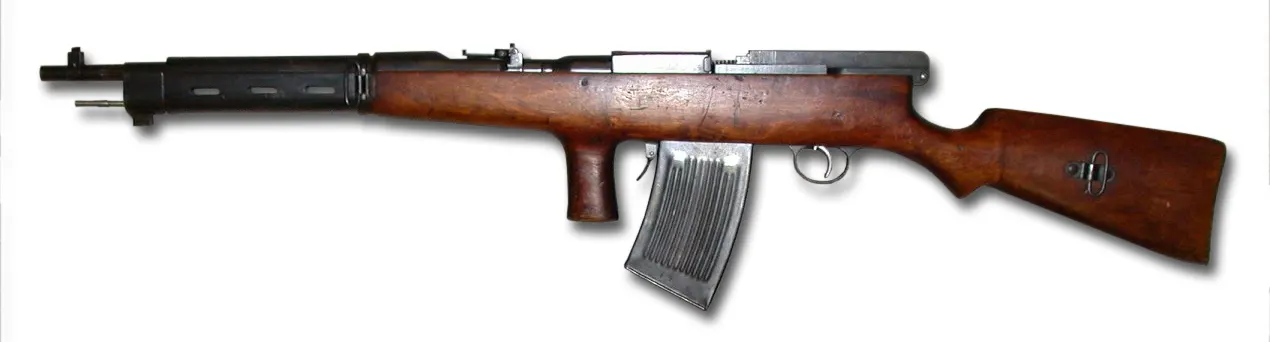

The Fyodorov Avtomat is a select-fire automatic rifle that reached Russian Imperial Army trench units in 1916 chambered for a Japanese rifle cartridge, an odd pairing that had nothing to do with the round's merits and everything to do with a wartime ammunition shortage.1 Russia had bought and captured large stocks of Japanese Type 38 Arisaka rifles and their 6.5x50mmSR ammunition to arm second-line troops during World War I, and when designer Vladimir Fyodorov needed a mass-producible round for his automatic rifle, that stockpile was simply what was available.2,3 His own rifle had originally been built for a different cartridge entirely, a proprietary 6.5mm round he designed himself years earlier, and the switch to Arisaka ammunition in 1916 was a wartime substitution, not the original plan.3
- select-fire with a 25-round detachable magazine, decades ahead of most contemporaries
- shared ammunition and stripper clips with issued Arisaka rifles in the field
- genuine combat service across three separate conflicts spanning 1916 to 1940
- compact and controllable enough for one soldier to carry and fire unsupported
- dependent on a finite, non-domestic ammunition supply the Soviet state could not sustain
- short-recoil action reported as complex to manufacture and difficult to field-strip
- barrel heated quickly, limiting sustained automatic fire to short bursts
- total production never exceeded roughly 3,200 rifles across its whole life
Design work traces back to 1906, when Fyodorov, an Imperial Russian Army officer and Mikhailovskaya Artillery Academy graduate, began converting the bolt-action Mosin-Nagant into a self-loading rifle.1 The select-fire mechanism and detachable box magazine arrived only in a 1916 redesign, after Fyodorov observed the French Chauchat light machine gun in the trenches and set out to build something between a rifle and a squad automatic weapon.1,7 Production never reached large scale. Roughly 3,200 rifles were built in total between the 1913 trial batch and a 1920s Soviet production run at the Kovrov Arsenal, and the type was withdrawn from front-line service by 1928, only to be pulled back out of storage for one final war eleven years later.1
Whether the Avtomat deserves the popular title of the world's first assault rifle is genuinely disputed among firearms historians. Ian McCollum of Forgotten Weapons has argued that its closeness to the modern definition is largely coincidental, since Fyodorov was solving a wartime supply problem rather than deliberately inventing a new class of infantry weapon, and the 6.5mm Arisaka round is better described as a shrunk full-power rifle cartridge than a purpose-built intermediate one.7 That debate does not change the more defensible claim, that the Avtomat was the first select-fire, magazine-fed automatic rifle firing a reduced-power cartridge to actually be adopted and see combat, roughly three decades before Germany's StG 44.7
The Short-Recoil Action and Its Tilting Locking Plates
The Avtomat is a genuine short-recoil operated weapon, not a gas gun described loosely as one. The barrel itself travels rearward under recoil, and the bolt is locked and unlocked by a pair of tilting locking plates at the sides of the breech rather than by a rotating bolt or gas piston.7 It fires from a hammer mechanism, feeds from a curved 25-round detachable magazine, and carries fixed iron sights with a rear range scale that was itself modified when the gun was converted to Arisaka ammunition.1,5 Cyclic rate is documented at roughly 600 rounds per minute, though Russian trial doctrine called for firing mostly in semi-automatic mode and reserving automatic fire for short bursts, since the action could sustain only around 300 rounds of continuous fire before overheating made it inoperable.1 That was still a marked improvement over the bolt-action Mosin-Nagant, which reportedly began to suffer after only about 100 rounds of rapid bolt work, but it was a long way from a modern automatic weapon's sustained-fire capability.1
- İlk Üretim Yılı1913
- Hizmete Giriş Yılı1916
- TasarımcıVladimir Grigoryevich Fyodorov
- Ağırlık (Boş)4,4 kg
- Ağırlık (Yüklü)5,2 kg
- Halen HizmetteEvet
- Önemli KullanıcılarRus İmparatorluğu, Rusya Sovyet Federatif Sosyalist Cumhuriyeti, Sovyetler Birliği, Finlandiya
A 1950s United States Army analysis of Soviet ordnance later concluded that the tilting-locking-plate action was unreasonably complex to manufacture and notoriously difficult to clean and repair under field conditions, a real mechanical drawback layered on top of the ammunition problem that eventually ended production.1 At 4.4kg empty and 5.2kg loaded, with a 520mm barrel, the rifle sat close to contemporary bolt-action service rifles in handling weight while offering select fire, a genuinely unusual combination for 1916.
- Fişek6.5×50mmSR Arisaka
- Çap6,5 mm
- Kovan Uzunluğu50 mm
- Çap Sınıfı6.5mm
- Mermi Ağırlığı8,5 g
- Kenar AteşlemeliHayır
- Kovansız MühimmatHayır
From a Proprietary 6.5mm Round to Japanese Arisaka Ammunition
Fyodorov's earliest self-loading rifle, developed from 1906, fired the standard Russian 7.62x54mmR round, but he judged that cartridge too powerful and its rimmed case too poorly shaped for a reliable automatic action.4 By 1912-1913 he had designed his own rimless 6.5mm cartridge specifically for lower recoil and cleaner feeding, and the Imperial government ordered around 150 rifles chambered for it for troop trials.1,4 That original cartridge was targeting a muzzle velocity in the region of 860 meters per second and never reached mass production, because tooling an entirely new caliber during a war that was already straining Russian industry to keep pace with rifle and 7.62mm ammunition demand was impractical.1,4 Converting the existing design to accept the readily available 6.5x50mmSR Arisaka round in 1916 required only a new chamber insert and a revised rear sight rather than a full redesign. It did cut delivered muzzle velocity to roughly 660 meters per second, correspondingly reducing muzzle energy well below the Arisaka round's native performance in a full-length Japanese service rifle.1,9 The tradeoff bought Fyodorov an ammunition supply he could actually field at scale. It cost him the ballistic performance his original design had aimed for.
- Mekanizma TipiKısa Geri Tepme
- Atış Modlarıseçmeli ateş
- Seçmeli AtışEvet
- Besleme SistemiÇıkarılabilir Şarjör
- Şarjör Kapasitesi25
- Teorik Atış Hızı600
- Tetik Tipihoroz
- Namlu Çıkış Hızı660 m/sn
- Namlu Enerjisi1.856
- Namlu Uzunluğu520 mm
- Nişangah TipiMekanik nişangah
- Optik RayıHayır
- Açık NişangahEvet
- Dişli NamluHayır
- Susturucuya HazırHayır
- Süngü TakozuHayır
- Entegre BipodHayır
- Bombaatar KabiliyetliHayır
- Gaz PistonluHayır
- Toplam Üretim3.200
- Üretim Başlangıcı1913
- Üretim Bitişi1925
- Varyantlar0
From a Converted Mosin-Nagant to a New Cartridge, 1906-1913
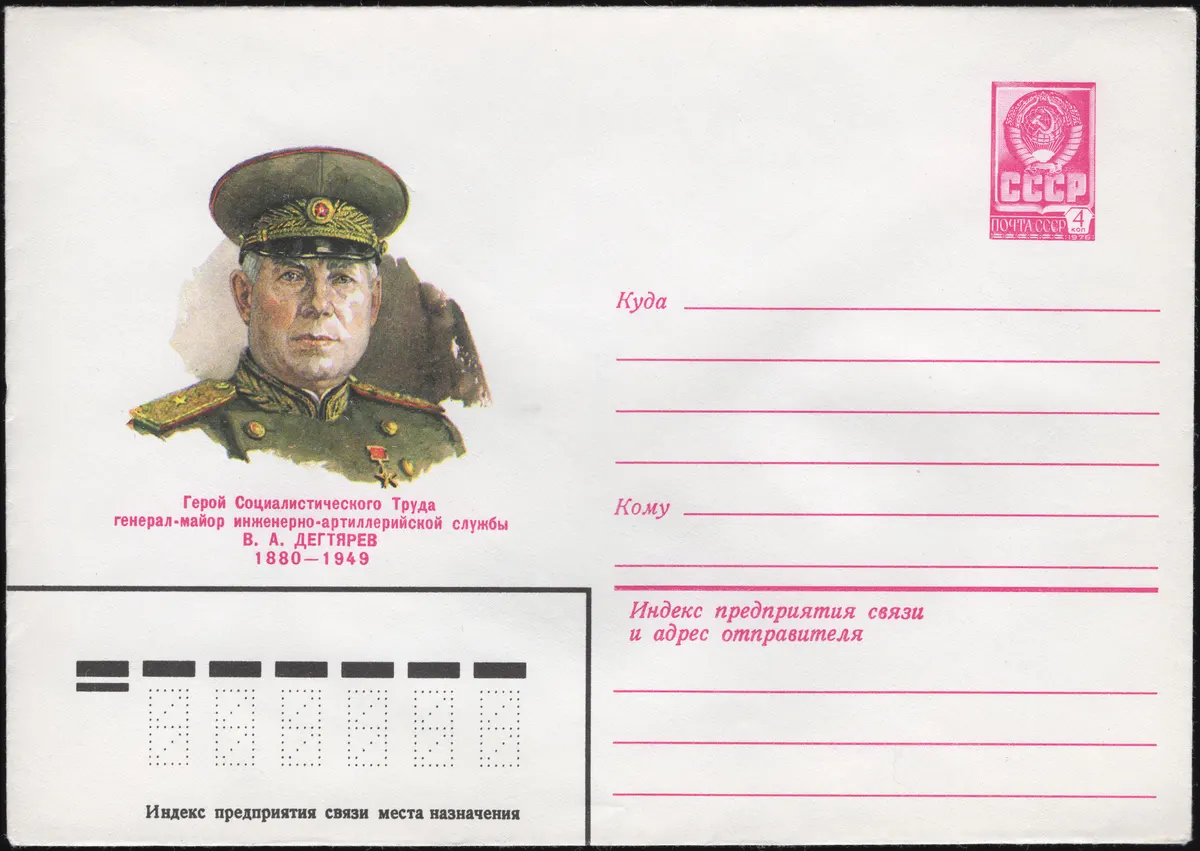
Vasily Degtyaryov, later one of the most influential Soviet small-arms designers in his own right, joined Fyodorov as an assistant from the very start of this work in 1906, years before Degtyaryov's own DP-27 light machine gun or PPD-40 submachine gun existed.1,2
Their early automatic-conversion work on the bolt-action Mosin-Nagant convinced Fyodorov that a genuinely new cartridge was needed, and the resulting 1913 prototype, chambered for his own 6.5mm round with a fixed magazine loaded from stripper clips, tested well enough that year to justify further trial orders.1,4
The Chauchat Insight and the 1916 Redesign for Walking Fire
Everything changed while Fyodorov was posted to observe French forces in 1915. Watching the French Chauchat light machine gun in practical trench use, he conceived of a weapon with firepower between a rifle and a light machine gun but with a rifle's mobility, intended to enable walking-fire tactics where advancing infantry fired from the shoulder or hip while moving forward.1,8 He returned to Russia in January 1916 and reworked the 1913 design into a select-fire weapon with a 25-round detachable box magazine, converted at the same time to the available Arisaka cartridge described above.1
First Combat Issue to the 189th Izmail Regiment
In the summer of 1916, a company of the 189th Izmail Infantry Regiment received eight Fyodorov Avtomats for training and tactical evaluation, with some sources placing the rifles' actual arrival as late as December that year.1,6 Doctrine that emerged from the trial favored a two-man crew, a gunner carrying the Avtomat and an ammunition bearer carrying a standard Arisaka rifle, since both weapons used the same 6.5mm ammunition and the same five-round stripper clips.1 Around ten more Avtomats went to Russian naval and military aviation units, where pilots reportedly found the weapon handier as an observer's gun in a light aircraft than the bulkier Chauchat.1 Total WWI-era production and fielding was small, with sources putting the figure at roughly 100 to 150 rifles before the collapse of the imperial war effort halted further output in late 1917.1,5
The Romanian Front and the Kerensky Offensive Collapse
The trained company from the 189th Izmail Regiment deployed to the Romanian sector of the World War I eastern front in early 1917, intended to report back systematic combat-effectiveness data.1 That report never came. The unit disintegrated during the Kerensky Offensive, the failed Russian summer 1917 push that coincided with mass desertions and collapsing discipline across the army after the February Revolution.1 The Avtomat's WWI combat trial was therefore cut short by the collapse of the army fielding it, not by any judgment on the weapon's performance, a genuine historical irony for a rifle later remembered mainly for its technical firsts.
No systematic combat report from the Romanian front ever reached Petrograd. What survives instead is the earlier training-trial doctrine from the 189th Izmail Regiment, not a verdict from sustained frontline use.
Renewed Production and the Karelian Fighting of the Russian Civil War
Under the new Bolshevik government, senior official Lev Kamenev authorized renewed production at the Kovrov Arsenal starting around 1920, the plant where Fyodorov himself had been made technical director in 1918.1 Fyodorov Avtomats equipped Red Army units fighting in the Karelian sector during the 1921-1922 East Karelian Uprising, part of the wider Russian Civil War, where combat reports were described as very positive as long as spare parts remained available, a recurring logistics problem across the type's service life.1
Sources disagree on how much was actually produced against how much was ordered. Wikipedia states the Bolshevik government commissioned 9,000 units during this period, but only around 3,200 were ever manufactured in total by the time production stopped in October 1925, and Modern Firearms separately records a peak output of only 822 rifles as of October 1923, consistent with a slow and constrained ramp rather than mass manufacture.1,5
Production ended in 1925 for a clear, well-documented reason. Soviet military leadership decided to stop supporting any small arm chambered for a foreign or non-standard cartridge, consolidating logistics around the domestic 7.62x54mmR round already used in the Mosin-Nagant and soon to arm the DP-27 and later the SVT-40.1,5 Since the Avtomat depended entirely on a finite, non-domestic stock of Japanese ammunition, it could not survive that standardization drive regardless of how well it performed in Karelia. The last operational unit to give up the type was the Moscow Proletariat Red Banner Rifle Division in 1928, and the type was considered fully retired by 1929.1
The Unexpected Return in the Winter War
Stockpiled Avtomats sat in storage for roughly a decade after 1928, then were pulled back out and reissued during the 1939-1940 Winter War against Finland, when the Red Army faced an acute shortage of individual automatic weapons because submachine gun production had not yet caught up with wartime demand.1,6 They were sent to the Karelian front, reportedly issued mostly to reconnaissance and intelligence units and, per one source, mobile ski units specifically.1 Most surviving Avtomats were expended, lost, or destroyed during this fighting, and Finland captured a number of them from Soviet forces, which is why the largest surviving group of original Avtomats today sits in Finland rather than in Russia, purely as war trophies rather than through any Finnish adoption of the type.1,6
The Winter War turned out to be the Avtomat's last combat issue of any kind. No Soviet or Russian force fielded the type again after 1940, and it never returned from storage a third time.
Across every deployment, from the Romanian front in 1917 through the Karelian fighting of 1921-1922 to the Winter War two decades later, the Avtomat's actual battlefield reports were consistently positive. What ended its career each time was supply and politics rather than combat performance, a pattern that held from its first issue to its last.
Two distinct patterns exist. The 1913 prototype was chambered for Fyodorov's own proprietary 6.5mm cartridge, fed from a fixed magazine loaded by stripper clips, and fired semi-automatic only, essentially an automatic-conversion Mosin-Nagant derivative rather than a purpose-built assault weapon.1,4 The 1916 pattern, the version that actually saw service and the one the database's core specifications describe, added the select-fire mechanism, the 25-round detachable box magazine, and the switch to 6.5x50mmSR Arisaka ammunition.1 A small naval and aviation batch of around ten rifles, issued in the same 1916-1917 window, was mechanically identical to the standard infantry pattern but issued specifically to observers and gunners in Russian military aircraft rather than to ground infantry.1
Fyodorov's own institutional legacy outlasted the rifle itself. In 1921 he organized a dedicated design bureau at Kovrov, and between roughly 1921 and 1926 he and Degtyaryov jointly developed a series of Fyodorov-Degtyaryov prototype light machine guns built directly on the Avtomat's action, with the air-cooled, disc-magazine-fed version of that work becoming the direct technical basis for the later DP-27, the light machine gun that armed Soviet infantry squads through the Second World War.2 Kovrov remains a major Russian small-arms manufacturing center today, home to the modern Degtyaryov Plant, a direct institutional continuation of the bureau Fyodorov founded there in 1921.2
No commercial semi-automatic reproduction of the Avtomat has ever been manufactured, unlike the Mosin-Nagant or the AR-15, and modern hobbyist interest is limited mostly to non-firing display replicas rather than functional shooters. Collector-market figures for surviving originals are thin and hard to verify independently, but the pattern is consistent with extreme rarity, given a total production run that never exceeded roughly 3,200 rifles across three wars.


The Russian Empire fielded the earliest trial and combat-issue rifles from 1916, and the successor Russian Soviet Federative Socialist Republic and early Soviet state continued production and issue through the Civil War, the 1921-1922 Karelian fighting, and the later Winter War reissue, before formally retiring the type by 1929 and again after 1940.1 Finland never operated the Avtomat as an issued service weapon. Its presence in Finnish hands is entirely a function of war-trophy capture during the Winter War, which is also why the largest surviving population of original rifles is there rather than in Russia.1,6
The Avtomat and the standard-issue Mosin-Nagant it was meant to supplement, not replace, shared the same Russian infantry squads for most of the Avtomat's life, and the contrast between them explains why the Avtomat never moved beyond limited issue. The Mosin-Nagant was simple, rugged, chambered for a domestically produced cartridge Russia could manufacture indefinitely, and required no special ammunition-supply chain. The Avtomat offered select fire and a five-times-larger magazine but depended on a foreign cartridge stock that could not be replenished once diplomatic and industrial circumstances changed, which is exactly the vulnerability that ended its production in 1925.
| Spec | Fyodorov Avtomat | Mosin-Nagant | StG 44 |
|---|---|---|---|
| Cartridge | 6.5x50mmSR Arisaka | 7.62x54mmR | 7.92x33mm Kurz |
| Fire modes | Select-fire | Bolt-action | Select-fire |
| Magazine | 25-round detachable | 5-round stripper clip | 30-round detachable |
| Muzzle velocity | ~660 m/s | ~865 m/s | ~685 m/s |
| Adopted | 1916 | 1891 | 1943 |
The comparison against Germany's StG 44, roughly three decades later, is really a comparison of intent rather than mechanism. The StG 44 was built around a cartridge purpose-designed from the ground up to occupy a power class between pistol and full-power rifle rounds, the deliberate foundation of the modern assault-rifle category.7 The Avtomat's 6.5mm Arisaka round was a reduced-caliber but still full-power service cartridge adopted for supply reasons, which is the core of Ian McCollum's argument that the Avtomat resembles an assault rifle by coincidence of circumstance rather than by the same deliberate category-defining design choice Germany made in the 1940s.7 Both weapons nonetheless share the same basic formula of select fire, a detachable magazine, and a cartridge lighter than the standard service round, and the Avtomat got there first by a wide margin, whatever the historians' debate over labels.


What cartridge does the Fyodorov Avtomat use? The fielded 1916 pattern uses 6.5x50mmSR Arisaka, a Japanese round Russia had in large stockpiled quantity from wartime purchases. Fyodorov's original 1913 prototype used a different, proprietary 6.5mm cartridge of his own design that was never mass-produced.1,4
Was the Fyodorov Avtomat really the first assault rifle? It is the earliest select-fire, magazine-fed rifle firing a reduced-power cartridge to actually be adopted and see combat, but whether that qualifies it as a true assault rifle in the strict modern sense is disputed. Historians including Ian McCollum argue the Arisaka round is a shrunk full-power cartridge rather than a purpose-built intermediate one, unlike the later StG 44.7
Is the Fyodorov Avtomat still in service? No. It was withdrawn from front-line Soviet service by 1928-1929, briefly reissued for the 1939-1940 Winter War, and never fielded again afterward.1
How many Fyodorov Avtomats were made? Roughly 3,200 in total, combining the small WWI-era trial batch with a 1920s production run at the Kovrov Arsenal, well short of the 9,000 the Bolshevik government reportedly commissioned during the Civil War period.1,5
What does avtomat mean? It is the Russian word for an automatic weapon, coined for this rifle by General Nikolai Filatov and later generalized into the standard Russian and former-Soviet term for automatic and assault rifles.1
- "Fedorov Avtomat", Wikipedia — en.wikipedia.org ↩
- "Vladimir Grigoryevich Fyodorov", Wikipedia — en.wikipedia.org ↩
- "The Original 6.5mm Cartridge of the Fedorov Avtomat", The Firearm Blog — thefirearmblog.com ↩
- "A brief history of the Russian Fedorov Avtomat Rifle", The Firearm Blog — thefirearmblog.com ↩
- "Avtomat Fedorova", Modern Firearms — modernfirearms.net ↩
- "Setting the Record Straight on the Fedorov Avtomat", Small Arms Review — smallarmsreview.com ↩
- "Fedorov, the First Assault Rifle?", Forgotten Weapons — forgottenweapons.com ↩
- "Fedorov Avtomat", Historical Firearms — historicalfirearms.info ↩
- "6.5x50mmSR Arisaka", Wikipedia — en.wikipedia.org ↩