

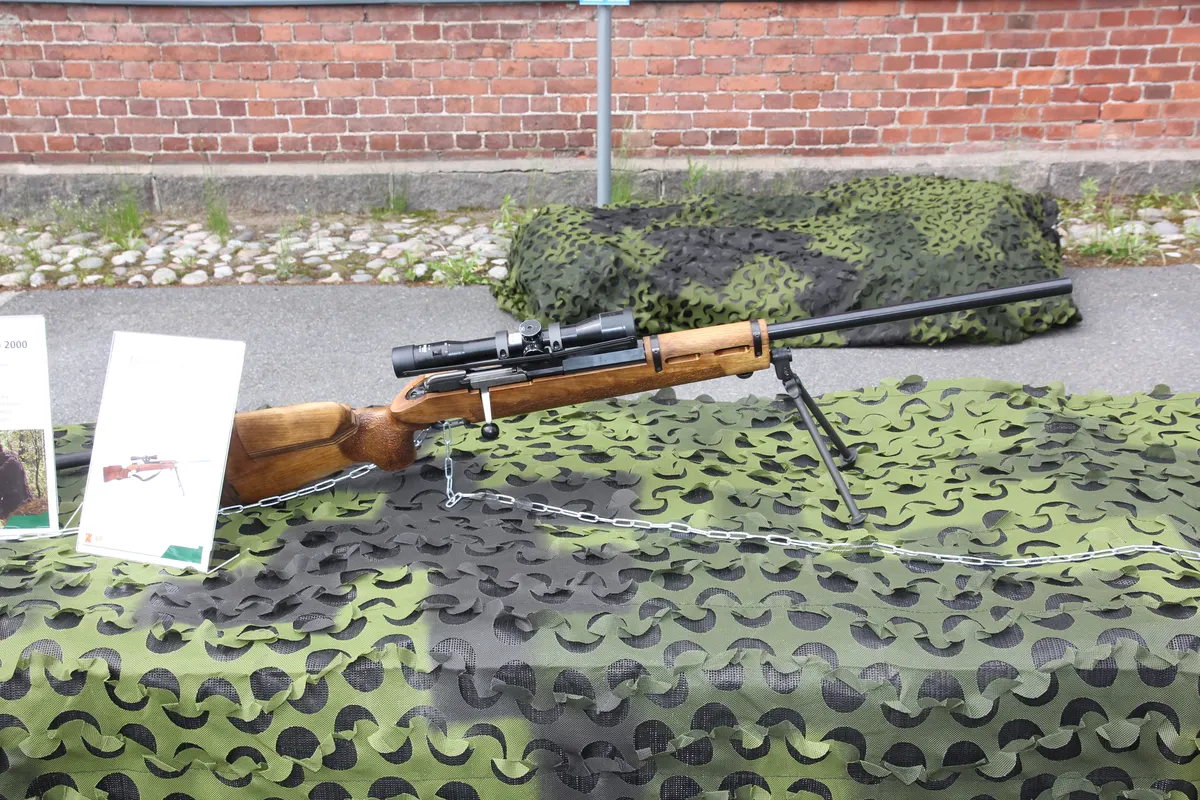
Finland spent the Cold War and the decades after it firing a bolt-action sniper rifle built on a Mosin-Nagant action. In January 2022 that changed. The Finnish Defence Forces Logistics Command signed a contract with Sako for a domestically designed, domestically built replacement family, the Rifle System M23.1 The program is better understood as two related weapons sharing one platform. The 7.62 KIV 23 is a designated marksman rifle issued down to infantry sections, and the 7.62 TKIV 23 is the dedicated sniper variant, fitted with a stronger optic and rated to a longer engagement distance.2
- domestic design and manufacture, no export licence dependency
- proprietary short-stroke gas piston, lower fouling than direct impingement
- suppressor issued as standard equipment, not an accessory
- shares parts and tooling with the RK 62M service rifle
- 10 and 20-round magazines both issued for role flexibility
- semi-automatic only, no select-fire capability
- effective range trails purpose-built bolt-action sniper systems
- no confirmed unit price, procurement transparency is thin
- combat record is nonexistent, all evaluation so far is peacetime
Both configurations fire the NATO standard 7.62x51mm cartridge, a deliberate move away from the rimmed 7.62x54mmR round the older TKIV 85 used, and both are built around a gas-operated rotating bolt derived from the American AR-10 and AR-15 pattern rather than a from-scratch mechanism.3
Sweden's involvement makes this more than a purely Finnish program. Sweden joined the evaluation in October 2021 and later signed its own procurement framework, fielding the same hardware under the designation Automatkarbin 24.4 Sako markets the whole family as the Sako ARG, with M23 and Ak 24 acting as national labels on shared engineering rather than two separate designs.5 The M23 sits within the broader family of battle rifles chambered for full-power NATO cartridges, though its role as a marksman and sniper system places it closer to the designated-marksman end of that category than to a general-issue infantry rifle.
Finland's defence establishment weighed the M23 against Heckler & Koch's HK417 during the trial phase and judged the two platforms close on raw performance, choosing Sako mainly for the industrial benefits of building the rifle at home.2 First deliveries reached Finnish units in late 2022, and the M23 family entered active service in 2023, replacing both the TKIV 85 and Dragunov-pattern rifles that had carried the marksman and sniper role since the Cold War.6
The contract that funds all of this is unusually open-ended. Sako's initial deal was worth roughly 10 million euros including tax, but it carries an option that could grow to as much as 525 million euros for follow-on orders, ammunition, and support.7
At 3.9 kg unloaded and 880 to 965 mm long with its adjustable Magpul CTR stock collapsed or extended, the M23 sits in typical weight and length territory for a modern AR-10-derived rifle.3 The KIV 23's barrel measures 406.2 mm, 16 inches, a compromise length meant to keep the rifle handy for a rifleman working inside a normal infantry section rather than shooting from a fixed position.3
- İlk Üretim Yılı2022
- Hizmete Giriş Yılı2023
- TasarımcıSako
- Ağırlık (Boş)3,9 kg
- Halen HizmetteEvet
- Önemli KullanıcılarFin Savunma Kuvvetleri, İsveç Silahlı Kuvvetleri
The action is where Sako diverged furthest from a stock AR-10 clone. Instead of the direct-impingement gas system Eugene Stoner's original design used, the M23 runs a proprietary self-regulating short-stroke gas piston, which keeps combustion byproducts out of the rotating bolt carrier and reduces the cleaning burden compared with a direct-impingement rifle firing the same volume of ammunition.2 Sako engineers also borrowed components from the RK 62M, the modernized Kalashnikov-pattern service rifle Finland already produces, cutting the cost of tooling and simplifying spare-parts logistics across the two very different rifle families.2
- Fişek7.62x51mm NATO
- Çap7,62 mm
- Kovan Uzunluğu51 mm
- Çap Sınıfımuharebe tüfeği
- Kenar AteşlemeliHayır
- Kovansız MühimmatHayır

Feeding comes from detachable polymer magazines in 10 and 20-round capacities, both issued rather than one being a rear-echelon substitute for the other, letting a unit swap between a low-profile 10-round magazine and a standard 20-round magazine depending on the mission.3 Fire control is semi-automatic only, consistent with a marksman and sniper role rather than a general assault rifle.
- Mekanizma TipiGazlı
- Atış Modlarıyarı otomatik
- Seçmeli AtışHayır
- Besleme SistemiÇıkarılabilir Şarjör
- Şarjör Kapasitesi20
Optics differ by variant, which matters for anyone trying to read a single spec sheet for the whole family. The KIV 23 carries a Trijicon VCOG 1-6x24 variable optic and is rated to an effective range of 600 m. The TKIV 23 instead mounts a Steiner M7Xi 2.9-20x50 scope with a Finnaccuracy MSR-FDF reticle developed for the program, and its rated effective range extends to 800 m.3 Both rifles share a full-length NATO Accessory Rail built to the STANAG 4694 standard along the top of the receiver, plus M-LOK slots on the handguard for lights, foregrips, or a bipod. Furniture is finished in a green ceramic coating, and the controls, safety, magazine release, and charging handle are ambidextrous.8
- Etkili Menzil (nokta)600 m
- Etkili Menzil (alan)800 m
That suppressor detail is worth dwelling on because it is unusual for a rifle issued this broadly. Flow-through suppressor designs vent propellant gas through the can rather than trapping it, which keeps the increase in bolt carrier velocity to roughly 5 percent instead of the 25 to 50 percent jump a conventional suppressor can cause, reducing wear and unlocking timing problems that plague suppressed direct-impingement rifles in particular.9 Combined with the suppressor-ready threading built into every barrel, Finland effectively issued a hearing-protected, flash-reduced rifle as the baseline configuration rather than treating suppression as a special-forces add-on.
- Namlu Uzunluğu406,2 mm
- Nişangah TipiMekanik veya optik nişangah; Trijicon VCOG 1–6×24 (KIV 23); Steiner M7Xi 2.9–20×50 (TKIV 23)
- Optik RayıEvet
- Açık NişangahHayır
- Dişli NamluEvet
Several of these choices point toward the same operating environment. The full-length accessory rail lets a unit mount a day optic and a separate night-vision or thermal device without swapping mounts, the ambidextrous controls keep the rifle usable in thick winter gloves regardless of which shoulder a shooter favors, and the green ceramic finish resists the wear that cold, wet, and abrasive terrain puts on a coated receiver. None of that is unique to Finland, but it lines up with a rifle meant to serve conscripts and reservists across a long winter training cycle rather than one design detail chosen in isolation.
- Toplam Uzunluk965 mm
- Kabza/Dipçik Malzemesipolymer, green ceramic coated
- Katlanır / Toplanır DipçikHayır
- Bullpup DüzeniHayır
- Çift Yönlü KumandalarEvet
- Susturucuya HazırEvet
- Entegre BipodEvet
- Bombaatar KabiliyetliHayır
- Gaz PistonluEvet
- Üretim Başlangıcı2022
- Varyantlar2
The M23 began under the internal codename K22, short for Kokeilu 22, meaning Experiment 22. The Finnish Defence Forces signed a letter of intent with Sako in May 2020 to develop a domestic replacement for the country's aging Cold War-era marksman and sniper rifles.2 Colonel Rainer Peltoniemi, then Inspector of the Infantry, was the officer who specified what the new system needed to do, pushing for a rifle that could serve both as a section-level marksman weapon and as a dedicated sniper platform from one common design.3
Finland did not run the program alone for long. In April 2021 Finland and Sweden signed an information-exchange agreement covering small arms, and that October Lieutenant General Petri Hulkko, commander of the Finnish Army, confirmed Sweden had formally joined the evaluation.3 Minister of Defence Antti Kaikkonen later authorized the joint acquisition arrangement that let both countries buy from the same production line.3

The Finnish Defence Forces announced its procurement decision on 21 December 2021, and the formal contract with Sako followed on 12 January 2022, signed at the Logistics Command headquarters.1 Deliveries began before the end of that year from Sako's plant in Riihimäki, and the rifle entered active Finnish service through 2023 as the 7.62 KIV 23 and 7.62 TKIV 23, retiring the SVD Dragunov-pattern rifles and the TKIV 85 bolt-action sniper rifle that had served since the 1980s.6
Sweden's commitment deepened further on 27 March 2023, when the two countries signed a ten-year framework agreement at Sako's Riihimäki factory covering a shared family of firearms, with three optional seven-year extension periods that could keep the arrangement running until 2053.4 Sweden's share of that 2023 framework was valued at roughly 875 million Swedish kronor, about 82 million dollars.5 In Swedish service the rifle carries the designation Ak 24 rather than M23, and its first fielded variant was a 5.56mm personal defense weapon, the SSV 24, which began reaching Swedish units in 2025.10 Sweden's 7.62mm infantry rifle and marksman variants, intended to replace the older Ak 5 and Ak 4 rifles, are planned to begin entering service in 2026.10
Major Mika Mäenpää, an officer involved with the program, publicly confirmed several design details of the rifle over social media as the K22 trials wound down, ahead of the formal December 2021 procurement announcement.3
Alongside the rifle program, Finland separately signed a letter of intent with Nammo Lapua Oy to develop a domestically produced 7.62mm cartridge, aiming to reduce reliance on imported ammunition for the new platform.3 Sako itself has been part of the Beretta group since 2000 and now sits within Beretta Defence Technologies alongside Beretta, Benelli, and Steiner, the optics maker that supplies the TKIV 23's sniper scope.11
The M23 family splits into two Finnish configurations built on the same receiver. The KIV 23 is the designated marksman rifle, issued at section level with a 16-inch barrel and a Trijicon VCOG 1-6x24 optic rated to 600 m. The TKIV 23 is the dedicated sniper rifle, mounting the higher-magnification Steiner M7Xi 2.9-20x50 scope and rated to 800 m.3 Sako groups both under the Sako ARG branding, the same underlying hardware Sweden buys as the Ak 24.
Sweden's branch of the family is developing on a slightly different timeline. The SSV 24, a 5.56mm personal defense weapon variant, began entering Swedish service in 2025 as the first fielded Ak 24 configuration.10 Sweden's 7.62mm variants, an infantry rifle and a designated marksman rifle intended to replace the Ak 5C along with the Ak 4B, Ak 4C, and Ak 4D rifles, are scheduled to start reaching units in 2026.10 Because the Swedish 7.62mm rollout has not yet begun in earnest, it is more accurate to describe Sweden as a committed procurement partner fielding an early variant than as a country with the rifle in service at Finland's scale.
The M23's cartridge choice is itself a quiet variant story. Moving the marksman and sniper role off the rimmed 7.62x54mmR round the Dragunov-pattern rifles used and onto standard 7.62x51mm NATO ammunition lets Finland train marksmen on the same bulk ammunition its other 7.62mm systems already consume, rather than maintaining a separate rimmed-cartridge supply chain for a small number of specialist rifles.2


| Yıl | Alıcı | Adet | Tutar | Bugünkü Değer (2025) |
|---|---|---|---|---|
| 2023 |  İsveç | — | $82.0 M | $86.6 M |
| 2022 |  Finlandiya | — | — | — |
Finland is the only country where the M23 family is fully fielded and operational, in service since 2023 as the standard designated marksman and sniper rifle across the Finnish Defence Forces.6 Sweden is a confirmed procurement and development partner rather than a current large-scale operator. Its 5.56mm SSV 24 began reaching units in 2025 under the Ak 24 designation, while the 7.62mm variants that will actually replace Sweden's Ak 5 and Ak 4 rifles are not scheduled to begin fielding until 2026.10 No other country has confirmed an order for the rifle.
Finland's own evaluators found remarkably little daylight between the M23 and the HK417 during the K22 trials, a Finnish defence commentator who tracked the program described the two rifles as barely distinguishable on paper.2 What actually decided the contract was not a performance gap. Building the M23 at Sako's Riihimäki plant gave Finland control over its own supply chain for a weapon system it expected to depend on for decades, along with the ability to repair and modify the rifle domestically rather than routing spares and technical support through a foreign supplier.2
| Sako M23 (KIV 23) | HK417 | |
|---|---|---|
| Cartridge | 7.62x51mm NATO | 7.62x51mm NATO |
| Action | Gas-operated, short-stroke piston | Gas-operated, short-stroke piston |
| Weight (empty) | 3.9 kg | approx 4.0 to 4.9 kg depending on barrel3 |
| Barrel length | 406.2 mm (16 in) | 12, 16, or 20 in variants3 |
| Primary adopter | Finland (2023) | Germany and multiple export customers |
Both rifles converge on the same underlying formula, an AR-10 pattern receiver driving a short-stroke piston in 7.62mm NATO, which is precisely why the trial came down to industrial policy instead of ballistics. The HK417 had the advantage of an established combat record and a wide existing customer base by the time Finland ran its evaluation, while the M23 offered Finland a rifle it could build, modify, and resupply without depending on Germany's arms-export approval process, a consideration that carried real weight for a country bordering Russia.2


Is the Sako M23 still in service? Yes. Finland fielded the KIV 23 and TKIV 23 configurations in 2023 and both remain the country's standard designated marksman and sniper rifles.6
What is the difference between the KIV 23 and TKIV 23? The KIV 23 is the designated marksman configuration, with a 406.2 mm barrel, a Trijicon VCOG 1-6x24 optic, and a 600 m rated range. The TKIV 23 is the sniper configuration, mounting a Steiner M7Xi 2.9-20x50 scope and rated to 800 m.3
How does the Sako M23 compare to the HK417? Finnish evaluators found little practical difference between the two rifles during trials and selected the M23 mainly to secure domestic production and supply, not because it outperformed the HK417.2
What is the Sako M23's unit cost? No confirmed per-unit price has been published. Finland's initial contract was worth about 10 million euros including tax, with a follow-on option that could reach 525 million euros, though that figure's exact scope, rifles alone or rifles plus ammunition and support, has not been officially detailed.7
Does Sweden use the Sako M23? Sweden uses the same underlying rifle platform under its own designation, Ak 24, as part of a joint ten-year procurement framework with Finland. Sweden's 5.56mm SSV 24 variant began fielding in 2025, with 7.62mm variants planned from 2026.10
- "Sako Ltd and Finnish Defence Forces sign a contract for the procurement of a new rifle system", Sako Ltd — sako.global ↩
- "M23 - If it aint broke, build it at home", Corporal Frisk — corporalfrisk.com ↩
- "Sako M23", Wikipedia — en.wikipedia.org ↩
- "Finland, Sweden select Sako rifles", Overt Defense — overtdefense.com ↩
- "Finnish and Swedish Defence Forces to acquire a joint range of firearms from Sako", The Firearm Blog — thefirearmblog.com ↩
- "Sako supplies the M23 rifle system for the Finnish Army", all4shooters — all4shooters.com ↩
- "Finland Buys Sako M23 Rifles to Replace Soviet-Era Snipers", The Defense Post — thedefensepost.com ↩
- "Finlands Defence Ministry buys Sako M23 sniper rifles and designated marksman rifle", Military Leak — militaryleak.com ↩
- "Sustainable Suppression, New Hush Products from ASE Utra", The Firearm Blog — thefirearmblog.com ↩
- "Sweden and Finland adopt common NATO interoperable rifle platforms", Strikehold — strikehold.net ↩
- "Sako Ltd and Finnish Defence Forces sign a contract for the procurement of a new rifle system", Beretta Defense Technologies — berettadefensetechnologies.com ↩