


The AVB-7.62 carries a name that reads like an acronym for something technical, but ABB simply stands for Автоматическая Винтовка Барышева, Baryshev's Automatic Rifle, after the one man who built it.3 Anatoly Filippovich Baryshev began developing his recoil-reduction system in 1962 as a private, unofficial project, a genuinely unusual thing inside the Soviet arms industry, where new small arms normally came out of state design bureaus rather than an individual working largely on his own initiative.2,4 The AVB-7.62 chambers the full-power 7.62x54mmR rifle round and fires from an open bolt through a delayed-blowback action with no gas system at all, a mechanical choice aimed squarely at one problem, taming automatic fire recoil from a cartridge that conventional Kalashnikov-pattern rifles struggle to control on full auto.1,2
- reportedly 2 to 3 times lower felt recoil than Kalashnikov-pattern rifles on full auto[^5]
- full-power 7.62x54mmR cartridge in a 3.9kg platform
- decades of sustained, largely self-funded development
- compatible magazine well with existing SVD-pattern box magazines[^2]
- never adopted by any military despite repeated trials
- reported reliability problems under harsh field conditions
- reported accuracy loss firing single shots
- sensitive to ammunition and fouling variation[^2]
Baryshev worked on the idea for roughly three decades, from the early 1960s into the late 1990s, chambering versions of the same basic mechanism in everything from 5.45x39mm to a 30mm grenade launcher.3,4 None of it was ever adopted. The Soviet Army tested prototypes in the 1980s and rejected the design over reliability and accuracy concerns, and the collapse of the Soviet Union in 1991 ended any remaining state interest before a production decision could be revisited.1,3 As a battle rifle chambered for a full-power cartridge and built around a folding stock and detachable box magazine, the AVB-7.62 sits at the far edge of that category, a weapon that never left prototype status yet accumulated a documented, decades-long development history few one-man projects in Soviet or Russian small arms design can match.
Baryshev was born on 8 July 1931 near Istra, north of Moscow, and died on 6 April 2021.10 He trained at a technical college in the Moscow suburb then called Kaliningrad, today's Korolyov, and reportedly worked under the noted Soviet engineers V.G. Grabin and A.M. Lyulka before turning to independent small arms design.4,10 That training gave him real engineering credibility, but not enough institutional backing to unseat an already-standardized Kalashnikov production base.
A Bolt With No Gas Tube, Built From an Inertia Piece and a Locking Lever
The AVB-7.62's action fires from an open bolt and dispenses with a gas port, gas tube, and piston entirely.2 The bolt group is built from four parts, a bolt with a tilting or rotating head, an inertia piece, and a locking lever.2,3 As the bolt group runs forward it strips and chambers a round, and the locking lever's engagement with the inertia piece delays the bolt face from unlocking off the barrel extension until chamber pressure drops, using the inertia piece's own forward momentum as the retarding element rather than a rotating gas-locked bolt or a piston.2,3 Baryshev received a Soviet inventor's certificate, No. 48117, in 1969 for the locking-bolt design, and a later patent from Russia, No. 2002195, filed in 1992, covers the same mechanism.4,9 The same device was separately patented across Austria, Britain, Belgium, Germany, Italy, France, Switzerland, the Czech Republic, Slovakia, Ukraine, and China, an unusually wide footprint for a design that never won a single production contract.10
- İlk Üretim Yılı1985
- TasarımcıAnatoly Filippovich Baryshev (1931-2021)
- Ağırlık (Boş)3,9 kg
- Halen HizmetteHayır
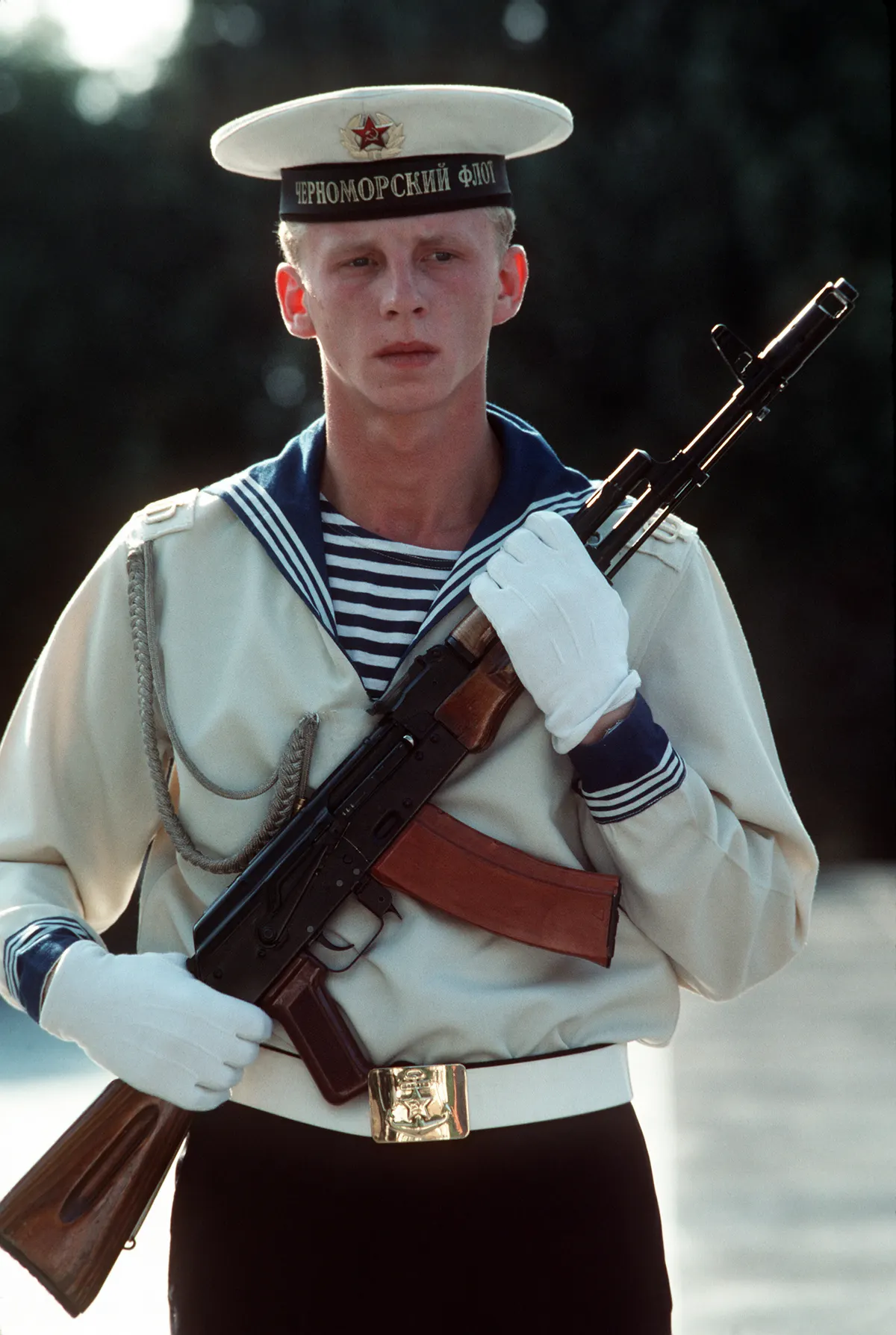
Externally the rifle is closer to a standard Kalashnikov than most delayed-blowback designs manage to be. It reportedly shares close to two-thirds of its parts with the AKM and AK-74, and differs from a folding-stock AKMS mainly in swapping the gas tube for a fixed carrying handle and using a different stock profile.1,2 That parts commonality was likely deliberate, since it would have simplified any production switch from standard Kalashnikov-pattern rifles had the Army adopted the design.1,2
- Fişek7.62x54mmR
- Çap7,62 mm
- Kovan Uzunluğu54 mm
- Çap Sınıfı7.62mm
- Kenar AteşlemeliHayır
- Kovansız MühimmatHayır
A Different Physics From the AK-107's Balanced Recoil System
The AVB-7.62 is sometimes confused with Kalashnikov Concern's family of balanced-recoil rifles, the AK-107 and AK-108, but the two systems share only a goal, not a mechanism or an origin. The AK-107's Balanced Automatics Recoil System, known as BARS, was invented by Pyotr Tkachev at the state institute TsNIITochMash and first demonstrated in 1965 on the AO-38 prototype, decades before it reached even limited production.8 Youriy Alexandrov later adapted BARS for Kalashnikov-pattern rifles at Izhmash, using two opposed operating rods, a main bolt carrier and a synchronized counter-mass, timed by a small star sprocket so their recoil impulses cancel each other simultaneously.8 Unlike Baryshev's mechanism, BARS is fully gas-operated, it doubles the moving mass to cancel recoil rather than delaying unlocking with an inertia piece. No documented connection between Baryshev and Tkachev or Alexandrov has surfaced, despite both tackling the same problem in the same country within decades of each other.
- Mekanizma TipiGeciktirmeli Blowback
- Besleme SistemiÇıkarılabilir Şarjör
- Şarjör Kapasitesi20
- Teorik Atış Hızı750
Dimensions, a Barrel-Length Discrepancy, and the SVD-Pattern Magazine
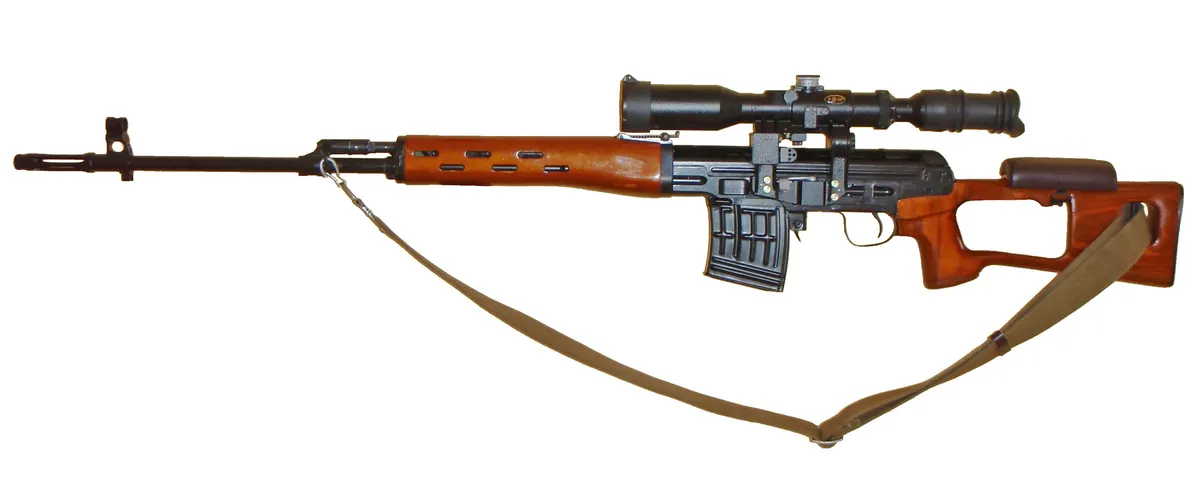
The AVB-7.62 measures 1,000mm overall with the stock extended and 750mm folded, weighs 3.9kg empty, and cycles at 750 rounds per minute.1,2 Barrel length is the one figure where sources disagree. Wikipedia and Modern Firearms independently list 455mm, while Russian aggregator sites such as weaponland.ru cite 500mm instead.1,2,3 The two independent English sources are treated as more reliable here, though the discrepancy remains unresolved in the wider literature. Muzzle velocity is reported at approximately 800 meters per second, and maximum range at roughly 800m.3,5
- Namlu Çıkış Hızı800 m/sn
- Azami Menzil800 m
The magazine is a detachable box magazine drawn from the SVD Dragunov's own magazine well, and here too sources split. Modern Firearms and the English Wikipedia entry both describe 10 or 20-round capacities as options, while Russian-language sources more often mention only the 10-round magazine as the one commonly seen in testing.1,2,3 Both capacities appear to be genuine, documented options rather than a simple sourcing error, so the rifle is best described as accepting either.
- Namlu Uzunluğu455 mm
- Bombaatar KabiliyetliHayır
- Gaz PistonluHayır
- Varyantlar4
Baryshev began independent prototyping in 1962, working outside any state design bureau at a time when Soviet small arms development was almost entirely institutional.3,4 He filed for his defining patent, the locking-bolt mechanism, in 1969 and received Soviet inventor's certificate No. 48117 that same year.4 Over the following decades that single mechanism grew into what its own documentation calls a complex of related weapons rather than one rifle. Alongside the AB-5.45 in 5.45x39mm and the AB-7.62 in 7.62x39mm M43, Baryshev scaled the same inertia-delayed principle up into the KPB, a 12.7x108mm heavy machine gun, and the ARGB, a 30mm automatic grenade launcher firing VOG-17 rounds.3,4 The AVB-7.62 in full-power 7.62x54mmR, the version described here, represents the rifle-caliber high end of that family.
Field trials in the 1980s tested the design against the Soviet Armed Forces, KGB border troops, and GRU special operations units, and the reaction split sharply along institutional lines.3 The special services reportedly pushed for urgent adoption, while Army leadership judged the existing Kalashnikov system already fully developed and the cost of switching production lines and retraining armorers too high to justify. Reported reliability problems under harsh conditions and reduced single-shot accuracy gave the Army a technical justification on top of the budgetary one.1,2,3
The Soviet collapse in 1991 removed whatever institutional path to adoption remained, and Baryshev kept working on the design privately through the 1990s rather than abandoning it.1,3 In the early 1990s he partnered with Czech company LCZ Group, which produced prototype derivatives in 7.62x39mm (the LCZ B10) and 7.62x51mm NATO (the LCZ B20).2,3
LCZ Group showed the prototypes at the IDET defense exhibition in Brno in 1995, and two independent accounts agree the firm displayed them without crediting Baryshev as the designer, after which the cooperation agreement was terminated.3,9 No buyer ever emerged for either prototype, and LCZ eventually returned them to Baryshev.2
The core Baryshev family runs to five members built around the same inertia-delayed mechanism, the AB-5.45 (5.45x39mm), the AB-7.62 (7.62x39mm M43), the AVB-7.62 described here (7.62x54mmR), the KPB (12.7x108mm heavy machine gun), and the ARGB (30mm automatic grenade launcher).3,4 Baryshev treated the mechanism as a general-purpose operating system rather than a single rifle design.
The Czech cooperation added a further branch. LCZ Group's own prototypes, the LCZ B10 and LCZ B20, never reached production, but the LCZ B20 went on to form the technical basis for later, separately developed Czech designs.2,6 The Czech firm ČZW built improved derivatives, the ČZW-556, a 5.56x45mm NATO assault rifle using the same lever-delayed blowback principle, first built in prototype form in 2004, and the ČZW-762, a folding-stock 7.62x39mm derivative pitched in a light machine gun role.6,7 Both were floated as possible successors to the aging vz. 58 service rifle, and the ČZW-762 was still being shown to buyers as late as 2014, at the KADEX defense exhibition in Kazakhstan, without ever securing an order.9
None of the Baryshev-family weapons or their Czech-designed descendants reached a production order of meaningful size. The family stayed a chain of prototypes across two countries and roughly four decades rather than a fielded weapons system, and both represent the closest the underlying mechanism ever came to real commercial traction.6

No armed force ever formally adopted the AVB-7.62 or any other weapon in the Baryshev family. The Soviet Armed Forces, KGB border troops, and GRU special operations units evaluated prototypes during 1980s field trials, and the special services reportedly favored adoption, but no procurement decision followed before the Soviet Union dissolved in 1991.1,3 The Czech LCZ Group and later ČZW displayed their own derivative prototypes through the 1990s and 2010s without securing a single confirmed military customer.2,6,9
Baryshev's rifle and the AK-107 attack the same underlying problem, controlling recoil during automatic fire, but they start from different cartridges and different institutions. The AVB-7.62 takes on the harder version, a full-power 7.62x54mmR round, using a private inventor's inertia-delayed blowback mechanism with no gas system at all. The AK-107 solves recoil for the intermediate 5.45x39mm round (and its 5.56x45mm AK-108 export version) using a state institute's fully gas-operated, dual counter-mass BARS system.1,8 Both projects trace back to the 1960s and promised comparable recoil reduction, but the AK-107 at least reached a production catalog listing at Kalashnikov Concern decades later, while the AVB-7.62 never left prototype status.8
| AVB-7.62 | AK-107 | |
|---|---|---|
| Cartridge | 7.62x54mmR1 | 5.45x39mm (5.56mm in AK-108)8 |
| Operating principle | Inertia-delayed blowback, no gas system2 | Gas-operated, dual counter-mass (BARS)8 |
| Origin | Private inventor (Baryshev)4 | State institute (TsNIITochMash), adapted at Izhmash8 |
| Adopted by a military | No | No, limited production only8 |
Set against a standard Kalashnikov-pattern rifle firing the same 7.62x39mm-class cartridge family, the difference is more straightforward. A conventional AKM relies on its mass and stock design alone to manage recoil, while the AVB-7.62's whole reason for existing was to cut that recoil mechanically, at the cost of the reliability and single-shot accuracy the Army ultimately would not accept in trade.1,2 That tradeoff, real recoil reduction against real reliability risk, is the throughline across every version of the Baryshev mechanism, from the original AB-5.45 through the AVB-7.62 to the Czech ČZW derivatives built decades later.


Was the AVB-7.62 ever adopted by any military? No. Soviet field trials in the 1980s tested it against the KGB, GRU, and the regular Army, and while the special services reportedly favored adoption, the Army rejected it and the Soviet collapse in 1991 ended any further state process.1,3
How does the AVB-7.62's delayed-blowback action work? It fires from an open bolt with no gas port, gas tube, or piston. A bolt with a tilting head, an inertia piece, and a locking lever work together so the inertia piece's forward momentum delays the bolt face unlocking from the barrel until chamber pressure has dropped.2,3
Is the AVB-7.62 the same as the AK-107's balanced recoil system? No. Both reduce recoil, but the AK-107's BARS mechanism is gas-operated with two synchronized counter-recoiling rods, invented at TsNIITochMash and adapted at Izhmash. The AVB-7.62 uses no gas system at all and was developed independently by a private inventor with no documented connection to the BARS program.2,8
What magazine does the AVB-7.62 use? SVD Dragunov-pattern detachable box magazines, reportedly offered in both 10 and 20-round capacities depending on the source.1,2
Is the AVB-7.62 still in service anywhere today? No. It never received a production order or formal adoption from any military, in the Soviet Union, Russia, or the Czech Republic, where a related family of prototypes was later developed.1,2,6
- "Baryshev AVB-7.62", Wikipedia — en.wikipedia.org ↩
- "Baryshev AB-7,62 AVB-7,62", Modern Firearms — modernfirearms.net ↩
- "Автомат Барышева АБ-5,45 / АБ-7,62 / АВБ-7,62", weaponland.ru — weaponland.ru ↩
- "Оружие без отдачи, система Барышева", Армейский вестник — army-news.ru ↩
- "Baryshev AVB-7.62", Grokipedia — grokipedia.com ↩
- "ČZW 556", Gun Wiki — guns.fandom.com ↩
- "ČZW 762", Gun Wiki — guns.fandom.com ↩
- "AK-107", Wikipedia — en.wikipedia.org ↩
- "Автомат Барышева", Wikipedia (Russian) — ru.wikipedia.org ↩
- "Анатолий Филиппович Барышев", Weaponplace.ru — weaponplace.ru ↩