

Delayed blowback describes an operating mechanism in which the bolt is never mechanically locked to the barrel, yet it is also not free to fly open the instant a cartridge fires. A roller, lever, or gas-retard device imposes brief mechanical resistance on the bolt's rearward travel, holding it shut just long enough for chamber pressure to fall before the fired case starts to extract. The best known implementation is the two-piece roller-locked bolt of the CETME and Heckler & Koch G3 family, where a pair of steel rollers cam into recesses machined into the barrel extension and release only once pressure has dropped to a safe level.
Straight blowback resists opening with nothing more than bolt mass and spring tension, which limits it mainly to lower-pressure pistol-caliber cartridges. Delayed blowback adds genuine mechanical resistance, rollers, levers, or tapped gas, that raises the force needed to open the bolt without making it physically heavier. That is what lets a comparatively light bolt safely cycle a full-power rifle round like 7.62x51mm NATO. Gas-operated and gas-piston-operated actions instead lock the bolt fully to the barrel until pressure drops, independent of bolt weight, but generally demand more machining than a roller-delayed action built around stamped sheet steel, and roller-delayed bolts typically cycle open faster than fully locked ones. The mechanism is common across the battle rifles built on the G3 pattern.
01From Mauser's Gerät 06 to the CETME Roller Lock
The roller-delay principle traces back to wartime Mauser, which first built the Maschinenkarabiner Gerät 06 as a gas-operated roller-locking rifle. In December 1943 engineer Karl Maier worked out that with locking-piece angles of roughly 45 and 27 degrees, the gas system could be dropped entirely.1 That refinement produced the StG 45(M), a genuine roller-delayed blowback prototype, with the roller idea itself borrowed from the MG 42 machine gun's own roller-locking bolt. Wilhelm Stähle and Ludwig Vorgrimler patented the mechanism, and the Wehrmacht reportedly ordered around 30 prototypes before the war ended production.1
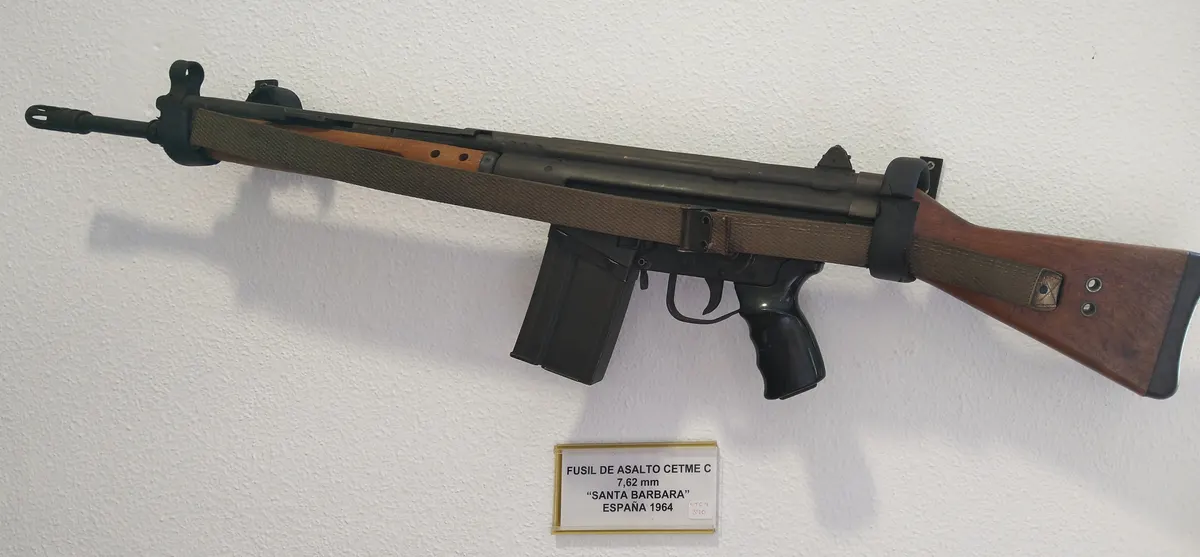
After capture, the Mauser design team relocated to French control at Mulhouse, where Vorgrimler and Theodor Löffler kept refining the action from 1946 to 1949, producing the CEAM Modèle 1950 carbine.2 When that French program was cancelled, Vorgrimler moved to Spain around 1950 to work for CETME, developing the Modelo 2 in 1953 and, after a West German request for a 7.62x51mm NATO version, the Modelo B that became the CETME rifle.2 Heckler & Koch, founded in 1948 by three former Mauser engineers, licensed the CETME design around 1957 and adapted it as the G3, officially adopted by the Bundeswehr in January 1959.2
01How the Two-Piece Roller-Delayed Bolt Actually Works
The G3-pattern bolt is a two-piece assembly. A bolt head carrying two rollers sits against the angled forward face of a heavier bolt carrier, with the rollers resting in matching recesses cut into the barrel extension when closed.3 On firing, chamber pressure pushes the bolt head rearward, and the angled recess geometry forces the rollers inward, driving the heavier carrier back faster than the bolt head during the high-pressure interval. That velocity mismatch between bolt head and carrier is the actual delay, not a lock in the sense a rotating-bolt rifle would use.4 Once pressure has fallen to a safe level the rollers disengage fully, and the bolt head and carrier travel back together to extract the case, eject it, and chamber the next round.4
Because the bolt head starts moving rearward while some chamber pressure still remains, G3-pattern chambers are cut with longitudinal flutes that float the fired case on a thin cushion of propellant gas, preventing the case head from sticking during extraction.4 It is a small but distinctive detail, often the quickest visual way to spot a roller-delayed action next to a locked-breech rifle.
01Spread of the Roller-Delay System Across the G3 Family and Beyond
The CETME rifle remained the direct Spanish parallel to the G3, refined through Modelo A, B, 58, and C variants.3 The G3 itself became the basis of an entire Heckler & Koch delayed-blowback family through the 1960s to 1980s, before the company shifted toward gas-piston designs in the 1990s.2 Norway built its own version as the AG-3 at Kongsberg Våpenfabrikk, serving from 1968 to 2008 and later modernized as the AG3F2.5 Pakistan Ordnance Factories received a transfer of technology from Heckler & Koch in 1965 and became one of the earliest foreign G3 manufacturers with the POF G3, whose G3A3 pattern remains its primary in-service variant.6 Sweden license-built the design as the Ak 4, first through Husqvarna Vapenfabrik from 1965 to 1970 and then Carl Gustafs Gevärsfaktori, later upgraded as the AK4C.5
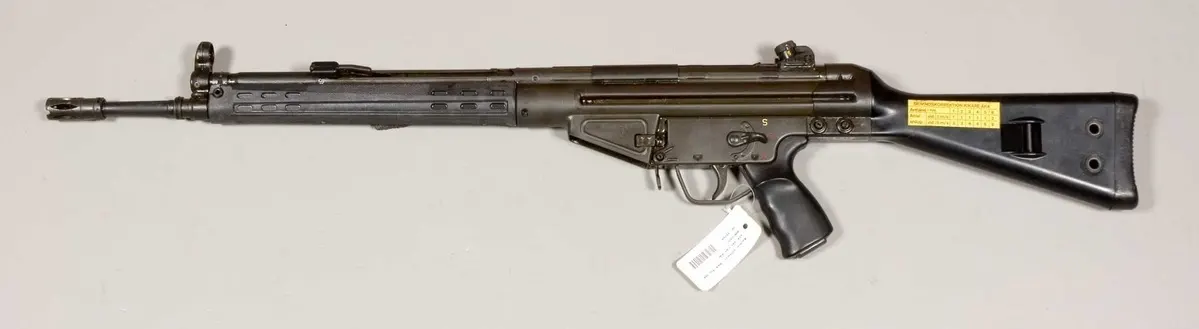
The action also spread into designated marksman and civilian variants. The HK MSG-90A1 and its predecessor HK MSG90 turned the roller-delayed G3 pattern into a precision rifle, while the PTR 91F continues the same action commercially in the United States after German reunification. The G3 was also license-produced in Turkey as the MKEK G3 and in Portugal, where the Portuguese army fielded its own contract-built G3 rifle m/961. Civilian and semi-automatic branches followed the same bolt too. The Heckler & Koch SL7, a 7.62x51mm sporting carbine, was built on the G3 action from the early 1980s until 1991 in Oberndorf am Neckar, and the semi-automatic-only HK41 was sold mainly to American civilian buyers before import restrictions curtailed it.7
Not every delayed-blowback design copied the roller geometry directly. Anatoly Baryshev's Soviet AVB-7.62 used a mechanically distinct lever-delay system firing 7.62x54mmR from an open bolt, cutting felt recoil but proving unreliable and inaccurate in trials, and it was never adopted.8 Switzerland's SIG SG 510, adopted in 1957, grew from a related but separately developed roller mechanism traced back to the wartime MG 45 and MG 55, though some sources describe its action as closer to a fully locked roller-lock than a pure roller-delay design, a distinction not consistently drawn across sources.
01Notes and Sources
- "Mauser Gerät 06/Stg.45(M) assault rifle", Modern Firearms — modernfirearms.net ↩
- "The Story Behind HK's Roller-Delayed Blowback Operating System", Strikehold.net — strikehold.net ↩
- "CETME mod. A, B, 58, C", Modern Firearms — modernfirearms.net ↩
- "How Does It Work: Roller-Delayed Blowback", Forgotten Weapons — forgottenweapons.com ↩
- "Modernizing the G3: The Swedish AK4C, Norwegian AG3F2 and More", Forgotten Weapons — forgottenweapons.com ↩
- "POTD: POF G3 Rifles From Pakistan", The Firearm Blog — thefirearmblog.com ↩
- "Heckler-Koch HK SL-6 SL-7", Modern Firearms — modernfirearms.net ↩
- "Baryshev AB-7,62 AVB-7,62", Modern Firearms — modernfirearms.net ↩


