

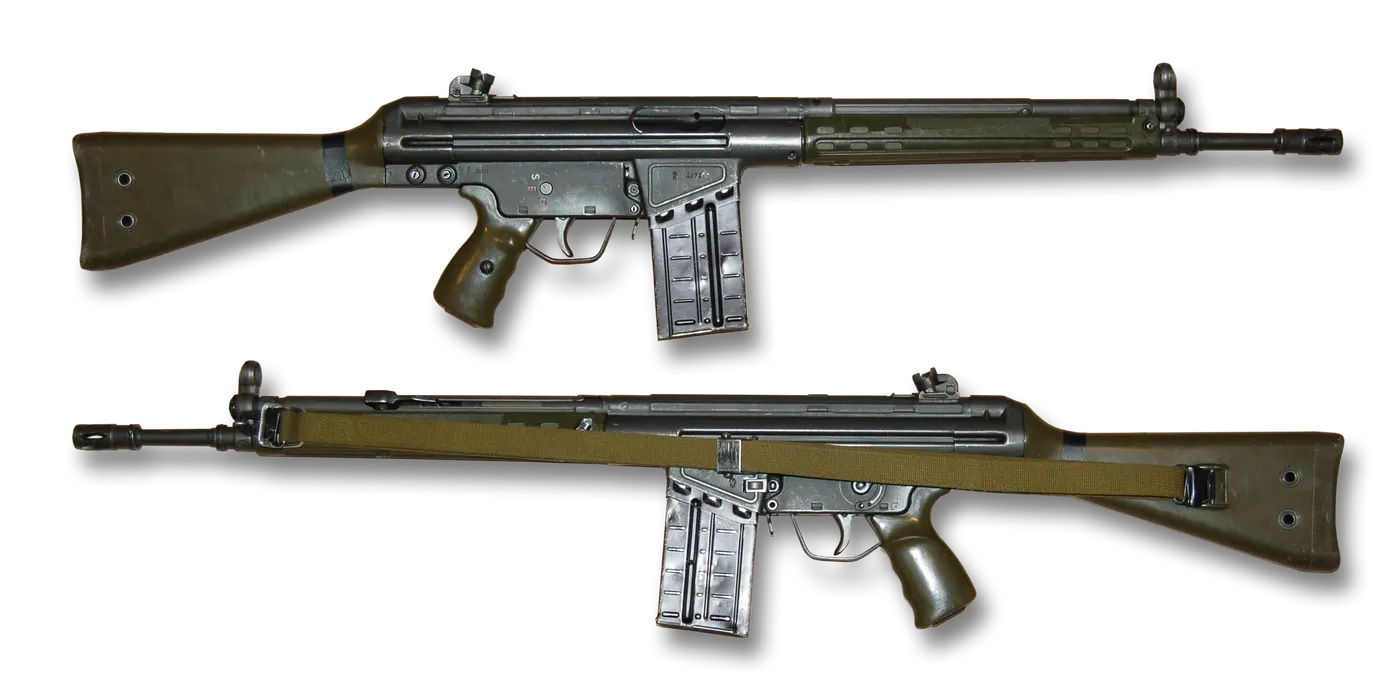

The Heckler & Koch G3 is a 7.62x51mm NATO battle rifle that became the standard infantry weapon of West Germany's Bundeswehr in 1959 and, over the following decades, one of the most widely produced and exported rifles of the Cold War.1 It uses a roller delayed blowback action rather than a gas system, and its receiver is built from stamped sheet steel rather than machined forgings, a manufacturing choice that made it markedly cheaper to produce than rivals like the FN FAL.2 Manufactured by Heckler & Koch in Oberndorf am Neckar, the G3 was exported to more than 70 countries and built under license in at least 15, putting more than 7.8 million rifles into service worldwide.3
- roller-delayed action needs no gas adjustment
- stamped-steel receiver, cheap to mass-produce
- full-power 7.62x51mm NATO cartridge
- proven in decades of continuous field use
- simple three-position safety/selector
- long and heavy compared to intermediate-caliber rifles
- sharp recoil impulse, hard to control on automatic fire
- accuracy adequate but not match-grade in standard builds
- fluted chamber leaves distinctive case marks and a reputation for rough extraction in dirty conditions
The rifle's roots run back to a wartime German engineering team, through a French internment program and a Spanish design institute, before returning to Germany as a domestic answer to a licensing dispute with Belgium's FN. That path, unusual for a Cold War service rifle, is described in the History section below.
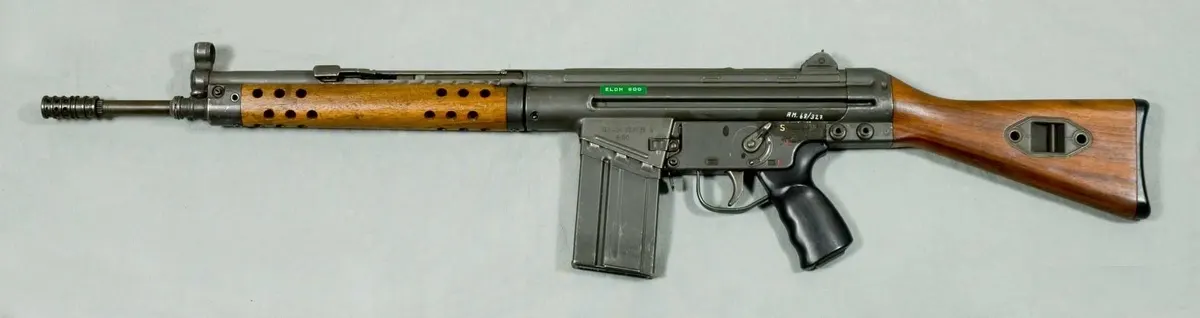
Its two most direct rivals through the Cold War were the Belgian FN FAL and the American M14, and its cheaper stamped-steel construction became the recurring reason procurement boards across several continents picked it over both, a point returned to in the Comparison section.
Germany replaced the G3 as its Bundeswehr's frontline rifle with the G36 during the 1990s, but modernized G3 variants remained in German reserve stocks as late as 2018, and the rifle is still in active first-line service with dozens of other armed forces today.4
Roller-Delayed Blowback and the Fluted Chamber
The G3 does not use a gas system at all. Its bolt is built in two pieces, a bolt head and a bolt carrier, linked by two lateral rollers that sit in locking recesses machined into the barrel extension.5 At the moment of firing, the rollers brace the bolt head against the barrel extension. Chamber pressure then forces the rollers inward and drives the bolt carrier rearward at roughly four times the speed of the bolt head in 7.62x51mm NATO chamberings, a delay ratio that lets pressure drop before the case is extracted.6 Heckler & Koch offers locking pieces of different mass and angle to fine-tune this timing for different ammunition.
- İlk Üretim Yılı1958
- Hizmete Giriş Yılı1959
- TasarımcıLudwig Vorgrimler, CETME, Mauser, Heckler & Koch
- Ağırlık (Boş)4,38 kg
A second feature works alongside the rollers. The chamber has longitudinal fluting, shallow grooves cut into the chamber wall that let a thin layer of propellant gas float the fired case away from the chamber surface during extraction.7 This is often called the signature of the roller-delayed design, and it leaves visible longitudinal marks on every spent case the G3 fires. The tradeoff is a design that runs without any gas port, gas piston, or adjustable regulator to fail or foul, which is the basis for the rifle's reputation for reliability. Compared with a gas-operated design like the FAL, there is genuinely less to adjust or maintain in the field, though critics note the extraction sequence can feel abrupt and can be less forgiving of poor-quality ammunition than a well-tuned gas gun.
- Fişek7.62x51mm NATO
- Çap7,62 mm
- Kovan Uzunluğu51 mm
- Mermi Ağırlığı9,5 g
- Kenar AteşlemeliHayır
- Kovansız MühimmatHayır
The Stamped-Steel Receiver and Its Cost Advantage
Where the FAL and the American M14 use machined or forged receivers, the G3's receiver, trigger housing, and most other structural parts are stamped from sheet steel and joined by spot welding and pinning.9 This was an explicit cost decision, not a byproduct of the roller-delayed action, and it made the G3 substantially cheaper to mass-produce than either rival. It is also the single most cited reason Sweden chose the G3 over the FAL in its 1964 rifle trials, discussed further in Comparison below.
- Mekanizma TipiGeciktirmeli Blowback
- Atış Modlarıyarı otomatik, otomatik
- Seçmeli AtışEvet
- Besleme SistemiÇıkarılabilir Şarjör
- Şarjör Kapasitesi20
- Teorik Atış Hızı500
Reliability is close to universally praised across military and civilian accounts, summarized bluntly in the enthusiast phrase that the rifle just runs.10 Accuracy is more nuanced. The G3 is not built to be a target rifle, and standard infantry-issue rifles typically group around 2 minutes of angle with quality ammunition, adequate for a service rifle but well short of a precision design.11 Build quality varied noticeably across the many licensed production lines, and commercial semi-automatic clones built to tighter tolerances have generally shot more consistently than mass-produced military-issue guns. Portuguese veterans of the colonial war in Africa, discussed in Conflicts, specifically praised the rifle's accuracy, stopping power, and ruggedness in heat, humidity, and sand.12 The cyclic rate of roughly 500 to 600 rounds per minute is on the slow side for an automatic rifle, which somewhat eases control on full-auto bursts but does not eliminate the sharp recoil impulse of a full-power 7.62mm cartridge fired from a rifle this light.
- Namlu Çıkış Hızı800 m/sn
- Azami Menzil1.000 m
- Namlu Uzunluğu450 mm
- Yiv Sayısı4
- Nişangah TipiArka: döner dioptrik; ön: kapaklı post
- Açık NişangahEvet
- Susturucuya HazırHayır
- Süngü TakozuEvet
- Entegre BipodEvet
- Bombaatar KabiliyetliEvet
- Gaz PistonluHayır
- Toplam Üretim8.000.000
- Üretim Başlangıcı1959
- Genişlik45 mm
- Yükseklik220 mm
From Mauser's Department 37 to a Spanish Design Institute
The G3's action was not invented for the G3. It began during the Second World War at Mauser's Department 37, where engineer Ludwig Vorgrimler and colleague Wilhelm Stähle developed a roller-delayed locking system, co-patented and tested in the Gerät 06 and StG 45(M) prototype rifles chambered for the intermediate 7.92x33mm Kurz cartridge.13 Germany's defeat ended that program before it reached production.
After the war, the Allies placed Department 37 under French administrative control as the DEFA Development Center at Oberndorf, and Vorgrimler and engineer Theodor Löffler were sent to France to continue the work at the CEAM research center in Mulhouse, refining roller-delayed prototypes in 7.92x33mm Kurz between 1946 and 1949.14 Facing expulsion from France, Vorgrimler relocated to Spain in September 1950 and joined the Spanish state design institute CETME, where he produced the LV-50 rifle.15 CETME developed this design further into the Model A and then the Model B, and when West Germany requested a version chambered for the emerging 7.62x51mm NATO cartridge, the resulting closed-bolt CETME Model B/58 was adopted by the Spanish Army in 1958 as the Modelo 58.
West Germany's Rifle Trials and a Licensing Dispute with FN
West Germany's own path back to a domestic rifle ran in parallel. In 1956 the Bundesgrenzschutz adopted the FN FAL as the G1, and that same year the newly reconstituted Bundeswehr began trials of 400 CETME rifles against the Swiss SIG SG 510 (trialed as the G2) and the American AR-10 (trialed as the G4).16 In January 1959 the Bundeswehr adopted the improved CETME proposal as the G3. Industrial policy drove the decision more than battlefield performance. West Germany wanted the rifle built domestically under license, and FN had refused to license FAL production to a West German manufacturer.17 Production was assigned jointly to Rheinmetall and the newly formed Heckler & Koch, founded in 1949 in Oberndorf am Neckar by former Mauser employees, with H&K adapting the CETME bolt, extractor, and ejection system to reliably handle the full-power NATO cartridge and altering the locking-piece angle from roughly 50 degrees to 45 degrees.18 Rheinmetall's production run ended some years later, leaving Heckler & Koch as sole manufacturer by 1977.
The G3 or its licensed derivatives have been fielded in most of the Cold War's proxy wars and several post-Cold War insurgencies. It has, unusually for a single rifle design, armed both sides of more than one of these conflicts.
First Blood in the Portuguese Colonial War
Portugal was among the very first nations to field the G3 in actual combat, deploying Fábrica Militar de Portugal-built rifles from 1961 in the Portuguese Colonial War across Angola, Mozambique, and Guinea-Bissau, in some accounts predating the Bundeswehr's own full operational fielding of the rifle.21
Portuguese troops praised the G3's accuracy, stopping power, and ruggedness in the heat, humidity, and sand of the African campaigns, while the independence guerrillas they fought were typically armed with the lighter and more mobile AK-47 or its AKM successor, a real and frequently noted contrast in weight and handling between the two rifle families.22
Rhodesia, Then Both Sides of the Same War
Rhodesia's security forces used licensed Portuguese-made m/961 and later m/963 pattern G3 rifles through the Rhodesian Bush War of 1966 to 1979, as the second most common rifle behind the FAL-derived R1 in Rhodesian Light Infantry service, where its recoil was noted as difficult to control on long automatic bursts.23 After Mozambique and Angola gained independence in the mid-1970s, captured and surplus G3s were funneled to ZANLA guerrillas fighting the Rhodesian government through Mozambique, meaning both sides of the same war ended up carrying the same rifle.24
Following Portugal's 1974 Carnation Revolution, South Africa purchased roughly 100,000 surplus Portuguese-made G3s, designated the R2 in South African service, and issued them to the South African Marine Corps, the South African Air Force, and the South West African Territorial Force.25
Iran's Sanctions-Era Rifle

The G3 was Iran's main service rifle in both the regular Army and the Islamic Revolutionary Guard Corps through the Iran-Iraq War of 1980 to 1988.26 Western arms sanctions imposed after the 1979 revolution cut off resupply from Heckler & Koch and other Western suppliers, making Iran's own domestic G3 production, run by the state Defense Industries Organization, essential to keeping the rifle in the field through the war.27
The G3 remained in widespread Iranian service for decades afterward and is only recently being phased out in favor of an indigenous rifle known as the Masaf.
El Salvador's Standard Rifle
The G3 was El Salvador's standard-issue service rifle for most of the Salvadoran Civil War of 1979 to 1992, before being phased out in favor of the American M16A1 and later M16A2.28 The United States purchased surplus Portuguese-made G3s as part of its military aid package to the Salvadoran government during the war. Combat feedback from that conflict, echoing a recurring theme in G3 history, held that the FAL was slightly more manageable to shoot while the G3 was regarded as slightly more reliable. There is no strong documented evidence that FMLN guerrilla forces used the G3 in significant numbers, since their FAL supply is far better sourced in the historical record.29
An Arms Embargo Workaround in the Nigerian Civil War
The Nigerian Civil War, also called the Biafran War, produced one of the more specific and unusual chapters in the G3's export history. The West German firm Fritz-Werner had built small-arms manufacturing capacity at Kaduna in northern Nigeria starting in 1963.30 In late 1967, the German director-general of the Kaduna plant personally arranged the purchase of G3 rifle kits through the arms dealer Interarms, and the West German Foreign Office authorized Fritz-Werner and Dynamit-Nobel to export three million rounds of 7.62mm ammunition each to Nigeria that year.31 When further West German export licenses were blocked in 1968, Fritz-Werner routed additional shipments through a third country to keep supply flowing.32 A 1976 contract modernized the Kaduna plant to produce an unlicensed rifle known as the Nigerian Rifle, prompting a formal objection from Heckler & Koch over the license infringement that was overruled by West German diplomats.33 Separately, Britain's Royal Ordnance, then Heckler & Koch's English manufacturing partner, assembled Nigeria-bound G3 rifles specifically to route around West Germany's own export restrictions.34 By the end of the war, the Nigerian Army's arsenal held roughly 6,000 G3 rifles alongside a similar number of the related HK21 and MP5.
The Turkish-PKK Insurgency and a Domestic Replacement
Turkey produced the G3 domestically under license through MKEK, and it was Turkey's standard-issue infantry rifle throughout the Kurdish-Turkish conflict that began with the PKK's 1984 insurgency and continued for decades afterward.36 Lessons drawn from that long counter-insurgency campaign fed directly into Turkey's decision to develop an indigenous replacement, the MPT-76, with the first 200 rifles delivered in May 2014 and a 20,000-unit production contract signed in June 2015.37
The rifle's other combat footprint spans the broader war on terrorism and the Iraq War, where G3s remained in the hands of Iraqi security forces and various militias, the war in Afghanistan from 2001 to 2021, the war in the Sahel, the Arab Spring uprisings, and, in a civilian-crime rather than state-conflict context, the Mexican drug war, alongside its general role as a standard NATO-adjacent battle rifle throughout the Cold War.
The original 1959 G3 had wood furniture and was followed by a steady series of factory upgrades rather than a wholesale redesign. The G3A2, introduced in 1962, added a rotary drum rear sight and a free-floating barrel.38 The G3A1, from 1963, introduced a retractable metal stock for compactness. The G3A3, also from 1963, became the definitive and most widely produced version, adding a flash suppressor doubling as a muzzle brake and a mount for firing NATO rifle grenades, along with a solid polymer stock and a free-floating handguard. At 4.38 kilograms unloaded it matches the weight most commonly cited for the type today.39 The G3A4, from 1974, paired the same features with a retractable stock, bringing empty weight to roughly 4.7 kilograms. The shortest carbine variant, the G3KA4, used an HK33-pattern handguard on a 322mm barrel, short enough that it cannot mount a bayonet or fire rifle grenades.40
A dedicated designated marksman variant, the G3SG/1, appeared around 1972, adding a bipod and a scope mount while retaining the standard rifle's automatic fire capability, a distinctly different approach from a purpose-built precision rifle.41
The roller-delayed action's real reach, though, is in the family of separate weapons it spawned rather than in the G3's own variant list. The HK21 adapted the mechanism into a general-purpose machine gun, the HK33 scaled it down to the 5.56mm NATO cartridge, the MP5 shrank it further into one of the most widely used submachine guns in the world, and the PSG1 and MSG90 turned it into dedicated precision rifles. The G41 later applied the same roller-delayed principle to a 5.56mm service rifle. Each of these is a distinct weapon in its own right rather than a G3 sub-variant, but all trace their action back to the same wartime roller-delayed concept.

Licensed production of the G3, separate from direct export sales, spread the design to at least 15 countries and by some counts as many as 18, according to the Small Arms Survey.42 Pakistan's Pakistan Ordnance Factories built the rifle domestically. Turkey's MKEK produced it, sometimes referred to locally as the T41, until Turkey moved to the domestic MPT-76 as described above. Portugal's Fábrica Militar de Portugal began production in 1962, with an early model called the Espingarda automática 7,62mm M/961 built from 1961 to 1964, superseded by the more widely issued M/963 pattern.43
Sweden trialed the FAL, the SIG SG 510, the domestic Carl Gustaf GRAM 63, the American M14, and the G3 side by side in 1964, ultimately selecting the G3 for license production as the Ak 4, built first by Husqvarna and later by Carl Gustafs Stads Gevärsfaktori from 1965 to 1985. Durability and lower manufacturing cost were the deciding factors.44 Norway's Kongsberg built the rifle as the AG-3, and Greece's Hellenic Defence Systems produced it domestically as well. Iran's Defense Industries Organization still nominally produces the design even as Iran phases in its own indigenous rifle. Additional licensed production ran in Saudi Arabia, Mexico, and Thailand.
Beyond licensed manufacturers, the G3 has been exported to more than 70 countries and adopted by more than 80 national armed forces at one time or another, described by some assessments as the single most widespread service rifle across the globe among Cold War battle rifles, ahead of the FAL, the M14, and the Soviet SVT and its successors.45
Spain does not properly belong on the G3's own operator list. Spain's service rifle was the parallel CETME design produced domestically by the Spanish institute that shares the G3's ancestry, not the German-built G3 itself, and any record listing Spain as a retired G3 operator likely conflates the two related but distinct rifles.
The G3 Against the FN FAL
The G3 and the FAL were direct rivals across dozens of Cold War rifle trials, and neither one clearly beat the other on raw performance. Both are generally well regarded for reliability, but the comparison usually comes down to how each achieves it. The FAL's gas system is robust and well proven, while the G3's roller-delayed blowback needs no gas port or adjustable regulator at all, the basis for its reputation for simply running.46 Combat feedback from El Salvador captured the tradeoff concretely. Troops there found the FAL somewhat more manageable to shoot, and the G3 somewhat more reliable under hard use.47
Accuracy comparisons are softer and more anecdotal. Some users report the G3 shooting slightly better at short range, inside about 100 yards, with the FAL's more finely machined barrel giving it a modest edge at longer range out to around 300 yards, though neither rifle was built as a match-grade design and both are described as satisfactory rather than exceptional for precision work.48 The sharpest, best-documented difference is cost of manufacture. The G3's stamped-steel receiver was considerably cheaper to mass-produce than the FAL's machined receiver, and that cost gap is the explicit, cited reason Sweden picked the G3 over the FAL in its thorough 1964 field trials, which remain the best-documented head-to-head comparison of the two rifles under a single evaluation program.49
| Heckler & Koch G3 | FN FAL | |
|---|---|---|
| Action | Roller-delayed blowback | Gas-operated, tilting bolt |
| Receiver | Stamped steel | Machined/forged |
| Cartridge | 7.62x51mm NATO | 7.62x51mm NATO |
| Weight (empty) | 4.38 kg50 | approx. 4.3 kg51 |
On adoption, the FAL had the early head start, reaching NATO-adjacent standard-issue status in more countries sooner. Measured over the full Cold War and beyond, the G3 has stayed in frontline and reserve service longer in aggregate and counts more active users today, a point made explicitly in retrospective assessments of the two rifles' careers.52


How does the Heckler & Koch G3 work? The G3 fires from a roller-delayed blowback action. A two-piece bolt braced by two lateral rollers delays the bolt's rearward movement just long enough for chamber pressure to drop before the case is extracted, and a fluted chamber floats the case off the chamber wall to ease that extraction, all without any gas port or piston.53
What are the G3's specifications? Standard G3A3 rifles fire the 7.62x51mm NATO cartridge from 20-round detachable box magazines, weigh 4.38 kilograms empty, run a cyclic rate of roughly 500 to 600 rounds per minute, and use a 450mm barrel.54
Is the G3 still in service? Yes. Germany itself retired the G3 from Bundeswehr frontline use in favor of the G36 during the 1990s but kept modernized variants in reserve stocks into the late 2010s, and dozens of other armed forces, including several licensed-production countries, still field it as an active-duty rifle.55
How does the G3 compare to the FN FAL? Both are reliable 7.62x51mm NATO battle rifles from the same era. The FAL's gas system and more finely machined barrel give it a slight edge in some long-range accuracy comparisons, while the G3's gasless roller-delayed action and cheaper stamped-steel receiver gave it a durability and cost advantage that won it more license-production customers over time, Sweden's 1964 trial being the clearest documented case.56
What did a G3 cost compared to other rifles? Exact historical unit costs are not consistently documented across the G3's many licensed production runs, but its stamped-steel construction was consistently cited as cheaper to manufacture than the machined-receiver FAL and M14, which is the reason several trial boards, including Sweden's, picked it on cost grounds.57
- "Heckler & Koch G3", Wikipedia — en.wikipedia.org ↩
- "G3 vs FAL: Comparing Cold War Battle Rifles", Small Arms Review — smallarmsreview.com ↩
- "Germany's G3 Rifle Has Lasted Longer Than the FAL and M14", The National Interest — nationalinterest.org ↩
- "Heckler & Koch G3", Wikipedia — en.wikipedia.org ↩
- "Roller-delayed blowback", Wikipedia — en.wikipedia.org ↩
- "Roller-delayed blowback", Wikipedia — en.wikipedia.org ↩
- "Heckler & Koch G3", Wikipedia — en.wikipedia.org ↩
- "Sturmgewehr 45", Wikipedia — en.wikipedia.org ↩
- "G3 vs FAL: Comparing Cold War Battle Rifles", Small Arms Review — smallarmsreview.com ↩
- "Heckler & Koch G3", Modern Firearms — modernfirearms.net ↩
- "Heckler & Koch G3", Modern Firearms — modernfirearms.net ↩
- "The Portuguese Colonial War and the G3 Rifle", Small Wars Journal — smallwarsjournal.com ↩
- "Sturmgewehr 45", Wikipedia — en.wikipedia.org ↩
- "CETME", Wikipedia — en.wikipedia.org ↩
- "CETME", Wikipedia — en.wikipedia.org ↩
- "Heckler & Koch G3", Wikipedia — en.wikipedia.org ↩
- "Heckler & Koch G3", Wikipedia — en.wikipedia.org ↩
- "Heckler & Koch G3", Modern Firearms — modernfirearms.net ↩
- "CETME", Wikipedia — en.wikipedia.org ↩
- "Heckler & Koch G3", Wikipedia — en.wikipedia.org ↩
- "Portuguese Colonial War", Wikipedia — en.wikipedia.org ↩
- "The Portuguese Colonial War and the G3 Rifle", Small Wars Journal — smallwarsjournal.com ↩
- "Rhodesian Bush War", Wikipedia — en.wikipedia.org ↩
- "Rhodesian Bush War", Wikipedia — en.wikipedia.org ↩
- "R2 rifle", South African Military History Society — samilitaryhistory.org ↩
- "Iran-Iraq War", Wikipedia — en.wikipedia.org ↩
- "Defense Industries Organization", Wikipedia — en.wikipedia.org ↩
- "Salvadoran Civil War", Wikipedia — en.wikipedia.org ↩
- "Salvadoran Civil War", Wikipedia — en.wikipedia.org ↩
- "Nigerian Civil War", Wikipedia — en.wikipedia.org ↩
- "Nigerian Civil War", Wikipedia — en.wikipedia.org ↩
- "Nigerian Civil War", Wikipedia — en.wikipedia.org ↩
- "Nigerian Civil War", Wikipedia — en.wikipedia.org ↩
- "Nigerian Civil War", Wikipedia — en.wikipedia.org ↩
- "Portuguese Colonial War", Wikipedia — en.wikipedia.org ↩
- "MPT-76", Wikipedia — en.wikipedia.org ↩
- "MPT-76", Wikipedia — en.wikipedia.org ↩
- "Heckler & Koch G3", Wikipedia — en.wikipedia.org ↩
- "Heckler & Koch G3", Modern Firearms — modernfirearms.net ↩
- "Heckler & Koch G3", Wikipedia — en.wikipedia.org ↩
- "Heckler & Koch G3SG/1", Wikipedia — en.wikipedia.org ↩
- "Small Arms Survey", Small Arms Survey — smallarmssurvey.org ↩
- "G3 (Portugal)", Wikipedia — en.wikipedia.org ↩
- "Ak 4", Wikipedia — en.wikipedia.org ↩
- "Germany's G3 Rifle Has Lasted Longer Than the FAL and M14", The National Interest — nationalinterest.org ↩
- "G3 vs FAL: Comparing Cold War Battle Rifles", Small Arms Review — smallarmsreview.com ↩
- "Salvadoran Civil War", Wikipedia — en.wikipedia.org ↩
- "G3 vs FAL: Comparing Cold War Battle Rifles", Small Arms Review — smallarmsreview.com ↩
- "Ak 4", Wikipedia — en.wikipedia.org ↩
- "Heckler & Koch G3", Modern Firearms — modernfirearms.net ↩
- "FN FAL", Wikipedia — en.wikipedia.org ↩
- "Germany's G3 Rifle Has Lasted Longer Than the FAL and M14", The National Interest — nationalinterest.org ↩
- "Roller-delayed blowback", Wikipedia — en.wikipedia.org ↩
- "Heckler & Koch G3", Modern Firearms — modernfirearms.net ↩
- "Heckler & Koch G3", Wikipedia — en.wikipedia.org ↩
- "Ak 4", Wikipedia — en.wikipedia.org ↩
- "Ak 4", Wikipedia — en.wikipedia.org ↩