


The SLEM-1 was a wartime prototype self-loading rifle designed by a team of Belgian engineers who had fled the German occupation of their own Fabrique Nationale factory in Liège.4
- Gas-operated, self-loading action years ahead of standard-issue bolt-action rifles
- Direct technical ancestor of the FN-49 and FN FAL
- Used 7.92x57mm Mauser, a rimless round already in British Besa production
- Built and tested despite its designers working as refugees in a foreign country
- Never entered service, only ~50 evaluation examples built
- Unresolved gas-pressure regulation fault killed the follow-on order
- Precise magazine type and capacity disputed across surviving sources
- No confirmed combat use of any kind
Working out of a drill hall in Cheshunt, north of London, under Britain's Small Arms Design Department, chief designer Dieudonné Saive adapted a rifle he had begun in Belgium before the war into a new prototype chambered for 7.92x57mm Mauser.1 The Royal Small Arms Factory at Enfield designated it EXP-1 and ordered 50 examples for troop trials in late 1943, completed in early 1944.1,5
The name is usually expanded as Self-Loading Experimental Model 1, though some accounts render it Self Loading Enfield Model 1. Both forms appear across the surviving literature, likely a case of the name being retold inconsistently rather than two separate designations.1 Trials went well enough that Enfield placed a follow-on order for 2,000 rifles, then cancelled it. Sources point to an unresolved problem regulating gas pressure in the action, arriving at the same moment the war in Europe was ending and the urgency for a new rifle programme with it.1,5
The SLEM-1 never became a service weapon. Its real importance is as the missing wartime link in a design that split into two of the most consequential Belgian rifles of the 20th century, the full-power FN Model 1949 and, by way of a parallel branch chambered first in 7.92x33mm Kurz and then in .280 British, the FN FAL.1,5 It belongs to the battle rifles group as the direct ancestor of two of the category's most widely fielded members, even though it was never issued itself.
The confirmed technical picture is narrow. The SLEM-1 used a gas-operated tilting-bolt action, the same locking principle Saive carried forward into the FN-49 and FN FAL.1,3 It was chambered for 7.92x57mm Mauser, chosen partly because Britain already produced that rimless round for the Besa tank machine gun, and partly because a rimless case suited an autoloading box-fed design better than the rimmed .303 British then standard in UK service.1 Roughly 50 prototypes were built, with at least one surviving specimen (serial number 47) confirming that production run through the collector market.2
- İlk Üretim Yılı1944
- TasarımcıDieudonné Saive
- Halen HizmetteHayır
Beyond that, the record is genuinely inconsistent. Wikipedia and its mirror sites describe a detachable, clip-fed 10-round magazine, while a separate American Rifleman retelling of the same programme instead describes clip loading with a five-round capacity.1,6 A hobbyist technical page, not independently corroborated, adds an overall length near 44 inches (1,117mm), a barrel around 23.25 inches (591mm), a weight near 9.5lb (4.3kg), four-groove rifling, and a claimed muzzle velocity of roughly 2,400ft/s (730m/s), while separately describing a fixed rather than detachable magazine.8 These figures cannot all be correct for a single specimen, and no source offers a complete, self-consistent spec sheet, so they are presented here as reported rather than settled.
- Fişek7.92x57mm Mauser
- Çap7,92 mm
- Mekanizma TipiGazlı
- Toplam Üretim50
- Üretim Başlangıcı1944
- Üretim Bitişi1944
Saive's self-loading rifle work predates the war. He patented a gas-operated design in 1936 and had a working prototype, chambered in 7.92mm with a five-round magazine, by 1937. FN was preparing to bring a version to market by late 1938, but the outbreak of war in Europe redirected Belgian production toward bolt-action rifles and machine guns instead.5,6

Germany invaded Belgium in May 1940 and occupied Liège, halting the project outright. Saive hid his drawings from the occupying forces before making his way to Britain with several colleagues, by one account through Spain in the summer of 1941, by another through Portugal the same year. The two accounts likely describe the same escape route told with different emphasis rather than two separate journeys.6,5
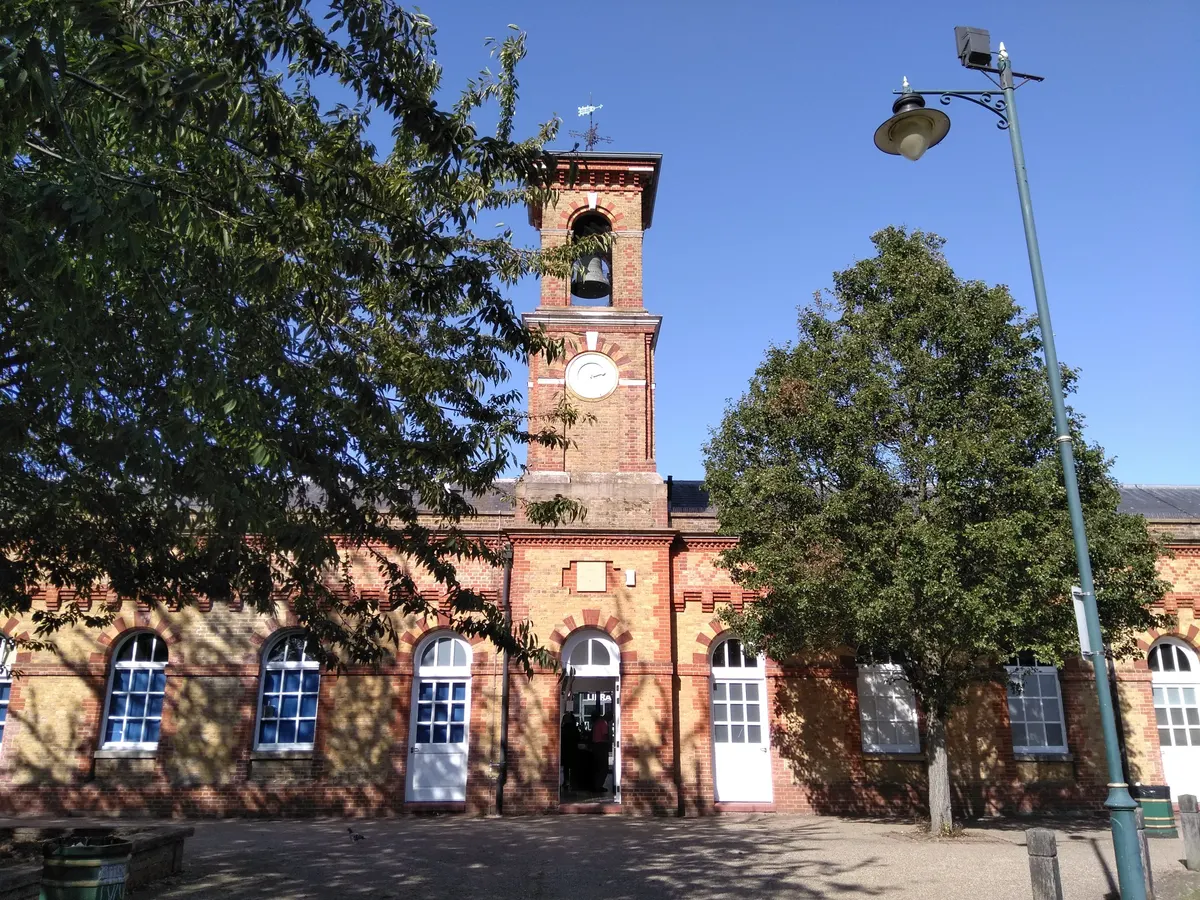
In Britain the Belgian engineers joined the Small Arms Design Department, itself relocated from Enfield to a drill hall roughly five miles away at Cheshunt, and resumed rifle development through the rest of the occupation.1 By 1943 the design had shifted to 7.92x57mm Mauser, reflecting both the availability of Besa ammunition production and a 1944 British General Staff review that considered basing a future service cartridge on the 8x57mm round.1,6
Enfield ordered 50 EXP-1 prototypes in late 1943, delivered in early 1944, and testing went well enough to justify a follow-on order for 2,000 rifles for wider troop trials.1,5 That order was then cancelled. The commonly cited reason is an unresolved fault in regulating gas pressure through the action, compounded by the war approaching its end and the shrinking case for funding a new rifle programme so late.1,5
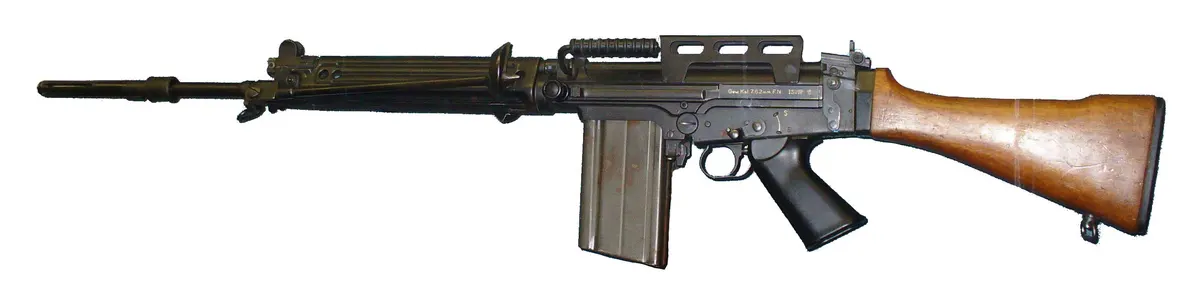
The same design effort then split in two directions. Saive finalized the full-power branch as the FN Model 1949 in 1947, eventually adopted by Argentina, Belgium, the Belgian Congo, Brazil, Colombia, Egypt, Indonesia, Luxembourg and Venezuela, with more than 176,000 built.5,2 A separate branch, first chambered in 7.92x33mm Kurz and then in .280 British as British and Belgian thinking moved toward an intermediate-power cartridge, became the prototype for the FN FAL, ultimately used by more than 40 countries including as the L1A1 in British and Commonwealth service.1,2
Surviving SLEM-1 specimens are rare. The Royal Armouries holds a cataloged example attributed to Saive, and at least one serialed rifle (serial 47) has passed through the collector auction market.7,2

The SLEM-1 was never issued for general service by any country. The only formal user was the United Kingdom, which put roughly 50 EXP-1 prototypes through evaluation trials via the Royal Small Arms Factory at Enfield in 1944 before cancelling the planned 2,000-rifle troop-trial batch.1,5 No other country trialed or adopted the design under this designation.
The SLEM-1's closest technical relative is not a rival design at all but its own direct descendant, the FN Model 1949. Both share the same tilting-bolt gas action and, in the SLEM-1's case, the same 7.92x57mm Mauser chambering the FN-49 would later offer as one of its export calibers. The practical difference is entirely one of fate rather than engineering. The SLEM-1 stopped at roughly 50 hand-built evaluation rifles, while the FN-49 went on to sell over 176,000 units to eight national armies.5,2
| SLEM-1 (1943-44) | FN Model 1949 (1947-) | |
|---|---|---|
| Action | Gas-operated, tilting bolt | Gas-operated, tilting bolt |
| Cartridge | 7.92x57mm Mauser | 7.92x57mm Mauser, .30-06, 7x57mm, others |
| Units built | ~50 | 176,000+ |
| Service status | Never adopted | Adopted by 8 countries |
A more instructive comparison is with the American M1 Garand, the self-loading rifle the SLEM-1's designers were working to match. Both were gas-operated infantry rifles developed under wartime pressure, but they solved the ammunition problem in opposite ways. The United States built an entirely new logistics chain around the dedicated .30-06 round and an internal-magazine en-bloc clip system, while the Enfield team deliberately borrowed an existing rimless round already moving through British ordnance depots for the Besa machine gun. The Garand reached mass production during the war it was designed for. The SLEM-1 reached only a 50-rifle trial batch before its own war ended around it.1,6


Is the SLEM-1 the same rifle as the FN-49? No, though they share a designer and the same gas-operated tilting-bolt action. The SLEM-1 was the wartime 7.92x57mm Mauser prototype built in Britain in 1943-44, while the FN Model 1949 was Saive's postwar production rifle, finalized in Liège in 1947 and offered in several calibers.5
What does SLEM-1 stand for? Self-Loading Experimental Model 1, also seen rendered as Self Loading Enfield Model 1. The Royal Small Arms Factory's own official designation for the same rifles was EXP-1.1
Why was the SLEM-1's production order cancelled? Enfield's planned follow-on batch of 2,000 rifles was cancelled after testing exposed an unresolved problem regulating gas pressure in the action, at the same time the war in Europe was ending and reducing the case for funding a new rifle programme.1,5
Where can a SLEM-1 be seen today? The Royal Armouries holds a cataloged example attributed to Dieudonné Saive, and individual serialed specimens have appeared in the firearms collector auction market.7,2
- "SLEM-1", Wikipedia — en.wikipedia.org ↩
- "Fabrique Nationale - EXP-1/SLEM", Rock Island Auction — rockislandauction.com ↩
- "Dieudonné Saive", Wikipedia — en.wikipedia.org ↩
- "SLEM-1", Wikidata — wikidata.org ↩
- "FN Model 1949", Wikipedia — en.wikipedia.org ↩
- "FN-49: The Last Old-School Battle Rifle", American Rifleman — americanrifleman.org ↩
- "Experimental Saive SLEM-1", Royal Armouries — royalarmouries.org ↩
- "SLEM Rifle", SLEM Autorifle blog — slemautorifle.blogspot.com ↩