

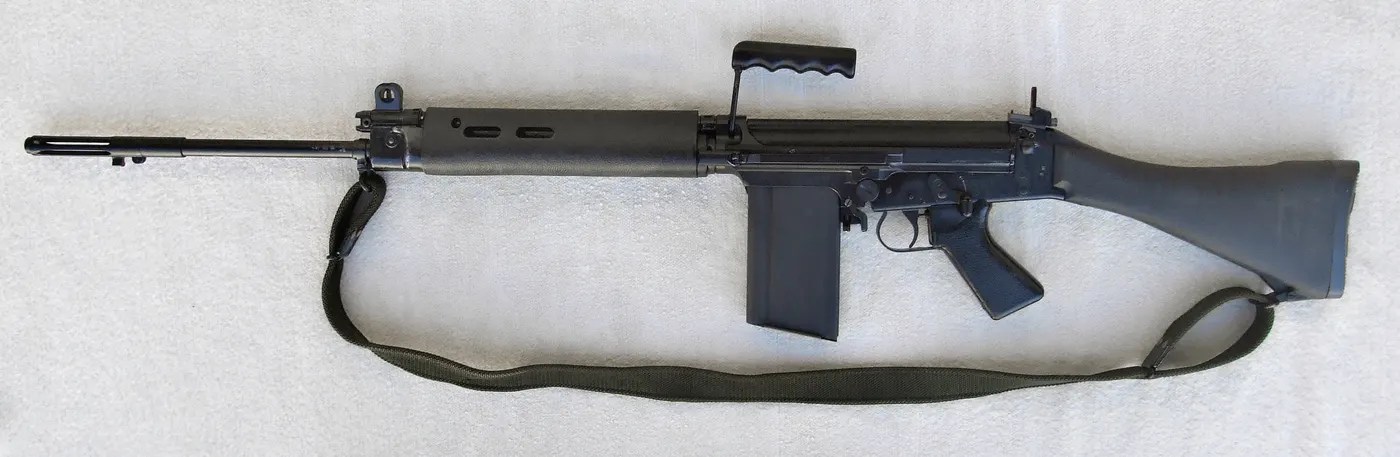
The L1A1 Self-Loading Rifle, universally known in Commonwealth service simply as the SLR, is the semi-automatic-only, imperial-measurement version of the Belgian FN FAL battle rifle that the United Kingdom adopted as its standard infantry weapon in the 1950s.1 It fires the 7.62x51mm NATO cartridge from a 20-round detachable box magazine through a gas-operated, tilting-breechblock action, the same mechanism used in the FAL itself, and it replaced the bolt-action Lee-Enfield No.4 after roughly half a century of bolt-action standard infantry rifles in British service.1
- Full-power 7.62x51mm cartridge with real stopping power and penetration
- Simple, robust gas-piston action tolerant of mud, sand and jungle neglect
- Reputation among Commonwealth troops for outperforming the M16 in Vietnam
- Standard bayonet lug and aperture sights for straightforward infantry use
- Heavier and harder to control on automatic fire than later intermediate-caliber rifles
- Semi-automatic-only doctrine surrendered volume of fire compared to select-fire rivals
- Inch-pattern magazines and furniture do not reliably interchange with metric FAL parts
- Basic sights offer no fine windage or elevation adjustment
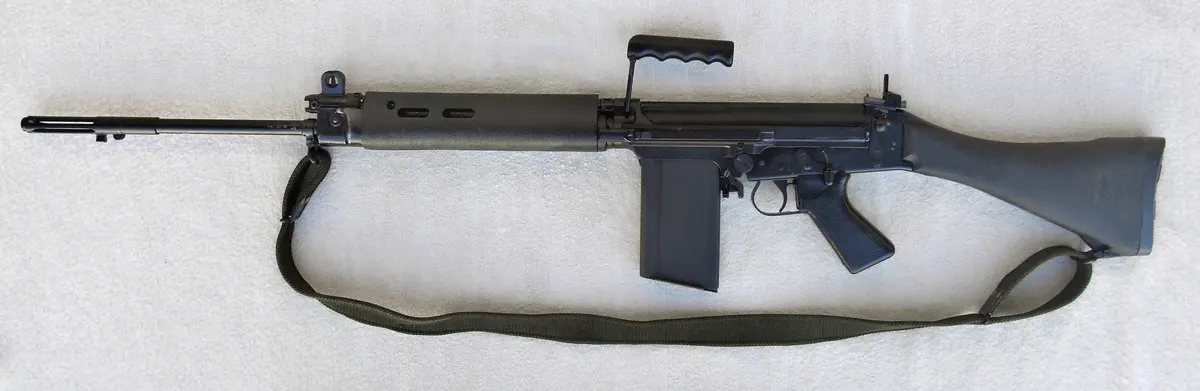
Mechanically the L1A1 is an FAL built without its automatic-sear parts fitted. Britain and the other Commonwealth nations that adopted it (Australia, New Zealand, India and others) deliberately chose semi-automatic fire only, judging aimed single shots from a full-power rifle round more useful in practice than uncontrollable full-automatic bursts, a doctrinal choice that set the Commonwealth rifle apart from the original Belgian FAL and from the Argentine version it would eventually meet in combat.1
Inch Pattern Manufacturing and What It Actually Changed
British production used imperial, or inch, measurements, while the original Belgian FN FAL and most non-Commonwealth licensees used metric dimensions.1 The underlying rifle design is essentially identical either way. The inch and metric labels describe the machine tools used to cut the parts rather than any fundamental redesign.1 That said, the two production standards created real, documented interchangeability problems. Buttstocks attach differently and do not swap between inch and metric rifles. Muzzle devices and flash hiders share the same thread pitch but run in opposite directions. Gas blocks differ too, the metric gas port meets the barrel at a right angle while the inch-pattern block meets it at an angle and stands taller.1 Many larger sub-assemblies interchange, but individual small parts within them frequently do not.
- İlk Üretim Yılı1954
- Hizmete Giriş Yılı1954
- TasarımcıDieudonné Saive, Ernest Vervier
- Ağırlık (Boş)4,337 kg
- Halen HizmetteEvet
- Önemli KullanıcılarBirleşik Krallık, Avustralya, Kanada, Hindistan, Jamaika, Malezya, Yeni Zelanda, Rodezya, Singapur
The FAL Action With the Auto-Sear Left Out
The L1A1 uses the FAL's short-stroke gas piston and tilting-breechblock locking system, an arrangement conceptually related to the Soviet SKS.1 What sets the L1A1 apart mechanically is a handful of missing internal parts rather than the receiver or the barrel. An FN FAL with its auto-sear installed fires full-automatic. Remove or never fit that sear, as Britain did on every production L1A1, and the rifle is fixed to semi-automatic only, even though the rest of the mechanism is fully capable of select fire.1 Australia and Canada later reversed that choice for a dedicated squad-support version, described below under Variants.
- Fişek7.62×51mm NATO
- Çap7,62 mm
- Kovan Uzunluğu51 mm
- Çap Sınıfımuharebe tüfeği
- Kenar AteşlemeliHayır
- Kovansız MühimmatHayır
| ÖZELLİK | L1A1 | FN FAL |
|---|---|---|
| Namlu Uzunluğu | 554.4 mm | 533 mm |
| Ağırlık (Boş) | 4.337 kg | 4.25 kg |
| Namlu Çıkış Hızı | 823 m/sn | 840 m/sn |
| Şarjör Kapasitesi | 20 adet | 30 adet |
Confirmed figures for the standard L1A1 include an empty weight of 4.337 kg, a 554.4mm barrel, a muzzle velocity of about 823 m/s, and an effective range of roughly 800 m from 20-round box magazines, all matching Wikipedia's commonly cited specification set.1 Some secondary sources list a heavier 5 kg figure and a shorter 533mm barrel, numbers that better match a loaded-magazine weight and the shorter flash-hider-excluded barrel measurement used for the plain FAL rather than the L1A1 proper, so the higher-precision figures above are the ones to trust.1
- Mekanizma TipiGazlı
- Atış Modlarıyarı otomatik
- Seçmeli AtışHayır
- Besleme SistemiÇıkarılabilir Şarjör
- Şarjör Kapasitesi20
- Namlu Çıkış Hızı823 m/sn
- Etkili Menzil (nokta)800 m
- Namlu Uzunluğu554,4 mm
- Nişangah TipiArka halka gez, ön arpacık
- Optik RayıHayır
- Açık NişangahEvet
- Dişli NamluHayır
- Susturucuya HazırHayır
- Süngü TakozuEvet
- Entegre BipodHayır
- Bombaatar KabiliyetliHayır
- Gaz PistonluEvet
- Toplam Üretim320.000
- Üretim Başlangıcı1954
- Üretim Bitişi1986
- Varyantlar2
The EM-2 and the .280 British Cartridge Britain Gave Up
Britain's first postwar attempt at a self-loading service rifle was not the L1A1 at all. It was the EM-2, a bullpup chambered for the intermediate .280 British (7x43mm) cartridge and designed at RSAF Enfield by Kazimierz Januszewski, a Polish emigre engineer who worked under the pseudonym Stefan Kenneth Janson.2 The Labour government, through Minister of Defence Manny Shinwell, formally adopted the EM-2 and its .280 round in 1951.2
That decision did not survive a change of government. Winston Churchill's incoming administration reversed the EM-2 adoption, judging that splitting NATO small-arms standardization on Britain's own intermediate cartridge risked isolating the alliance just as the United States was pushing its own full-power 7.62x51mm round toward NATO standard.2 Trial reports had rated the EM-2 highly on its own technical merits, so the cancellation reflected alliance politics rather than any flaw in the rifle itself.2
From a Licensed FAL to Britain's Own Semi-Automatic Rifle
With the .280 program dead, Britain licensed the Belgian FN FAL, designed by Dieudonné Saive and Ernest Vervier at FN over roughly 1947 to 1953, and adapted it into an inch-pattern, semi-automatic-only rifle designated L1A1.1 No single named British engineer is credited with leading that inch-pattern conversion the way Januszewski is credited with the EM-2. It reads in the sources as an institutional effort carried out at RSAF Enfield.1
British trials in Aden and Malaya reportedly found many fundamental faults in the rifle before it reached formal adoption.1 Sources disagree on exactly when that adoption became official British service. The War Office's 1954 decision is the year most commonly cited, and it matches the rifle's earliest trials-pattern production, but the Royal Armouries dates the sealed pattern drawings to 1 March 1957 and the first full production batch to 30 May 1957, treating that year as the true start of standard-issue service.4 Read together, 1954 marks the adoption decision and early trials rifles, while 1957 marks full-rate production and the point the SLR became the rifle actually issued across the British Army.4
Manufacturing at Enfield, Birmingham and Lithgow
Royal Small Arms Factory (RSAF), Enfield, a state-owned arsenal, was the L1A1's primary British manufacturer from 1954 until the factory closed in 1988, reportedly turning out more than 100,000 rifles between 1954 and 1956 alone at a peak rate near 750 a week.1 Additional UK production ran at Birmingham Small Arms and at the Royal Ordnance Factory site at Fazakerley, with post-closure spares later made by the commercial gunmaker Parker Hale.1
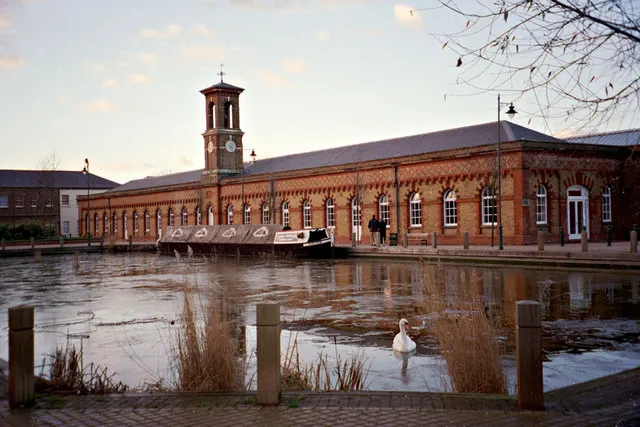
Australia built its own L1A1s at the Lithgow Small Arms Factory, turning out roughly 220,000 rifles between 1959 and 1986, alongside about 9,557 L2A1 heavy-barrel automatics between 1962 and 1982.6 Lithgow cut production time per rifle from 60 hours in 1959 to 23 hours by 1963, a gain achieved across some 20,000 drawings, 25,000 tooling pieces and more than 1,300 machining operations.6 Combined UK and Australian production alone therefore runs well past 300,000 rifles, a figure that treats India's separately produced Ishapore rifles (covered under Variants) as a distinct manufacturing line rather than part of the same count.1,6 The Australian War Memorial dates the SLR's Australian Army service to 1960 through 1992, with Lithgow production and issue actually beginning slightly earlier, in 1959.7
Malaya, Aden and the Counter-Insurgency Doctrine That Shaped the Rifle
The SLR entered combat during the tail end of the Malayan Emergency, and its early trials ran concurrently in the Aden Emergency, both jungle and urban counter-insurgency campaigns that shaped British small-arms doctrine well before the rifle's formal 1957 adoption.1 The same semi-automatic, aimed-fire doctrine carried through the Mau Mau uprising in Kenya, the Suez Crisis, the Indonesia-Malaysia confrontation, the following Communist insurgency in Malaysia, and the Dhofar Rebellion, a run of small colonial and post-colonial wars across the late 1950s and 1960s in which the SLR was the standard British infantry weapon.1 None of these campaigns involved the large-scale conventional battles the rifle's 7.62mm cartridge was originally built for, and that steady diet of small-unit jungle and urban patrol actions did more to shape the SLR's lasting reputation than any set-piece battle would have.
Vietnam and the Australian Preference Over the M16
The United Kingdom sent no combat units to Vietnam, but Australia and New Zealand both issued the SLR as their standard infantry rifle throughout the Vietnam War.1 Australian troops widely regarded their SLRs as more reliable and more lethal at range than the American M16 carried by US forces, crediting the 7.62mm round's stopping power and the SLR's simple gas system for holding up better in jungle conditions than the M16's early reliability problems allowed, a preference the 5th Battalion Royal Australian Regiment's own veteran association still records today.1,8 Australian SAS patrols went further still, building the field-modified the Bitch variant described above for close-range jungle fighting with an attached grenade launcher.1
The Falklands War, One Rifle Family, Two Fire Modes
The Falklands War of 1982 put both branches of the same rifle family on opposite sides of a single battlefield. British paratroopers, Royal Marines and infantry carried the semi-automatic-only L1A1, while Argentine troops carried the FM FAL Model 50-00, Argentina's own licensed FN FAL variant, which unlike the British rifle could fire fully automatic.1 Every rifleman on both sides that June was, in effect, carrying the same underlying weapon fitted with a different fire-control decision made three decades and two hemispheres apart.

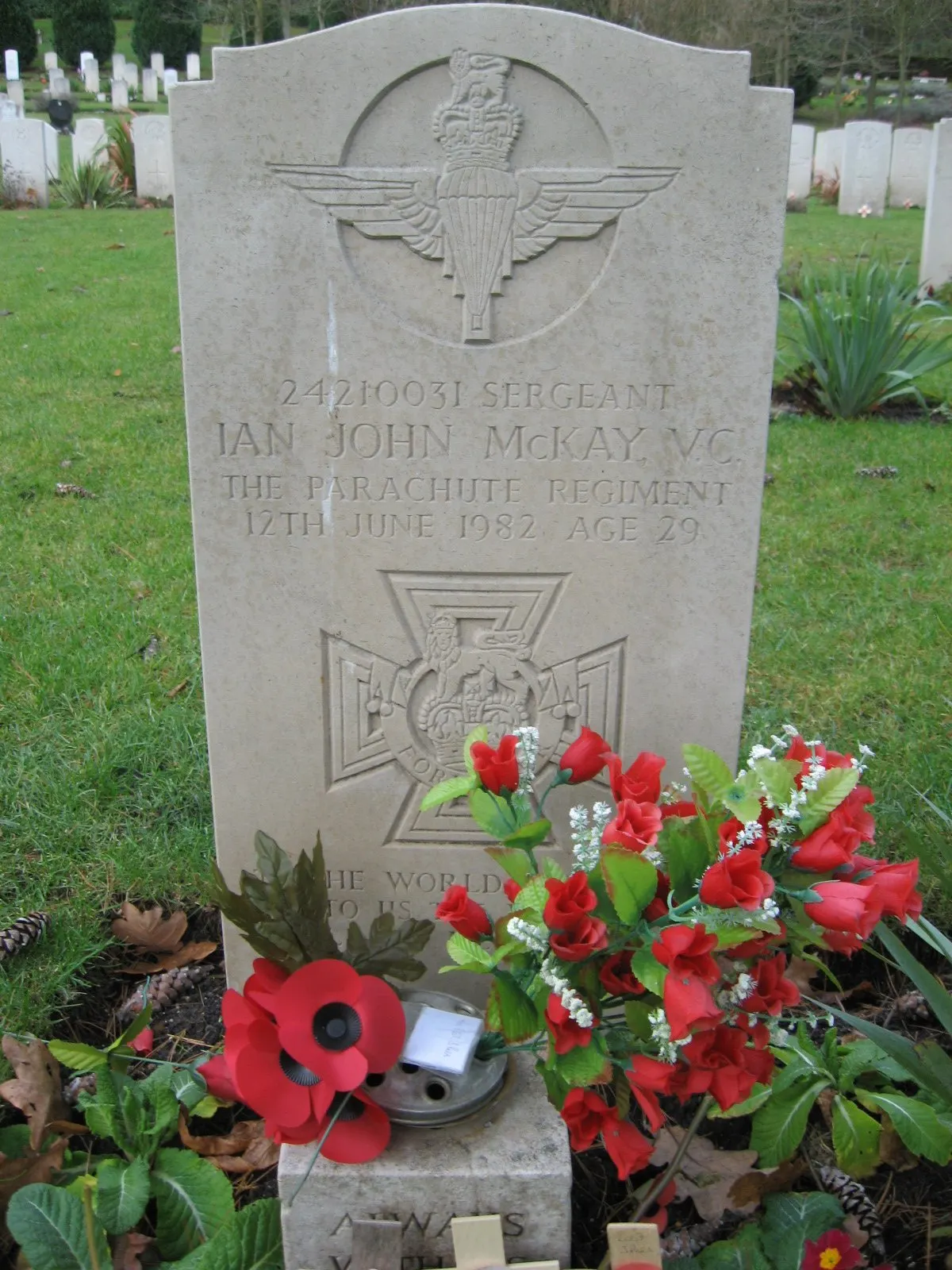
At the Battle of Mount Longdon on 11 to 12 June 1982, the British 3rd Battalion, Parachute Regiment, under Lieutenant Colonel Hew Pike, assaulted Argentine 7th Infantry Regiment positions carrying L1A1 SLRs alongside L7A2 GPMGs.15 Sergeant Ian McKay was killed leading a grenade assault on an Argentine machine-gun post during that battle and was posthumously awarded the Victoria Cross.16 Days earlier, at the Battle of Goose Green, the 2nd Battalion, Parachute Regiment, under Lieutenant Colonel Herbert Jones (known to his troops as H Jones), who was also killed and posthumously received the Victoria Cross, fought a numerically inferior force of roughly 690 British paratroopers against about 1,000 Argentine defenders.1
Sources genuinely disagree on magazine cross-compatibility during the campaign, as noted above under Specs and Design, and that disagreement is worth surfacing rather than resolving artificially in either direction.5 What both sides agreed on in practice was the cartridge itself. British and Argentine wounds from rifle fire came from the same 7.62x51mm round, so the tactical difference in the Falklands infantry fight came down almost entirely to rate of fire rather than terminal effect.
Rhodesia's Bush War Under a British Arms Embargo
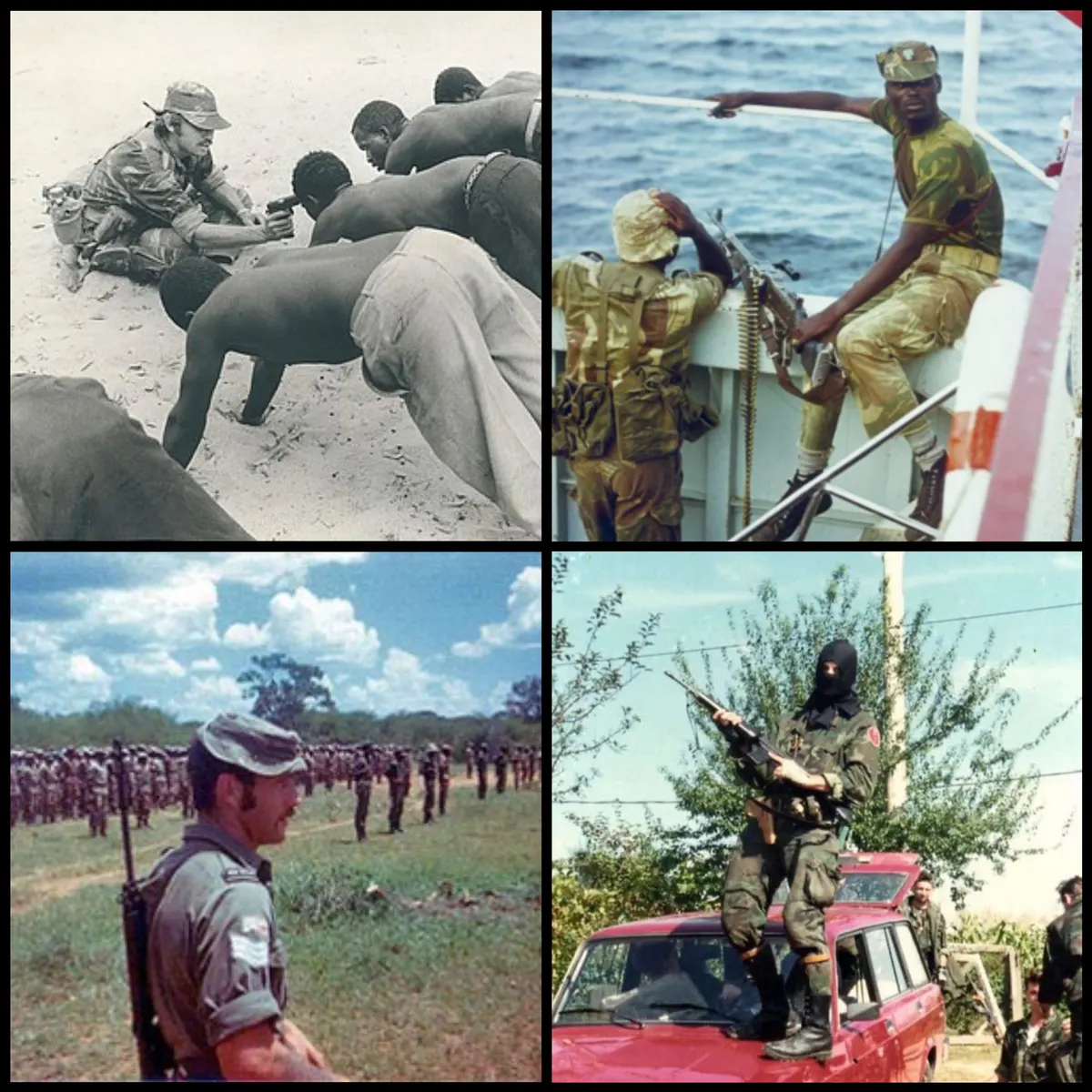
Southern Rhodesia adopted the L1A1 by the early 1960s, carrying the counter-insurgency doctrine it had absorbed from Malaya and Aden into its own Rhodesian Bush War.10 A standard Rhodesian infantry section paired four riflemen carrying SLRs with one FN MAG machine gunner.10 Rhodesia's 1965 Unilateral Declaration of Independence triggered a British arms embargo that cut off further SLR supply, forcing Zimbabwe's Rhodesian forces to source roughly 30,000 South African-made R1 rifles, itself a licensed FAL variant, as a wartime substitute alongside existing SLR stocks.10 That substitution left Rhodesian units fighting through the war's final years with a visibly mixed inventory of original SLRs and South African R1s side by side in the same platoons.
Later Service Across Africa, South Asia and the Gulf
The SLR remained in frontline use well beyond its 1980s British retirement. Sierra Leone received 10,000 SLRs in 2000 during its civil war, arming government forces through the tail end of the Sierra Leone Civil War.1 Kuwait's army fielded SLRs during the Gulf War, and India has used its Ishapore-derived rifles across the Indo-Pakistani War of 1965, the Indo-Pakistani War of 1971, and the 1999 Kargil War.1 Residual SLR stocks also saw use in Nepal's civil war, Sri Lanka's long civil war, the Soviet-Afghan War era, and the Bougainville conflict in Papua New Guinea, reflecting decades of Commonwealth stock filtering into later regional conflicts rather than fresh purchasing.1 The rifle was also the standard-issue British Army weapon through most of the Troubles in Northern Ireland during the 1970s and 1980s, before the SA80 replaced it.1
The L2A1 Heavy-Barrel Automatic Rifle
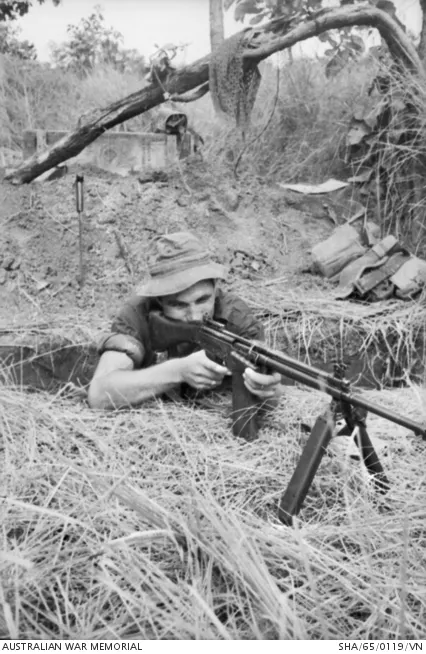
Australia and Canada jointly developed the L2A1, a fully automatic heavy-barrel rifle with a 21-inch barrel, a combined bipod and handguard, and a cyclic rate near 675 rounds per minute, built for a Bren-like squad automatic role rather than as a primary infantry rifle.6 Doctrine still favored semi-automatic fire from the L2A1 for sustained accuracy, reserving full-automatic bursts for suppressive fire. Lithgow built roughly 9,557 examples between 1962 and 1982, exporting the rifle to Ghana, India, Singapore, Malaysia and Papua New Guinea among others, before Australia phased it out in favor of the M60 and later the F89 Minimi.6 A shortened L1A1-F1 variant, of which around 460 to 500 were produced, went specifically to Papua New Guinea.1
Canada's C1A1 and India's Ishapore 1A1, Related But Not Identical
Canada fielded its own version of the FAL family, the C1A1, from 1955, differing from the L1A1 in its rotating-disc rear sight, two-piece firing pin and a shorter receiver cover built for stripper-clip reloading, along with a distinctive removable Arctic trigger guard sized for heavy mittens.13
India took a different path entirely. Unable to agree production terms with FN, the Ordnance Factories Board at Ishapore reverse-engineered its own rifle from a mixture of sample British L1A1 and Belgian FAL rifles, producing the Ishapore 1A1, a genuine third pattern incompatible with either standard, with its own barrel thread, gas tube position and bolt-locking geometry.11 Domestic Ishapore production began in 1960, and India formally inducted the rifle as the 7.62mm Rifle 1A1 in 1963, shortly after the Sino-Indian War, following a licensing dispute that Prime Minister Jawaharlal Nehru personally helped settle with FN.12 Cumulative Indian production of the Ishapore rifle and its select-fire 1C derivative reportedly reached around one million units by 2019.11 Collectors and armorers treat the three patterns, British inch, Belgian and Commonwealth metric, and Indian Ishapore, as genuinely distinct builds rather than interchangeable siblings, since a part that fits one will often not fit either of the other two.


Beyond the United Kingdom, Australia, New Zealand, Canada and India, a long tail of small Commonwealth nations inherited SLRs at independence and still hold residual stocks, including Malta, Cyprus, Malaysia, Brunei, Bangladesh, Nigeria, Zambia, Yemen, and a cluster of Caribbean states such as Jamaica, Barbados, Grenada and Dominica.1 Most of these holdings reflect decades-old inherited stock kept in reserve, police or ceremonial roles rather than continued active purchasing, consistent with the rifle's long production run and durability. Sierra Leone stands out as a genuinely late acquisition, buying SLRs new in 2000 rather than inheriting them, while Kuwait's stock remains in active service.1
The L1A1's closest comparison is its own parent design, the metric FN FAL, since the two rifles share essentially the same receiver, barrel and locking system and differ mainly in fire-control parts and manufacturing standard. The FAL, in its original Belgian and most licensed forms, offers select-fire capability that the L1A1 deliberately lacks, a difference rooted entirely in doctrine rather than mechanical limitation, since fitting FAL auto-sear parts into an L1A1 receiver makes it functionally identical.1 That doctrinal split produced a genuinely awkward outcome in the Falklands, where British and Argentine soldiers carried rifles from the same family with different fire-control options, described above under Conflicts.1
| Feature | L1A1 (Commonwealth) | FN FAL (metric) |
|---|---|---|
| Measurement standard | Inch pattern1 | Metric pattern1 |
| Fire modes | Semi-automatic only1 | Semi-automatic and full-automatic on most variants3 |
| Empty weight | 4.337 kg1 | Approximately 4.25 kg3 |
| Barrel length | 554.4 mm1 | 533 mm (standard)3 |
| Magazine interchange | Disputed, not fully compatible with metric magazines5 | Not fully compatible with inch-pattern magazines5 |
Against the American M16, the comparison runs less on shared ancestry and more on cartridge philosophy. Commonwealth troops in Vietnam trusted the SLR's full-power 7.62mm round for range and penetration through jungle vegetation, while the M16's lighter 5.56mm round and higher magazine capacity gave American infantry more ammunition and less recoil at the cost of range and, in the M16's early service years, documented reliability problems the SLR did not share.1 That same argument, heavy round against light round, later drove Britain's own move away from the L1A1 toward the 5.56mm SA80, described below.


What are the L1A1 SLR's specifications? The standard L1A1 fires 7.62x51mm NATO from a 554.4mm barrel, weighs 4.337 kg empty, reaches a muzzle velocity of about 823 m/s, and feeds from 20-round detachable box magazines with an effective range near 800 m.1
How does the L1A1 differ from the FN FAL? The L1A1 uses the same gas-operated, tilting-breechblock action as the Belgian FN FAL but is built to inch-pattern imperial measurements and has its automatic-sear parts left out, restricting it to semi-automatic fire only, a doctrinal choice rather than a mechanical limitation.1
Why was the L1A1 semi-automatic only? Britain and the other Commonwealth adopters judged that aimed single shots from a full-power 7.62mm cartridge served infantry better than uncontrollable automatic bursts, a doctrine that held even as other NATO forces moved toward select-fire rifles.1
Is the L1A1 still in service? British front-line service ended through the 1980s as the SA80 arrived, but a number of Commonwealth and former Commonwealth states, including Kuwait, Malaysia, Malta, Nigeria and several Caribbean nations, still hold SLRs in active, reserve or ceremonial roles.1,14
What replaced the L1A1 in British service? The SA80 (L85), chambered in 5.56x45mm NATO, first reached British troops in October 1985 and became standard issue by 1987, ending nearly three decades of L1A1 service.14
- "L1A1 Self-Loading Rifle", Wikipedia — en.wikipedia.org ↩
- "EM-2 rifle", Wikipedia — en.wikipedia.org ↩
- "FN FAL", Wikipedia — en.wikipedia.org ↩
- "Centrefire self-loading military rifle, SLR, L1A1, 1957", Royal Armouries — royalarmouries.org ↩
- "Guns of the Falklands War", American Rifleman — americanrifleman.org ↩
- "Military Production", Lithgow Small Arms Factory Museum — lithgowsafmuseum.org.au ↩
- "L1A1 Self Loading Rifle", Australian War Memorial — awm.gov.au ↩
- "FAL 7.62mm L1A1 SLR (Self Loading Rifle)", 5th Battalion, The Royal Australian Regiment Association — 5rar.asn.au ↩
- "The Russian 1P29 Sight", Small Arms Review — smallarmsreview.com ↩
- "Rhodesian Bush War", Wikipedia — en.wikipedia.org ↩
- "Rifle Factory Ishapore", Wikipedia — en.wikipedia.org ↩
- "Ishapore Rifle (3 June 1963)", The Nehru Archive — nehruarchive.in ↩
- "FN C1 Self-Loading Rifle", The Canadian Encyclopedia — thecanadianencyclopedia.ca ↩
- "SA80", Wikipedia — en.wikipedia.org ↩
- "Battle of Mount Longdon", Wikipedia — en.wikipedia.org ↩
- "Ian McKay", Wikipedia — en.wikipedia.org ↩