

Grenade-launch capability describes a rifle's built-in provision for sending a grenade well past throwing range, either through a muzzle spigot or cup launcher, or through a dedicated underbarrel tube such as an M203-pattern 40mm launcher. It turns a rifleman into a short-range, one-man indirect-fire asset without waiting on a mortar crew. The feature runs through the battle rifles family, from Cold War muzzle-launcher rifles like the Heckler & Koch G3 to modern rail-equipped designs like the FN SCAR-H.
A rifle without this provision has a muzzle device sized only for its own bullet, and a gas system tuned solely for cycling the action. Firing a rifle grenade from it, if even possible, risks bursting the barrel or overpressuring the gas system. Grenade-launch hardware is deliberately load-rated instead, a reinforced muzzle spigot, a gas regulator with its own grenade setting, or an underbarrel rail built for a 40mm tube.
01The Cup Discharger and the Interwar Move to the Spigot
British forces in World War I adopted the cup discharger, known informally as the Burns Cup, around 1917.1 It replaced the earlier rod-type grenade, credited to Martin Hale around 1907, disliked for damaging the Lee-Enfield's barrel and giving poor accuracy.2 Cup dischargers stayed in British service through World War II before spigot projectors replaced them around 1946.1
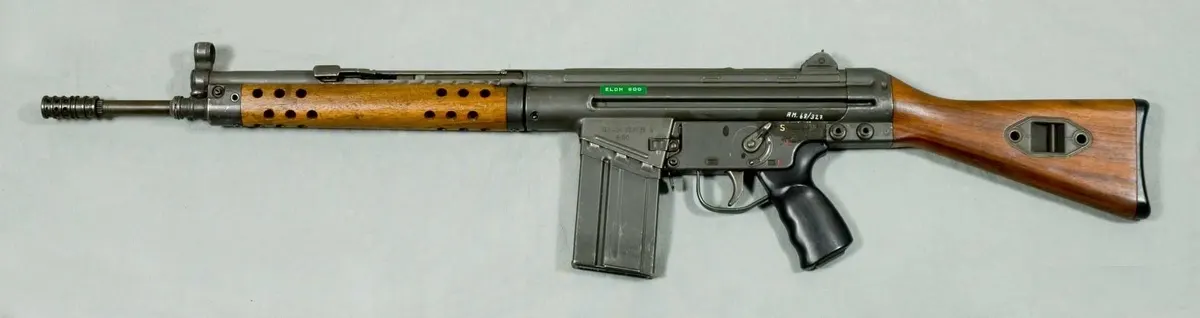
Between the wars, American ordnance engineers developed the spigot-type launcher, a lighter steel tube clamped over the muzzle that a finned grenade slipped over.2 Unlike the cup, it fired standard-issue ammunition instead of a dedicated blank. The approach carried through World War II and, after 1945, spread NATO-wide onto the FN FAL and Heckler & Koch G3 family, replacing cup designs.2
The Belgian FN FAL G1, built by FN Herstal in Belgium, carried the same arrangement into general NATO service, a family trait rather than a one-off feature.
01Setting the Gas Plug to Fire a Grenade
On the FAL-family action, the shooter turns the gas plug to a dedicated grenade position, slides the grenade over the muzzle launcher, chambers a blank, and fires. This bleeds off gas so the higher pressure needed to throw a grenade does not damage the action. NATO's standard 22mm launcher ring lets any compliant rifle fire STANAG rifle grenades without an adapter.6 These come in a standard type fired with a blank, and a bullet trap type built to accept live ammunition fired straight through it.6
The French MAS Type 62, a Cold War prototype heavily influenced by the FAL, carried over the gas cutoff and muzzle-launcher hardware directly from the earlier MAS 49/56.3 The reuse shows the package was treated as one transferable subsystem across French and Belgian designs, engineered once rather than rebuilt for every new rifle.
The Belgian anti-tank rifle grenade Energa, built by Mecar from the 1950s, used a ballistite-filled blank and stayed in service through the FAL and G3 era, until the disposable M72 LAW rocket took over the anti-armor role.2
01From Muzzle Spigot to Underbarrel Tube
The FN FAL and Heckler & Koch G3 remain the archetype Cold War rifles built around this approach. The American T48 rifle, a FAL-pattern trial rifle that competed against the M14 in the 1950s, carried the same launcher and gas-cutoff hardware into that competition.
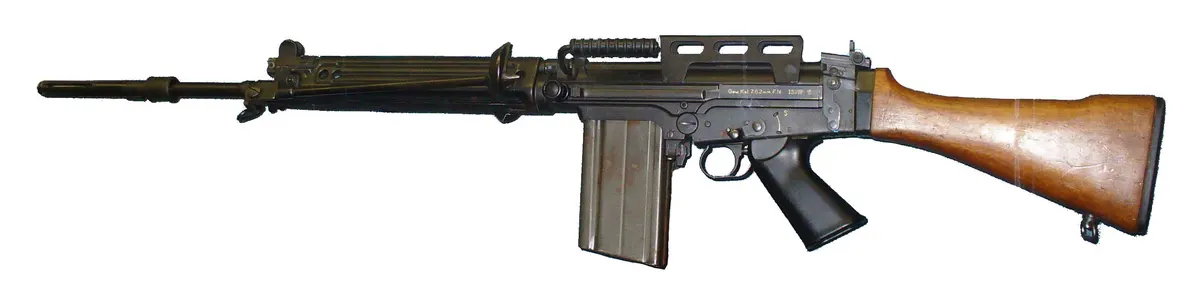
The same trait spread far beyond Western Europe. The Pakistani-built POF G3 from Pakistan Ordnance Factories and the South African R1 rifle built under Denel both inherited the same arrangement rather than reinventing it locally.
A separate underbarrel evolution eventually displaced the muzzle-launched rifle grenade for most infantry use. Heckler & Koch's HK79, from the 1980s, fired 40x46mm grenades from a break-action barrel under a G3-type handguard.4 Mounting it on a G3 changed the rifle's designation to G3 TGS. Only Greece and Norway adopted it in meaningful numbers before Heckler & Koch discontinued it for the AG36.4

The American M203, formalized in the late 1960s, was built as an underbarrel attachment so a grenadier could still fight as a rifleman rather than carry a single-shot launcher like the M79.5 It solved a problem that plagued the failed XM148 prototype, which needed roughly 30 pounds of force to cock and had a trigger prone to snagging.5
Modern rifles like the FN SCAR-H and HK417 treat the underbarrel launcher as a separate, purchasable rail module instead. FN's EGLM/FN40GL bolts onto the SCAR's rail rather than being built into the rifle, and the same rail-mounted approach appears on the SIG SAPR and the Beretta ARX200.
01Notes and Sources
- "Lee-Enfield Rifle Grenades and Launchers", Rifleman.org.uk — rifleman.org.uk ↩
- "Rifle Grenades! Immediately Available Artillery", Small Arms Defense Journal — sadefensejournal.com ↩
- "MAS Type 62, France Does the FAL, With a Twist", Forgotten Weapons — forgottenweapons.com ↩
- "Heckler and Koch HK 79", Weaponsystems.net — weaponsystems.net ↩
- "The Vietnam Trials of the XM203 Underbarrel Grenade Launcher", The Firearm Blog — thefirearmblog.com ↩
- "22 mm grenade", Wikipedia — en.wikipedia.org ↩


