

The Steyr StG 58 (Sturmgewehr 58) is the Austrian-built, select-fire version of the Belgian FN FAL battle rifle, chambered for 7.62x51mm NATO and built around the same short-stroke gas-piston, tilting-breechblock action as the original.1 Austria's Bundesheer adopted it as its standard infantry rifle in 1958. The first 20,000 examples were built directly by FN Herstal in Belgium while Steyr-Daimler-Puch tooled up its own production line at Steyr in Upper Austria.2,3 From roughly 1960 onward Steyr built the rifle itself at a reported 8,000 to 10,000 units a year, reaching a total run of more than 150,000 rifles by the time production ended in 1977.2
- Same proven FAL gas-piston action and 7.62x51mm NATO stopping power
- Integral folding bipod built into the handguard, no separate accessory needed
- Stoll muzzle device combines flash suppression, grenade launching, and wire cutting
- Steel and later synthetic furniture more resistant to cold-weather cracking than wood
- Simple, well-understood design Bundesheer conscripts trained on for two decades
- No bayonet lug at all, a real capability gap against rival NATO rifles of the era
- Barrel-mounted bipod can shift point of impact when folded out or removed
- Stamped steel handguard runs uncomfortably cold against bare hands in Alpine winters
- Never combat-tested by its primary operator, so its battlefield record is effectively unknown
- Production limited essentially to one country, unlike the FAL's dozens of licensees
The StG 58 differs from the Belgian rifle in several concrete, mechanical ways rather than serving as a simple rebadge with a new stamp. Bundesheer requirements, and specifically the recommendations of Major Stoll, who headed the army's purchasing commission, produced a rifle with a distinctive steel handguard, an integral folding bipod, a unique combination muzzle device, and no bayonet fitting of any kind, differences substantial enough that a StG 58 and a standard Belgian-pattern FAL are immediately distinguishable at a glance.2,3 Those differences, and how they came about, are the core subject of this profile rather than a footnote to the FAL's own much longer and more widely told story.
Roughly 90 countries adopted the FAL itself in original or licensed form, but the StG 58 stayed almost entirely an Austrian weapon.1 Austria was not, and still is not, a NATO member. Its 1955 constitutional declaration of permanent neutrality bars it from joining any military alliance, yet Vienna chose the alliance's new standard 7.62mm rifle anyway, a choice better explained by trial performance and continental arms-industry ties than by bloc politics.5
The first 20,000 rifles were built directly by FN Herstal in Belgium (1958 to roughly 1960) before Steyr-Daimler-Puch's own tooling came online; the remaining majority of the 150,000+ total run was manufactured domestically in Austria through 1977.
The Stoll Combination Muzzle Device and Its Three Jobs
The single most recognizable feature separating a StG 58 from a Belgian-built FAL sits at the muzzle. Major Stoll, the Austrian purchasing-commission officer overseeing the rifle's adoption, is credited with designing a combination device that works as a flash suppressor, a rifle-grenade launcher, and a barbed-wire cutter in one four-pronged fitting.3 To cut wire, a soldier hooked the prongs around a strand, twisted the rifle to draw it taut, and fired a round, the cartridge's gas pressure doing the actual cutting.3 The same fitting, threaded internally, accepted standard rifle grenades, and its unusually long body was sized specifically to keep those grenades stable in flight and to control muzzle blast during launch.3
- İlk Üretim Yılı1958
- Hizmete Giriş Yılı1958
- TasarımcıDieudonné Saive and Ernest Vervier (FN Herstal, base design); Austrian-specific muzzle device credited to Major Stoll of the Bundesheer purchasing commission
- Ağırlık (Boş)4,25 kg
- Halen HizmetteEvet
- Önemli KullanıcılarAustria (Bundesheer, 1958-1977 standard rifle; ceremonial/drill use continues with the Gardebataillon)
Steel Furniture, a Folding Bipod, and No Bayonet Lug
Steyr also reworked the rifle's furniture. The earliest StG 58s, built by FN in Belgium before Steyr's own tooling came online, largely followed the Belgian FAL's wood-stocked pattern.2 Steyr's own domestic production, which made up the large majority of the run, moved away from wood specifically to shave weight and improve cold-weather durability, fitting a stamped two-piece steel handguard similar in style to the one West Germany used on its own short-lived, FN-built G1 rifle, and later shifting the buttstock and pistol grip to synthetic material as well.1,2 Reviewers who have handled surviving examples describe the steel handguard as rugged but cold enough in Alpine winters to be uncomfortable against bare skin, a genuine tradeoff rather than an unqualified upgrade.2
- Fişek7.62x51mm NATO
- Çap7,62 mm
- Kovan Uzunluğu51 mm
- Çap Sınıfıfull-power rifle cartridge
- Mermi Ağırlığı9,5 g
- Kenar AteşlemeliHayır
- Kovansız MühimmatHayır
Steyr built an integral folding bipod into the design, a simple stamped-metal unit that tucks into the handguard when not needed and can be removed entirely with a screwdriver.2 Because the bipod's legs mount directly to the barrel rather than to the handguard or receiver, some users noted it could shift the rifle's point of impact slightly depending on how it was folded, a minor accuracy quirk absent from the Belgian FAL's own optional bipod attachments.2
- Mekanizma TipiGazlı
- Atış Modlarısafe, semi-automatic, full-automatic
- Seçmeli AtışEvet
- Besleme SistemiÇıkarılabilir Şarjör
- Şarjör Kapasitesi20
- Teorik Atış Hızı700
The StG 58 also dropped the bayonet lug entirely. Austrian doctrine simply did not issue bayonets with the service rifle, so Steyr never machined a mounting point for one, a genuine capability difference from most other NATO-aligned rifles of the period, which retained bayonet fittings as standard.2 Steyr additionally lowered the sight line relative to the Belgian rifle, adopted a straighter buttstock comb, and fitted a redesigned quick-release gas plug paired with a shortened gas tube soldered permanently in place, changes aimed at simplifying field maintenance for conscript troops rather than at any change in ballistics.2
- Namlu Çıkış Hızı838 m/sn
- Nişan Menzili600 m
Basic dimensions and ballistics otherwise track the standard 7.62mm FAL closely. The StG 58 weighs about 4.25 kg empty without its bipod, measures roughly 1,136 mm overall with a 530 mm barrel, and feeds from a 20-round detachable box magazine at a cyclic rate reported between 650 and 700 rounds per minute, with a muzzle velocity near 838 m/s.10 Sights consist of a post front sight and an aperture rear sight adjustable out to 600 m, mounted lower than on the Belgian rifle to match the modified sight-line specification.1,2
- Namlu Uzunluğu530 mm
- Nişangah Tipipost front sight, aperture rear sight adjustable to 600 m, lowered sight line versus the Belgian FAL
- Optik RayıHayır
- Açık NişangahEvet
- Toplam Uzunluk1.136 mm
- Gövde Malzemesi (Receiver)steel
- Kabza/Dipçik Malzemesiwood on earliest FN-built Belgian batch; steel handguard and synthetic stock/pistol grip in main Steyr-Daimler-Puch production
- Katlanır / Toplanır DipçikHayır
- Bullpup DüzeniHayır
- Süngü TakozuHayır
- Entegre BipodEvet
- Bombaatar KabiliyetliEvet
- Gaz PistonluEvet
- Toplam Üretim150.000
- Üretim Başlangıcı1958
- Üretim Bitişi1977
Austria's rearmament began from close to zero. The Austrian State Treaty, signed in May 1955, ended a decade of four-power occupation, and the last Allied troops left the country on 25 October 1955.5 The following day, Austria's parliament passed a constitutional Declaration of Neutrality, permanently barring the country from joining any military alliance or hosting foreign bases, a status Austria maintains to this day.5 The Bundesheer itself was formally established on 11 January 1956 under a National Defense Act passed the previous September, starting with roughly 40,000 personnel organized into three corps.6
The new Bundesheer needed rifles immediately, and it did not yet have the FAL. The United States transferred 25,811 M1 Garand rifles to Austria in 1955, some handed over directly by departing occupation forces and the rest bought outright, and the Bundesheer designated the American rifle GM1 and issued it as its first standard infantry weapon.4 The Garand held that role for roughly three years while Austria evaluated newer NATO-caliber designs.4
In 1958 the Bundesheer ran a rifle trial that, according to several firearms histories, pitted the FN FAL against Spain's CETME and the American Armalite AR-10, with the FAL reportedly winning selection as Austria's new standard rifle.1,3 FN and the Austrian government concluded a production license, and to get rifles into Bundesheer hands quickly, FN built the first 20,000 units itself at Herstal in Belgium while Steyr-Daimler-Puch prepared tooling, drawings, and its own production line at Steyr.2,3
Steyr took over full production shortly after, building roughly 8,000 to 10,000 rifles a year through the 1960s and into the mid-1970s, for a combined total exceeding 150,000 units by the time production ended in 1977.2 That figure makes the StG 58 program small next to the FAL's global output, but it represented a substantial domestic manufacturing commitment for a country of Austria's size, run almost entirely through a single arms works at Steyr.2
The StG 58's own service life ended when the Bundesheer adopted the bullpup Steyr AUG in 1977, designated StG 77 in Austrian service, chambered for the smaller 5.56x45mm cartridge and built by the same Steyr works.7 The changeover across the force was gradual. Some Bundesheer reserve and support units kept StG 58 rifles in inventory and training use well into the mid-1980s even after front-line combat units had converted to the AUG.1
The StG 58 has no confirmed combat record of its own, and that absence is itself a direct consequence of the political circumstances that produced the rifle. Austria's 1955 neutrality declaration committed the country to staying out of military alliances and, in practice, out of the era's proxy wars, so the Bundesheer's standard rifle from 1958 to 1977 spent its service life on Austrian and Alpine training ground rather than in a shooting war.5
That does not mean the rifle sat entirely at home. Austria contributed a field hospital and associated security personnel to the United Nations Operation in the Congo between 1960 and 1963, deploying roughly 166 Austrians, most of them Bundesheer personnel, to Kamina, Stanleyville, Kindu, and Luluabourg.9 The mission fell across the transition years when the Bundesheer was still fielding Garand rifles alongside early StG 58 deliveries, and available sources describe the deployment's security arrangements only in general terms, so which rifle Austrian personnel actually carried in the Congo is not clearly documented.9
Austria became one of the founding troop contributors to the United Nations Peacekeeping Force in Cyprus when it was established in 1964, and later joined the UN Disengagement Observer Force on the Golan Heights after its 1974 creation, both missions falling squarely inside the StG 58's 1958 to 1977 service window.8 Austrian units of that era would plausibly have carried the StG 58 as their rifle of record on both deployments, but the available sourcing documents the troop contributions themselves rather than confirming the specific rifle issued on either mission, so that connection should be read as a reasonable inference from the timeline rather than a confirmed fact.8
Set against the FAL's own record of Sinai, the Congo's Jadotville siege, Rhodesia, the Falklands, and Northern Ireland's Troubles, the StG 58's near-total absence from combat is a genuine point of contrast rather than a gap in the research. Austrian neutrality doctrine worked as designed, and the country's standard rifle for two decades of the Cold War never had to prove itself against an enemy.
That same absence shapes what kind of sources exist on the rifle today. There are no combat memoirs, after-action reports, or wartime press photography to draw on, and most of what is documented about the StG 58 in the field comes from Bundesheer training records, collector and technical literature, and the surviving hardware itself rather than from any battlefield account.

 Steyr StG 58
Unlike FN's own sprawling FAL product line, which spanned fixed-stock, folding-stock, heavy-barrel, and paratrooper models sold to dozens of countries, the Bundesheer issued the StG 58 in essentially one configuration, a fixed-stock, full-length rifle.1 Steyr did not build a folding-stock or shortened-barrel version for domestic service, reflecting the Bundesheer's role as a home-defense and Alpine-terrain force rather than an expeditionary one that might have wanted a compact folder.
In the mid-1990s the American importer DS Arms acquired roughly 40 tons of surplus StG 58 parts, accessories, and original Steyr-Daimler-Puch manufacturing tooling, blueprints, and drawings directly from the Austrian Ministry of Defense.2 The purchase covered the physical means of production, not just leftover rifles, giving an American company direct access to the machinery Steyr-Daimler-Puch itself had used to build the original rifles.2
DS Arms used that tooling and parts stock to launch its semi-automatic SA58 rifle line in 1997, initially built around a mix of original Austrian and newly manufactured US components fitted to new semi-automatic receivers.2 The company later added a dedicated STG58-pattern model that reproduces the Austrian rifle's specific handguard, sight, and furniture details more closely than its general-purpose SA58 variants.2
That civilian line has kept the StG 58's particular design identity, steel handguard, folding bipod, and lowered sight line included, visible and collectible in the United States decades after the Bundesheer itself moved on. It is a rare case of a Cold War rifle program's tooling outliving the rifle's own military service by decades, continuing under new ownership on a different continent entirely.

| Yıl | Alıcı | Adet | Tutar | Bugünkü Değer (2025) |
|---|---|---|---|---|
| 1996 |  Amerika Birleşik Devletleri | — | — | — |
| 1958 | Avusturya | 20,000 | — | — |
Austria remains the StG 58's only significant military operator on record, acquiring the rifle in 1958 and fielding it as the Bundesheer's standard infantry weapon until the Steyr AUG's 1977 adoption.1,2
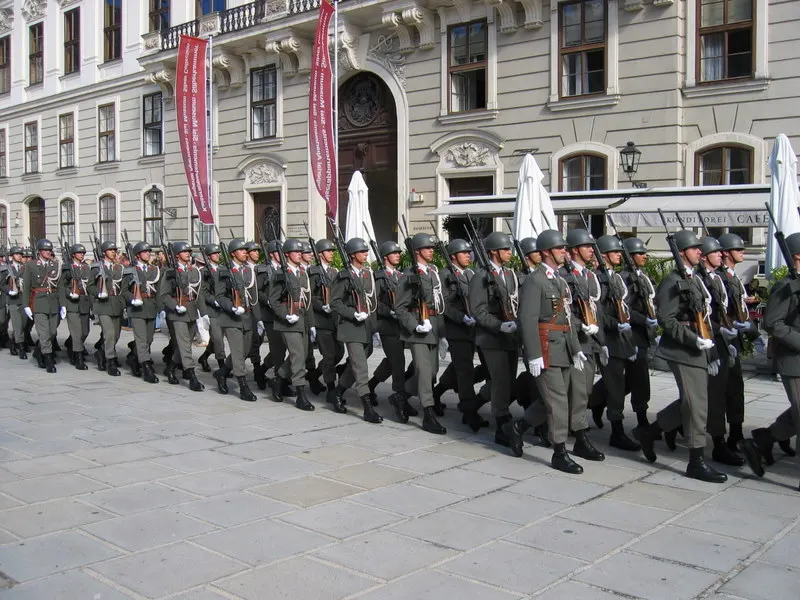
No widely documented secondary military user or export customer for the Austrian-built rifle turned up in research for this profile, a real contrast with the FAL's roughly 90 adopting states and consistent with Austria's neutral, non-exporting posture through the Cold War.1 Surviving examples have not fully left Austrian service even now. A number remain in limited ceremonial and drill use with the Bundesheer's Gardebataillon, the guard unit responsible for state ceremonial duties in Vienna, decades after the type's frontline retirement.1
That ceremonial afterlife is a modest one next to the rifle's collector profile abroad. More surviving StG 58 parts and complete rifles likely circulate today through the DS Arms tooling purchase and the American semi-automatic market described below than remain in active Austrian government hands.2
The StG 58's closest comparison is not a rival design but its own parent, the Belgian-built FN FAL, and the interesting question is less which rifle performs better and more why Austria modified a design it had just licensed. Both rifles share the identical short-stroke gas piston and tilting-breechblock action, the same 7.62x51mm NATO chambering, and near-identical weight and length figures, so none of the StG 58's changes touch how the rifle actually cycles or shoots.1,10 Every substantive difference sits in fittings and furniture, the Stoll combination muzzle device replacing the standard flash hider, steel and later synthetic furniture in place of wood, an integral folding bipod, a lowered sight line, and the deleted bayonet lug, changes that reflect specifically Austrian doctrine (a home-defense conscript force that issued no bayonet and wanted a rifle-mounted wire cutter for Alpine border terrain) rather than any judgment that the Belgian original was mechanically deficient.2,3
| Feature | Belgian FN FAL 50.00 | Steyr StG 58 |
|---|---|---|
| Furniture | Wood stock and handguard1 | Steel handguard, synthetic stock in main production2 |
| Bipod | Optional accessory | Integral, folds into handguard2 |
| Muzzle device | Standard flash hider | Stoll flash hider, grenade launcher, and wire cutter3 |
| Bayonet lug | Standard fitting | None fitted2 |
| Adopting states | Roughly 901 | Essentially Austria alone1 |
Set against the Bundesheer's own later rifle, the bullpup Steyr AUG that replaced it in 1977, the StG 58 looks like a different generation of design entirely rather than a close cousin.7 The AUG traded the FAL-pattern layout for a bullpup stock, an integrated optical sight, and the lighter 5.56x45mm cartridge, cutting overall length and weight while giving up the 7.62mm round's longer-range power, a tradeoff that reflected NATO's broader shift toward intermediate-caliber rifles through the 1970s rather than any specific dissatisfaction with the StG 58's own record.7


What are the Steyr StG 58's specifications? The StG 58 weighs about 4.25 kg empty, measures roughly 1,136 mm overall with a 530 mm barrel, and fires 7.62x51mm NATO from a 20-round detachable box magazine at a muzzle velocity near 838 m/s and a cyclic rate of 650 to 700 rounds per minute.10
How does the Steyr StG 58 differ from the standard FN FAL? It shares the FAL's gas-piston action and cartridge but replaces the Belgian rifle's flash hider with the Stoll combination flash suppressor, grenade launcher, and wire cutter, uses steel and later synthetic furniture instead of wood, adds an integral folding bipod, lowers the sight line, and omits the bayonet lug entirely.2,3
Is the Steyr StG 58 still in service? Not as a frontline rifle. The Bundesheer replaced it with the Steyr AUG starting in 1977, some reserve units kept it into the mid-1980s, and surviving rifles now see only ceremonial and drill use with the Gardebataillon guard unit in Vienna.1,7
What is the difference between the Steyr StG 58 and the Steyr AUG? They are unrelated designs from different rifle generations. The StG 58 is a FAL-pattern rifle in 7.62x51mm NATO with a conventional layout, while the AUG that replaced it in 1977 is a bullpup rifle in 5.56x45mm with an integrated optical sight.7
What is a DS Arms STG58? It is a modern American semi-automatic civilian rifle built by DS Arms using original Steyr-Daimler-Puch tooling and surplus Austrian parts purchased in the mid-1990s, reproducing the Austrian rifle's steel handguard and other distinctive features for the US market.2
What was the Steyr StG 58's unit cost? No verifiable per-unit contract price was found in the sources consulted for this profile. Austrian government procurement of this era was not consistently published in a form that survives in open sources.
- "FN FAL", Wikipedia — en.wikipedia.org ↩
- "STG58: Origins and Review of DS Arms' New Rifle", Athlon Outdoors — athlonoutdoors.com ↩
- "The StG58: Austria's Select Fire FAL", Small Arms Review — smallarmsreview.com ↩
- "Austria and the US M1 Carbine", Bavarian M1 Carbines — bavarianm1carbines.com ↩
- "Declaration of Neutrality", Wikipedia — en.wikipedia.org ↩
- "Austrian Armed Forces", Wikipedia — en.wikipedia.org ↩
- "Steyr AUG", Wikipedia — en.wikipedia.org ↩
- "United Nations Peacekeeping Force in Cyprus", Wikipedia — en.wikipedia.org ↩
- "Im Dienste des Friedens", Austrian Federal Ministry of Defence — bmlv.gv.at ↩
- "Rifle Details: Stg 58 (FN FAL Austria)", Swisswaffen — swisswaffen.com ↩