

A bayonet lug is a metal stud or bar fixed near a rifle's muzzle, built to mate with the mounting ring or slot on a bayonet's handle. A spring-loaded catch locks the blade in place once the two parts engage, and a release lever lets the soldier detach it again in seconds. The fitting turns an ordinary rifle into a fixed-blade weapon without extra hardware.
A rifle built without this fitting has no factory-approved way to carry a fixed blade at all. That is normally deliberate on designated marksman rifles and dedicated sniper variants within the DMR category, where the extra stud and reinforced muzzle threading add weight the accuracy-focused role rarely needs. General-issue battle rifles and other semi-automatic rifles keep it as standard equipment instead, since ordinary riflemen close with an enemy at short range far more often than a marksman does.
01From the Socket Ring to the Mauser Bar
The earliest fixed mounting system dates to the 1680s, when French military engineer Sébastien Le Prestre de Vauban introduced a socket bayonet with a sleeve that slid over the muzzle and locked against a stud on the barrel.1 That stud is the direct ancestor of the bayonet lug, solving the plug bayonet's worst flaw, jamming a blade into the bore and losing the ability to fire at all.

For over two centuries the muzzle-ring approach persisted despite its own accuracy penalty, since a loaded bayonet hanging off a thin barrel shifted the point of impact enough to matter at distance. In 1898 the Mauser brothers answered this with a reinforced bayonet bar that moved the blade's weight onto the stock instead of the barrel, removing the muzzle ring entirely.2 Germany's WWII-era FG 42, built by Rheinmetall for airborne troops, carried its lug forward of the gas system.
By the time self-loading rifles reached mass production before World War II, the muzzle-ring pattern and the Mauser-style bar were coexisting in different national arsenals, each new design simply inheriting whichever local pattern its army already stocked bayonets for.
01A Stud, a Slot, and a Locking Catch
Mechanically, most 20th century self-loading rifles converged on the same basic parts, a fixed lug or bar under the muzzle, a matching slot or ring on the bayonet's pommel, and a spring catch that snaps shut once the two are pushed together.

Most designs kept the geometry simple, but a few pushed it further. The Soviet AVS-36, adopted in 1936 as one of the first mass-issued self-loading service rifles, gave its bayonet an unusual two-position mount.3 The FN FAL, the Heckler and Koch G3, and Spain's CETME rifle, built by CETME, reached for a plainer version of the same lug and catch instead, prioritizing a bayonet any armorer across dozens of client armies could fit without special tools.
NATO members standardized the fitting during the Cold War. Rifles built around a common 22mm muzzle ring could take the same family of knife bayonets regardless of manufacturer, so a soldier's bayonet no longer had to match one specific national rifle design.1
01Knife Blades, Spike Points, and the Hardware Each Demands
Not every lug accepts every bayonet, because the blade itself splits into two families with different mounting needs. A knife-bayonet carries a full cutting edge and a handle a soldier can grip and use off the rifle, so its pommel needs a slot cut to a specific width and a catch recess machined to close tolerance, matching one lug pattern and effectively no others.4 A spike-bayonet drops the blade entirely in favor of a triangular or cruciform steel rod with no cutting edge and no separate handle, so its mount can be simpler, often a plain tube that slides over the barrel and a closed loop that hooks the lug, since there is no grip geometry to accommodate and no expectation the soldier will ever use it as a knife.4
The distinction shows up clearly across a single rifle family. China's early Type 56 rifles, built for both the AK-47 pattern and the SKS carbine, shipped with a folding spike-bayonet permanently hinged under the barrel on some production runs, a fixture that never needed a detachable lug at all because it was never meant to come off.5 Detachable spike-bayonets on other SKS and early AK production used their own narrow-shanked lugs, incompatible with the wider slot-and-catch mounts that later knife-bayonets required once Soviet and Chinese doctrine shifted back toward a general-utility blade.5
That shift culminated in the AKM, adopted in 1960 and built by Izhmash, later reorganized as the Kalashnikov Concern. Its Type I bayonet paired a Bowie-style clip-point blade with a bulbous plastic grip, a muzzle ring, and a pommel catch, a noticeably heavier mounting arrangement than the plain spike it replaced, and one that let the scabbard's steel body double as a wire-cutting jaw when the blade was clamped against it.6
01M7, M9, and the AK Pattern, National Standards Diverge
Every major arms-producing country settled on its own lug geometry, and the differences were never trivial enough to ignore. The United States built its Cold War rifles around the M7 bayonet for the M1 Garand's wartime successors and, later, the M9 for the M16 and its carbine descendants, both keyed to a front sight post and lug combination that stayed fixed across decades of rifle updates so a soldier's bayonet still fit the next-issue rifle without modification.7
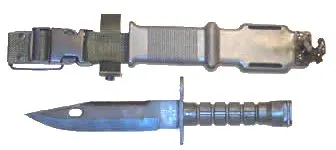
The M9, adopted in 1986 after a competitive trial won by designer Charles Finn and manufactured under contract by Buck Knives, folded a saw-backed field knife and a wire cutter into the same fitting the M7 had used for decades, so the underlying lug geometry never had to change even as the blade itself grew heavier and more capable.8
The Soviet and later Russian AK-pattern lug took a different physical shape from the American standard, and neither a Warsaw Pact bayonet nor a NATO one crossed over onto the other's rifles without a separate adapter, which is exactly the interoperability gap NATO's own 22mm ring standard had been meant to close for its own member armies.1 Canada later pursued the same goal from the opposite direction with the C7 rifle's bayonet, developed under a NATO standardization agreement into the multi-purpose CAN bayonet 2000, built to clamp onto a common lug across that rifle's variants while still functioning as a wire cutter and utility knife.9
01Standard Equipment Long After the Charge Became Rare
Bayonet charges had already been called obsolete by the trench warfare of World War I, where confined ground and machine-gun fire made closing to blade range a poor bet.10 Doctrine never fully caught up to that judgment. Since the mid-1950s, nearly every infantry rifle adopted by a major army has still shipped with a bayonet lug, the M14, its trials-era rival the T48 rifle, and Britain's L1A1 Self-Loading Rifle among them.
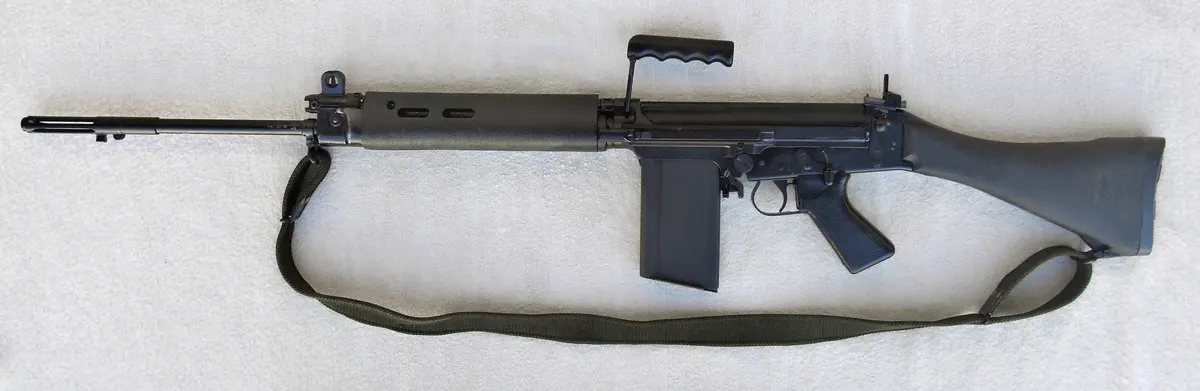
That lug still earned its keep well past 1945. United Kingdom troops carrying the L1A1 fixed bayonets during the 1982 Falklands War, most decisively during 3 Para's night assault on Mount Longdon, where paratroopers cleared Argentine trench positions with rifle fire, grenades, and bayonet thrusts at close range in an action that cost the battalion 23 dead and over 80 wounded before the position fell.11 The lug proved itself again in 2004 near Amarah in Iraq, when Argyll and Sutherland Highlanders pinned down by Mahdi Army fighters during the Iraq War ran low on ammunition and fixed bayonets before charging roughly 180 meters of open ground into the militia's trench line, killing an estimated 20 to 28 insurgents in the hand-to-hand fighting that followed.12,5 It was the first time British infantry had fixed bayonets in combat since the Falklands.12
The War in Afghanistan (2001-2021) produced its own examples. Lieutenant James Adamson of the Royal Regiment of Scotland ran out of ammunition mid-firefight in Helmand in 2008 and killed an insurgent gunman with his bayonet, an action that earned him the Military Cross.13 A Prince of Wales's Royal Regiment lance corporal, Sean Jones, led a bayonet charge against Taliban fighters in Helmand in 2011 under similar circumstances.5 Modern rifles such as the FN SCAR-H and the ArmaLite AR-10, built by ArmaLite, kept the fitting for the same mix of doctrine, tradition, and last-resort utility that carried the L1A1 through the Falklands.
Training with a fixed blade survived for reasons unrelated to expecting a charge. Drill instructors keep bayonet fighting in the syllabus to build aggression and close-combat confidence, and honor guards fix bayonets purely for ceremonial parade duty.14 Military historian John Stone frames the lug's survival as psychological rather than tactical, arguing its real value lies in motivating a frightened, isolated soldier to keep moving forward when instinct says otherwise, not in any expectation that the blade will actually meet an enemy.15 Some newer rifle programs have quietly dropped the fitting anyway, betting that the weight and complexity of a dedicated lug buys less than the morale argument claims. The lug that survived every one of those doubts still costs a design almost nothing in weight, which is why it remains standard on most general-issue rifles even as its combat role shrank to almost nothing.
01Notes and Sources
- "Bayonet lug", Wikipedia — en.wikipedia.org/wiki/Bayonet_lug ↩
- "1898 The Mauser Bayonet Bar", World Bayonets — worldbayonets.com ↩
- "Simonov AVS-36", Modern Firearms — modernfirearms.net ↩
- "Spike bayonet", Wikipedia — en.wikipedia.org/wiki/Spike_bayonet ↩
- "AK Bayonets 101, The Four Basic Types", World Bayonets — worldbayonets.com ↩
- "Understanding AK Bayonet Attachment Methods", Kalashnikov Bayonets of the World — akbayonets.info ↩
- "M9 bayonet", Wikipedia — en.wikipedia.org/wiki/M9_bayonet ↩
- "The M9 Bayonet, The Military's Do Everything Cutting Tool", Gunmag Warehouse — gunmagwarehouse.com ↩
- "CAN bayonet 2000", Wikipedia — en.wikipedia.org/wiki/CAN_bayonet_2000 ↩
- "Bayonets", GlobalSecurity.org — globalsecurity.org ↩
- "The Battle of Mount Longdon, Inside One of the Falklands War's Most Violent Firefights", Military History Now — militaryhistorynow.com ↩
- "Battle of Danny Boy", Wikipedia — en.wikipedia.org/wiki/Battle_of_Danny_Boy ↩
- "List of British gallantry awards for the War in Afghanistan (2001-2021)", Wikipedia — en.wikipedia.org/wiki/List_of_British_gallantry_awards_for_the_War_in_Afghanistan_(2001%E2%80%932021)) ↩
- "Why bayonet training is still just as important for today's troops", We Are The Mighty — wearethemighty.com ↩
- "The Bayonet, What's the Point?", JSTOR Daily — daily.jstor.org ↩


