

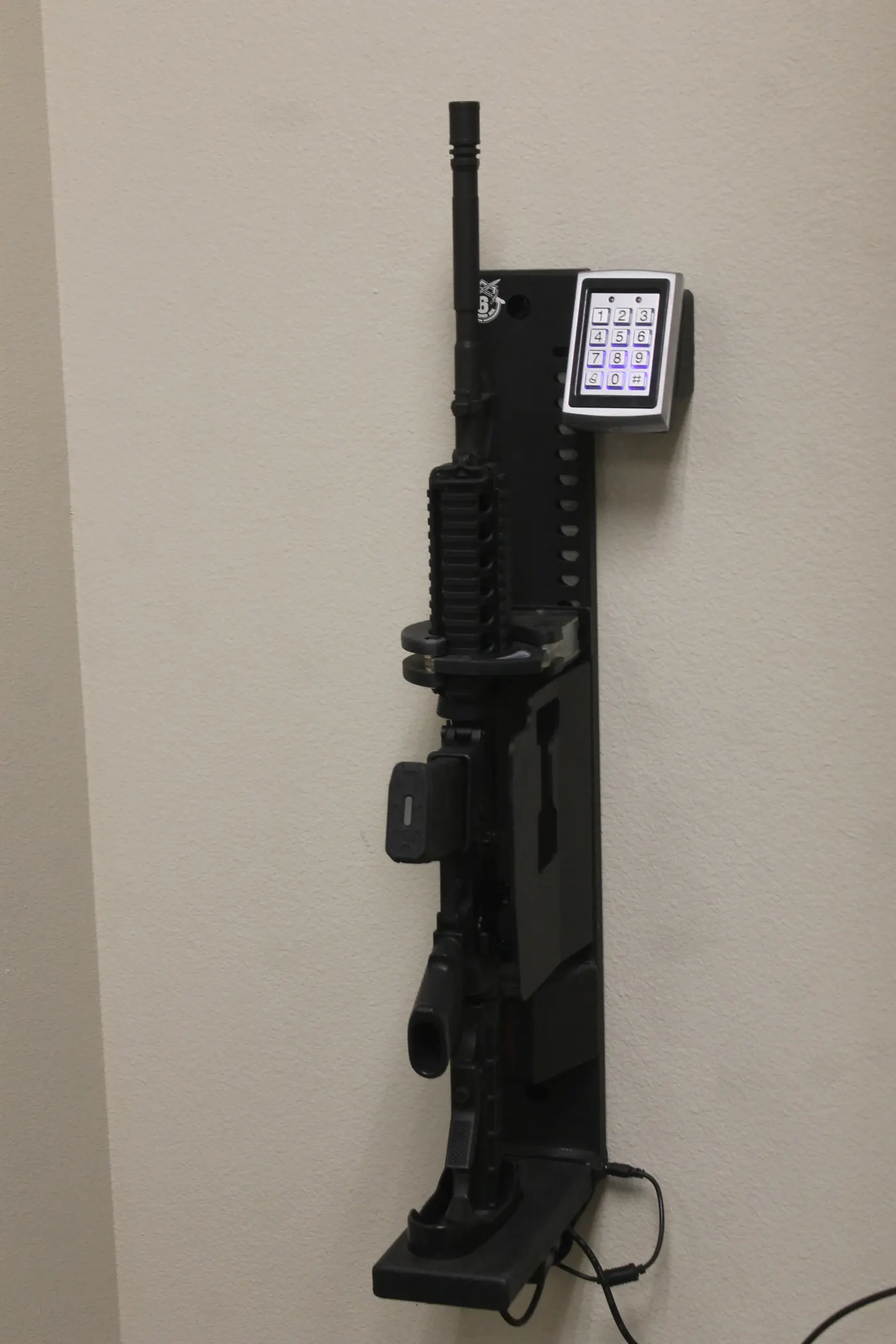

The AR-15-style rifle is a rifle pattern rather than a single product, a family of semi-automatic rifles built around the upper receiver, lower receiver, and magazine well dimensions ArmaLite and its chief engineer Eugene Stoner first laid down in 1957.1 The pattern's core promise is interchangeability. Any mil-spec upper assembly, barrel, bolt, and magazine built to the same dimensions will generally mount on any mil-spec lower receiver built by any manufacturer, regardless of brand.2 That single fact, more than any one company's branding, is what has turned the AR-15 pattern into the best-selling rifle category in the United States, with an estimated 24 million or more AR-15-pattern rifles in American civilian hands as of the early 2020s.3
- modular upper/lower interface, parts and calibers interchange across brands
- light recoiling intermediate cartridge, easy to shoot accurately for long strings
- enormous aftermarket, competitive pricing across dozens of manufacturers
- direct impingement models foul the receiver faster than piston designs
- trademark and patent history make the name *AR-15* legally contested
- civilian market intertwined with the U.S. gun-control debate, restricted or banned by name in several jurisdictions
Only Colt's Manufacturing Company may legally sell a rifle labeled AR-15, since Colt bought the name along with the design from ArmaLite in 1959 and still holds the trademark.4 Every other manufacturer, from Bushmaster to Smith & Wesson to Sturm, Ruger & Co., sells the same basic mechanism under its own model name. The AR-15 pattern covered here is the firearms-design category itself, distinct from the specific commercial product line documented at Colt AR-15 and distinct again from the select-fire military M16 and M4 family the same ArmaLite design also produced.
The AR-15 pattern belongs to the broader semi-automatic rifles category, sitting alongside older designs like the SKS and the M1 Garand as a civilian-legal, one-round-per-trigger-pull rifle. Unlike those older designs, the AR-15 pattern was born as a scaled-down sibling of a full military rifle rather than a standalone civilian product, and that dual heritage, part sporting rifle and part demilitarized service weapon, shapes almost everything about how it is built, marketed, and regulated. How the AR-15 works mechanically, what an AR-15's effective range and accuracy actually look like across different barrel lengths, and why AR-15 pattern rifles vary so much in price between manufacturers are among the most commonly searched questions about any modern firearm, precisely because AR-15 describes a category rather than a single fixed product.
The Direct Impingement System That Started the Pattern
Stoner's original AR-15 design taps propellant gas from a port partway down the barrel and routes it through a thin steel tube directly into the bolt carrier, cycling the action without a separate operating rod or piston.2 Engineers call this a gas-operated direct impingement system, and it remains the defining mechanism of the pattern. The rotating bolt locks into an extension machined into the barrel itself rather than into the aluminum receiver, so an AR-15-pattern upper can be unbolted from its lower and swapped for another without affecting the barrel's headspace.2
- İlk Üretim Yılı1959
- Hizmete Giriş Yılı1960
- Ağırlık (Boş)2,7 kg
- Ağırlık (Yüklü)3,1 kg
- Halen HizmetteEvet
Because the system vents hot combustion gas straight into the receiver, direct impingement AR-15-pattern rifles accumulate carbon fouling on the bolt carrier faster than piston-driven rifles, an effect that grows worse when a suppressor is attached and back pressure rises.5
- Fişek5.56×45mm NATO / .223 Remington (varies by pattern derivative)
- Çap5,56 mm
- Kovan Uzunluğu45 mm
- Çap Sınıfıorta güçlü
- Mermi Ağırlığı4 g
- Kenar AteşlemeliHayır
- Kovansız MühimmatHayır
Not every AR-15-pattern rifle uses direct impingement. A significant branch of the pattern replaces Stoner's gas tube with a short-stroke or long-stroke gas piston that drives an operating rod instead of venting gas into the action, trading a small weight and balance penalty for cleaner, cooler operation and reduced parts fouling.5 The Heckler & Koch HK416, developed with input from U.S. Army Delta Force in the 1990s and adopted by France and Norway as a select-fire service rifle, is the best known piston-driven descendant of the AR-15 upper receiver architecture, and its commercial success pushed piston conversion kits and complete piston uppers into the wider civilian AR-15-pattern market.6
- Mekanizma TipiGazlı
- Atış Modlarıyarı otomatik
- Seçmeli AtışHayır
- Besleme SistemiÇıkarılabilir Şarjör
- Şarjör Kapasitesi30
- Teorik Atış Hızı700
- Pratik Atış Hızı150
- Tetik Tipitek kademeli
- Emniyet Tipikol
STANAG Magazines and the Interchangeable Lower
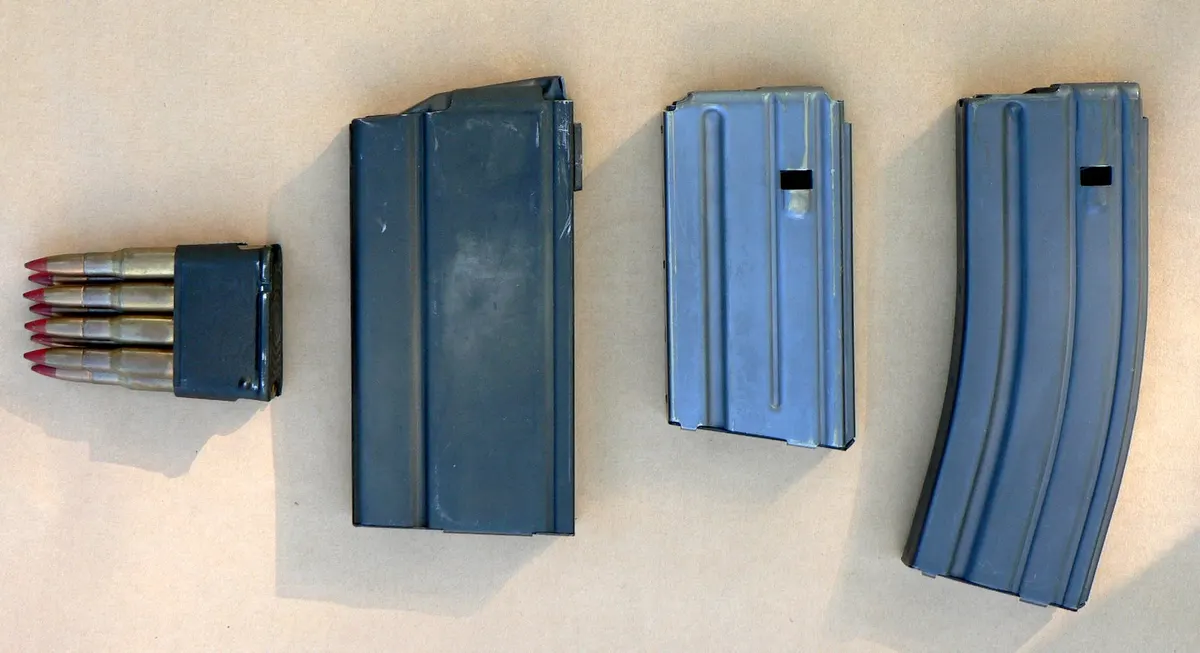
A NATO working group proposed STANAG 4179 in 1980 to standardize the dimensions of a 30-round detachable box magazine compatible with the 5.56x45mm NATO cartridge, using the U.S. military's M16 magazine as the template.7 The agreement was never formally ratified by every NATO member, but the magazine pattern spread anyway through simple market pressure, and STANAG magazine became shorthand across the industry for any detachable magazine built to the AR-15/M16 magazine well.7 The practical effect for the AR-15-pattern category is large. A magazine made by one company will generally feed a rifle made by an entirely different one, though STANAG only fixes external dimensions and the feed lips, so internal geometry still varies enough between makers that true reliability is never guaranteed across every brand combination.7
- Namlu Çıkış Hızı940 m/sn
- Namlu Enerjisi1.700
- Etkili Menzil (nokta)500 m
- Etkili Menzil (alan)800 m
- Azami Menzil3.600 m
- Nişan Menzili500 m
- İsabet1
The aluminum lower receiver carries the trigger group, magazine well, and pistol grip, but it is not a structural pressure part. All chamber pressure is contained by the barrel and the bolt locked into it, which is why a 6061-T6 aluminum lower (cheaper, more corrosion resistant) and a 7075-T6 aluminum lower (roughly twice as strong) can both serve safely in an AR-15-pattern rifle without affecting how the rifle fires.8 That low structural demand on the lower is also what let civilian manufacturers build polymer and even 3D-printed lowers decades later without redesigning the locking system itself.
- Namlu Uzunluğu510 mm
- Yiv Adımı1:7
- Yiv Sayısı6
- Nişangah Tipiayarlanabilir
- Nişangah Mesafesi450 mm
- Optik RayıEvet
- Açık NişangahEvet
- Dişli NamluEvet
Barrel length, twist rate, and handguard length vary enormously across the pattern, from the original 20 inch rifle-length Colt Sporter of 1964 to today's common 16.1 inch carbine-length barrels and even shorter pistol-brace configurations, but the core interface between barrel extension, bolt, upper receiver, and lower receiver has stayed dimensionally the same across six decades precisely so that parts keep interchanging.8,9 Modern AR-15-pattern rifles typically weigh between 6 and 8 lb (2.7 to 3.6 kg) unloaded depending on barrel profile and furniture, and shoot the 5.56x45mm NATO or commercial .223 Remington cartridge, though pattern derivatives chambered in 6.5mm Grendel, .300 AAC Blackout, 7.62x39mm, and other cartridges exist by swapping only the barrel, bolt, and magazine.
- Gövde Malzemesi (Receiver)alüminyum alaşımı
- Kabza/Dipçik Malzemesipolimer
- Katlanır / Toplanır DipçikEvet
- Bullpup DüzeniHayır
- Çift Yönlü KumandalarEvet
- Modülerlikyüksek
- Susturucuya HazırEvet
- Süngü TakozuEvet
- Entegre BipodEvet
- Bombaatar KabiliyetliHayır
- Gaz PistonluHayır
- Üretim Başlangıcı1959
- Genişlik60 mm
- Yükseklik200 mm
From ArmaLite's Sale to a Rifle Category
Eugene Stoner and ArmaLite built the first AR-15 prototypes in 1956 and 1957 as a lightweight, 5.56mm alternative to the U.S. Army's 7.62mm M14, but ArmaLite lacked the manufacturing scale to produce the rifle in quantity and sold both the design and the AR-15 trademark to Colt in 1959.1,10
Colt split the rifle in two directions at once. It developed the select-fire military version into the M16 for the U.S. armed forces, and in 1964 it launched a semi-automatic-only civilian Sporter under the AR-15 name, the rifle now documented separately as the Colt AR-15.11
The pattern did not become a genuine multi-manufacturer category until Colt's core AR-15 patents expired in 1977.1 Once the mechanism entered the public domain, other companies were free to build their own versions of the same rifle, so long as they avoided the AR-15 name itself, which Colt kept as a registered trademark.4 Growth was slow at first. By the year 2000 only around 29 companies were producing AR-15-pattern rifles or major components.3 What followed over the next fifteen years was explosive. By 2015, industry estimates put the number of companies manufacturing AR-15-pattern rifles, uppers, or lowers at roughly 500, a seventeen-fold expansion inside a single generation.3
The 1986 and 1989 Regulatory Turning Points
Two federal actions in the late 1980s shaped how the AR-15 pattern is sold today, independent of any single manufacturer's choices. The Firearm Owners' Protection Act of 1986 included the Hughes Amendment, which closed the National Firearms Act registry to any newly made machine gun after May 19, 1986.12 That provision did not target the AR-15 pattern specifically, it applies to every firearm design, but it is the reason no AR-15-pattern rifle made after 1986 can legally be sold to an ordinary American civilian in a select-fire configuration. Every civilian AR-15-pattern rifle built since is semi-automatic only by federal law, not by any particular company's preference.12
In March 1989, following the Stockton, California schoolyard shooting carried out with a Kalashnikov-pattern rifle, the George H. W. Bush administration suspended the import of foreign-made semi-automatic rifles found to lack a legitimate sporting use, a ban made permanent that July.13 The action targeted foreign military-pattern imports broadly, including AR-15-pattern rifles and receivers built overseas, and pushed the center of AR-15-pattern manufacturing further toward domestic U.S. companies, since the import suspension did not reach rifles built inside the United States.13
Marketing the Category as the Modern Sporting Rifle
Industry trade group the National Shooting Sports Foundation coined the term modern sporting rifle in 2009 specifically to rebrand the AR-15 pattern and similar rifles as hunting and target-shooting tools rather than military look-alikes.14 The term caught on across retailers and manufacturers throughout the 2010s even as the underlying rifles kept the same semi-automatic direct impingement or piston mechanism the pattern has used since 1964. By the National Shooting Sports Foundation's own industry estimates, cumulative civilian production of modern sporting rifles, the great majority of them AR-15-pattern, passed 24 million units by the early 2020s, making it by volume the most common centerfire rifle pattern ever sold in the United States.3,14
Competitive shooting sports accelerated the pattern's civilian spread well before the modern sporting rifle marketing push. Three-gun competition, which grew out of the Soldier of Fortune conventions of the early 1980s and the broader practical-shooting movement, came to be dominated by AR-15-pattern rifles because of their light recoil, high magazine capacity, and tunable trigger and gas systems, a dominance that persists in the sport today without any rule requiring the platform.15 The pattern's earlier military-adjacent origins also made it a fixture of High Power service rifle competition at matches such as the National Matches at Camp Perry, Ohio, a competitive niche the Colt AR-15 Match Target and Sporter Target models were built specifically to serve.
The AR-15 pattern's direct combat history belongs mostly to its select-fire military derivatives, the M16 and M4 rifles, which are documented as their own separate weapons rather than part of this semi-automatic civilian pattern.
Where the AR-15 pattern's core upper receiver design does reach a modern battlefield in something closer to its civilian form is through piston-driven derivatives like the Heckler & Koch HK416, fielded by French troops during Operation Barkhane in Mali and the wider Sahel from 2014 onward, and by Norwegian and German special operations units, which share the AR-15 upper and lower receiver geometry while diverging from Stoner's original direct impingement gas system.6,17
The pattern itself has no organized-military combat record independent of those select-fire derivatives, since federal law has kept every civilian AR-15-pattern rifle semi-automatic only since 1986. Its most extensive real-world operational record instead runs through American civilian and law-enforcement hands, a use pattern the Colt AR-15 article covers in more detail for the specific criminal shootings and policy debate tied to that one product line.
The AR-15 pattern is best understood as a shared interface with an unusually large number of implementations rather than a single set of named models tracing one to the next.
- Colt AR-15, the original civilian product that gave the pattern its name, in continuous or near-continuous production since 1964 and the only rifle line legally entitled to carry the AR-15 trademark.11
- Bushmaster XM-15, one of the earliest and highest-volume non-Colt AR-15-pattern rifles, built once Colt's core patents expired in 1977 and marketed heavily through the 1990s and 2000s.16
- Ruger AR-556 and Ruger SR-556, direct impingement and piston-driven AR-15-pattern rifles respectively from Sturm, Ruger & Co., positioned at the value and premium ends of the same manufacturer's AR-15-pattern lineup.
- Smith & Wesson M&P15, Smith & Wesson's mainstream AR-15-pattern rifle and consistently one of the best-selling modern sporting rifles in the United States by unit volume.
- Heckler & Koch MR223, a European-built, short-stroke piston AR-15-pattern rifle from Heckler & Koch aimed at the premium civilian and law-enforcement segment of the category.
- Rifles chambered outside 5.56x45mm NATO on the same receiver architecture, including AR-10-derived designs in Smith & Wesson M&P10 chambered for 7.62x51mm, illustrate how far the same basic upper/lower interface has been stretched beyond Stoner's original 1957 cartridge choice.
 Amerika Birleşik DevletleriAKTİF
 ArjantinAKTİF
 AvustralyaAKTİF
 Birleşik Arap EmirlikleriAKTİF
 Birleşik KrallıkAKTİF
 BolivyaAKTİF
 Bosna-HersekAKTİF
 BrezilyaAKTİF
 BulgaristanAKTİF
 ÇekyaAKTİF
 DanimarkaAKTİF
 EndonezyaAKTİF
 EstonyaAKTİF
 EtiyopyaAKTİF
 FilipinlerAKTİF
 FinlandiyaAKTİF
 GanaAKTİF
 Güney AfrikaAKTİF
 Güney KoreAKTİF
 HırvatistanAKTİF
 İsrailAKTİF
 İsveçAKTİF
 JaponyaAKTİF
 KanadaAKTİF
 KatarAKTİF
 KenyaAKTİF
 KolombiyaAKTİF
 LetonyaAKTİF
 LitvanyaAKTİF
 MacaristanAKTİF
 MalezyaAKTİF
 MeksikaAKTİF
 NijeryaAKTİF
 NorveçAKTİF
 ParaguayAKTİF
 PeruAKTİF
 PolonyaAKTİF
 RomanyaAKTİF
 ŞiliAKTİF
 SingapurAKTİF
 SırbistanAKTİF
 SlovakyaAKTİF
 SlovenyaAKTİF
 Suudi ArabistanAKTİF
 TanzanyaAKTİF
 TaylandAKTİF
 UgandaAKTİF
 ÜrdünAKTİF
 UruguayAKTİF
 Yeni ZelandaAKTİF
Operators of the AR-15 pattern fall into three broad, overlapping groups rather than the single national military typical of most rifles. The largest is the American civilian market itself, spanning hunting, home defense, and target shooting, alongside a substantial number of United States municipal, county, and state law enforcement agencies that issue AR-15-pattern carbines as standard patrol rifles.11 A second group is competitive shooters, who have used the pattern across High Power service rifle matches and three-gun competition for decades. A third and smaller group is foreign militaries and special operations units fielding select-fire, piston-driven descendants of the AR-15 upper receiver such as the Heckler & Koch HK416, used by France, Norway, and Germany's special forces, even though those select-fire service rifles sit outside this semi-automatic civilian pattern's own scope.6
The AR-15 pattern's most useful comparison runs against the older design it was built to replace inside U.S. military thinking, the 7.62mm M14 battle rifle, since that contrast explains why the pattern looks the way it does. Where the M14 and other battle rifles of its generation fired a full-power 7.62x51mm cartridge from a wood-stocked, roughly 4.5 kg rifle with sharp recoil, Stoner's AR-15 halved the cartridge's power and the rifle's felt recoil while cutting empty weight to well under 3.2 kg, trading long-range stopping power for controllability and magazine capacity.2,8 That single design trade, more than any cosmetic feature, is what let a soldier or civilian shooter fire faster, more accurate strings from a lighter rifle, and it is the same trade every AR-15-pattern manufacturer since has inherited unchanged.
Within the pattern itself, the more revealing comparison sits between direct impingement AR-15-pattern rifles and piston-driven ones like the Heckler & Koch HK416 or the Ruger SR-556. Direct impingement rifles keep Stoner's original 1957 mechanism, run lighter and slightly more accurately on average because the barrel and gas tube have less to disturb harmonics, and dominate the competitive shooting side of the category. Piston-driven AR-15-pattern rifles trade a small weight and balance penalty for a cooler, cleaner-running action favored by militaries and shooters expecting heavy suppressor use or sustained fire in harsh conditions.5,6
| Spec | Direct impingement AR-15 pattern | Piston-driven AR-15 pattern (e.g. HK416) |
|---|---|---|
| Gas system | Tube vents gas into bolt carrier2 | Short/long-stroke piston, gas stays forward5 |
| Typical weight | Lighter, fewer moving parts8 | Slightly heavier, added operating rod |
| Fouling | Higher carbon fouling in receiver5 | Lower fouling, cleaner receiver5 |
| Common users | Civilian, competition, most U.S. law enforcement | Special operations, select foreign militaries6 |

**What makes a rifle an AR-15 if Colt owns the trademark?** Colt's Manufacturing Company holds the registered AR-15 trademark from ArmaLite's 1959 sale, so only Colt's own rifles can legally be labeled AR-15 on the receiver.4 Every other manufacturer sells a mechanically equivalent rifle under its own model name, and the press and public use AR-15 generically for the whole pattern.1
How does an AR-15-style rifle work? Most AR-15-pattern rifles use a direct impingement gas system that taps propellant gas from the barrel and routes it through a tube into the bolt carrier, cycling a rotating bolt locked into the barrel extension.2 A growing minority use a gas piston instead of the direct impingement tube, trading a small weight penalty for reduced fouling.5
What caliber do AR-15-pattern rifles use? The overwhelming majority are chambered in 5.56x45mm NATO or the closely related .223 Remington, though the same receiver architecture has been adapted to 7.62x51mm, 6.5mm Grendel, .300 AAC Blackout, and other cartridges by swapping the barrel, bolt, and magazine.8
Is the AR-15 pattern still in production? Yes. Dozens of manufacturers, roughly 500 by 2015 industry estimates, continue to build AR-15-pattern rifles and components, and cumulative civilian production has passed 24 million rifles.3,14
Why are civilian AR-15-pattern rifles semi-automatic only? Federal law has barred the sale of newly manufactured machine guns to civilians since the 1986 Hughes Amendment closed the National Firearms Act registry, so every AR-15-pattern rifle built for the U.S. civilian market since then is semi-automatic only by law, not by any single manufacturer's design choice.12
- "AR-15-style rifle", Wikipedia — en.wikipedia.org ↩
- "AR-15 Platform Guide", Firearms Republic — firearmsrepublic.com ↩
- "Commonly Owned, NSSF Announces Over 24 Million MSRs in Circulation", National Shooting Sports Foundation — nssf.org ↩
- "Colt Defense LLC v. Bushmaster Firearms, Inc.", FindLaw — caselaw.findlaw.com ↩
- "Direct Impingement vs Gas Piston AR-15, Pros and Cons", Mid State Firearms — midstatefirearms.com ↩
- "Heckler & Koch HK416", Wikipedia — en.wikipedia.org ↩
- "STANAG magazine", Firearm Wiki — firearmwiki.com ↩
- "Mil-Spec Magic, Understanding AR-15 Parts Compatibility Across Brands", Daytona Tactical — daytonatactical.com ↩
- "Colt AR6721 AR-15 A3 .223 Remington Tactical Carbine Rifle, 16 Inch Heavy Barrel", Classic Firearms — classicfirearms.com ↩
- "ArmaLite AR-15", Wikipedia — en.wikipedia.org ↩
- "Colt AR-15", Wikipedia — en.wikipedia.org ↩
- "Firearm Owners' Protection Act", Wikipedia — en.wikipedia.org ↩
- "Treasury Prohibits Importation of Certain Semiautomatic Assault Rifles", U.S. Department of the Treasury — home.treasury.gov ↩
- "A Brief History of the Modern Sporting Rifle", National Shooting Sports Foundation — nssf.org ↩
- "Top ARs in 3-Gun Shooting Today", Guns and Ammo — gunsandammo.com ↩
- "How a Maine Businessman Made the AR-15 Into America's Best-Selling Rifle", ProPublica — propublica.org ↩
- "Heckler & Koch 416F deployed in Sahel, Africa", The Firearm Blog — thefirearmblog.com ↩