


The Remington Model 740 Woodsmaster is a gas-operated semi-automatic hunting rifle built by Remington Arms in Ilion, New York, and sold from 1955 through 1959. It was the first rifle in what became Remington's long-running postwar autoloader family, the line that continued through the Remington Model 742 Woodsmaster, the Model 7400, and the Model Four. Remington produced roughly 251,398 Model 740 rifles in a five-year run, a fast sales pace that made it one of the best-selling centerfire autoloaders of its era among American deer hunters.
- fast follow-up shots for moving deer
- noticeably softer recoil than recoil-operated rivals
- four-round detachable magazine, quick to reload
- cheaper to manufacture than the Model 8 it replaced
- soft receiver rails peen under bolt-lug impact over years of use
- pivoting bolt ejector prone to breakage (fixed on the 742)
- gas port and nozzle foul quickly and need frequent cleaning
- weak magazine springs and thin feed lips on early production
Remington reused the Woodsmaster name from its earlier Remington Model 8, but the two rifles do not share an operating system. The Model 8, patented by John Browning decades earlier, cycles by long recoil, with the barrel and bolt moving rearward together inside the receiver. The Model 740 instead taps propellant gas from a port in the barrel to drive a short-stroke piston, unlocking a rotating, multi-lug bolt. That switch to gas-operated cycling cut manufacturing cost, softened recoil, and let Remington chamber the action for long, powerful cartridges without the bulk of the Model 8's recoil-operated receiver.

As a member of the semi-automatic rifles category, the Model 740 fed from a 4-round detachable magazine, weighed about 3.4 kg (7.5 lb) empty, and carried a 559 mm (22 in) barrel.1 It launched chambered only in .30-06 Springfield, with .308 Winchester added in 1956 and both .244 Remington and .280 Remington added in 1957.2 The rifle is a purely semi-automatic sporting arm, never select-fire, with no military service history, and it was never issued to any armed force. It remains a fixture of the American secondary market for used deer rifles, though Remington has not built one since 1959.
Collectors and gunsmiths gave the 740 and its direct successor a blunt nickname, Jamomatics, for their reputation for jamming when neglected.3 Whether that reputation was deserved is still argued today, and the Specs and Design and Comparison sections below go into the specific mechanical reasons why.
Remington's engineers built the Model 740 around a short-stroke gas piston system, a departure from the long-recoil Model 8 design it replaced in the catalog. High-pressure gas bled from a port partway down the 22-inch (559 mm) barrel drives a piston a short distance rearward, which in turn unlocks a rotating bolt with a ring of small locking lugs (commonly described as nine lugs in period gunsmith literature, though sources vary on the exact count).4 The bolt carrier then continues rearward under its own momentum, extracting and ejecting the spent case before a return spring drives it forward to strip the next round from the detachable magazine.
- İlk Üretim Yılı1955
- TasarımcıTwo competing in-house Remington design teams (L. Ray Crittendon, Ilion NY; William Gail Jr., Wilmington DE) whose shared work also produced the Model 760
- Ağırlık (Boş)3,4 kg
- Halen HizmetteHayır
The receiver is machined blued steel, and the stock and forend are cut from walnut, with a plain, straight comb and a semi-beavertail forend carrying finger grooves. Sighting is conventional for the period, a white-metal bead-ramp front sight paired with a step-adjustable semi-buckhorn rear, both iron sights. Two features stand out as the design's real weak points, and both were corrected on the Model 742 that replaced it.
- Fişek.30-06 Springfield (1955), .308 Winchester (1956), .244 Remington and .280 Remington (1957)
- Çap7,62 mm
- Çap Sınıfımerkezi ateşlemeli
- Kenar AteşlemeliHayır
- Kovansız MühimmatHayır
The first is the ejector. The 740 uses a receiver-mounted pivoting bar ejector, machined with a pivot hole through a wall too thin to reliably support the loads it saw in service, and it was prone to snapping.5 The second is the forearm attachment, a single-pitch threaded barrel nut that let the forend climb under recoil during rapid fire, throwing successive shots off the point of aim.5 Remington also cut the receiver rails from comparatively soft steel. Repeated impact from the bolt's locking lugs, especially in the harder-kicking .30-06 Springfield chambering, would peen visible marks into those rails over years of use, marks that could eventually deepen enough to bind the bolt.6
- Mekanizma TipiGazlı
- Atış Modlarıyarı otomatik
- Seçmeli AtışHayır
- Besleme SistemiÇıkarılabilir Şarjör
- Şarjör Kapasitesi4
None of this stopped the Model 740 from selling well. Gen. Julian Hatcher and Elmer Keith reviewed it for The American Rifleman in February 1955 and praised its handling and the convenience of the four-round detachable magazine, with Keith calling it accurate enough and well suited to fast-moving game.7 Remington sold the rifle across four ascending grades beyond the base 740A Standard, a distinction covered under Variants below.
- Namlu Uzunluğu559 mm
- Nişangah Tipimekanik nişangah
- Optik RayıHayır
- Açık NişangahEvet
- Dişli NamluHayır
- Gövde Malzemesi (Receiver)bluelenmiş metal
- Kabza/Dipçik Malzemesiceviz
- Katlanır / Toplanır DipçikHayır
- Bullpup DüzeniHayır
- Çift Yönlü KumandalarHayır
- Susturucuya HazırHayır
- Entegre BipodHayır
- Bombaatar KabiliyetliHayır
- Gaz PistonluEvet
- Toplam Üretim251.398
- Üretim Başlangıcı1955
- Üretim Bitişi1959
- Varyantlar5
Remington's gas-operated sporting rifle traces back to an internal design competition that began in the late 1940s, when the company split development between two competing engineering teams, one led by L. Ray Crittendon in Ilion, New York, and the other by William "Bill" Gail Jr., working out of Wilmington, Delaware.8 That same competition produced the pump-action Model 760 Gamemaster, introduced in 1952, and the 740's semi-automatic action shares core architecture and parts with the 760, a relationship that mattered later when Remington borrowed the 760's proven bolt-head ejector to fix the 740's broken one on the Model 742.5 The database record crediting the Model 740's design simply to "Remington R&D" understates this, no single named inventor of record has surfaced for the 740 specifically, but its lineage runs directly through the Crittendon and Gail teams' shared work rather than an anonymous department.
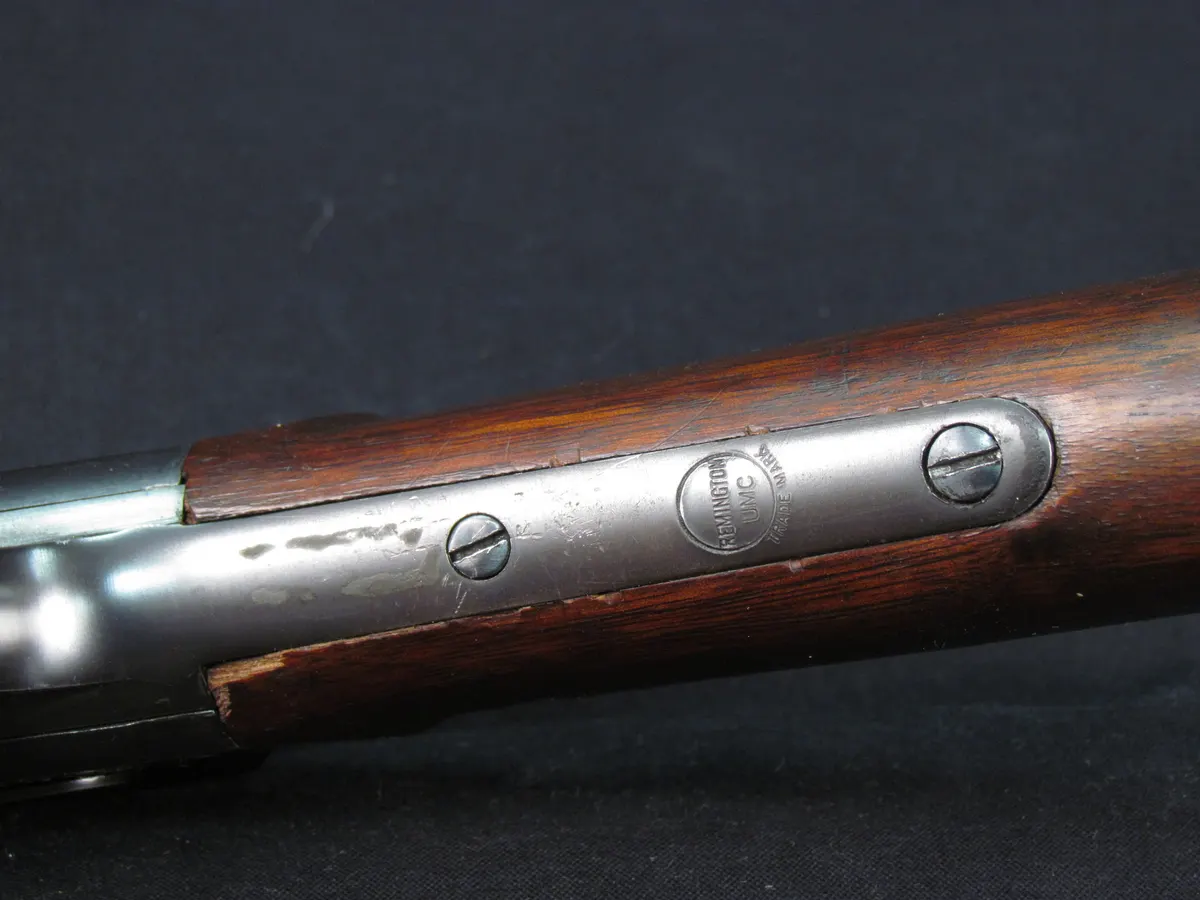
Remington needed a replacement for the aging Model 8 (and its later variant, the Model 81) because that Browning-patented long-recoil design was expensive to machine and heavy in the hand. The Model 740 answered both problems, its gas-operated action was cheaper to build and lighter to carry, while still handling the same long-action, high-power cartridges deer and elk hunters wanted.9 Remington launched the Model 740 in 1955 chambered only in .30-06 Springfield. .308 Winchester followed in 1956, and both .244 Remington and .280 Remington arrived in 1957.2 The .244 Remington chambering deserves a specific note, Remington had only introduced that cartridge itself in 1955, alongside the bolt-action Model 722, as a rival to Winchester's new .243 Winchester. The .244's slower 1-in-12 rifling twist could not stabilize the heavier 100-grain hunting bullets that .243 Winchester handled easily, and the cartridge lost the commercial fight badly enough that Remington rebranded it as the 6mm Remington in 1963 with a faster twist.10 So the Model 740's .244 Remington option was already carrying a cartridge past its market peak by the time it reached the rifle in 1957.
Production ran through 1959. Remington's own factory-history material rounds the end date to 1960, but the serial-number date-code system stamped on 740 barrels only runs through the letter F, corresponding to 1959, and period gunsmith production breakdowns describe a "740A" run that was phased out as inventory cleared before the Model 742 formally replaced it in December 1959 and January 1960.5 That leaves the weapons table's own 1960 end-year figure close but slightly late, and the weapon_specs table's 1963 figure clearly wrong, 1963 is actually the year the unrelated .244 Remington cartridge was rebranded as the 6mm Remington, which may explain the mix-up. Total production across the run reached 251,398 rifles.4

The Model 740's short production life reflects a deliberate replacement decision rather than a failure in the field, it sold in large numbers to happy deer hunters throughout its five years. Remington had already engineered fixes for its known problems, the broken ejectors, the climbing forend, the peened receiver rails, and rolled every one of them into the Model 742 replacement rather than retrofitting the 740's tooling.5 The Model 742 that followed in 1960 went on to sell roughly six times as many rifles as the 740 over its own twenty-year run, a sign that Remington's diagnosis of the 740's weaknesses was largely correct.
The Remington Model 740 Woodsmaster has no combat or military service history. It was designed, marketed, and sold exclusively as a civilian sporting rifle for deer and big-game hunting in the United States, and no army, police force, or paramilitary group is documented to have adopted it. Its combat history, in other words, is a hunting-camp story rather than a battlefield one.
Remington sold the Model 740 across five ascending factory grades rather than as mechanically distinct models, which is worth noting since the database's variants count of one understates how many distinct factory configurations actually left Ilion.
- 740A Standard (the base production grade, plain walnut, no engraving)
- 740ADL Deluxe and 740BDL Deluxe (upgraded wood and checkering over the Standard grade)
- 740D Peerless (scroll-engraved receiver with select figured walnut and improved checkering, produced across the full 1955-1959 run)
- 740F Premier (the top factory grade, receiver coverage exceeding 95 percent fine scroll and punch-dot engraving, an engraved magazine, gold inlay, and an engraved mountain-goat's head on the receiver top, with the metalwork alone reportedly representing roughly 80 man-hours of hand finishing)11
The Model 740 itself has no carbine, sniper, or military derivative. Its true variant, in the sense the rest of this leaf uses the term, is really its direct successor, the Remington Model 742, which reused the same basic receiver silhouette and grade structure while replacing the internal parts responsible for the 740's known failures.

The Model 740 Woodsmaster was a civilian retail rifle sold through Remington's normal dealer network in the United States, and its "operators" were American hunters rather than any government or military force. No confirmed law-enforcement or government contracts for the Model 740 have surfaced in Remington's own records or in collector research, unlike some later Remington centerfire rifles that Remington did eventually market under law-enforcement and military banners.
By the time it went out of production in 1959, the 740 had reached deer camps across the American Midwest and South in large enough numbers that period gunsmith accounts describe it as "the" rifle in some regions, to the near-exclusion of bolt-action and lever-action rivals.5 That regional dominance is also why so many Model 740s survive today in shootable condition, they were bought to be used every autumn rather than collected, and the secondary market for the rifle remains active decades after Remington stopped building it.
The most direct comparison for the Remington Model 740 is its own successor. Remington engineered the Remington Model 742 specifically to fix the 740's documented failure points rather than to change its role or market, and the two rifles share the same basic profile, the same .30-06 Springfield/.308 Winchester/.244 Remington/.280 Remington chamberings, and the same 4-round detachable magazine.
| Feature | Model 740 (1955-1959) | Model 742 (1960-1980) |
|---|---|---|
| Ejector | Pivoting bar, prone to breakage | Spring-loaded bolt-head type (from Model 760) |
| Forearm attachment | Single-pitch thread, climbs under recoil | Dual-pitch thread, holds float at rear |
| Barrel nut | Spanner style | Flat-sided style |
| Production run | 251,398 over 5 years | Approximately 1,400,000-1,500,000 over 20 years |
That the Model 742 sold roughly five to six times as many rifles over four times the production span says something concrete about how well Remington's fixes worked, and it is why gunsmith retrospectives on the whole 740/742/7400 family single out the ejector and forearm changes as the moment the design actually matured.5
The Model 740's real design-philosophy rival was not a semi-automatic at all, it was Remington's own earlier Remington Model 8, the long-recoil rifle it replaced in Remington's own catalog. Where the Model 8 locked the barrel and bolt together and drove them rearward as a unit, absorbing recoil energy directly through spring compression, the Model 740's gas system bled off only a portion of the propellant gas, leaving more of it to push the bullet and less to punish the shooter's shoulder. That made the 740 noticeably softer-shooting in the same .30-06 Springfield chambering both rifles offered, at the cost of the fouling and gas-system maintenance the Model 8 never had to deal with.
Winchester had its own experience with short-stroke gas-piston operation in the same period, though not in a hunting rifle. The Winchester model 30, an experimental military self-loading rifle developed from Jonathan Edmund Browning's design and later reworked by David Marshall Williams (the same engineer behind the M1 Carbine's short-stroke piston), used a comparable gas system to compete unsuccessfully for U.S. service-rifle contracts against the M1 Garand in the years before World War 2.12 Winchester never carried that gas-piston expertise into a civilian sporting rifle to rival the Model 740 directly, that did not happen until the unrelated Winchester Model 100 arrived in 1960, a year after the 740 had already left production. For the whole of the Model 740's own production run, it had no true gas-operated sporting-rifle rival from Winchester, only from within Remington's own catalog.

What cartridges does the Remington Model 740 come in? The Remington Model 740 Woodsmaster was chambered in .30-06 Springfield from its 1955 launch, with .308 Winchester added in 1956 and both .244 Remington and .280 Remington added in 1957.2
Is the Remington Model 740 still in production? No. Remington built the Model 740 from 1955 through 1959, then replaced it with the improved Model 742 Woodsmaster. It has not been in production since 1959.
How much is a Remington Model 740 Woodsmaster worth today? Used values vary heavily by grade and condition, a plain 740A Standard in worn condition sells for a few hundred dollars, while a factory-engraved 740D Peerless or 740F Premier grade in good condition can bring several times that. Remington did not publish a current retail price because the rifle has been out of production since 1959.
How does the Remington Model 740 work? It is a gas-operated semi-automatic rifle. Firing a round taps propellant gas from a port in the barrel to drive a short-stroke piston, which unlocks a rotating multi-lug bolt and cycles the action, feeding the next round from a 4-round detachable magazine automatically.
What replaced the Remington Model 740? The Remington Model 742 Woodsmaster replaced it starting in late 1959/1960, correcting the 740's ejector and forearm-attachment weaknesses. The 742 was in turn replaced by the Model 7400 in 1981.
- "Remington Model 740", Wikipedia — en.wikipedia.org ↩
- "Remington Model 740, Model 742 and Model 7400 Autoloading Rifles", Remington Society of America — remingtonsociety.org ↩
- "Sorry, But Your Remington Autoloader Is a Crappy Deer Rifle", Field & Stream — fieldandstream.com ↩
- "Remington Model 740 Woodsmaster", Chuck Hawks — chuckhawks.com ↩
- "Remington 740/742/7400 Semi-Auto", Leeroy's Ramblings — leeroysramblings.com ↩
- "TFB Armorer's Bench: Commentary on The Remington 74 Series", The Firearm Blog — thefirearmblog.com ↩
- "A Century of Remington Autoloading Rifles", American Rifleman — americanrifleman.org ↩
- "Remington Model 760 & Model 7600 Rifles", Remington Society of America — remingtonsociety.org ↩
- "Fudd Friday: Remington's Model 8 And Model 81 Were Weird And Wonderful", The Firearm Blog — thefirearmblog.com ↩
- "Cartridge History: Ever Heard of the .244 Remington?", The Accurate Shooter Daily Bulletin — bulletin.accurateshooter.com ↩
- "Premier 'F' Grade Remington Model 740 FDL Semi-Automatic Rifle", Rock Island Auction — rockislandauction.com ↩
- "Backing Another Horse: The Winchester G30 Semiautomatic Rifle", American Rifleman — americanrifleman.org ↩