

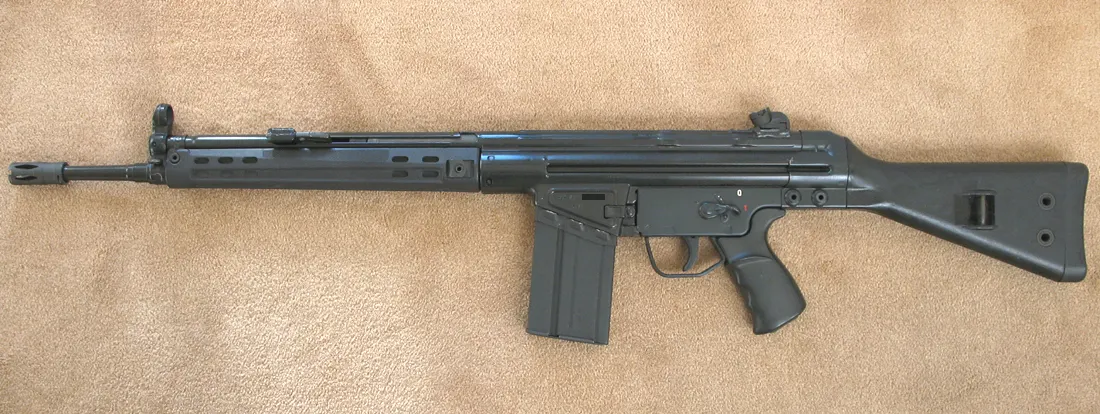

The Heckler & Koch HK41 is a semi-automatic-only rifle chambered in 7.62x51mm NATO, built by the West German manufacturer Heckler & Koch as a civilian-legal counterpart to its own Heckler & Koch G3 battle rifle.1 It is one of many semi-automatic rifles built by simply removing full-automatic capability from an existing military design, and it sits at the origin point of an entire family of G3-derived civilian rifles sold outside Germany, including the later American PTR-91F.2 The HK41 was never a general-issue weapon for any army. It was built almost entirely to satisfy one narrow legal and practical need, a rifle West German reservists could legally buy and keep at home that handled exactly like the select-fire G3 they trained on in uniform.2
- Identical handling and controls to the issue G3 rifle
- Roller-delayed blowback action, no gas system to foul or maintain
- Genuine 1960s-70s West German manufacturing quality
- Compatible with standard G3 furniture and accessories
- Semi-automatic only, no burst or automatic fire
- Extremely limited production, very hard to find today
- Original 5-round magazine restriction under West German law
- No bayonet lug or grenade-launching capability on compliant models
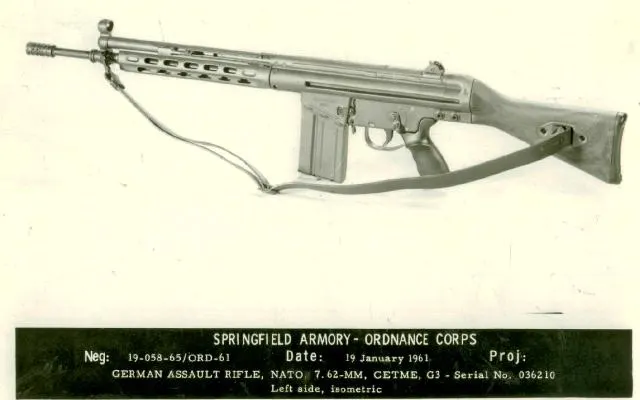
Roughly 1,350 examples were produced in total between the early 1960s and 1977, with fewer than 400 ever imported into the United States, making the HK41 one of the rarest rifles Heckler & Koch ever sold commercially.2,1 A figure of only 41 units produced appears occasionally in secondary references, and it looks like a data entry error rather than a documented number, since no source found in this research supports a total anywhere near that low, with 1,350 (or a range of roughly 1,300 to 1,350) the figure specialist sources actually agree on.
The rifle's history is really the history of West German firearms law colliding with a company that wanted to keep a production line open. Heckler & Koch built the Germany-designed G3 for the West German army starting in 1959, and by the early 1960s it wanted to sell a version to the public, mainly to reservists who wanted a personal rifle that duplicated their service weapon for weekend range practice.2 The legal path to that market required stripping the automatic fire control group entirely, and the result was marketed first under G3 markings and then, from 1966 onward, under the new commercial name HK41.1,2 Confusingly, sources differ on the exact starting date, with early G3-marked semi-automatic examples dated to the early 1960s and the dedicated HK41 commercial name applied from 1966, so this account treats the true start of steady production as somewhere in that range rather than a single confirmed year.
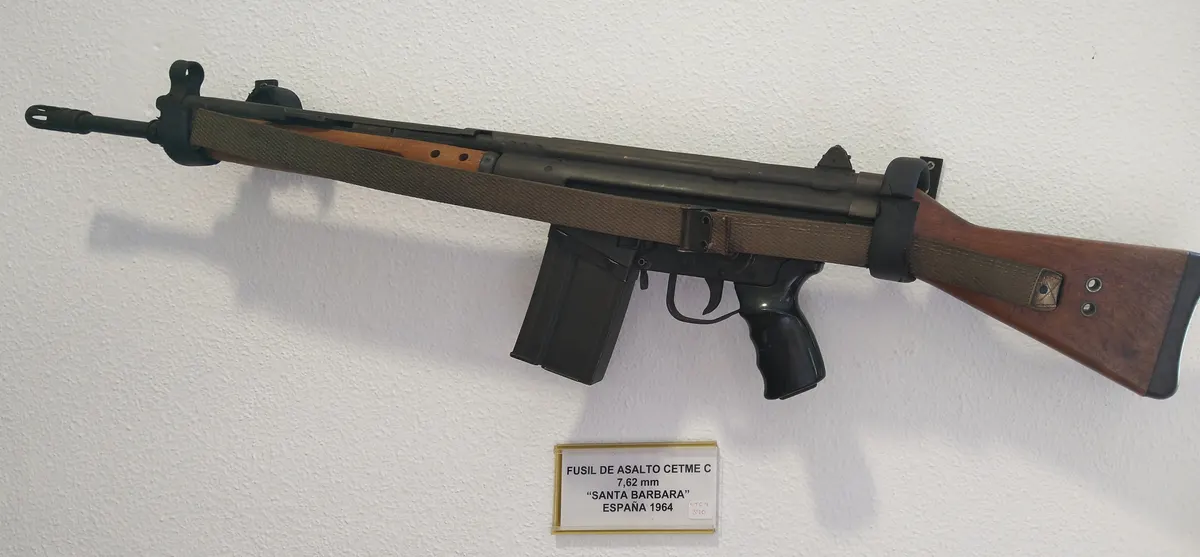
The Heckler & Koch HK41 uses the same roller-delayed blowback action as the G3, a system originally developed for Spain's CETME rifle by engineer Ludwig Vorgrimler, who had worked on wartime German roller-locked designs before emigrating and later joining Heckler & Koch's own rifle program.2 The action delays bolt opening with a pair of rollers rather than gas pressure, which is why the HK41 has no gas port, gas piston, or gas regulator anywhere on the barrel, a detail collectors and gunsmiths use to spot it at a glance next to a gas-operated rifle of the same era.
- İlk Üretim Yılı1964
- TasarımcıHeckler & Koch
- Ağırlık (Boş)4,95 kg
- Halen HizmetteHayır
- Önemli KullanıcılarBundeswehr yedek personeli
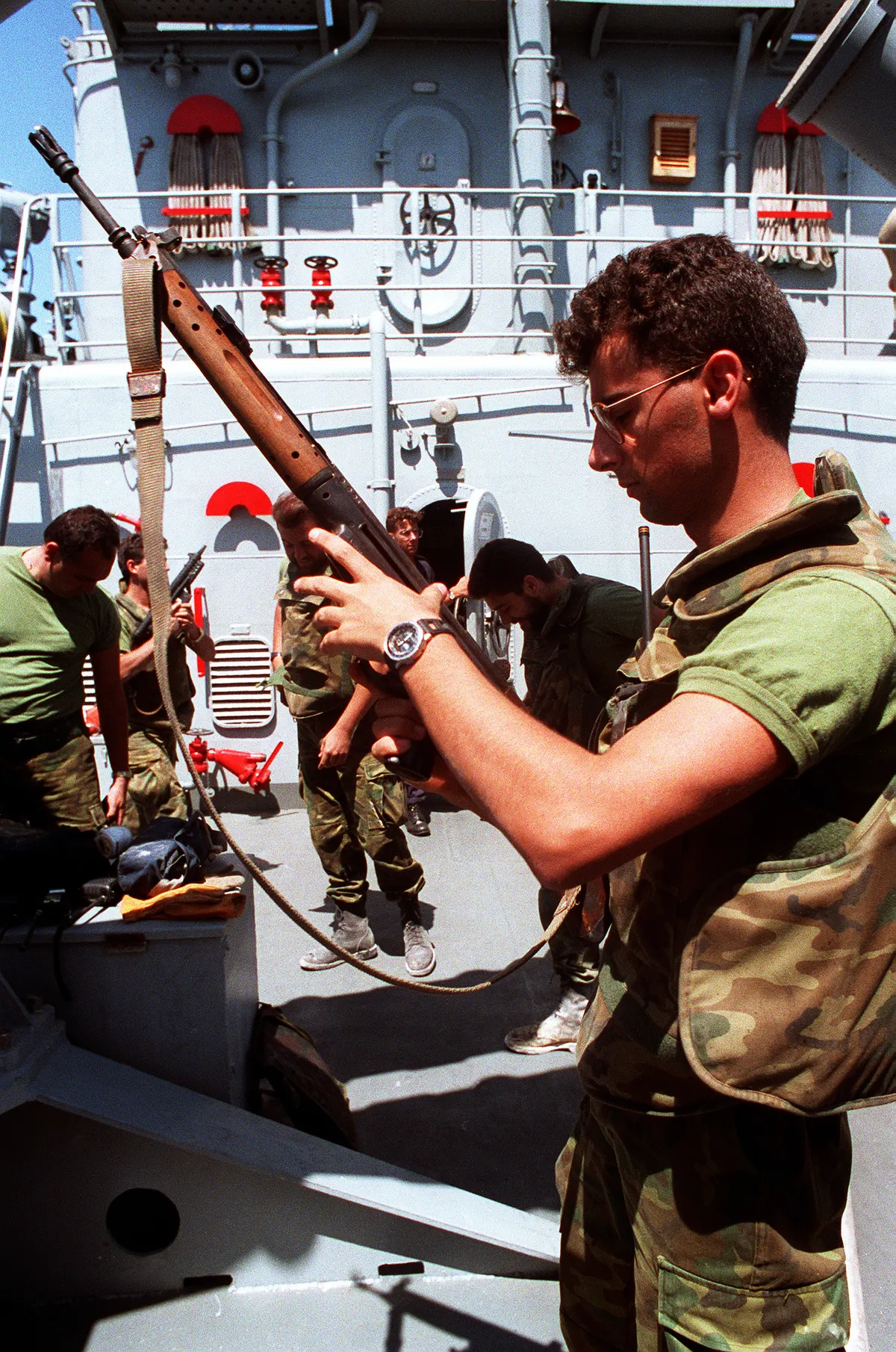
Compliant HK41 rifles fire from a 20-round detachable magazine, with a 50-round drum also cataloged, though the earliest West-German-market rifles were legally restricted to a 5-round magazine and barred from mounting a bayonet or a rifle grenade launcher, the same paramilitary-rifle restrictions West German gun law placed on any civilian-owned military-pattern arm.2 The trigger housing itself tells the compliance story. Genuine G3 rifles use an SEF group (Sicher, Einzelfeuer, Feuerstoss, German for safe, single shot, burst), while compliant HK41s carry an SE group with the full-automatic notch simply absent, and Heckler & Koch tightened this further over the production run, first with a welded receiver strip and later, on 1974-dated rifles, with a U-shaped metal insert that physically blocked an SEF group from ever being installed.3,1
- Fişek7.62×51mm NATO
- Çap7,62 mm
- Kovan Uzunluğu51 mm
- Çap Sınıfı7.62mm
- Kenar AteşlemeliHayır
- Kovansız MühimmatHayır
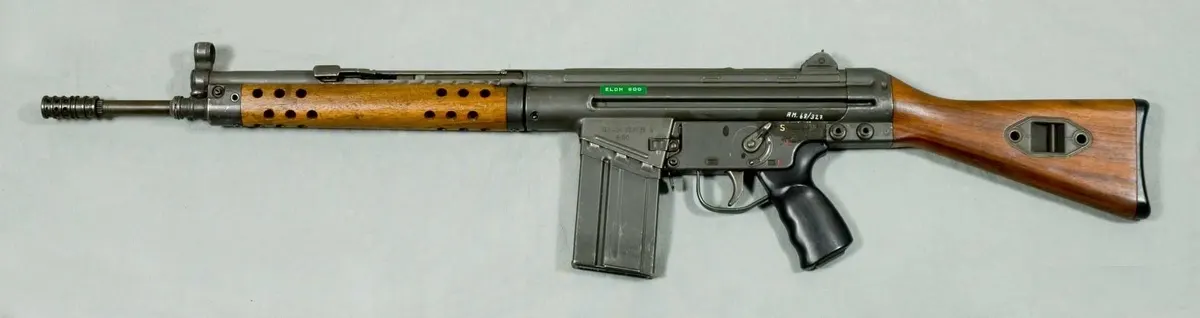
At 4.95kg empty, with a 500mm barrel and an overall height of 210mm, the HK41 weighs and handles almost identically to a standard-length G3, and it kept the G3's hooded post front sight and rotating diopter rear sight unchanged.1 The furniture is hardwood on the earliest examples rather than the black polymer more associated with later G3 production, and the HK41A3 variant added a folding stock while the HK41A2 kept a fixed stock, the only structural difference between the two factory variants.1
- Mekanizma TipiGecikmeli Blowback
- Atış Modlarıyarı otomatik
- Seçmeli AtışHayır
- Besleme SistemiÇıkarılabilir Şarjör
- Şarjör Kapasitesi20
- Tambur / Şerit Kapasitesi50
- Tetik TipiSE
Current price guides commonly quote a standard-condition HK41 in the five to twelve thousand dollar range today, a modern collector valuation rather than the rifle's original 1960s-70s commercial price when new, a distinction worth keeping in mind for anyone reading a unit cost figure for this rifle without checking which era it describes.4
- Namlu Uzunluğu500 mm
- Nişangah TipiKapaklı ön arpacık, döner diyoptr nişangahı
- Optik RayıHayır
- Açık NişangahEvet
- Dişli NamluHayır
- Kabza/Dipçik Malzemesisert ahşap
- Katlanır / Toplanır DipçikEvet
- Bullpup DüzeniHayır
- Çift Yönlü KumandalarHayır
- Susturucuya HazırHayır
- Süngü TakozuHayır
- Entegre BipodHayır
- Bombaatar KabiliyetliHayır
- Gaz PistonluHayır
- Toplam Üretim1.350
- Üretim Başlangıcı1964
- Üretim Bitişi1976
- Birim Maliyet6.900 USD
- Varyantlar2
- Yükseklik210 mm
West German law is the reason the HK41 exists at all, and the reason it stopped existing under that name. The Kriegswaffenkontrollgesetz (War Weapons Control Act) and later civilian firearms regulation drew a hard line between a military rifle capable of automatic fire and a sporting rifle a private citizen could legally own, and Heckler & Koch's answer was to build the G3's action into a rifle that could never cross that line without gunsmith-level modification.5 The West German army's own training regulation, ZDv 3/12, formally authorized reservists to bring an HK41 to organized weekend range sessions in place of an issue G3, and troops nicknamed it the Reservistengewehr, the reservist's rifle.2 That is the closest the HK41 ever came to formal military status. It was never issued, procured, or inventoried by the Bundeswehr as a service weapon, it was a privately purchased training substitute recognized by regulation rather than adopted as equipment.
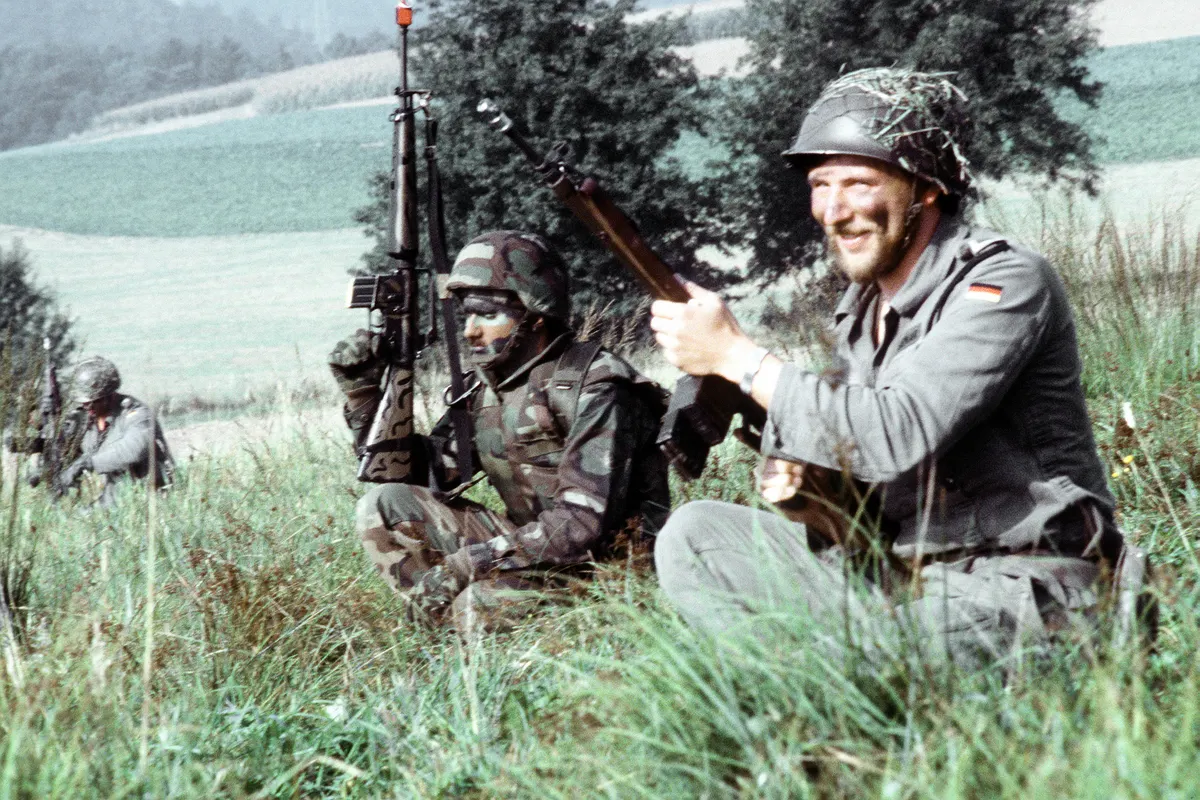
Exports followed a narrower, stranger path than the G3's own worldwide adoption. Golden State Arms Company's Santa Fe Division, based in Pasadena, California, imported HK41s into the United States between roughly 1962 and 1966, before the Gun Control Act of 1968 effectively froze new imports for several years.1 Security Arms Company (SACO) of Arlington, Virginia resumed limited importation from 1974, and Heckler & Koch's own American subsidiary took over final distribution from 1980.1 Total US imports across every importer never reached 400 rifles, a genuinely small number next to the many hundreds of thousands of G3s built worldwide under license for Portugal, Pakistan, Iran, Sweden, and dozens of other operators.3
1973 and 1974 brought the decisive break. Renewed West German legislation tightened the definition of a prohibited paramilitary rifle, and Heckler & Koch responded by welding a receiver insert into new production that made any conversion toward automatic fire physically impossible, then renaming the compliant rifle HK91 to distance it from the militarized HK41 name and market it explicitly as a sporting arm.1,3 Production of the true HK41 ended around 1976 to 1977, folded into the HK91 line, and the name HK41 survives today mainly as a collector's designation for the earlier, rarer rifles built before that renaming.1
Survival rates today are thin for a second reason beyond the low original production run. Gunsmiths converted a meaningful share of original HK41s to fire automatically during the seventies and early eighties, while that kind of conversion was still legal, and those conversions absorbed a large part of the surviving stock before the United States barred new machine gun registrations in May 1986, leaving genuinely unmodified factory-configuration examples rarer still.4
Two production variants are documented, matching what West German and US import records actually show. The HK41A2 kept the G3's fixed polymer or hardwood buttstock, while the HK41A3 used the G3's retractable single-position metal stock, and both were otherwise identical in action, caliber, and the SE-only trigger group.1 Neither variant ever received an optical rail or threaded muzzle from the factory, keeping the rifle visually close to a standard-issue G3.
Where the HK41 story really branches is downstream, not sideways. When 1974's compliance rename produced the HK91, that rifle in turn became the tooling and parts baseline for a much larger later industry of American-made G3-pattern semi-automatic rifles, most directly the modern PTR-91F, built by PTR Industries using retooled G3-pattern machinery originally sourced from Portugal's manufacturing line.3 The HK41 therefore sits at the root of a genus of semi-automatic-only G3 derivatives that stretches from a few hundred rare 1960s West German rifles to a far larger modern American production run built for an entirely different civilian market decades later.
Nearly every surviving HK41 has been individually modified at some point in its life, whether through gunsmith full-automatic conversions before 1986, aftermarket furniture swaps, or import-compliance parts changes, so unmolested factory-configuration examples are now considered a distinct and separately priced sub-variant among collectors rather than a simple baseline.4,6


The Heckler & Koch HK41 was never adopted by a foreign military, and it should not be read as a general-issue Bundeswehr rifle. Its only real institutional connection to Germany is the reservist training role recognized under ZDv 3/12, a regulation permitting personally owned HK41s at organized range sessions rather than a procurement contract.2 Portugal is sometimes listed as a former operator of the HK41, a claim this research could not confirm anywhere. Portugal's own Heckler & Koch rifle, the Espingarda Automática m/961, was a locally built, full-automatic-capable G3A3, not the semi-automatic-only HK41, and no source found here connects the HK41 specifically to Portuguese service.3
Beyond West Germany, HK41 ownership was almost entirely a civilian and collector phenomenon rather than an institutional one, concentrated among the small number of American buyers who acquired one through Golden State Arms, SACO, or Heckler & Koch's own later US import arm before the rifle's total production ran out.1
No confirmed law enforcement adoption in Germany or elsewhere turned up in this research either, despite the rifle sometimes being loosely described online as a police training weapon. The distinction matters because it separates the HK41's real, narrow, well-documented role (a personally purchased reservist practice rifle recognized by one training regulation) from a broader and unsupported police-and-military framing that occasionally circulates in casual descriptions of the gun.
A single welded insert is the entire mechanical difference between an HK41 and its own 1974 successor, the HK91, and that small part explains why the two names get confused constantly in HK41 specifications searches today. Both use the identical roller-delayed blowback action and identical 7.62x51mm NATO chambering, but the HK91 added the U-shaped insert that made automatic conversion physically impossible and dropped the militarized model name, turning an ambiguous paramilitary rifle into an unambiguous sporting one under West German law.1,3 A buyer researching HK41 specifications today is often really asking an HK91 question, since the two rifles share nearly every dimension, weight figure, and control layout.
| Spec | HK41 | PTR-91F |
|---|---|---|
| Cartridge | 7.62x51mm NATO | 7.62x51mm NATO |
| Action | Roller-delayed blowback | Roller-delayed blowback |
| Origin | West Germany, 1960s-70s | United States, 2000s-present |
| Total production | ~1,350 | Far larger ongoing commercial run |
The more interesting comparison is against the American PTR-91F, because the two rifles occupy almost opposite ends of the same idea. The HK41 was a scarce, legally constrained, short-run product built in West Germany specifically around a reservist's practice needs, while the PTR-91F is a modern, high-volume American commercial rifle built from retooled G3-pattern machinery with no reservist rationale behind it at all, aimed purely at the US civilian rifle market decades after the HK41's production line closed.3 Where an HK41 buyer in the 1960s or 1970s was navigating West German paramilitary-rifle law, a PTR-91F buyer today is simply choosing a G3-pattern semi-automatic rifle among several modern options, a completely different market built on the same underlying roller-delayed blowback design first proven on Spain's CETME rifle.


What is the Heckler & Koch HK41? It is a semi-automatic-only version of the Heckler & Koch G3 battle rifle, built in West Germany from the 1960s through 1976-77 primarily so Bundeswehr reservists could legally own a rifle handling like their service weapon.2
How many HK41 rifles were made? Roughly 1,350 in total, with fewer than 400 ever imported into the United States, making it one of the rarest commercial products Heckler & Koch ever sold.2,1
Is the HK41 the same as the HK91? They share the same action and chambering, but the HK91 is the 1974 compliance-driven renaming and further modification of the HK41, with an added insert that makes automatic conversion physically impossible.1,3
What is the difference between the HK41 and the HK G3? The G3 is West Germany's full-automatic-capable service rifle, while the HK41 is its semi-automatic-only civilian derivative, legally restricted from burst or automatic fire and, on early compliant models, from mounting a bayonet or magazine larger than 5 rounds.2
Can civilians in the United States still own an HK41 today? Original semi-automatic HK41s that were lawfully imported before the relevant cutoff dates remain legally transferable as ordinary semi-automatic rifles, though genuine examples are scarce and command high collector prices, while any full-automatic-converted example falls under separate, much stricter machine gun regulation.4
- "Heckler & Koch HK41", Wikipedia — en.wikipedia.org ↩
- "HK 41: Paramilitary Rifle for the Bundeswehr", Forgotten Weapons — forgottenweapons.com ↩
- "The Military Rifles of Portugal Part 2", Firearms News — firearmsnews.com ↩
- "Extremely Rare Heckler & Koch HK41 Rifle 7.62 in NATO Up for Auction", Athlon Outdoors — athlonoutdoors.com ↩
- "Gun control in Germany", Wikipedia — en.wikipedia.org ↩
- "Dog Soldiers", Internet Movie Firearms Database — imfdb.org ↩