

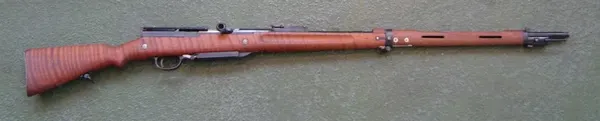

The Meunier rifle, formally the Fusil Automatique Meunier A6, was France's first serious attempt to field a semi-automatic infantry rifle, tentatively adopted by the French army in 1910 to replace the bolt-action Lebel Model 1886 rifle.1 It never got the chance to prove itself at scale. Only 1,013 rifles were ever built, and the outbreak of the First World War in August 1914 stopped mass production before it truly started, leaving the design a historical footnote rather than a standard-issue weapon.1,2
- advanced high-velocity 7x59mm cartridge for its era
- genuine semi-automatic firepower a decade before rival armies fielded one
- well received in the limited trench trials it did undergo
- rotating-bolt long-recoil action, mechanically sound and reliable in testing
- required its own non-standard 7mm ammunition, incompatible with 8mm Lebel logistics
- mechanically complex and expensive relative to a bolt-action rifle
- production halted almost immediately by the outbreak of war in 1914
- never issued beyond a small trial batch, no real combat record
Designed by Étienne Meunier, a weapons inspector attached to the Section Technique de l'Artillerie (STA) at the Puteaux arsenal, the A6 used a long-recoil operating system with a rotating bolt, mechanically closer to John Browning's contemporary shotgun patents than to anything else in French service at the time.3,8 It fired a proprietary 7×59mm Meunier cartridge, a rimless, high-velocity round that was substantially more advanced than the Lebel's aging 8mm Lebel service cartridge, itself dating to 1886.1,2 That ambition is exactly what doomed the rifle logistically once war came. A weapon needing its own unique ammunition supply chain was a hard sell to a wartime army that needed every rifle chambered for the cartridge already flowing through French depots by the millions.4
The Meunier program sits at the very start of the semi-automatic rifles category's history, predating the American M1 Garand by roughly a quarter century and even predating France's own next attempt, the RSC 1917, by several years.5 Where the RSC 1917 succeeded by compromising, reusing standard Lebel-pattern parts and firing the existing 8mm Lebel round to get 86,000 rifles into French hands by 1918, the Meunier rifle pursued a technically purer but logistically isolated design that the French army could not afford to scale up once general mobilization began.5,6 The result is one of the rarer and less understood chapters in the story of France's slow, expensive road toward a standard-issue semi-automatic rifle, a road that would not actually finish until the postwar MAS-49 rifle decades later.1
The Long-Recoil, Rotating-Bolt Action Behind the A6
The Meunier A6 cycles by long recoil, an operating principle in which the barrel and bolt recoil together, locked, for the full length of the fired cartridge case before the bolt unlocks and returns forward alone to strip and chamber a fresh round.3,8 Meunier's design used a rotating bolt secured by three interrupted-thread locking lugs, a scheme distinct from the five-lug bolt on his own earlier, abandoned STA A1 prototype of 1897, and one that gave the A6 strong primary extraction even with the high chamber pressures of its 7mm cartridge.8 The system owed an acknowledged debt to John Browning's 1900-era long-recoil patents, the same family of mechanisms behind the Browning Auto-5 shotgun and, later, the American Remington Model 8 rifle.3
- Hizmete Giriş Yılı1910
- TasarımcıÉtienne Meunier
- Ağırlık (Boş)4 kg
- Ağırlık (Yüklü)4,1 kg
- Halen HizmetteEvet
- Önemli KullanıcılarFransa
Long recoil gave Meunier's design a genuinely reliable lockup for a period when most rival semi-automatic prototypes fought fouling, timing failures, or weak extraction. The tradeoff was mechanical complexity and cost. A long-recoil action needs a telescoping recoil spring arrangement and precise timing between barrel and bolt travel, both harder and more expensive to manufacture consistently than a simple bolt-action turnbolt like the Lebel's.3,8 Field reports from the rifle's limited 1916 to 1918 trench trials generally described the mechanism as sound, a genuine achievement for a weapon of this era, but one that came at real cost in machining hours the wartime Manufacture Nationale d'Armes de Tulle could not spare for full-scale output.2
- Fişek7x59mm Meunier
- Çap7 mm
- Kovan Uzunluğu56,95 mm
- Kenar AteşlemeliHayır
- Kovansız MühimmatHayır
The 7×59mm Meunier Cartridge Against the 8mm Lebel

The 7×59mm Meunier cartridge was the rifle's most forward-looking feature and its biggest practical liability. Its case length of 56.95mm was only finalized in 1912 after years of argument between the Puteaux and Tulle arsenals over exactly how long the case should be and how hot it should be loaded.1,2 The original high-power loading exceeded 1,040 m/s, an extraordinary figure for a full-power rifle round in the 1910s, before French ordnance settled on a reduced 820 m/s service loading in 1913 to ease pressure and barrel wear.1,2 Either figure comfortably outran the roughly 700 m/s the rimmed 8mm Lebel cartridge managed from the bolt-action rifle it was meant to replace, and the Meunier's rimless case fed far more cleanly from a box magazine than the Lebel's old rimmed design ever could.1
- Mekanizma TipiUzun Geri Tepmeli
- Atış Modlarıyarı otomatik
- Seçmeli AtışHayır
- Besleme SistemiSabit Şarjör
- Şarjör Kapasitesi5
That same rimless, high-velocity cartridge is exactly why the rifle failed to reach general issue. No other weapon in French service used 7×59mm Meunier ammunition, so every rifle fielded meant a separate supply line the army's wartime logistics network had no room for once millions of soldiers needed standard 8mm Lebel rounds instead.4,6 The rifle fed from a fixed 5-round internal magazine charged with stripper clips, sensible and conventional in itself, but tied permanently to ammunition nothing else in the French arsenal could use.1
- Namlu Çıkış Hızı820 m/sn
- Namlu Uzunluğu715 mm
- Nişangah TipiAçık demir nişangah
- Optik RayıHayır
- Açık NişangahEvet
- Dişli NamluHayır
- Toplam Uzunluk1.295 mm
- Katlanır / Toplanır DipçikHayır
- Bullpup DüzeniHayır
- Çift Yönlü KumandalarHayır
- Susturucuya HazırHayır
- Süngü TakozuEvet
- Entegre BipodHayır
- Bombaatar KabiliyetliHayır
- Gaz PistonluHayır
- Toplam Üretim1.013
- Varyantlar2
Étienne Meunier's Self-Loading Program, 1894 to 1910
France's search for a semi-automatic replacement for the Lebel rifle began in 1890, and Étienne Meunier, a STA engineer working out of the Puteaux arsenal, started his own experiments by 1894.1,8 Four separate government bodies, the STA, the École Normale de Tir, Puteaux itself, and the Commission Technique de Versailles, tested more than twenty prototypes between them over the following two decades, roughly split between recoil-operated and gas-operated approaches.1 Meunier's own first completed design, presented in 1897 to 1898 as the STA No.4 (later redesignated the Meunier A1), was gas-operated, fed from an 8-round magazine, and fired an experimental 6x58mm round at close to 900 m/s, a genuinely advanced firearm for the 1890s that never left the prototype stage.8
Following requirements set by the French Supreme War Council in 1909, Meunier reworked his design entirely around the long-recoil principle, producing the STA A6 rifle presented in 1910 and put through troop testing in 1911 and 1912.8 The French army tentatively adopted the A6 that same year, 1910, pending final agreement on the cartridge, and the case-length dispute between Puteaux and Tulle that followed was not resolved until 1912.1,2 By the time the specification finally settled, the rifle Meunier had spent sixteen years developing was only months from a war that would decide its fate.
War, the Tulle Production Run, and the 1916-1918 Trench Trials
Limited production tooling began in 1913, and the Manufacture d'Armes de Saint-Étienne was set up to eventually turn out 5,000 Meunier rifles a month.1 That plan collapsed almost immediately. With war against Germany looking imminent by the spring of 1914, French ordnance judged it too risky to re-equip the army with an unproven new rifle and its unique ammunition on the eve of a major conflict, and full-scale production was cancelled.1,2 The 1,013 rifles that do exist were completed later, at the Manufacture Nationale d'Armes de Tulle, largely across 1916 and 1917, using tooling and partial runs left over from the abandoned 1913 to 1914 program.8
Sources disagree on exactly how many of the 1,013 completed rifles actually reached front-line troops. Some accounts describe roughly 300 rifles sent forward for trench trials beginning in 1916, well received by the soldiers who carried them.1 Others put the number distributed to operational units as high as 843 by 1918.4 Either figure describes a trial batch, not a general issue weapon, and the rifle's dependence on non-standard 7mm ammunition remained its central handicap throughout, a resupply problem no army fighting a war of that scale could tolerate for long.4,6

Development of a successor began in 1915, before the Meunier's own trench trials had even finished. The result, credited to designers Ribeyrolles, Sutter, and Chauchat, was formally adopted in May 1916 as the Fusil Automatique Modèle 1917, universally known as the RSC 1917.5,6 Unlike the Meunier, the RSC 1917 was gas-operated and deliberately built around existing Lebel-pattern components, including the barrel, stock, handguard, and trigger guard, and it fired the standard 8mm Lebel round loaded in five-round en-bloc clips rather than any new cartridge.5,7 That compromise let French industry build roughly 86,000 RSC 1917 rifles by the end of 1918, a figure the far more ambitious Meunier program never came close to reaching.5,6
The Meunier rifle's only real combat exposure came during the First World War, specifically in the limited trench trials French ordnance ran between roughly 1916 and 1918 on the Western Front.1,2 These were never a general-issue deployment. The rifles went to a small number of trial units rather than standard infantry companies, a deliberate choice given how few had actually been built and how tightly their unique ammunition was rationed.1
Because the trial issue was so limited, the Meunier rifle left essentially no independent combat record of its own, unlike weapons such as the SVT-40 or the later M1 Garand that saw genuine mass deployment. Its wartime significance is that of a live-fire technology demonstrator rather than a combat rifle, one whose real influence shows up in what French ordnance learned and then applied to the RSC 1917 rather than in any battlefield outcome it changed itself.4,6
Two distinct configurations of the Meunier design exist. The original A6 rifle, adopted in 1910 and produced from 1916 onward, measured 1,295mm overall with a 715mm barrel and weighed roughly 4 kg empty.1 A shorter 1916 Carbine variant cut that length down to 1,096mm, close to the later M1 Garand's overall length, and added the unusual three-dot night sight arrangement noted above.4 Sources differ on the carbine's magazine, with some describing genuinely detachable 5, 10, and 15-round magazines and others noting the weapon was still charged via stripper clips in practice regardless of the magazine's outward design, a detail modern references have not fully reconciled.4,8
Only a small number of carbines were made by cutting down existing long rifles rather than through separate production, and only one example is confirmed to survive today, held unrestored in the Springfield Armory collection.1 Neither configuration reached a formal production variant count beyond these two forms before the program ended.

France was the Meunier rifle's only operator, and even that use was limited to a small trial issue rather than standard army-wide service.1 No export sales, licensed production abroad, or foreign trial adoptions are documented, a direct consequence of how few rifles existed and how tightly bound the design was to its own non-standard ammunition.1,2

France's own retention of the Meunier rifle effectively ended once the RSC 1917 entered production in 1916 and 1917, at which point remaining Meunier rifles were withdrawn from whatever trial units held them rather than kept in parallel service.4,6 The type never returned to any active role after the First World War ended, and its surviving footprint today is entirely a museum and collector one, not a service history.
France's decision between the Meunier rifle and the RSC 1917 was really a decision about wartime industrial mobilization, not raw mechanical merit. The Meunier A6 was, on paper, the more technically ambitious rifle, with a purpose-built rimless cartridge running as fast as 1,040 m/s against the Lebel's roughly 700 m/s, but it demanded an entirely separate manufacturing and ammunition supply chain that French industry could not stand up quickly once general war began.1,2 The RSC 1917 solved the opposite problem. It gave up cartridge performance entirely, keeping the old 8mm Lebel round, in exchange for reusing existing Lebel-pattern barrels, stocks, and fittings that Manufacture d'Armes de Saint-Étienne and its sister arsenals already knew how to mass-produce.5,7
| Spec | Meunier A6 | RSC 1917 |
|---|---|---|
| Action | Long-recoil, rotating bolt | Gas-operated, rotating bolt |
| Cartridge | 7x59mm Meunier (proprietary) | 8mm Lebel (standard issue) |
| Feed | 5-round internal magazine | 5-round en-bloc clip |
| Total production | 1,013 | approx. 86,000 |
That production gap, 1,013 rifles against roughly 86,000, is the real verdict on the two designs' respective fit for a total war.1,5 The Meunier rifle was arguably the better engineered of the two in isolation, its long-recoil action and high-velocity cartridge represented a genuine technical leap over the 1886-vintage Lebel, but the RSC 1917 was the rifle French industry could actually deliver to soldiers in meaningful numbers while a war was underway.6,7 Neither rifle became France's permanent standard infantry weapon. Both were essentially wartime expedients, and France would not settle on a definitive standard-issue semi-automatic rifle until the MAS-49 rifle entered service after the Second World War.1

What caliber is the Meunier rifle chambered in? The Meunier rifle fires a proprietary 7×59mm Meunier cartridge, a rimless round with a case length of 56.95mm, unrelated to the standard 8mm Lebel round used by other French rifles of the period.1,2
How does the Meunier rifle's action work? It cycles by long recoil. The barrel and a rotating, three-lug bolt recoil together for the full case length before the bolt unlocks and strips a fresh round from the fixed 5-round magazine on its return stroke.3,8
Why was Meunier rifle production stopped? Full-scale production, tooled at Manufacture d'Armes de Saint-Étienne for 5,000 rifles a month, was cancelled in 1914 because French ordnance judged it too risky to re-equip the army with a new rifle and its unique ammunition on the eve of war with Germany. Only 1,013 rifles were ultimately completed, mostly in 1916 and 1917.1,2
Is the Meunier rifle still in service anywhere today? No. It saw only a limited 1916 to 1918 trench trial with France and was withdrawn once the RSC 1917 entered production. Surviving examples exist only in museum and archival collections today.1
How does the Meunier rifle compare to the RSC 1917? The Meunier A6 had a more advanced cartridge and action but required its own separate ammunition supply. The RSC 1917 sacrificed cartridge performance to reuse standard Lebel-pattern parts and 8mm Lebel ammunition, letting France build roughly 86,000 of them by 1918 against the Meunier's 1,013. See the Comparison section above for the full breakdown.5,6
How rare is a Meunier rifle today? Extremely rare. With only 1,013 ever built and most lost during the First World War, one confirmed example survives at the Musée de l'Armée in Paris and another, a carbine, in the Springfield Armory collection in the United States, with essentially none in private collector hands.1
- "Meunier rifle", Wikipedia — en.wikipedia.org ↩
- "Fusil semi-automatique Meunier A6", Wikipédia — fr.wikipedia.org ↩
- "French A6 Meunier M1916", Forgotten Weapons — forgottenweapons.com ↩
- "The Most Advanced Gun in the World (in 1916): The 1916 Meunier Carbine", The Firearm Blog — thefirearmblog.com ↩
- "Fusil Automatique Modèle 1917", Wikipedia — en.wikipedia.org ↩
- "The Classics: The French RSC of World War I", American Rifleman (Shooting Illustrated) — shootingillustrated.com ↩
- "This Old Gun: French RSC Modele 1917", American Rifleman — americanrifleman.org ↩
- "Meunier M1916", Modern Firearms — modernfirearms.net ↩