

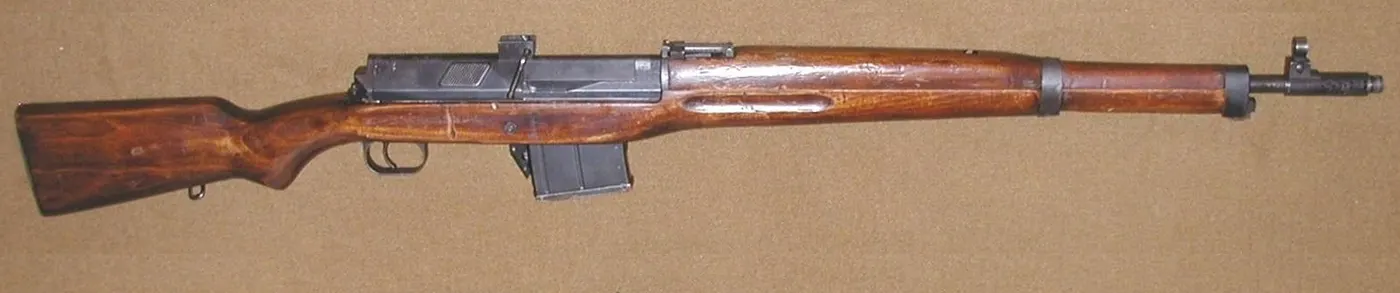

Egypt's army entered the 1948 Palestine War armed mostly with bolt-action Lee-Enfields and a mismatched stock of war-surplus Mauser rifles, a firepower gap that Egyptian military planners spent the next decade trying to close. The Hakim rifle, the country's first indigenously produced semi-automatic rifle, was the eventual result. Built at Egypt's Factory 54 in Maadi from the mid-1950s onward, the Hakim rifle was a license-derived copy of the Swedish Automatgevär m/42 (also called the Ljungman), rechambered from the Swede's 6.5x55mm cartridge to the 7.92x57mm Mauser round that Egypt already held by the ton. Around 70,000 were produced before Egypt switched to Maadi-built AK-47 pattern rifles in the mid-1960s.
- full-power semi-automatic firepower over the bolt-action rifles it replaced
- effective muzzle brake keeps 7.92x57mm Mauser recoil manageable
- adjustable gas valve lets one rifle digest ammunition of varying pressure
- simple, well-proven Ljungman-derived gas system
- gas valve is finicky and must be readjusted for different ammunition lots
- heavy at nearly 5 kg unloaded, longer and bulkier than contemporaries
- detachable magazine was loaded like a fixed one, awkward compared to true box-fed rifles
- production began too late to matter in the war that justified building it
The Hakim rifle's design history is really a licensing story before it is a combat story. Sweden's own Automatgevär m/42, designed by Erik Eklund of AB C.J. Ljungmans Verkstäder, used a simple direct gas-operated impingement system with a tilting bolt, loosely descended from wartime SVT experimentation.1 Egypt bought the actual production tooling and drawings for this rifle rather than reverse-engineering it, which is why the Hakim rifle's action is close to a mechanical copy of its Swedish parent rather than a fresh design.1,2 The one system Egypt could not leave alone was the cartridge. Sweden's 6.5x55mm was a low-pressure round tuned for the Ljungman's fixed gas port. Egypt's post-WWII depots were instead full of German 7.92x57mm Mauser ammunition of wildly inconsistent manufacture and pressure, so Egyptian engineers rechambered the rifle for that round, added an integral muzzle brake to tame the recoil, and, critically, added an adjustable gas valve the original Swedish rifle never had.1,3
The Hakim rifle's specifications sit in familiar full-power battle rifle territory, close in concept to Egypt's earlier stopgap, the Belgian-built FN Model 1949, which also fired 7.92x57mm Mauser. Anyone researching Hakim rifle specifications or asking how the Hakim rifle works is really asking the same underlying question, namely how a Swedish battle rifle designed around a mid-power 6.5mm cartridge survived being rebored for a full-power 8mm round without becoming unreliable. The short answer is that it mostly did, at the cost of a gas system that needed constant attention. Later sections cover the Hakim rifle's design in detail, its combat record in the 1956 Suez Crisis and the 1967 Six-Day War, and how it compares to the Ljungman rifle it was copied from.
Rechambering to 7.92x57mm Mauser and Egypt's Muzzle Brake
The Hakim rifle weighs 4.75 kg (10.5 lb) unloaded, measures 1,216 mm (47.9 in) overall, and carries a 638 mm (25.1 in) barrel ending in a large, permanently fixed muzzle brake.1,4 That brake was not optional. Full-power 7.92x57mm Mauser generates considerably more recoil than the Swedish 6.5x55mm the original Ljungman rifle was built around, and Egyptian engineers judged the stock and action strong enough to handle the pressure but not the felt recoil, so they cut extra vents into an enlarged brake to bring it down to a manageable level.4,6 Shooters who have tested surviving Hakim rifles describe the recoil as unexpectedly soft for a rifle of this weight and cartridge, crediting the brake directly, though they also describe the muzzle blast and noise as severe for anyone standing beside the shooter.4 Average muzzle velocity with period 8mm Mauser ammunition ran close to 610 m/s (2,000 fps), producing roughly 1,741 ft lb of muzzle energy at the muzzle.5 The rear sight is a sliding tangent design graduated from 100 to 1,000 meters, though realistic point-target range with iron sights on a rifle this heavy sits well under that maximum.4
- İlk Üretim Yılı1954
- Hizmete Giriş Yılı1955
- TasarımcıErik Eklund
- Ağırlık (Boş)4,75 kg
- Halen HizmetteHayır
- Önemli KullanıcılarMısır, Güney Yemen, Tunus, Somali, İrlanda Ulusal Kurtuluş Ordusu
The Direct Gas Impingement Action and Its Adjustable Valve
Like the Swedish rifle it was copied from, the Hakim rifle runs on a gas-operated direct impingement system. Gas is bled from a port partway down the barrel, driven back through a steel tube, and allowed to strike the front face of the bolt carrier directly, which unlocks and cycles a tilting bolt with no intermediate piston.1 The Swedish original ran this system with a fixed gas port, tuned once for a single well-controlled cartridge. Egypt's ammunition situation made that approach unworkable. Wartime and postwar 7.92x57mm Mauser in Egyptian stocks came from multiple manufacturers with genuinely different pressure curves, and a fixed gas port tuned for one batch would either fail to cycle or slam the action hard enough to damage parts with another. Egyptian engineers solved this by adding a triangular, pie-marked gas valve, adjustable with a small wrench, positioned in the gas tube ahead of the receiver.4,9 The valve had to be set for whatever ammunition was loaded and readjusted when the ammunition changed, and collectors shooting surviving rifles today still describe the same behavior, smooth cycling with some commercial loads, malfunctions with others (steel-cased Romanian surplus is a commonly cited offender) until the valve is reset.4 A gas valve stuck fully open lets the bolt carrier start extracting a fired case while pressure is still present in the chamber, a genuinely dangerous failure mode that period Egyptian armorers and modern collectors both had to learn to avoid.4
- Fişek7.92x57mm Mauser
- Çap7,92 mm
- Kovan Uzunluğu57 mm
- Çap Sınıfı7.92mm
- Kenar AteşlemeliHayır
- Kovansız MühimmatHayır
A Detachable Magazine Loaded Like a Fixed One

The Hakim rifle feeds from a 10-round detachable magazine, but in practice Egyptian soldiers rarely detached it. The magazine spring was stiff enough, and the magazine catch stiff enough to operate under recoil, that the rifle was designed and issued to be topped off through the open action with 5-round stripper clips while the magazine stayed locked in place, exactly like the fixed-magazine Swedish original it copied.1,9 That loading method, on a rifle with an exposed charging handle and no manual bolt hold-open convenient to a soldier's off hand, produced a well-documented complaint among Hakim rifle shooters of pinched or bruised thumbs during rapid reloading, a quirk repeated often enough in collector circles that it has become one of the rifle's better-known nicknames.9 The iron sights consist of a dovetailed, windage-adjustable front post and the tangent rear notch described above.4
- Mekanizma TipiGazlı
- Atış Modlarıyarı otomatik
- Seçmeli AtışHayır
- Besleme SistemiÇıkarılabilir Şarjör
- Şarjör Kapasitesi10
- Namlu Çıkış Hızı610 m/sn
- Nişan Menzili1.000 m
- Namlu Uzunluğu638 mm
- Nişangah Tipitangent
- Açık NişangahEvet
- Toplam Uzunluk1.216 mm
- Katlanır / Toplanır DipçikHayır
- Bullpup DüzeniHayır
- Bombaatar KabiliyetliHayır
- Gaz PistonluHayır
- Toplam Üretim70.000
- Üretim Başlangıcı1954
- Üretim Bitişi1965
- Varyantlar1
Egypt's military lost the 1948 Palestine War fighting almost entirely with bolt-action rifles, a fact that shaped procurement decisions for the next several years.1 The first corrective purchase was not the Hakim rifle at all. In 1951, still under King Farouk, Egypt broke from its usual reliance on British ordnance and ordered 37,602 Belgian-built FN Model 1949 semi-automatic rifles from FN Herstal, chambered, by coincidence of Egyptian ammunition stocks rather than any design link to the later Hakim rifle, in the same 7.92x57mm Mauser round.1,3 The FN-49 order gave Egypt a real semi-automatic rifle years before the Hakim rifle existed, and its adoption is the direct reason 7.92x57mm was already the Egyptian army's standard rifle cartridge when the Hakim rifle program began.
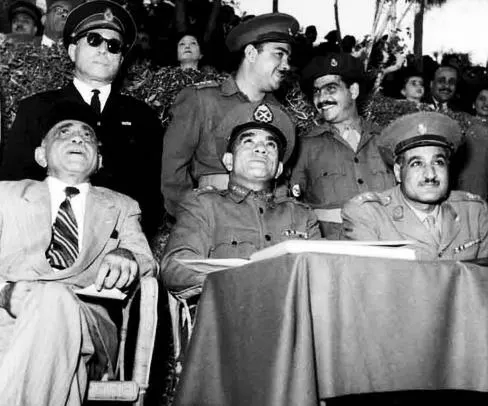
The Hakim rifle program itself followed Gamal Abdel Nasser's 1952 coup against Farouk, part of a broader push to reduce Egypt's dependence on former colonial suppliers and build domestic arms production.1 Egypt negotiated with Sweden for the manufacturing rights, drawings, and tooling of the Automatgevär m/42B, the improved version of the Ljungman rifle Sweden had itself only adopted in limited numbers, and Sweden shipped the equipment to a new state factory, Factory 54, in the Maadi district south of Cairo.1,2 Actual Hakim rifle production did not begin until the mid-1950s, several years after the license was signed and well after the 1948 war it is sometimes assumed to have fought in. One period account of the program notes that fewer than a few thousand Hakim rifles even existed by the time of the 1956 Suez Crisis, meaning the bulk of the 70,000-rifle production run was still ahead of the factory when Egypt's next war began.9
Production wound down through the mid-1960s once Egypt began building AK-47 pattern rifles under license at the same Maadi complex, a switch driven as much by the availability of cheap Soviet-bloc arms aid after Egypt's 1955 Czechoslovak arms deal as by any specific fault of the Hakim rifle's design.9 A shortened, non-adjustable 7.62x39mm derivative, the Rasheed carbine, followed the Hakim rifle into limited production later in the decade, covered separately under Variants below.
The 1956 Suez Crisis is the war most often associated with the Hakim rifle in popular accounts, but the association is largely symbolic. Only a small fraction of the eventual 70,000-rifle production run had left Factory 54 by October 1956, and most photographic evidence from the Sinai campaign shows Egyptian units carrying older bolt-action rifles or newly arrived Soviet-bloc weapons rather than the Hakim rifle.9 Egypt's 1955 arms deal with Czechoslovakia had already begun supplying Soviet-pattern SKS carbines and Czech vz. 52 rifles in bulk, and those weapons, not the still-scarce Hakim rifle, did most of the infantry rifle work during the Suez fighting.9
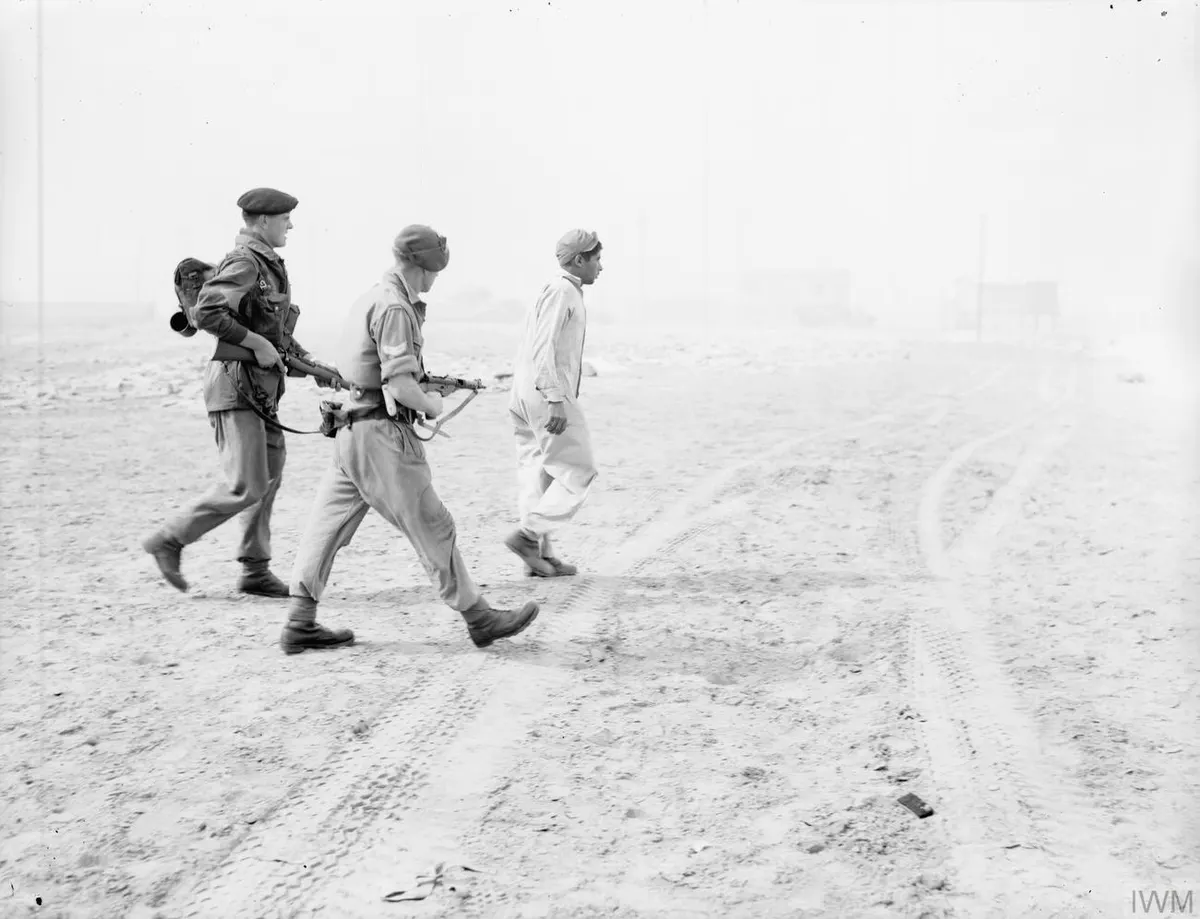
By the 1967 Six-Day War, Factory 54 had finished the bulk of its production run and the Hakim rifle was genuinely present in Egyptian ranks, though by then it was already a second-line weapon behind the Maadi-built AK-47 pattern rifle equipping frontline infantry.1 One of the more widely reproduced photographs from the period, taken just before the war began, shows an Egyptian soldier carrying a Hakim rifle while watching the American aircraft carrier USS Intrepid transit the Suez Canal in June 1967.1 Neither the 1956 nor the 1967 war gave the Hakim rifle any particular battlefield distinction, and a substantial number were reportedly captured or abandoned by retreating Egyptian units in the Sinai during the 1967 fighting, adding to the pool of Hakim rifles that later reached the Western surplus market.9
Away from Egypt itself, Somalia is recorded as a Hakim rifle user, and Wikipedia's own combat history for the rifle lists Somali use during the 1964 Ethiopian-Somali border war, one of the earliest of the recurring Ethiopia-Somalia frontier conflicts of the Cold War era.1 The exact route by which Egyptian-pattern Hakim rifles reached Somali forces is not well documented in English-language sources, and it should be treated as an area where the historical record is genuinely thin rather than settled.
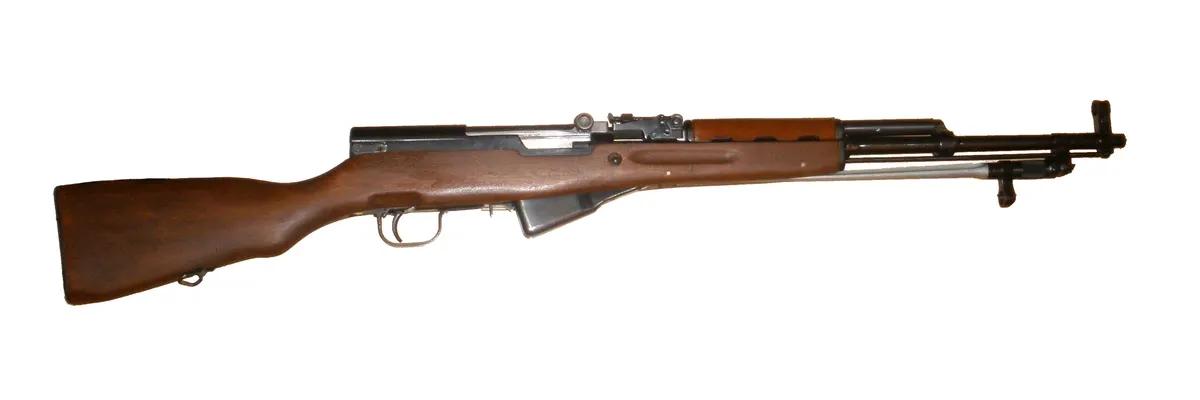
The only real derivative of the Hakim rifle is the Rasheed carbine, and it is worth treating as a distinct weapon rather than a simple variant. Egypt's Ministry of Military Production scaled the Hakim rifle's action down at Factory 54 starting in 1966, shortening the barrel to 520 mm, trimming overall length to roughly 1,035 mm, cutting unloaded weight to about 4.19 kg, and rechambering the whole system for the intermediate 7.62x39mm cartridge already familiar from Egypt's AK-47 production.7,8 The Rasheed carbine kept the same 10-round detachable magazine and direct impingement gas system as the Hakim rifle, including a version of the adjustable gas valve, now with three positions plus a cutoff setting for firing rifle grenades, but it dropped the Hakim rifle's stripper-clip loading requirement.7 Only around 7,300 to 8,000 Rasheed carbines were built between 1966 and 1968, a fraction of the Hakim rifle's 70,000-unit run, and it was issued mainly to Egypt's District Ward Reserve Army, a second-line reserve force, seeing service in both the Six-Day War and the later Yom Kippur War.7 Its permanently attached folding bayonet gives the Rasheed carbine a strong visual resemblance to the Soviet SKS carbine, close enough that unfamiliar observers regularly misidentify the two.7
Iraq later produced its own version of the Rasheed carbine, the so-called Baghdad variant, built from 1969 to 1977 using the same Egyptian tooling and machinery transferred abroad, extending the design's production life by nearly a decade beyond Egypt's own run.7


Egypt was the Hakim rifle's sole manufacturer and its primary operator, issuing it as a standard infantry rifle from the mid-1950s until it was displaced by the Maadi-built AK-47 pattern rifle in the mid-1960s, after which surviving stocks lingered in reserve and police service for years longer.1 Beyond Egypt, the Hakim rifle's notable users include Somalia, Tunisia, Togo, and former South Yemen, all recipients of Egyptian surplus or gifted stocks during the 1960s and 1970s.1 Togo is recorded as having formally adopted the Hakim rifle and kept it in service into the 1990s, longer than Egypt itself retained the weapon on active duty.1 Surplus Hakim rifles also turned up far from their original service context, most notably with the Irish National Liberation Army during the Troubles in Northern Ireland, then part of the United Kingdom, a use with no operational connection to the rifle's Middle Eastern service history beyond the availability of cheap surplus arms on the international market.1
Today the Hakim rifle is retired from all known military service. It remains legally importable into the United States as a curio and relic firearm because of its age, and a substantial share of the original 70,000-rifle production run reached the American surplus market during the 1990s and 2000s, making the Hakim rifle a comparatively affordable and available Cold War-era battle rifle for civilian collectors and shooters today.6
The Hakim rifle and the Automatgevär m/42 fire from mechanically near-identical direct impingement gas systems, a direct result of Egypt buying Sweden's actual production tooling rather than independently copying the design.1,2 What separates the two rifles is everything Egypt changed to make the design survive a switch to full-power ammunition. The Swedish Automatgevär m/42 fired the mild 6.5x55mm cartridge from a fixed, non-adjustable gas port and needed no muzzle brake, producing a notably smoother-shooting rifle that never saw combat in Swedish hands.2 The Hakim rifle fired the considerably more powerful 7.92x57mm Mauser, required an integral muzzle brake to keep recoil manageable, and needed an adjustable gas valve the Swedish original never had, precisely because Egyptian 7.92x57mm surplus stocks varied so much in pressure between manufacturers.1,4 Sweden built roughly 30,000 Automatgevär m/42 rifles and issued them only in limited numbers alongside the bolt-action m/96 Mauser that remained its standard infantry rifle.2 Egypt built more than double that number of Hakim rifles and issued the design as its actual standard infantry rifle for roughly a decade, giving the Egyptian derivative a combat history, however limited, that the Swedish original entirely lacks.1,2
| Hakim rifle (Egypt) | Automatgevär m/42 (Sweden) | |
|---|---|---|
| Cartridge | 7.92x57mm Mauser | 6.5x55mm |
| Gas system | Direct impingement, adjustable valve | Direct impingement, fixed port |
| Unloaded weight | 4.75 kg | 4.71 kg |
| Production | approx. 70,000 | approx. 30,000 |
| Combat use | Suez Crisis, Six-Day War (limited) | None recorded |
The comparison against Egypt's own earlier stopgap rifle, the FN Model 1949, is less about mechanics and more about timing. Both rifles fired the same 7.92x57mm Mauser cartridge and both were, in their own way, foreign designs adapted to Egyptian ammunition stocks, but the FN-49 used a tilting-bolt gas piston system derived from John Browning's SAFN-49 work rather than the Ljungman's direct impingement, and it reached Egyptian hands in 1951, years before a single production Hakim rifle existed.1,3 The FN-49 order is the reason 7.92x57mm was already Egypt's standard cartridge when the Hakim rifle program began, making the Hakim rifle a domestic-production answer to a cartridge choice Belgium's export contract had already locked in.

What caliber does the Hakim rifle use, and why not the original Swedish 6.5x55mm? The Hakim rifle is chambered in 7.92x57mm Mauser, not the 6.5x55mm of the Swedish Automatgevär m/42 it was copied from. Egypt rechambered the design because its postwar depots held large stockpiles of German 7.92x57mm ammunition left over from the desert campaigns of the Second World War, and switching calibers let the new rifle share ammunition with existing Mauser bolt-action rifles already in Egyptian service.1
Is the Hakim rifle the same weapon as the Swedish Ljungman rifle? The Hakim rifle is a license-built derivative of the Swedish Automatgevär m/42, commonly called the Ljungman, using tooling and drawings Egypt purchased directly from Sweden. The action and general layout are nearly identical, but the Hakim rifle differs in caliber, carries an integral muzzle brake the Swedish rifle lacks, and adds an adjustable gas valve the fixed-port Swedish original never needed.1,2
Did the Hakim rifle see combat in the 1948 Arab-Israeli War? No. The Hakim rifle's production did not begin until the mid-1950s, several years after the 1948 Palestine War ended. Egypt fought that war with bolt-action Lee-Enfield and war-surplus Mauser rifles, and the Hakim rifle program itself was a direct response to the firepower gap that defeat exposed.1
Is the Hakim rifle still in service anywhere today? No known military still fields the Hakim rifle. Egypt retired it from frontline service in favor of the Maadi-built AK-47 pattern rifle by the mid-1960s, and even Togo, its longest-serving foreign operator, phased it out by the 1990s. Surviving examples exist almost entirely in collector and museum hands today.1
What replaced the Hakim rifle in Egyptian service? Egypt replaced the Hakim rifle with license-built AK-47 pattern rifles produced at the same Maadi factory complex, a switch driven largely by cheap Soviet-bloc arms aid that followed Egypt's 1955 Czechoslovak arms deal.9
- "Hakim rifle", Wikipedia — en.wikipedia.org ↩
- "Automatgevär m/42", Wikipedia — en.wikipedia.org ↩
- "Egyptian Contract FN-49 Semi-Automatic Sniper Rifle", Rock Island Auction — rockislandauction.com ↩
- "Collecting and Shooting the Military Surplus Rifle, The Hakim Story", This Old Rifle — thisoldrifle.com ↩
- "Collecting and Shooting the Hakim, Ammunition", This Old Rifle — thisoldrifle.com ↩
- "Hakim & Rasheed Rifles, Egypt's Best?", Pew Pew Tactical — pewpewtactical.com ↩
- "The Rasheed, Egypt's Semiauto Battle Carbine From Sweden", Forgotten Weapons — forgottenweapons.com ↩
- "Rasheed carbine", Wikipedia — en.wikipedia.org ↩
- "Egyptian Hakim Service Rifle, Crushing Thumbs Since 1956", The Firearm Blog — thefirearmblog.com ↩