

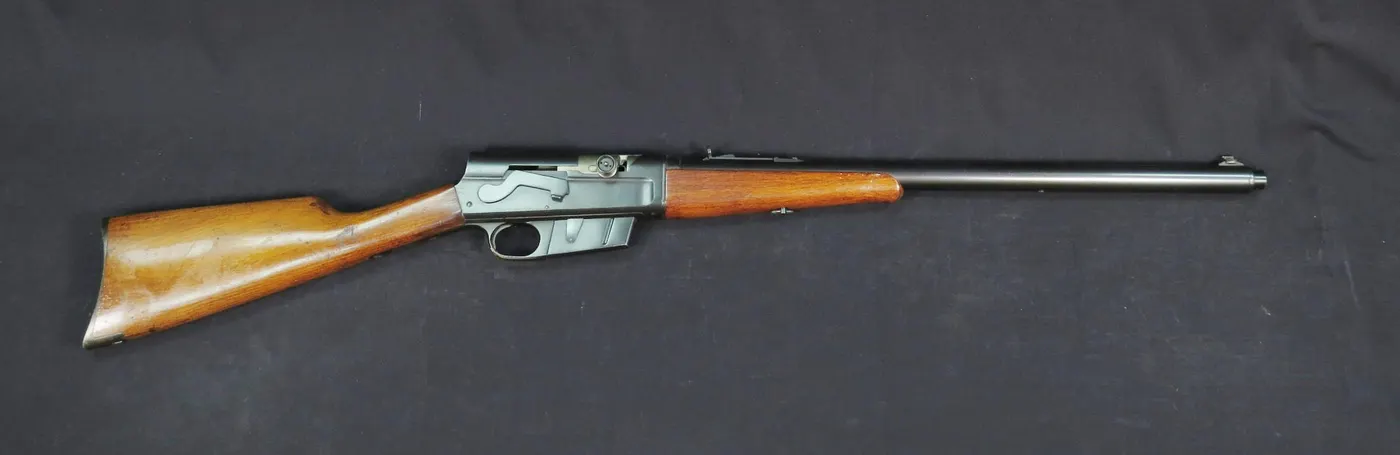

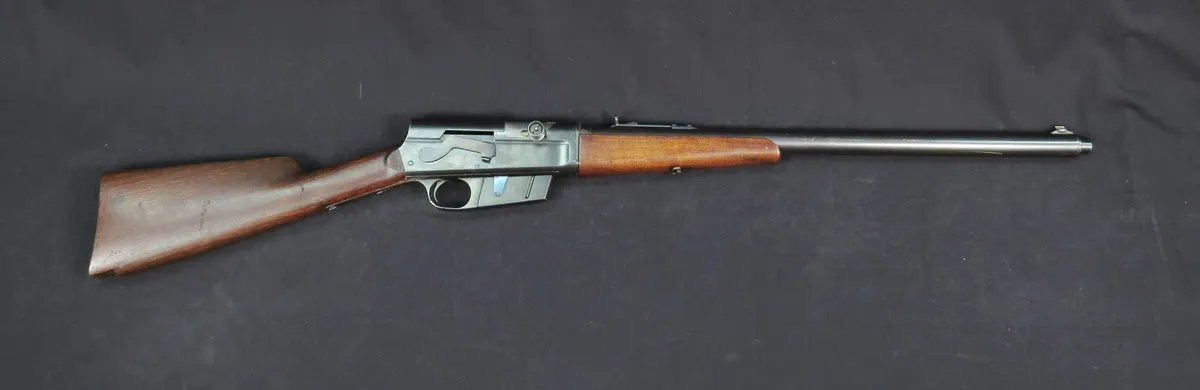
John Browning filed the patent behind the Remington Model 8 on October 16, 1900, nineteen years before Mikhail Kalashnikov was even born, and the safety lever on that patent later turned up almost unchanged on the side of the AK-47 receiver.1,8 Remington Arms put the design into production in 1905 as the Remington Autoloading Rifle, renamed it the Model 8 in 1911, and sold roughly 80,600 of them before the improved Model 81 took over in 1936.1,2 It was a semi-automatic rifle chambered in one of four dedicated Remington cartridges (.25, .30, .32, or .35 Remington), built for deer and black bear hunters rather than soldiers, and it is generally credited as the first truly reliable high-power autoloading rifle sold commercially in the United States.1,3
- long recoil action handled full-power rifle cartridges reliably
- take-down design for compact transport
- four purpose-built rimless cartridges avoided rimlock in the magazine
- simple crossbolt safety later echoed in other designs
- fixed 5-round magazine limited standard capacity
- heavy, barrel-shrouded profile compared to bolt-action rivals
- proprietary Remington cartridges never achieved wide commercial support
- exposed spring tube made cleaning and maintenance more involved
The Remington Model 8's closest American rival in its own era was the Winchester Model 1907, and the two guns spent three decades competing for the same hunters and the same police departments.9 Outside the United States, FN Herstal in Belgium built a near-identical licensed variant, and that Belgian-made rifle went on to a brief and unusual career as an aerial weapon in the opening months of the World War I era, long before synchronized machine guns existed.7 The rifle also carries a well-documented connection to American law enforcement history, most famously the 1934 ambush that killed Bonnie Parker and Clyde Barrow, and it remains a fixture of one of the deeper corners of the semi-automatic rifles category, alongside its own factory descendants such as the Remington Model 740 and Remington Model 7400.
The Long Recoil Action Borrowed From a Browning Shotgun
The Remington Model 8 uses a long-recoil, recoil-operated action, essentially a rifle-scaled adaptation of the mechanism John Browning had already worked out for the Browning Auto-5 shotgun.3 On firing, the barrel and the rotating bolt head stay locked together and travel rearward as a unit, compressing two recoil springs inside a full-length steel sleeve that covers the 22-inch (558.8mm) barrel.1,3 The barrel is then released to spring forward first, extracting and ejecting the spent case, before the bolt itself returns forward under its own spring, stripping a fresh round out of the fixed 5-round box magazine and chambering it.1 That shrouded barrel profile gave the Remington Model 8 its distinctive silhouette, and it also spawned a persistent (and false) rumor among owners that the sleeve could be bored out to fire a 12-gauge shotgun shell.8
- İlk Üretim Yılı1905
- Tasarımcıjohn_browning
- Ağırlık (Boş)3,63 kg
- Halen HizmetteHayır
- Önemli KullanıcılarFederal Soruşturma Bürosu (FBI), Texas Rangers
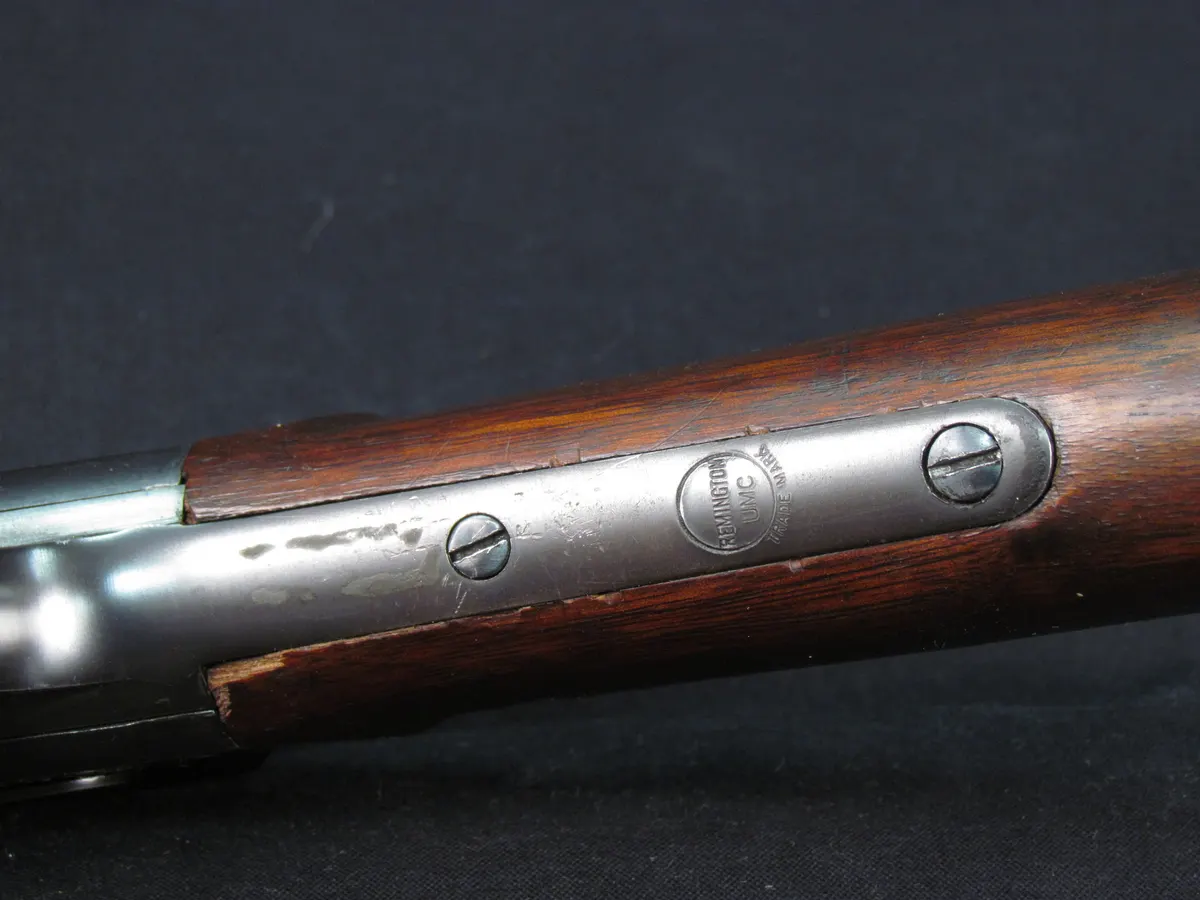
Remington built four rimless cartridges specifically for the Model 8, the .25 Remington, .30 Remington, .32 Remington and .35 Remington, because the rimmed hunting cartridges of the day fed poorly through a box magazine under long-recoil cycling.1,3 The .35 Remington, launching a 150-grain bullet at roughly 2,400 feet per second, proved the most popular chambering by far and is the only one of the four still loaded commercially today.9 Weighing about 8lb (3.63kg) empty and offered with a internal magazine fixed five-round box loaded from stripper clips, the rifle also had a genuine take-down feature, letting an owner separate the barrel assembly from the receiver by hand for transport without tools.1
- Fişek25_remington_30_remington_32_remington_35_remington
- Çap6,35 mm
- Çap Sınıfıkenarsız şişe boyunlu merkezi ateşlemeli
- Kenar AteşlemeliHayır
- Kovansız MühimmatHayır
Sights, Trigger, and Handling
Standard Model 8 rifles carried plain iron sights, a silver bead front post and a semi-buckhorn rear notch on most production guns, paired with a single-stage trigger and a manual safety just forward of the trigger guard.6 Police-contract variants swapped the fixed magazine for extended 10-, 15- or 20-round box magazines supplied by aftermarket vendors such as the Peace Officer Equipment Company, a modification that turned a deer rifle into a genuine law-enforcement weapon capable of outgunning most handguns and lever-action carbines an officer might otherwise face.5
- Mekanizma TipiGeri Tepmeli
- Atış Modlarıyarı otomatik
- Seçmeli AtışHayır
- Besleme SistemiSabit Şarjör
- Şarjör Kapasitesi5
- Tetik Tipitek kademeli
- Emniyet TipiElle
- Namlu Uzunluğu558,8 mm
- Nişangah Tipimekanik nişangah
- Optik RayıHayır
- Açık NişangahEvet
- Dişli NamluHayır
- Gövde Malzemesi (Receiver)Çelik
- Kabza/Dipçik Malzemesiahşap
- Katlanır / Toplanır DipçikHayır
- Bullpup DüzeniHayır
- Çift Yönlü KumandalarHayır
- Modülerlikparçalara ayrılabilir tasarım
- Susturucuya HazırHayır
- Süngü TakozuHayır
- Entegre BipodHayır
- Bombaatar KabiliyetliHayır
- Gaz PistonluHayır
- Toplam Üretim80.600
- Üretim Başlangıcı1911
- Üretim Bitişi1936
- Varyantlar1
From a 1900 Patent to the Remington Autoloading Rifle
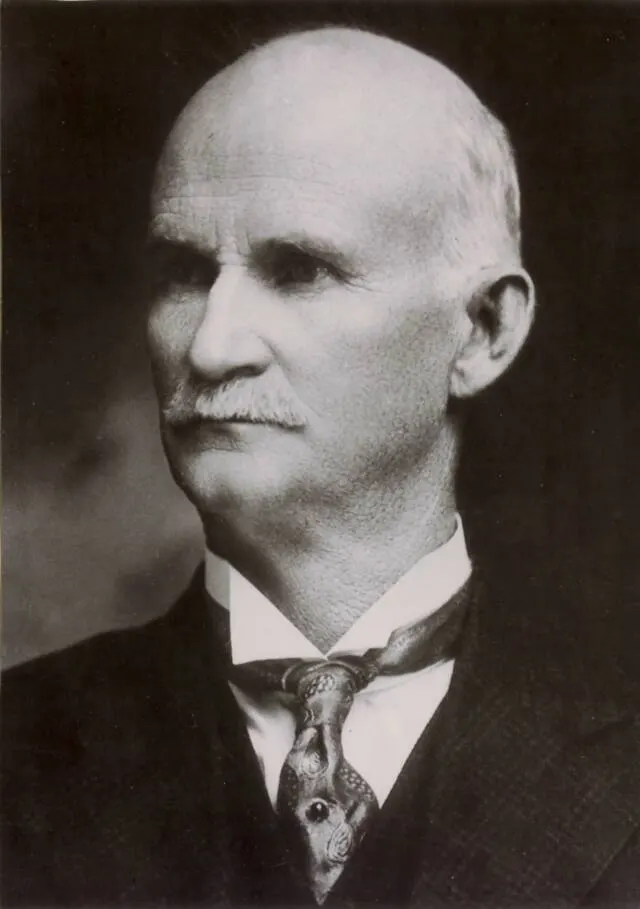
John Browning had already made his name with the Winchester lever guns and the Colt-Browning machine gun family when he patented the long-recoil action behind the Remington Model 8 on October 16, 1900, then sold the design outright to Remington Arms rather than manufacturing it himself.1,3 Remington, based at Ilion, New York, spent several years refining the mechanism before releasing it in 1905 as the Remington Autoloading Rifle, with the first rifles reaching customers the following year.1,2 Firearms historians generally treat it as the first commercially successful autoloading hunting rifle sold in the United States, ahead of rival self-loaders from Winchester and Savage.2,3
Remington renamed the rifle the Model 8 in 1911, by which point roughly 26,000 of the earlier Autoloading Rifle pattern had already left the Ilion factory.1 Production of the Model 8 itself ran from 1911 to 1936, and Remington's own figures put total output at 80,600 rifles, a number that lines up closely with independent tallies compiled by collectors.1,3
Licensed Production as the FN Browning Model 1900
FN Herstal, the Belgian arms maker better known to American shooters through the Browning Auto-5, built its own version of the design under license and sold it as the Browning Patent Modèle 1900, a near-identical copy of the Remington original aimed at buyers in Canada and Western Europe.7 FN produced roughly 4,913 of these rifles between 1910 and 1929, a modest run compared to Remington's own output, but the design's most unusual chapter came from this Belgian-built version rather than the American one.3,7
The Aéronautique Militaire and Early Aerial Observers
Before synchronization gear let machine guns fire safely through a spinning propeller, French aircrews needed some way for an observer to shoot at enemy aircraft without hitting their own propeller blades, and a fast-shooting semi-automatic rifle was one stopgap answer.7 Around 100 FN-built Browning Model 1900 rifles saw front-line service with the French World War I air arm, the Aéronautique Militaire, alongside a smaller number of Winchester Model 1907s, with roughly 90 still recorded in front-line inventory as late as October 1915.7 Collectors and researchers still debate exactly how many of the rifles in French aviation service were the Belgian FN-built Model 1900 rather than an American-made Remington Model 8, since period photographs rarely distinguish the two at a glance, but the FN-built rifle is the version most consistently documented in French sources.7
The Ambush That Killed Bonnie and Clyde
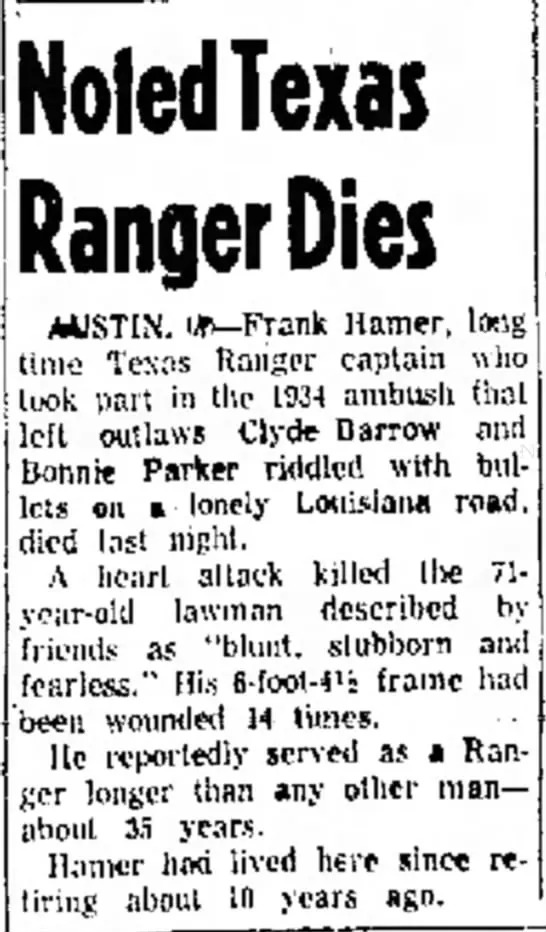
The Remington Model 8's best-known moment in American history came on May 23, 1934, on a rural stretch of Louisiana State Highway 154 near Gibsland, where a six-man posse led by former Texas Ranger Frank Hamer ambushed Bonnie Parker and Clyde Barrow.4,5 Hamer had carried a plain .30-caliber Model 8 for years, but for the manhunt he specifically ordered a new rifle in .35 Remington from a store in Austin, reasoning that the heavier cartridge would punch through the steel body of Barrow's stolen Ford V8 far more reliably than a smaller round.5 His personal rifle, serial number 10045, carried a special-order extended magazine holding either 15 or 20 rounds depending on the account, sourced from the Peace Officer Equipment Company of St. Joseph, Missouri.4,5 A second Model 8, serial number 48990 and fitted with the standard 22-inch barrel and factory 5-round magazine, was fired by Deputy Sheriff Prentis Oakley, whose opening shots are generally credited as the first to strike Barrow.6 That second rifle sold at a James D. Julia firearms auction in 2006 for $69,000 against a pre-sale estimate of $50,000 to $150,000, with its provenance backed by notarized affidavits and a prior exhibition at the Cody Firearms Museum.6 The posse's combined fire from Model 8s, a Colt Monitor automatic rifle, shotguns and revolvers totaled around 160 rounds.4
The Bureau of Investigation, the FBI's predecessor, drew its own lesson from a separate and unrelated 1933 shootout, the Kansas City Massacre, and afterward asked Remington for a semi-automatic rifle of its own.10 What the agency actually adopted, however, was the improved Model 81 rather than the Model 8 covered here, chambered in .30 Remington and .35 Remington, and issued from 1936 onward.10 The distinction matters because the two rifles are frequently conflated in popular accounts of early FBI armament, even though the Model 81 postdates the Kansas City shooting by roughly three years.
The Remington Model 81 Woodsmaster
Remington replaced the Model 8 with the Model 81 Woodsmaster in 1936, keeping the same long-recoil mechanism but reshaping the stock with a pistol grip in place of the older straight grip and cleaning up the forearm and internal parts for better reliability.3,9 The .25 Remington chambering was dropped within the Model 81's first year, and Remington added .300 Savage to the lineup in 1940 to compete more directly with bolt-action hunting rifles.9 The Model 81 stayed in production until 1950, with roughly 55,600 to 56,000 built, before Remington replaced the entire long-recoil family with the gas-operated Remington Model 740 in 1955.9
The Model 740 and its own successors, the Remington Model 742, the Remington Model 7400 and the Remington Model Four, abandoned the long-recoil system entirely in favor of a gas-operated action better suited to modern bolt-action cartridges like .30-06 Springfield, but all of them trace their basic role, a semi-automatic hunting rifle built by Remington for the same civilian market, straight back to the Model 8.9


The Remington Model 8 was never formally adopted as a military service rifle by any government, but it saw real institutional use on two continents. In the United States, individual departments and lawmen, most famously the Texas Rangers through Frank Hamer, bought Model 8 rifles privately or through department funds for use against motorized, heavily armed criminals during the Prohibition and Depression-era crime wave, and the rifle's reputation with police shaped the FBI's later (and separate) adoption of the improved Model 81.4,10 In France, the Aéronautique Militaire fielded roughly 100 FN-built Browning Model 1900 rifles as an improvised aerial weapon in the first year of the World War I, retiring them once synchronized machine guns made a hand-cycled rifle in the cockpit unnecessary.7
For three decades, an American hunter or a police department shopping for a self-loading rifle usually ended up weighing the Remington Model 8 against the Winchester Model 1907, two guns built around opposite answers to the same mechanical problem.9 The Winchester's simple blowback action kept the rifle cheap and light, but it limited the cartridge to the comparatively mild .351 Winchester Self-Loading round, while the Remington Model 8's locked-breech long-recoil action let it handle the considerably more powerful .35 Remington safely.9
| Spec | Remington Model 8 | Winchester Model 1907 |
|---|---|---|
| Action | Long recoil, locked breech | Blowback |
| Common caliber | .35 Remington | .351 Winchester SL |
| Barrel length | 22in (558.8mm) | 20in |
| Magazine | Fixed 5-round (10/15/20 police) | Detachable 5/10/15-round |
| Weight | 8lb (3.63kg) | ~8lb |
Both rifles found their way into American police cars in the 1920s and 1930s for the same reason, patrol officers needed something that could punch through the sheet steel of a Ford V8 sedan at a distance a service revolver simply could not manage, and both eventually lost that role to purpose-built law-enforcement carbines.9 Mechanically, the Remington Model 8 shares far more with the Browning Auto-5 shotgun than with the Winchester, since both guns came from the same Browning long-recoil layout applied to a rifle cartridge on one side and a shotshell on the other, right down to the shrouded barrel and the takedown joint.3


What caliber does the Remington Model 8 use The Remington Model 8 was chambered in four dedicated Remington cartridges, .25 Remington, .30 Remington, .32 Remington and .35 Remington, with the .35 Remington by far the most common and the only one still loaded commercially.1,9
Is the Remington Model 8 still in production No. Remington built the Model 8 from 1911 to 1936, replaced it with the Model 81 Woodsmaster, and later moved the whole product line to the gas-operated Model 740 series in 1955.1,9
What action does the Remington Model 8 use It uses a long-recoil, locked-breech action designed by John Browning, the same basic mechanism he had already applied to the Browning Auto-5 shotgun.1,3
What rifle did Frank Hamer use to kill Bonnie and Clyde Frank Hamer carried a Remington Model 8 in .35 Remington, serial number 10045, fitted with a special-order extended magazine, during the May 23, 1934 ambush near Gibsland, Louisiana.4,5
How much is a Remington Model 8 worth today Ordinary Remington Model 8 rifles in used condition typically sell in the low hundreds to low thousands of dollars depending on caliber and condition, while rifles with direct historical provenance, such as the one fired by Deputy Prentis Oakley in the Bonnie and Clyde ambush, have sold at auction for tens of thousands of dollars.6,11
- "Remington Model 8", Wikipedia — en.wikipedia.org ↩
- "The Remington Model 8, A Look Back", American Rifleman — americanrifleman.org ↩
- "Classic Guns, Remington Model 8 Rifle", Gun Digest — gundigest.com ↩
- "Hamer's Hammer, The Remington Model 8", GunsAmerica Digest — gunsamerica.com ↩
- "The Guns of Frank Hamer", sightM1911 — sightm1911.com ↩
- "Historic Remington Model 8 Rifle Used to Kill Bonnie and Clyde, Lot 1170", James D. Julia Auctioneers — jamesdjulia.com ↩
- "The Great Model 8 and 81, F.N. 1900", Remington Society of America — thegreatmodel8.net ↩
- "Fudd Friday, Remington's Model 8 and Model 81 Were Weird and Wonderful", The Firearm Blog — thefirearmblog.com ↩
- "Classic Police Self-Loaders, Model 8 Versus Model 1907", Gun Tests — gun-tests.com ↩
- "Firearms of the FBI, A Historical Overview", Inside Safariland — inside.safariland.com ↩
- "Remington Model 8, For Sale, Price and Used Value", Blue Book of Gun Values — bluebookofgunvalues.com ↩