

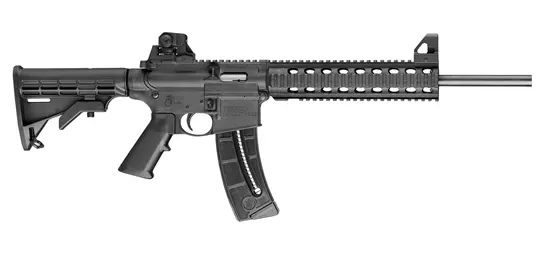
Smith & Wesson built the M&P15-22 to solve a budget problem for police departments, not to chase the sport shooting market it now dominates. A department that issued the centerfire M&P15 in 5.56mm NATO could burn through an expensive ammunition budget just keeping officers current on qualification drills, and .223/5.56 ammunition costs several times more per round than .22 Long Rifle. The M&P15-22 gave those same officers a rifle with the same weight, the same grip angle, the same safety selector position and roughly the same trigger feel, chambered instead in cheap rimfire ammunition, so range time stopped being a line-item problem.1
- AR-15 manual of arms at .22 LR ammunition cost
- light weight, around 2.5 kg unloaded
- wide range of finishes and configurations
- inexpensive, sub $500 base price
- large accessory and optics aftermarket
- proprietary magazines, incompatible with real AR-15 or 10/22 mags
- polymer charging handle reported fragile by owners
- pre-2019 rifles were subject to an official safety recall
- accuracy varies noticeably by ammunition brand
Smith & Wesson announced the rifle on January 19, 2009, at the SHOT Show in Orlando, Florida, positioning it as a companion product to the existing M&P15 line.1 The shared name invites a confusion the two rifles do not deserve. The Smith & Wesson M&P15-22 borrows only the silhouette and control layout of the real M&P15. Mechanically it is a separate rifle, built around a blowback action and an all-polymer upper and lower receiver set that will not accept a genuine AR-15 upper or lower without modification.1 It is equally unrelated to the M&P10, Smith & Wesson's gas-operated, aluminum-receiver .308 Winchester rifle built on the larger AR-10 pattern. All three share the M&P (Military and Police) brand name, but only the M&P15-22 is a rimfire design, and it is the only one of the three intended primarily as a low-cost trainer rather than a duty or field rifle.
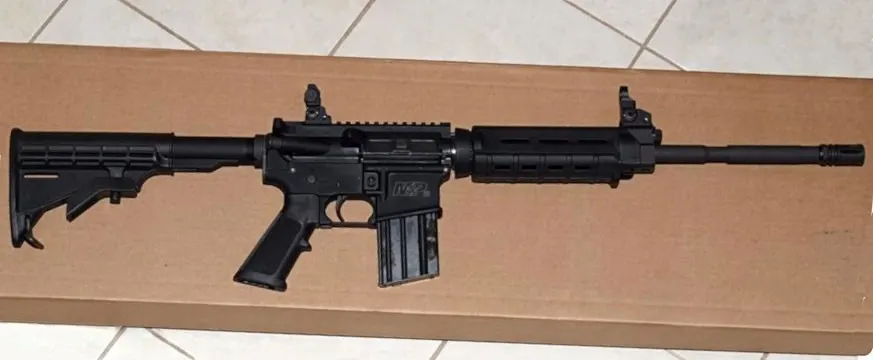
Since its 2009 launch, the M&P15-22 has grown into one of the best-selling AR-15-pattern .22 Long Rifle rifles sold in the United States, helped by a base price under 500 dollars and continuous production for over fifteen years.2 Reviewers frame it first as a training rifle and second as a plinking rifle, though most private buyers use it for the second reason far more than the first.2 It competes directly with other AR-15-styled rimfire rifles such as the Ruger SR-22, built by Sturm, Ruger & Co., and less directly with the Ruger 10/22, the older, mechanically unrelated rifle that still defines the budget rimfire-plinking segment the M&P15-22 also sells into.
Smith & Wesson's own manufacturing footprint has shifted since the M&P15-22 launched. The company moved its headquarters and a large share of its polymer molding and assembly capacity out of Massachusetts between 2021 and 2023, opening a new campus in Tennessee, part of the United States.9 The rifle remains one of the most recognized entry points into semi-automatic rifles ownership in the American market, and its low running cost is the reason gun-press roundups on whether the M&P15-22 is still worth buying keep appearing more than fifteen years after its debut.2
The Smith & Wesson M&P15-22's most important design decision is its action type. Where the centerfire M&P15 and M&P10 cycle by gas-operated direct impingement, the M&P15-22 is a simple blowback design. Blowback works because .22 Long Rifle generates far less chamber pressure than 5.56mm NATO or .308 Winchester, so the bolt can be held closed by spring tension and its own mass alone, with no gas tube, gas key or gas rings needed anywhere in the rifle.1 That simplicity is what lets the whole upper and lower receiver set be molded from polymer rather than machined or forged from aluminum.
- İlk Üretim Yılı2009
- Ağırlık (Boş)2,5 kg
- Halen HizmetteHayır
Both the upper and lower receivers on the M&P15-22 are high-strength polymer, not the aluminum forgings used on a real AR-15 or on the centerfire M&P15.1 The two receivers are deliberately shaped so they will not mate with genuine AR-15 upper or lower halves, and owners who try to swap parts between an M&P15-22 and a real AR-15 lower report the fit does not work without modification.1 The rifle feeds from a proprietary polymer box magazine, not a standard AR-15 magazine and not the rotary magazine used by the Ruger 10/22, in either a 10-round or 25-round capacity depending on the state-compliance configuration sold.1 The safety selector, magazine release and bolt catch sit in the same locations as a standard AR-15, which is the entire point of the design, even though none of the internal fire-control parts interchange with a genuine AR-15 lower.1
- Fişek.22 Long Rifle
- Çap5,7 mm
- Kovan Uzunluğu15,6 mm
- Çap Sınıfıkenar ateşlemeli
- Mermi Ağırlığı2,6 g
- Kenar AteşlemeliEvet
- Kovansız MühimmatHayır
Standard M&P15-22 rifles carry a 16.5 inch barrel (about 420mm) with a 1 to 15 inch rifling twist, cut for .22 Long Rifle rather than a centerfire chambering.1 Weight runs close to 5.5 lb (2.5 kg) unloaded on the base Sport configuration, and overall length is 33.75 inches extended or 30.5 inches collapsed, using a six-position collapsible buttstock rather than a side-folding stock.1 Most current-production Sport models ship with a threaded barrel, making them suppressor-ready out of the box, a configuration that has become close to standard on the line even though early-production M&P15-22 rifles from 2009 were not threaded this way.5
- Mekanizma TipiBlowback (Geri İtmeli)
- Atış Modlarıyarı otomatik
- Seçmeli AtışHayır
- Besleme SistemiÇıkarılabilir Şarjör
- Şarjör Kapasitesi25
- Emniyet TipiAR-15 tarzı
Sighting is handled by folding Magpul MBUS front and rear iron sights mounted on a full-length Picatinny top rail, with M-LOK handguard variants adding side and bottom rail real estate for lights or lasers.5 The rail accepts any standard red dot or optic, and Smith & Wesson also sells factory bundles that include a mounted red dot rather than the plain iron sights.5 Every current configuration keeps the same trigger, safety and magazine release geometry so that practice on the M&P15-22 carries over directly to a centerfire AR-15 or M&P15 in the shooter's hands.1
- Namlu Uzunluğu419 mm
- Nişangah TipiPicatinny rayına monteli demir nişangah
- Optik RayıEvet
- Açık NişangahEvet
- Dişli NamluEvet
- Gövde Malzemesi (Receiver)polimer
- Kabza/Dipçik Malzemesipolimer
- Katlanır / Toplanır DipçikHayır
- Bullpup DüzeniHayır
- ModülerlikAR-15 uyumlu tetik grubu
- Susturucuya HazırEvet
- Süngü TakozuHayır
- Entegre BipodHayır
- Bombaatar KabiliyetliHayır
- Gaz PistonluHayır
- Üretim Başlangıcı2009
- Varyantlar11
Smith & Wesson revealed the M&P15-22 at the January 2009 SHOT Show in Orlando, framing it publicly as a law-enforcement training tool before it became a mainstream civilian seller.1 The core idea, giving officers a .22 Long Rifle rifle that handled identically to their duty AR-15 or M&P15 patrol rifle, let departments run far more range days on the same ammunition budget, since .22 Long Rifle costs a fraction of 5.56mm NATO per round.1 Civilian sales followed almost immediately once retailers picked it up, and word of mouth pulled it well beyond the law-enforcement market it was designed for.2
Gun-press testing has generally rated the rifle well for its price class. Gun Tests magazine's 25-yard accuracy comparison recorded a best five-shot group of half an inch with Aguila 40-grain ammunition and an average close to one inch across several loads, calling it the top performer among the .22 Long Rifle rifles in that test.3 Shooting Illustrated's review of the SMU-pattern variant recorded a 50-yard mean group size of 1.77 inches with a mounted Leupold scope and reported only two ammunition-related failures to fire across an extended test session, though it noted some 25-round magazines could be temperamental.4 Pew Pew Tactical's 2024 retest of the base Sport model, fifteen years into the model's production run, still rated it highly for value and called the design proven, citing broad aftermarket parts support as one reason it has stayed relevant.2
The rifle's record has not been entirely clean. In September 2016, Project Appleseed, a marksmanship-clinic organization built around rifle fundamentals training, banned all M&P15-22 rifles and pistols from its events after a string of out-of-battery and uncommanded multi-shot (runaway) discharges at clinics in several states, including an incident in Bowie, Maryland, where a fragment struck a bystander shooter.7 Investigators traced the defect to the fire-control group and breech design allowing the rifle to fire without the trigger being pulled under specific conditions.7
Smith & Wesson followed with an official consumer safety alert in 2019, covering every M&P15-22 rifle and pistol manufactured before February 1, 2019. The company identified an out-of-specification breech-face counter-bore that could let the bolt crush a chambered round's rim on closing and ignite it without a trigger pull, and it offered free inspection and bolt replacement for affected rifles.8 Owners of pre-2019 rifles were advised to stop firing them until inspected.8
More recently, the M&P15-22's manufacturing base has followed the rest of Smith & Wesson's centerfire line to a new factory. The company cut the ribbon on a 230-acre campus in Maryville, Tennessee, in October 2023, after announcing the relocation of its headquarters and a large portion of its molding and assembly operations out of Massachusetts in 2021.9 The move was driven directly by Massachusetts legislation that threatened the company's ability to keep manufacturing AR-platform rifles in the state, and the M&P15-22's injection-molded polymer receivers made the shift in molding capacity especially relevant to this specific rifle.9
 Smith & Wesson M&P 15-22
Smith & Wesson currently sells the M&P15-22 across more than ten distinct configurations, far more than the base Sport model most buyers picture. Active lines include the base Sport, an M-LOK-compliant Sport, a Sport MOE SL offered in black or flat dark earth furniture, camouflage-finished Sport models in Kryptek Highlander pattern, an OD Green Topographic finish, a Flag Finish model, and factory bundles that pair the rifle with a red dot optic or hearing protection.5,2 Older, now-discontinued finishes have included a Muddy Girl camouflage pattern aimed at the youth and new-shooter market.1
At the top of the line sits the Performance Center M&P15-22, built with an 18-inch fluted, match-grade barrel in place of the standard 16.5-inch barrel, a half-inch by 28 threaded muzzle, a two-stage match trigger, a Hogue overmolded grip and a Vltor stock with built-in storage compartments, weighing about 5.6 lb.6 Reviewers found the Performance Center variant a noticeably nicer rifle to shoot but not always a dramatically more accurate one than the base Sport, given how much rimfire accuracy depends on the specific ammunition used rather than barrel quality alone.6
Smith & Wesson has also sold a dedicated SMU-pattern model reviewed independently by Shooting Illustrated,4 and the M&P15-22 Pistol, a short-barreled variant with an 8-inch threaded barrel and an SB Tactical SBA3 arm brace instead of a shoulder stock. The Pistol variant launched in 2010, was discontinued in 2013, and returned to the lineup in December 2020 with the updated brace.1 Across its production history the M&P15-22 line has therefore run through well over ten named configurations, a wider spread of variants than a first glance at the base Sport model suggests.


The M&P15-22 has no confirmed foreign military or government adoption, unlike the centerfire M&P15 and M&P10, which see broader institutional sales. Its actual operators are United States civilian shooters buying it for practice and plinking, and individual American law-enforcement agencies that use it informally as a low-cost training substitute for issued AR-15 and M&P15 patrol rifles rather than as an issued duty weapon in its own right.1
Civilian marksmanship organizations were an early adopter group as well. Project Appleseed used the M&P15-22 at its rifle fundamentals clinics until the September 2016 ban described above, and general NRA-affiliated training and youth-shooting programs have used it for the same reason other buyers do, a low ammunition cost that lets new shooters fire far more rounds per training session than a centerfire rifle allows.2,7
Where the Ruger SR-22 uses an all-metal receiver to chase the weight and feel of a genuine AR-15, the Smith & Wesson M&P15-22 uses an all-polymer receiver set to chase a lower price, and that single material choice defines how the two rimfire rifles actually get used. Reviewers who have handled both note the M&P15-22 runs several pounds lighter than the metal-bodied SR-22, while the SR-22's metal construction is seen as the sturdier of the two, particularly around the charging handle, where the M&P15-22's polymer part has drawn owner complaints about fragility.10 Neither rifle accepts real AR-15 magazines, and neither accepts the other's magazine either, since both use their own proprietary designs.10
A third approach to the same problem comes from companies like CMMG, which sell drop-in .22 Long Rifle conversion bolts and dedicated rimfire uppers that mount onto an actual AR-15 lower receiver rather than replacing it. That is a meaningfully different solution to the same goal. The Smith & Wesson M&P15-22 duplicates AR-15 ergonomics on its own dedicated platform, while a CMMG conversion keeps the shooter's real AR-15 lower and fire-control group in the loop. Buyers already invested in AR-15 parts and accessories sometimes prefer the conversion route for exactly that reason, even though it costs more than a complete M&P15-22.1
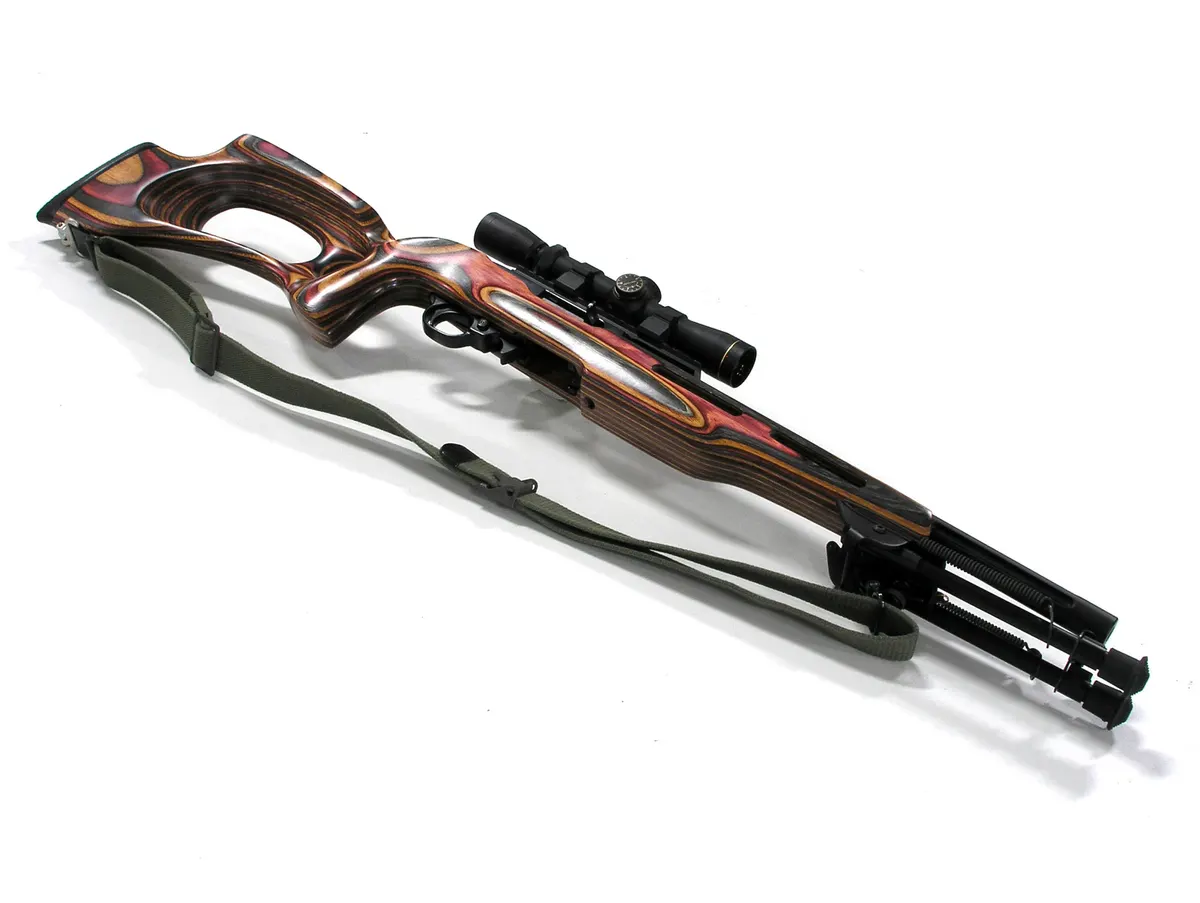
The M&P15-22's other major rival is not AR-styled at all. The Ruger 10/22, built around a rotary box magazine and a traditional stocked profile with no AR-15 heritage, has outsold nearly every rimfire rifle on the American market since 1964 and remains the default comparison point whenever the M&P15-22's plinking and small-game credentials come up.11 The two rifles solve different problems. The 10/22's simple blowback design and enormous aftermarket have made it the standard do-everything .22 rifle for hunting small game and casual shooting, while the M&P15-22 exists specifically to mirror AR-15 controls for shooters who already own or want to train on a centerfire AR platform.11 Buyers choosing purely on accuracy and reliability at the lowest price often still land on the 10/22, while buyers whose real goal is AR-15 familiarization or a lightweight AR-pattern range gun choose the M&P15-22 instead.
| Rifle | Action | Receiver Material | Weight |
|---|---|---|---|
| Smith & Wesson M&P15-22 | Blowback | Polymer | ~2.5 kg |
| Ruger SR-22 | Blowback | Aluminum alloy | Heavier, several lb more |
| Ruger 10/22 | Blowback | Alloy/polymer (varies by model) | ~2.5 kg |


What caliber does the Smith & Wesson M&P15-22 use? The Smith & Wesson M&P15-22 is chambered in .22 Long Rifle, a rimfire cartridge, not the 5.56mm NATO used by the centerfire M&P15.1
Is the Smith & Wesson M&P15-22 a real AR-15? No. It copies the AR-15's outward shape and control locations, but its upper and lower receivers are proprietary polymer parts that will not interchange with a genuine AR-15's aluminum receivers.1
How much does a Smith & Wesson M&P15-22 cost? Current Smith & Wesson pricing runs from about $499 for a base Sport model up to roughly $809 for the Performance Center variant, depending on finish and features.5,2
Are Smith & Wesson M&P15-22 magazines compatible with a real AR-15 or a Ruger 10/22? No. The M&P15-22 uses its own proprietary polymer box magazines in 10-round or 25-round capacities, and they do not fit either a standard AR-15 or a Ruger 10/22's rotary magazine well.1
Is the Smith & Wesson M&P15-22 good for home defense? Most reviewers and trainers treat it as a training and plinking rifle rather than a defensive one, since .22 Long Rifle offers far less stopping power than the 5.56mm NATO fired by the centerfire M&P15.1
Is the Smith & Wesson M&P15-22 still in production? Yes. Smith & Wesson continues to list more than ten active M&P15-22 configurations on its current product line, over fifteen years after the rifle's 2009 introduction.5,2
- "Smith & Wesson M&P15-22", Wikipedia — en.wikipedia.org ↩
- "Smith & Wesson M&P 15-22 Sport Review", Pew Pew Tactical — pewpewtactical.com ↩
- "Smith & Wesson M&P 15-22 22 LR", Gun Tests — gun-tests.com ↩
- "Smith & Wesson M&P 15-22 SMU Review", Shooting Illustrated — shootingillustrated.com ↩
- "M&P15-22", Smith & Wesson — smith-wesson.com ↩
- "Review: Smith & Wesson M&P 15-22 Performance Center Rifle", GunsAmerica — gunsamerica.com ↩
- "S&W M&P 15/22 Rifles BANNED at Appleseed Events", The Firearm Blog — thefirearmblog.com ↩
- "M&P15-22 Consumer Safety Alert", Smith & Wesson — smith-wesson.com ↩
- "Smith & Wesson Cuts Ribbon on Huge New Factory in Pro-Gun Tennessee", Guns.com — guns.com ↩
- "Back In Black: 3 Tactical Rimfire Reviews", RifleShooter Magazine — rifleshootermag.com ↩
- "S&W 15-22 vs Ruger 10/22, the Survival Rifle Debate", Survival Cache — survivalcache.com ↩