

Straight blowback, usually just called blowback, is the simplest self-loading action a firearm can use. No lug, roller, or gas piston locks the bolt to the barrel at the instant of firing. Chamber pressure alone pushes the fired case rearward against the bolt face, and the bolt starts moving the moment the round goes off. What keeps the breech from flying open too soon is nothing more than the bolt's own mass and its return spring, a balance of weight, spring tension, and gas pressure rather than any mechanical device holding things shut.
Delayed blowback keeps that same unlocked breech but adds a temporary mechanical brake, rollers or a lever at a mechanical disadvantage, overcome before the bolt can move, buying dwell time for a hotter cartridge without a heavier bolt. Gas-operated and gas-piston-operated rifles go further and lock the breech shut on fixed timing, independent of bolt mass. That is why nearly every full-power centerfire rifle uses a locked-breech system rather than blowback, and why straight blowback stays confined to lower-pressure rounds, above all the .22 rimfire cartridge that dominates the semi-automatic rifles built around it.
01Thomas Johnson and Winchester's Blowback Rifle Family
Thomas C. Johnson, a designer at the Winchester Repeating Arms Company, built the first successful line of blowback self-loading rifles. His Winchester Model 1903 came first, a .22 rimfire autoloader cycled by nothing but bolt mass and spring tension. The Winchester Model 1905 followed as the first centerfire version, chambered in the proprietary .32 WSL or .35 WSL cartridge, though its modest power kept it from real success.1
The Winchester Model 1907, chambered in the more powerful .351 WSL cartridge, became the most successful of the family. Winchester produced it from 1907 to 1957, more than 50,000 units, and French, Russian, and British forces issued it in the First World War, followed by decades of American law-enforcement service.1,5 Its bolt weighed roughly 2.4 pounds and sat L-shaped in the forend below the barrel, a workaround needed because .351 WSL ran hotter than a typical rimfire round.1
01Why Bolt Weight Alone Can Hold the Breech Shut
A heavy bolt moves slowly relative to the pressure spike inside the chamber. The bullet clears the barrel in a fraction of a millisecond, and only then does chamber pressure fall to a safe level, before the bolt has traveled far enough to open the breech. Only the standing inertia of the breechblock, and to a lesser extent the recoil spring, seal the breech, with no mechanical delay device separating straight blowback from delayed blowback.2
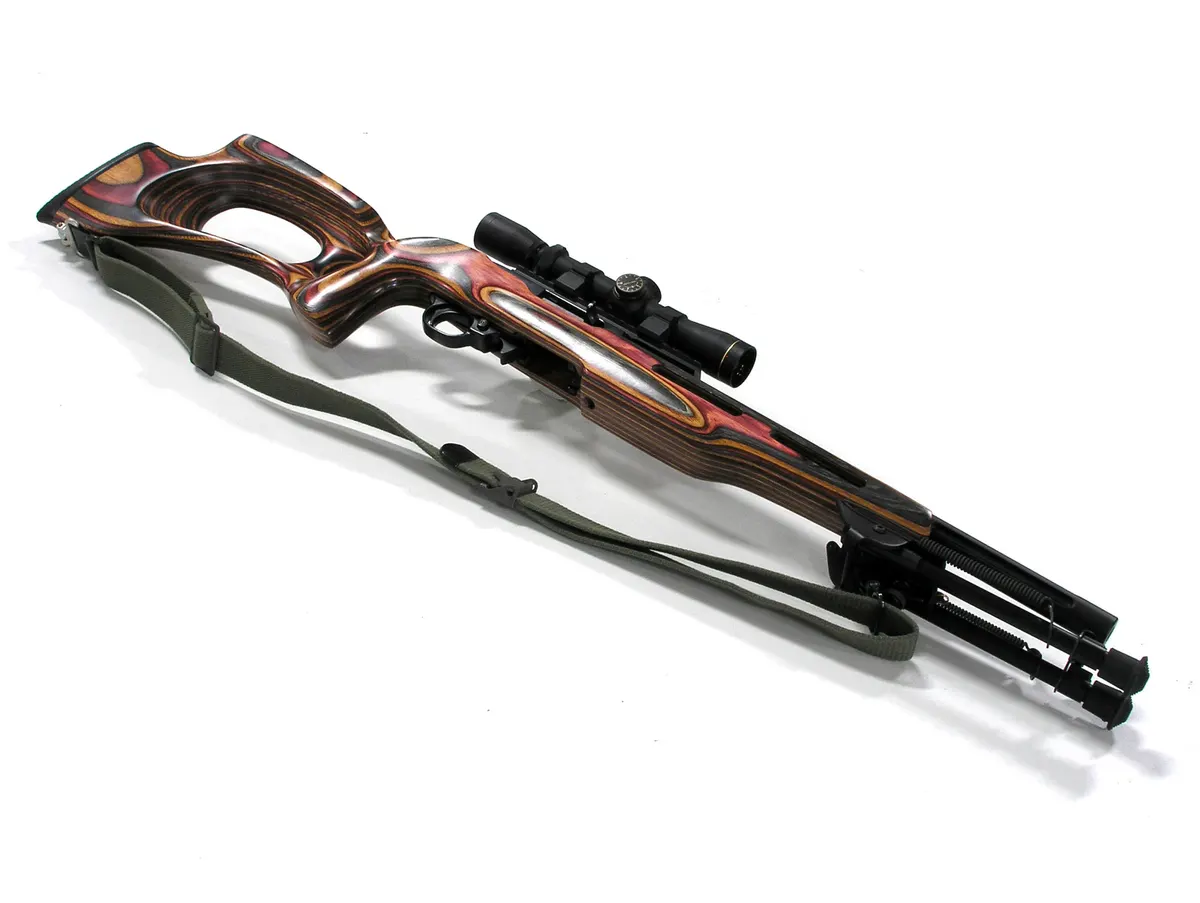
The Ruger 10/22, built by Sturm, Ruger & Co. since 1964, states the principle plainly. American Rifleman describes its bolt mass as sufficient to keep the breech closed until chamber pressure drops to a safe level, with the hammer pressing against the bolt's rear adding a small extra retarding effect.4
The tradeoff shows up in every straight blowback design. It is not well suited to more powerful, higher-pressure rounds, and it produces more felt recoil than a locked-breech system firing an equivalent cartridge. Simplicity is the reward, since it needs no gas port, piston, rotating lugs, or delay linkage to machine or maintain, which is why it became the default for cheap, reliable .22 rimfire autoloaders and budget centerfire handguns worldwide.2
01From Rimfire Plinkers to a Wartime 9mm Carbine
Straight blowback covers nearly every .22 rimfire semi-automatic rifle built since Johnson's era, among them the Armscor M16 22 from the Philippines, the Ruger 10/22, the Remington Model 597, the Remington Nylon 66, and the CZ 511 from the Czech Republic, all sharing the same unlocked, spring-and-mass breech regardless of country or era.2
Straight blowback occasionally pushed past rimfire into centerfire territory too, by pairing it with an unusually low-pressure cartridge to compensate for the unlocked breech. The Smith & Wesson Model 1940 Light Rifle, a United Kingdom contract project from the Second World War, is an open-bolt, straight blowback shoulder rifle chambered in 9x19mm, an unusually low-pressure choice for a rifle-length weapon.
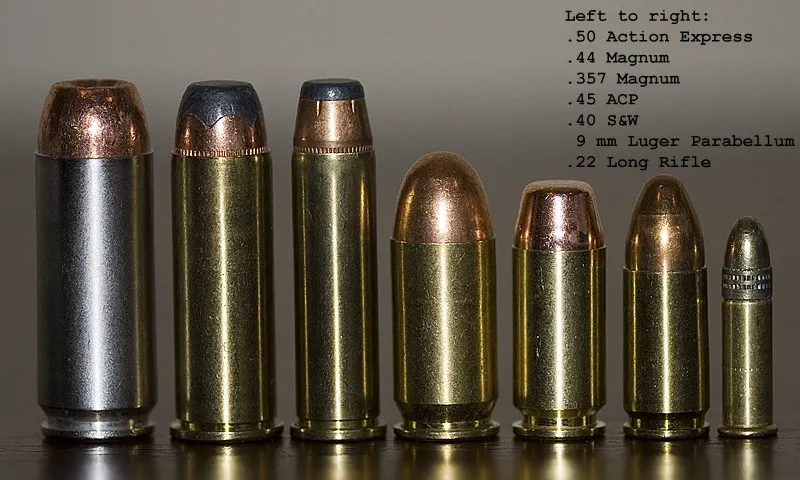
Its Mark I used a bolt-mounted floating firing pin cammed by a receiver protrusion, but the design failed in British service. The receiver's threaded rear-cap joint was too thin, and it cracked after roughly a thousand rounds of hot British-spec 9mm ammunition.3
That failure shows how quickly straight blowback runs into trouble once a cartridge pushes past its pressure ceiling. It is why the mechanism never spread into full-power rifle cartridges the way gas operation and gas-piston operation did.
01Notes and Sources
- "Winchester Model 1905, Model 1907 and Model 1910 SL rifles (USA)", Modern Firearms — modernfirearms.net ↩
- "Operating Systems 101: Straight Blowback", The Firearm Blog — thefirearmblog.com ↩
- "Smith & Wesson Light Rifle, Model 1940", Forgotten Weapons — forgottenweapons.com ↩
- "Ruger 10/22 Rifle", American Rifleman — americanrifleman.org ↩
- "I Have This Old Gun: Winchester Model 1907", American Rifleman — americanrifleman.org ↩


