

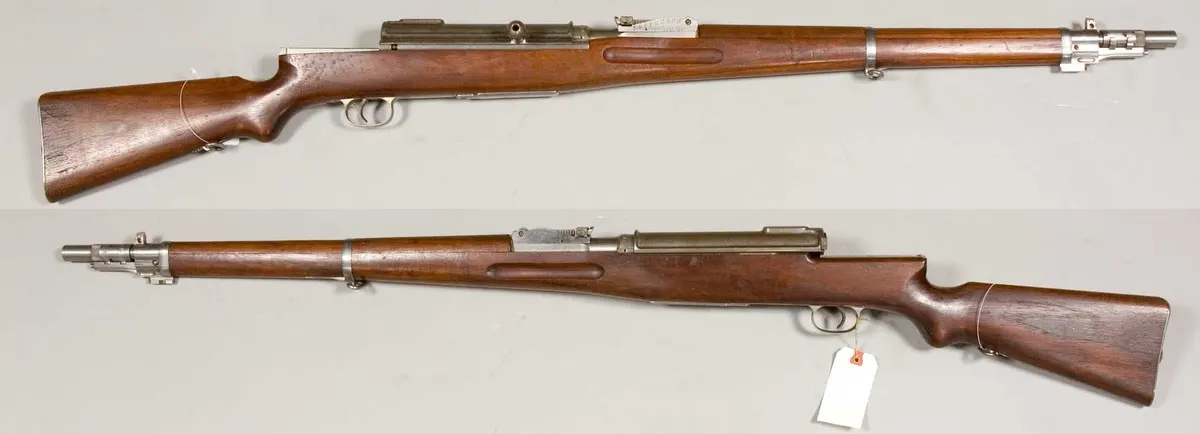

The General Liu rifle was an early Chinese attempt at a self-loading infantry rifle, built and tested between 1916 and 1918 and never issued beyond a handful of prototypes.1,2 It takes its name from its designer, General Liu Qing-En (1869 to 1929), the first Superintendent of the Hanyang Arsenal in Hubei province, and it never received a formal model designation of its own beyond his name. Chinese ordnance officers who tested it in 1916 simply called it the self-loading rifle, abbreviated SLR in the surviving test report.1
- genuine dual-mode design, gas-trap semi-auto with a manual bolt fallback on one gun
- American-made example fired six magazines with no stoppages in 1916 trials
- recoil rated as minimal by period testers
- validated the underlying gas-trap concept a generation before wider adoption
- hand-fitted Chinese-made driving spring failed to cycle reliably
- required imported steel and cost more per rifle than the standard infantry rifle
- muzzle climb, since the shooter's arm alone bore the rifle's full weight
- program collapsed when its patron was incapacitated, never reaching general issue
Liu's design was unusual even among the small handful of gas-trap rifles built worldwide before 1920. It cycled by a muzzle-mounted gas-operated gas trap, the same broad family of mechanism used by the Danish M1922 Bang rifle, Germany's later Gewehr 41, and the earliest production M1 Garand rifles.1,3 What set Liu's rifle apart was a built-in manual fallback. Turning the muzzle cap sealed off the gas trap entirely and converted the same rifle into a straight-pull bolt-action repeater, fired one round at a time by hand.1 Fewer than a handful of complete examples were ever built, split between Liu's own Hanyang Arsenal and the American contractor Pratt & Whitney, and the project was effectively over before China's civil wars of the 1920s even began.2,4
The semi-automatic rifles category as a whole would not produce a rifle Chinese forces actually carried in numbers until decades later, and the General Liu rifle's real legacy is not the roughly ten prototypes it produced but the American machine tools bought to build it. That tooling eventually manufactured China's standard-issue Hanyang 88 rifle and the Type 24 rifle instead, after Liu's own program had already failed.2,5
The Muzzle Gas Trap and Its Straight-Pull Fallback
A surviving translation of the original Nan Yuan Proving Ground test report, dated September 8, 1916, describes the mechanism in detail.1 Propellant gas, expelled as the fired round left the barrel, pushed forward against a muzzle cap fitted with three adjustment holes. That forward motion drove an operating rod rearward through the receiver, cycling a sliding-block bolt carrier that extracted the spent case, chambered a fresh round, and re-locked the bolt.1 The listed major assemblies were the muzzle and gas regulator, the barrel and sliding-block receiver, the bolt carrier, and the operating mechanism itself (piston, cocking piece, driving spring, and buffer spring).1
- İlk Üretim Yılı1916
- TasarımcıGeneral Liu Qing-En
- Halen HizmetteHayır
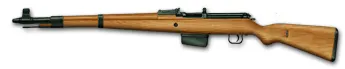
Turning the muzzle cap clockwise sealed the gas trap and stopped the self-loading function outright, leaving a conventional single-shot manual bolt the firer had to cycle by hand for every round, functionally a straight-pull bolt-action rifle sharing the same receiver and magazine as the semi-automatic mode.1 No comparable production rifle of the era offered that specific switch built into the same gun. The Danish M1922 Bang rifle used a similar muzzle gas trap for its semi-automatic cycling but had no manual fallback mode of its own.3
- Fişek7.92x57mm Mauser
- Çap7,9 mm
The 1916 report gives concrete figures for the rifle tested at Nan Yuan. It chambered a 7.9mm cartridge, almost certainly the 7.92×57mm Mauser round China's Hanyang Arsenal already produced for its bolt-action service rifles, at a measured muzzle velocity of 780 m/s.1 It fed from a fixed 6-round internal magazine, reloaded by clip like a standard bolt-action rifle rather than by any new feeding device.1 The report lists an overall length of 703.1mm, though the translated document does not specify whether that figure describes the full rifle or a specific sub-assembly, and no other source independently confirms it.1 Weight came to 5 kg with the bayonet attached, roughly a Chinese catty (about 600 grams under the measurement conventions of the era) heavier than the standard infantry rifle it was meant to replace, a difference testers flagged as a real practical drawback rather than a rounding error.1
- Mekanizma TipiGazlı
- Seçmeli AtışHayır
- Besleme SistemiSabit Şarjör
- Şarjör Kapasitesi6
- Pratik Atış Hızı40
The American-built example fired through six full magazines at Nan Yuan without a single stoppage, giving a measured practical rate of about 40 rounds per minute from 6-round clips, against a theoretical cyclic figure the report separately listed at 50 rounds per minute.1 The Hanyang-built example did not fare as well. Its self-loading mechanism seized during testing, a fault General Liu himself attributed to the hand-fitted driving spring, made without the precision machinery available at Pratt & Whitney's Hartford, Connecticut plant.1,2 Testers also noted the sliding-block receiver's long travel tended to strike shooters trained on conventional bolt-action rifles in the face, since Chinese infantry were accustomed to bolt strokes of 10 centimeters or less, and manual bolt-action fire produced occasional double feeds.1 The report's overall verdict was still positive, calling Liu's results promising and describing the rifle as best suited to sustained repeating fire even though that mode burned through ammunition quickly.1
- Namlu Çıkış Hızı780 m/sn
- Süngü TakozuEvet
- Gaz PistonluEvet
- Toplam Üretim10
- Üretim Başlangıcı1916
- Üretim Bitişi1918
Liu Qing-En's Program and the Pratt & Whitney Contract, 1914 to 1916
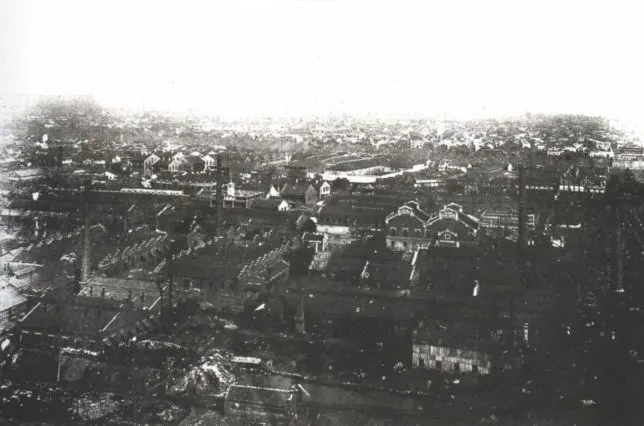
General Liu Qing-En, Superintendent of the Hanyang Arsenal, began his self-loading rifle project around 1914 by contracting the Pratt & Whitney Tool Company of Hartford, Connecticut for more than a million dollars in new machine tools for the arsenal, and by commissioning the same firm to build prototype rifles to his own gas-trap design.2,4 Liu's design drew acknowledged inspiration from the Danish M1922 Bang rifle's muzzle-cup gas system, adapted with the added straight-pull manual mode described above.3 Liu traveled to Hartford himself with his family and seven subordinate officers to study the equipment firsthand, remaining in Connecticut through at least June 1915.2
By September 1916, two rifles built to Liu's design, one made by hand at Hanyang and one machined by Pratt & Whitney, were ready for formal testing at the Nan Yuan Proving Ground outside Beijing, run by China's Army Materiel Command.1 Follow-up minutes from that same month recommended further trials at the Officer Cadet School, design refinements, and eventual infantry field tests, while also flagging that the rifle's steel would need to be imported from Germany or Sweden and that its raw material cost already ran more than two Yuan per rifle above the standard infantry rifle.1
The Springfield Armory Test and the Program's Collapse, 1918 to 1935
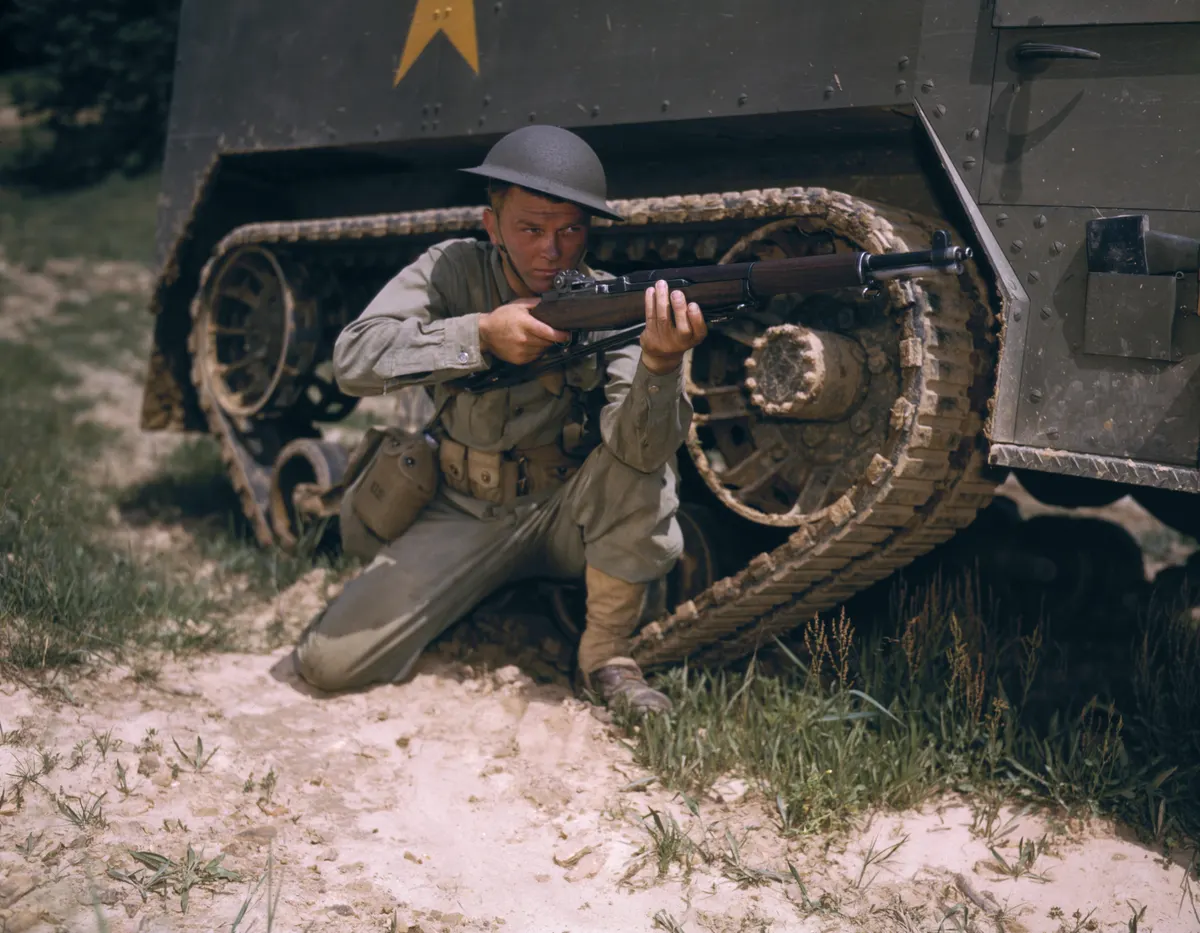
In 1918, two examples of Liu's rifle were shipped to the United States and tested at the Springfield Armory by Julian Hatcher, a US Army ordnance officer who went on to become one of the best-known American firearms writers of the twentieth century.2 The same country would independently reach a near-identical muzzle gas-trap solution more than twenty years later, when the earliest production M1 Garand rifles briefly used one before switching to a simpler gas-port system.3 No detailed American verdict from Hatcher's 1918 test has surfaced publicly, and the program's momentum did not survive much longer regardless of the result.
The machinery Liu had purchased from Pratt & Whitney for full production sank in transit back to China in 1919, the same year Liu himself suffered a stroke that left him partially paralyzed and forced his resignation from Hanyang Arsenal.2
Salvaged machinery finally reached Shanghai in 1921, only to sit in storage for years before being diverted to the Gongxian Arsenal.2 It was not until 1935 that the equipment finally arrived at Hanyang Arsenal itself, sixteen years after Liu had first commissioned it and six years after his death in 1929. By then his own self-loading rifle project was long dead. The tooling instead went on to produce the standard bolt-action Hanyang 88 rifle and the later Type 24 rifle, better known as the Chiang Kai-shek rifle, weapons Liu's own design had originally been built to replace.2,5
Total production of Liu's own rifle never exceeded a handful of prototypes built across the two batches at Hanyang and Pratt & Whitney between 1916 and 1918.1,2 Only a small number of confirmed examples are known to survive today.6,8

The machinery General Liu bought from Pratt & Whitney to build his own self-loading rifle ended up, two decades later, manufacturing the standard bolt-action rifle it was designed to replace. That single fact says more about the General Liu rifle's fate than any spec comparison could. Against the Hanyang 88 rifle, the older Gewehr 88-pattern bolt-action already in Chinese arsenal production, Liu's design offered a genuine technical leap, the same fixed 6-round magazine and the same 7.92×57mm-class cartridge family, but paired with a self-loading gas-trap mechanism decades ahead of what China's own industrial base could reliably manufacture at scale.1,5 The Hanyang 88 needed no imported machined springs and no dust-sensitive muzzle cap, and it went on to arm Chinese forces for decades. Liu's rifle needed both, and never left the prototype stage.1,2
Set against its true mechanical peers rather than its own arsenal-mate, Liu's gas-trap system predates the Danish M1922 Bang rifle's own semi-automatic service trials, and it predates Germany's Gewehr 41 and the earliest gas-trap production M1 Garand rifles by roughly a quarter century.1,3 None of those later rifles knew about Liu's work, and the resemblance is convergent engineering rather than direct influence, several designers arriving independently at a muzzle gas cup as the simplest way to tap propellant gas without drilling a port in the barrel. Where Liu's design genuinely stood apart, even from the Bang rifle, was its built-in manual bolt fallback, a feature none of its gas-trap cousins bothered to include.1,3


What caliber was the General Liu rifle chambered in? The 1916 test report lists a 7.9mm caliber, almost certainly standard 7.92×57mm Mauser ammunition, the same round China's Hanyang Arsenal already manufactured for its bolt-action service rifles.1
How does the General Liu rifle's dual-mode mechanism work? Propellant gas pushes a muzzle-mounted cap forward, cycling the bolt for semi-automatic fire. Turning that same cap clockwise seals the gas trap and converts the rifle to a manual straight-pull bolt-action, fired one round at a time from the same 6-round internal magazine.1
Why did the General Liu rifle never enter production? Its Chinese-made driving spring could not match the tolerances of the American-machined version, imported steel and higher raw material costs made it markedly more expensive than the standard infantry rifle, and General Liu's 1919 stroke removed the program's only real advocate before full-scale manufacturing ever began.1,2
Is the General Liu rifle still in service anywhere today? No. It never passed its 1916 to 1918 testing phase, and only a handful of prototypes were ever built. Surviving examples exist only in museum and private collections today.6,8
How does the General Liu rifle compare to the M1 Garand's gas-trap system? Both used a muzzle gas cup to cycle the action rather than a barrel gas port, but Liu's rifle was tested roughly 25 years before the M1 Garand's own gas-trap production run, and unlike the Garand, Liu's rifle could switch to a fully manual bolt-action mode on the same gun.1,3
- "Army Materiel Command's test in Nan-Yuan Proving Grounds on the new rifle by General Liu Qing-En" (translated 1916 test report), hosted by Forgotten Weapons — forgottenweapons.com ↩
- "General Liu rifle", Wikipedia — en.wikipedia.org ↩
- "General Liu rifle", Forgotten Weapons — forgottenweapons.com ↩
- "Forgotten Weapons Finds A Rifle Few Even Knew About, Chinese Liu WWII-Era Semi-Auto", The Firearm Blog — thefirearmblog.com ↩
- "Chiang Kai-shek rifle", Wikipedia — en.wikipedia.org ↩
- "Chinese General Liu Prototype Rifle", Rock Island Auction — rockislandauction.com ↩
- "General Liu Rifle", Battlefield Wiki (Fandom) — battlefield.fandom.com ↩
- "Extremely Rare Chinese Test Trial General Liu Designed Prototype", Rock Island Auction — rockislandauction.com ↩