

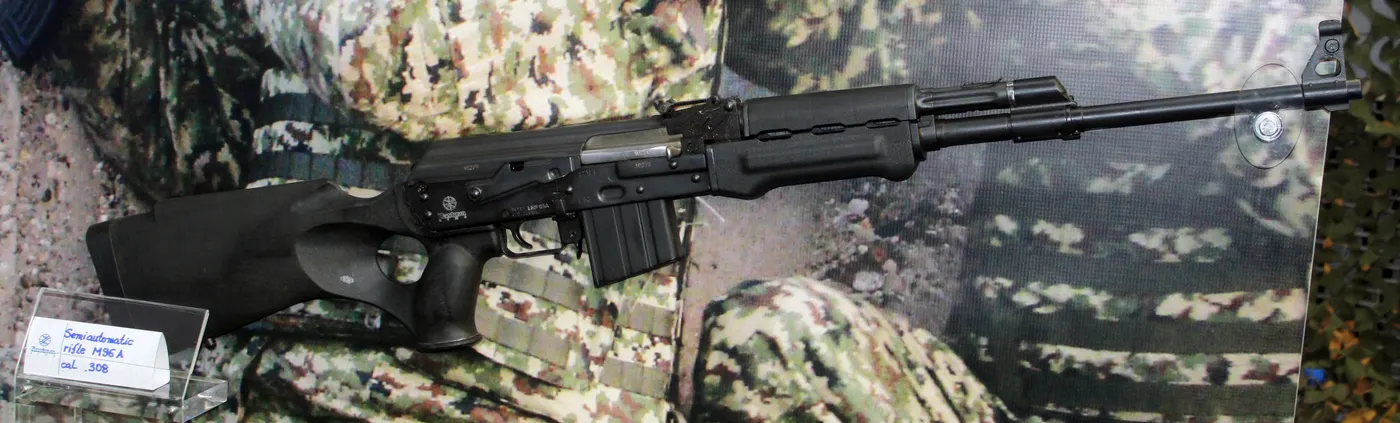

The Zastava PAP series shares its name with an older, unrelated Yugoslav rifle, the Zastava M59/66, whose troops nicknamed it papovka from poluautomatska puška (semi-automatic rifle).1 Decades later Zastava Arms of Serbia reused the same PAP abbreviation for something completely different, a family of civilian, semi-automatic-only versions of its own Kalashnikov-pattern Zastava M70 rifle, built specifically to satisfy United States firearms import law rather than to serve in any army.2 Every PAP-series rifle fires from a gas-operated long-stroke piston action lifted directly from the select-fire M70, M92, M77 and M90 military line, but strips out select-fire capability, bayonet lugs, night sights and grenade-launching hardware, the features US import law treats as disqualifying for a sporting semi-automatic rifle.2,3
- forged, overbuilt AK-pattern receiver and RPK-style trunnion shared with military M70
- four caliber options across one product family (7.62x39mm, .308 Win, 5.56x45mm NATO)
- chrome-lined, cold-hammer-forged barrels standard on current production
- direct factory support through Zastava USA since 2018
- semi-automatic only, cannot legally be converted to select fire in the US
- earlier Gen 1 import batches had a documented single-stack bolt reliability bug
- supply repeatedly disrupted by Serbian export policy, most recently in 2025
- heavier than most 5.56mm NATO rivals due to the thick 1.5mm receiver
Zastava Arms built its reputation on the semi-automatic rifles category long before the PAP name existed, tracing back to the licensed SKS production that became the M59/66, and the PAP series carries that commercial identity into the modern American gun market.1 Import houses, first EAA Corp and later Century Arms, brought the earliest PAP-badged 7.62x39mm rifles into the United States in the mid-1990s as sporterized, fixed-magazine hunting-style guns, a configuration dictated entirely by the 1994 federal Assault Weapons Ban rather than any Zastava design choice.4 Since 2018, Zastava USA has imported factory-direct ZPAP rifles built with standard 30-round detachable magazines, a bulged front trunnion borrowed from the RPK light machine gun, and chrome-lined barrels, a configuration the original military M70 never had.2,5
A new Zastava PAP series rifle typically retails in the United States for $1,400 to $1,480, depending on caliber and furniture, positioning the line as a mid-priced alternative to both cheaper Romanian and Russian-pattern imports and considerably more expensive American-made AR-15-pattern rifles chambered in the same calibers.5 Buyers researching Zastava PAP series specifications most often compare the 7.62x39mm PAP M70 against the .308 Winchester PAP M77 PS and the 5.56x45mm PAP M85 and PAP M90, four distinct rifles built around one shared gas-operated action.2
A Gas-Operated AK Action Across Four Different Calibers
Every Zastava PAP-series rifle uses the same long-stroke gas piston and rotating-bolt action as the military M70 family, feeding from a detachable magazine rather than the fixed magazine of the older M59/66.2 The flagship PAP M70 and its short-barreled sibling the PAP M92 fire the 7.62x39mm intermediate cartridge, the same round the original Soviet AK-47 and Yugoslavia's own Zastava M59/66 use, with a 38.7mm case and a bullet weight around 8 grams (123 grains).6,7 The PAP M77 PS scales the same action up to .308 Winchester (7.62x51mm), and the PAP M85 and PAP M90 shrink it down to the Western 5.56x45mm NATO round, a caliber the Yugoslav military itself briefly experimented with in a cancelled M90 prototype meant to replace the M70 before Yugoslavia's breakup ended the program.8
- İlk Üretim Yılı1994
- Ağırlık (Boş)3,8 kg
- Halen HizmetteEvet
- Önemli KullanıcılarNo confirmed military or police operators; sold almost entirely to civilian shooters in the United States
A current-production ZPAP M70 weighs about 3.8 kg empty, runs a 414mm (16.3-inch) chrome-lined, cold-hammer-forged barrel rifled with a 254mm right-hand twist (one turn every 10 inches) across four grooves, and measures roughly 940mm overall with a fixed wood or polymer stock.5,9 Muzzle velocity from the 7.62x39mm loading runs to approximately 715 m/s, generating close to 2,000 joules of muzzle energy, figures identical to any other 16-inch-barreled AK-pattern rifle chambered for the same cartridge since the underlying ballistics never changed from the military M70.7 The PAP M77 PS stretches to a 19.7-inch barrel and a 20-round magazine, the PAP M85 pistol variant uses a much shorter 10.5-inch barrel with a threaded 26x1.5mm left-hand muzzle for a compensator or suppressor, and the PAP M90 rifle runs an 18.25-inch barrel with an adjustable gas system tuned for reliable 5.56x45mm cycling.10,8
- Fişek7.62x39mm (PAP M70/M92), .308 Winchester/7.62x51mm (PAP M77 PS), 5.56x45mm NATO (PAP M85/M90)
- Çap7,62 mm
- Kovan Uzunluğu38,7 mm
- Çap Sınıfıintermediate
- Mermi Ağırlığı8 g
From a Single-Stack Sporterized Rifle to the Bulged-Trunnion ZPAP
The earliest EAA-imported PAP rifles of the mid-1990s were sporterized guns built around a single-stack 10-round magazine well and an integrated thumbhole stock, a configuration forced by the 1994 Assault Weapons Ban's restrictions on detachable large-capacity magazines and military-style features.4,11 When Century Arms revived double-stack, 30-round PAP imports after the ban's 2004 sunset, the first N-PAP rifles kept a bolt still cut for the old single-stack magazine well, and the mismatch between a single-stack bolt and a double-stack magazine gave Gen 1 N-PAPs a well-documented reputation for feeding malfunctions.12 Century corrected the fault with a properly fitted double-stack bolt on the Gen 2 N-PAP, then thickened the receiver to 1.5mm and added a bulged RPK-style front trunnion on the Gen 3 O-PAP, matching the reinforced construction Zastava's own engineers had specified for the military M70 to survive rifle-grenade launching.3,13 Zastava standardized chrome-lined barrels across the line in a 2020 update to the Gen 4 Z-PAP, and since 2018 Zastava USA has imported the current ZPAP generation factory-direct rather than through a third-party importer.5,11
- Mekanizma TipiGazlı
- Atış Modlarısemi-automatic only
- Seçmeli AtışHayır
- Besleme SistemiÇıkarılabilir Şarjör
- Şarjör Kapasitesi30
- Tetik Tipisingle-stage AK-pattern trigger, largely US-made for 922(r) parts-count compliance
- Emniyet TipiAK-pattern lever safety doubling as dust cover, no separate manual bolt release
- Namlu Çıkış Hızı715 m/sn
- Namlu Enerjisi2.000
- Namlu Uzunluğu414 mm
- Yiv Adımı254mm (1 turn per 10 in), right-hand
- Yiv Sayısı4
- Nişangah Tipiadjustable AK-pattern notch rear sight and hooded front post
- Optik RayıEvet
- Açık NişangahEvet
- Dişli NamluEvet
- Toplam Uzunluk940 mm
- Gövde Malzemesi (Receiver)stamped steel, 1.5mm with bulged RPK-style front trunnion on current ZPAP production
- Kabza/Dipçik Malzemesiwalnut, beech, or polymer depending on model
- Katlanır / Toplanır DipçikHayır
- Bullpup DüzeniHayır
- Çift Yönlü KumandalarHayır
- Modülerlikshares AK-pattern furniture, optics rails and magazines across 7.62x39mm, .308 Win and 5.56x45mm NATO variants
- Susturucuya HazırEvet
- Süngü TakozuHayır
- Entegre BipodHayır
- Bombaatar KabiliyetliHayır
- Gaz PistonluEvet
- Üretim Başlangıcı1994
- Birim Maliyet1.450 USD
A 1968 Import Law Shapes an AK Nobody's Army Ever Fielded
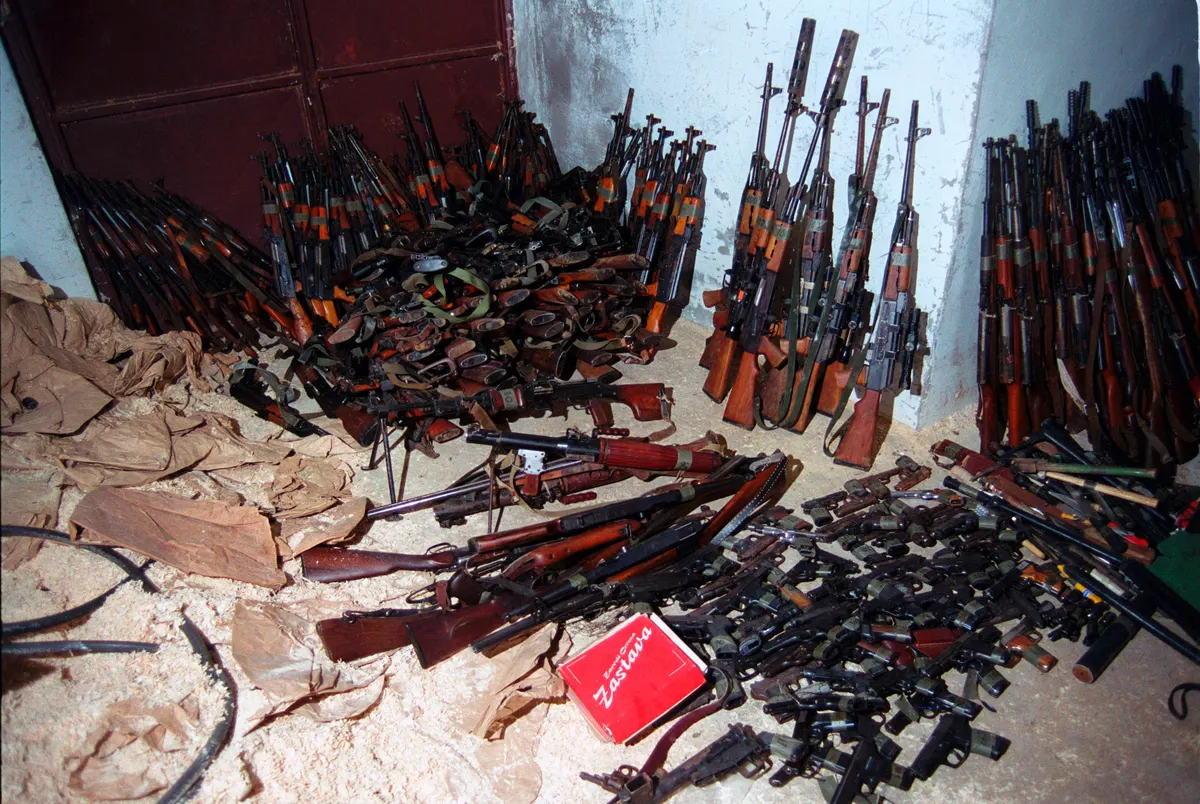
The Zastava PAP series exists because of American firearms law, not Yugoslav or Serbian military procurement. The 1968 Gun Control Act's sporting purposes test already restricted which foreign semi-automatic rifles could legally enter the United States, and a 1989 Treasury Department ruling tightened that test further, banning importation of AK-pattern and similar rifles that retained bayonet lugs, folding stocks, flash suppressors, night sights or grenade-launcher mounts.14 Yugoslav-made M70-pattern rifles imported after 1989 had those features removed or disabled at the factory, and when the 1994 Assault Weapons Ban added its own restrictions on detachable large-capacity magazines, importers like EAA Corp responded with the fixed 10-round, thumbhole-stocked PAP M70 that reached American gun shops in the mid-1990s.4,14
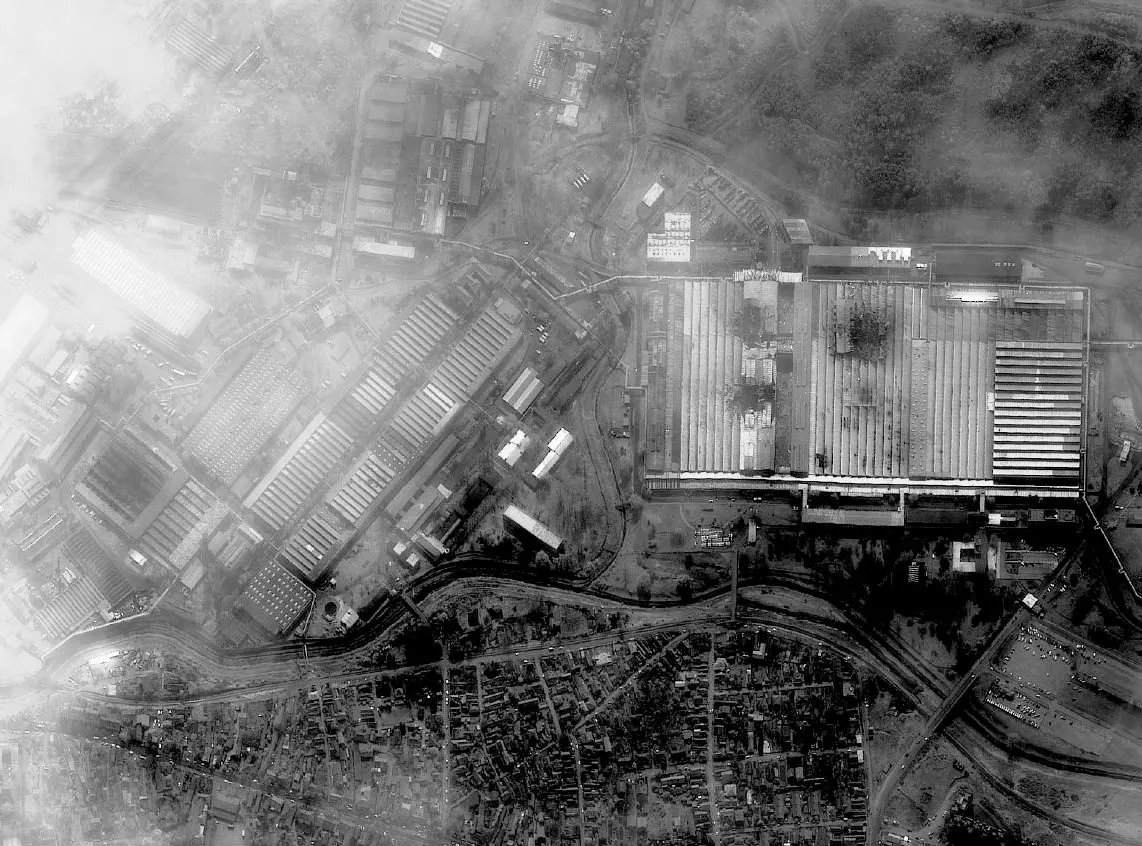
Zastava Arms itself dates back to 1853 as a Serbian state arsenal, and it built the original select-fire M70 that the PAP series descends from starting in 1970, developed by a Yugoslav engineering team that included Božidar Blagojević, Miloš Ostojić, Miodrag Lukovac, Milutin Milivojević, Milan Ćirić, Stevan Tomašević, Predrag Mirčić and Mika Mudrić.3,15 That team deliberately overbuilt the M70's receiver to 1.5mm, thicker than the Soviet AKM's standard 1mm stamping, specifically so the rifle could survive repeated rifle-grenade launches, a requirement the PAP series inherited as a durability feature decades after the grenade-launching capability itself was stripped out for the US market.3 United Nations sanctions during the 1991 to 1995 Yugoslav Wars and NATO's 1999 bombing campaign against Yugoslavia both disrupted Zastava's Kragujevac production, interruptions that fed directly into gaps and inconsistencies collectors still track across different PAP import years.16
2004's Assault Weapons Ban Sunset Reopens the Double-Stack Market
When the federal Assault Weapons Ban expired in September 2004, Century Arms began importing double-stack, 30-round PAP M70 rifles under the N-PAP name, restoring the pistol grip and detachable-magazine configuration the 1994 law had blocked.11,12 Reliability complaints about the early Gen 1 N-PAP's mismatched bolt pushed Century and Zastava toward the corrected Gen 2 parts, and by the O-PAP and Z-PAP generations of the 2010s the rifles had converged on the thick-receiver, bulged-trunnion specification that remains standard today.12,13 Zastava USA's 2018 launch as a dedicated American subsidiary let the company skip third-party importers entirely for its flagship ZPAP line, a shift industry reviewers credited with tighter quality control than earlier Century-imported generations.5,11
Serbia's 2025 Export Ban Interrupts Supply Again
On 23 June 2025, Serbian President Aleksandar Vučić announced a complete suspension of weapons and ammunition exports from Serbia, citing concern that Serbian-made arms had reportedly surfaced on both sides of the war in Ukraine despite no official Serbian sales to either combatant, alongside separate scrutiny over arms shipments toward Israel following the October 2023 Hamas attacks.17 The ban halted new shipments of Zastava USA's ZPAP M70, M77, M85 and M90 rifles to American distributors overnight, and US retailers warned buyers that prices would likely rise as existing inventory dwindled with no confirmed restocking date.17 Zastava USA secured an exception from Serbia's National Security Council roughly five months later, and the first ZPAP M70 shipments under the exception reached the United States in late November 2025, restoring supply after the longest interruption the PAP series had faced since the 1990s import-law changes.18
Four Calibers, One Shared Receiver
The PAP M70 in 7.62x39mm remains the series' flagship, sold in fixed-stock and folding-stock (N-PAP DF) configurations with wood, polymer or Serbian red furniture.2,9 The PAP M92 shortens the same 7.62x39mm action to a 10-inch barrel, sold in the United States exclusively as an NFA pistol rather than a rifle because of its length, mirroring the military Zastava M92 short-barreled carbine it commercially derives from.2,19 The PAP M77 PS scales the receiver up to .308 Winchester with a 19.7-inch barrel and 20-round magazine, tracing back to the select-fire military Zastava M77 designated marksman rifle rather than the M70 proper.20,19 The PAP M85 (a 5.56x45mm pistol) and PAP M90 (a 5.56x45mm rifle) round out the family, both borrowing their caliber from Yugoslavia's own cancelled Zastava M90 prototype of the early 1990s, a rifle that never entered service before the country broke apart but whose 5.56mm chambering Zastava revived decades later for the American market.8,9
Beyond new production, Zastava USA and its predecessor importers have also sold PAP M70AB1 and M70AB2 surplus rifle lines, built from genuine demilitarized ex-Yugoslav People's Army M70 and M70B1 receivers rather than new manufacture, converted to semi-automatic-only function and refinished for civilian sale.21 These surplus-derived rifles sit apart from the new-production ZPAP line technically and commercially, carrying real military service history in a way no newly manufactured PAP rifle can.21


No army, police force or government agency operates the Zastava PAP series, since it exists specifically as a civilian, semi-automatic product for the American commercial market rather than a service rifle.2 That distinguishes it sharply from the military weapons it derives from, the select-fire Zastava M70, Zastava M92 and Zastava M77, all of which remain in active or reserve service with Serbia's armed forces and several other former Yugoslav successor states.19
Sales are overwhelmingly concentrated in the United States, where federal law's sporting-purposes framework created the demand for a semi-automatic-only AK-pattern rifle in the first place, though Zastava markets its civilian sporting rifles more broadly across the roughly forty countries it exports to in total.16 Whether the PAP series remains available to American buyers now depends less on Zastava's manufacturing capacity than on Belgrade's export policy, as the 2025 suspension and its narrow, negotiated exception for Zastava USA demonstrated.17,18
Choosing between a Zastava PAP-series rifle and a Romanian WASR-series rifle usually comes down to one procurement question American buyers ask constantly, whether a thicker, RPK-derived receiver is worth a price premium over a thinner Romanian stamping. Both rifles occupy the same market niche, a budget-conscious, import-compliant 7.62x39mm AK pattern rifle sold new for roughly the same price bracket, but Zastava's 1.5mm bulged-trunnion receiver descends from a rifle engineered from the start to survive rifle-grenade launching, while the WASR's thinner receiver traces to a Romanian PM md. 63/65 line built to standard AKM tolerances.13 Reviewers and collectors have argued for decades over whether that extra Zastava steel translates into meaningfully better long-term durability for rifles neither one will ever actually fire a grenade from, but the reputational gap between the two brands in the American market has held for years.
| Spec | Zastava PAP M70 | WASR-10 |
|---|---|---|
| Cartridge | 7.62x39mm | 7.62x39mm |
| Receiver thickness | 1.5mm (bulged trunnion) | 1mm |
| Barrel length | 414mm (16.3 in) | 415mm (16.3 in) |
| Magazine capacity | 30 rounds | 30 rounds |
| Chrome-lined barrel | Standard since 2020 | Not standard |
Every figure in that table is sourced above in Specs and Design.5,9
The more direct comparison, though, is not to a rival brand at all but to the military rifles the PAP series is legally forbidden from resembling too closely, the select-fire Zastava M70 and its M92 and M77 siblings. Where the military M70 can fire automatically, mount a bayonet and launch rifle grenades, every PAP-series rifle sold in America strips all three capabilities out by law, leaving the same forged receiver and gas system wrapped around a strictly semi-automatic, one-shot-per-trigger-pull rifle instead.2,14 That gap between what the hardware is mechanically capable of and what US import law actually permits it to do defines the entire PAP series more than any single spec ever could.

Is the Zastava PAP series still in production Yes, Zastava Arms and its Zastava USA subsidiary continue producing and importing PAP-series rifles as of 2025, though a mid-2025 Serbian export suspension briefly halted new shipments before an exception let deliveries resume that November.17,18
What caliber does the Zastava PAP series use The PAP M70 and M92 fire 7.62x39mm, the PAP M77 PS fires .308 Winchester, and the PAP M85 and M90 fire 5.56x45mm NATO, giving the series four caliber options across one shared AK-pattern receiver design.2,8
How much does a Zastava PAP series rifle cost A current-production ZPAP M70 retails for roughly $1,400 to $1,480 in the United States, with pricing subject to swings whenever Serbian export policy disrupts supply, as it did in 2025.5,17
What is the difference between the Zastava PAP and the military Zastava M70 The PAP series shares its receiver, gas system and 7.62x39mm chambering with the select-fire military M70, but it cannot fire automatically, cannot mount a bayonet, and lacks the grenade-launching sight and gas cutoff the military rifle carries, all changes required to satisfy US civilian import law.2,14
Can you buy a Zastava PAP series rifle with a folding stock Yes, the N-PAP DF variant offers an underfolding stock alongside the standard fixed wood or polymer stock configurations most PAP M70 rifles ship with.2,9
Why did Zastava PAP rifles become hard to find in 2025 Serbia suspended all weapons and ammunition exports on 23 June 2025 over concerns about Serbian-made arms reportedly reaching both sides of the war in Ukraine, cutting off new ZPAP shipments to the United States until Zastava USA secured a narrow export exception roughly five months later.17,18
- "Zastava M59/66", Wikipedia — en.wikipedia.org ↩
- "Zastava PAP series", Wikipedia — en.wikipedia.org ↩
- "Yugoslavia's AK Path, The M70 Family of Rifles", Ronin's Grips — blog.roninsgrips.com ↩
- "EAA Zastava PAP", Precise Shooter — preciseshooter.com ↩
- "Zastava M70 Hands-On Overview, The Best AK for the Money", AR15Discounts — ar15discounts.com ↩
- "AK-47", Wikipedia — en.wikipedia.org ↩
- "7.62x39 Ballistics, Velocity, Energy, Drop and More", Ammunition To Go — ammunitiontogo.com ↩
- "Zastava M90", Wikipedia — en.wikipedia.org ↩
- "Zastava ZPAP M70, An Authentic AK For The U.S. Market", American Rifleman — americanrifleman.org ↩
- "AK 556 Pistol Joy, Review of Zastava ZPAP M85", Guns.com — guns.com ↩
- "Yugoslavian Serbia AK-47 History, Zastava", Faktory 47 — faktory47.com ↩
- "Gun Review, Century Arms Zastava N-PAP AK-47", The Truth About Guns — thetruthaboutguns.com ↩
- "Zastava AKs, Part 2, M70, The First Mass-Produced Yugoslavian Kalashnikov", The Firearm Blog — thefirearmblog.com ↩
- "Treasury Prohibits Importation Of Certain Semiautomatic Assault Rifles", U.S. Department of the Treasury — home.treasury.gov ↩
- "The Yugo M70, It's More Than Just Another AK", The Firearm Blog — thefirearmblog.com ↩
- "Zastava Arms", Wikipedia — en.wikipedia.org ↩
- "Serbia Suspends Arms Exports, What It Means for Zastava Rifle Buyers", GunPrime — gunprime.com ↩
- "Zastava, PAP M70 Rifles Inbound After Months of Waiting", Guns.com — guns.com ↩
- "Zastava M70 (assault rifle)", Wikipedia — en.wikipedia.org) ↩
- "Review, Century International Arms Zastava PAP M77 PS Semi-Automatic Rifle", American Rifleman — americanrifleman.org ↩
- "PAPM70AB2 (Surplus Rifle)", Zastava Arms USA — zastavaarmsusa.com ↩