

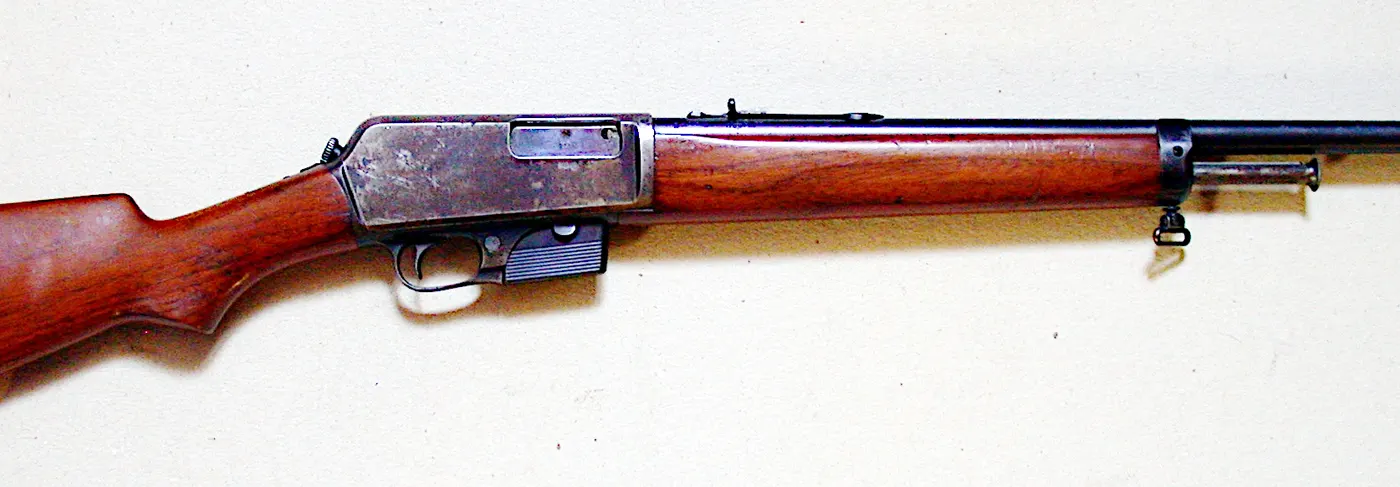

The Winchester Model 1905 is a blowback operated semi-automatic rifle built by the Winchester Repeating Arms Company between 1905 and 1920. It holds a specific historical distinction, it was the first centerfire semi-automatic rifle sold commercially in the United States1, arriving two years after Winchester's own earlier Model 1903 had opened the self-loading category in .22 rimfire2. Designer Thomas Crossley Johnson scaled up his rimfire mechanism into a full-size sporting rifle chambered for two brand-new proprietary rounds, the .32 Winchester Self-Loading and the .35 Winchester Self-Loading1,2.
- Detachable box magazine, unusual for a 1905 sporting rifle
- Fast takedown for cleaning and transport
- Reliable cycling reported even in Arctic cold
- Historic status as the first US-made centerfire self-loader sold commercially
- .32 WSL and .35 WSL cartridges too weak for medium and large game
- Heavy, inconsistent trigger pull noted by contemporary reviewers
- Outsold badly by the Remington Model 8 and by Winchester's own later Model 1907
- Production run cut short after only 15 years
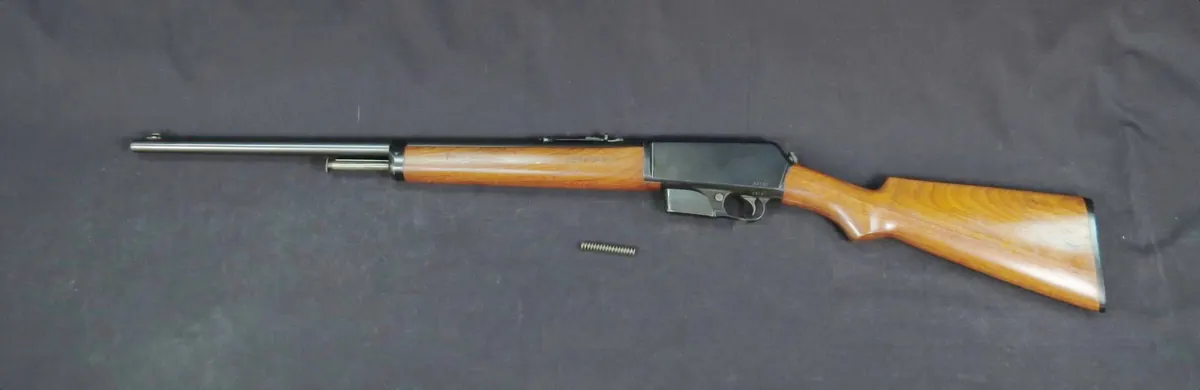
The Winchester Model 1905 fed from a 5-round detachable box magazine (a 10-round option was also cataloged) and sold new in 1905 at $28 for the plain finish and $43 for the fancy grade with a checkered pistol grip7. Its detachable-magazine feed and quick-takedown receiver were modern for a hunting rifle of the era, but the .32 WSL and .35 WSL cartridges themselves were the rifle's undoing. Both were straight-walled, low-pressure rounds tuned to Winchester's unlocked blowback breech rather than to what hunters actually wanted from a big-game rifle3,4.
Winchester built roughly 29,113 Model 1905 rifles before ending regular production in 1920, with some estimates running to about 31,467 once small runs assembled from remaining parts into the early 1920s are counted1,10. That is a modest total next to the Remington Model 8, John Browning's rival long-recoil design that reached the market only a couple of years later and outsold every Winchester self-loader combined8. Within Winchester's own catalog, the Model 1905 was also overtaken quickly by its direct successors, the Model 1907 and Model 1910, both built on the same basic action but chambered for noticeably more powerful cartridges.
The Winchester Model 1905 sits at the early end of the semi-automatic rifles category, a class of arms still viewed with public suspicion in 1905, which is part of why Winchester's marketing avoided the word automatic altogether and insisted on self-loading instead7. Later entries in the same family, the Model 1907 and Model 1910, corrected the cartridge problem and stayed in Winchester's catalog for decades after the Model 1905 was gone.
A Simple Blowback Action With No Locking Breech
The Winchester Model 1905's action is a direct blowback design. There is no rotating bolt, no locking lug, and no gas system, the breech-bolt is simply held closed by spring tension and by its own mass until chamber pressure drops enough for safe extraction6,7. A heavy operating rod sits below the barrel, its forward plunger visible at the front of the forend, connected to a spiral return spring that both slows the bolt's rearward travel and drives it back into battery6. Because the cartridge case had to hold pressure just long enough without a locked breech, Winchester used a thick, heavy case head on both the .32 WSL and .35 WSL, partly to resist extractor tear-out and partly to survive residual pressure the moment the bolt began to move7.
- İlk Üretim Yılı1905
- TasarımcıT.C. Johnson
- Ağırlık (Boş)3,18 kg
- Ağırlık (Yüklü)3,63 kg
- Halen HizmetteHayır
- Önemli KullanıcılarHarry Payne Whitney
Takedown was genuinely quick for a 1905 sporting rifle, a single cross screw separated the upper barrel and receiver group from the lower stock and trigger assembly, a feature Winchester carried across the whole self-loading family6. The receiver was steel and the stock and forend were walnut, standard practice for the period, and the rifle used plain iron-sights with an optional tang or receiver-mounted aperture sight for hunters who wanted more precision1,7. There was no bayonet lug, no bipod, and no provision for a scope base, this was built as a sporting arm from the outset and not adapted from a military pattern.
- Fişek.32SL and .35SL
- Çap8,15 mm
- Kovan Uzunluğu31 mm
- Çap Sınıfıkenarsız şişe boyunlu
- Mermi Ağırlığı10,7 g
- Kenar AteşlemeliHayır
- Kovansız MühimmatHayır
The .32 and .35 Winchester Self-Loading Cartridges
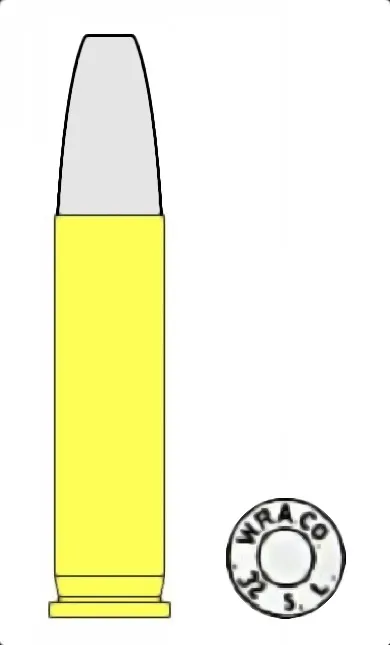
Winchester introduced the .32 Winchester Self-Loading and .35 Winchester Self-Loading specifically for the Model 1905, and neither cartridge was chambered in any other rifle at launch3,4. The .32 WSL fired a 165-grain soft-point bullet at roughly 1,390 to 1,440 feet per second for about 760 foot-pounds of energy, while the heavier .35 WSL, introduced in August 1905 alongside the rifle itself, pushed a 180-grain bullet to about 1,452 feet per second for around 842 foot-pounds4,7. Both were rimless, straight-walled cases rather than the bottlenecked shape sometimes assumed from their appearance, a detail period reloading references and modern cartridge references agree on3,4.
- Mekanizma TipiBlowback (Geri İtmeli)
- Atış Modlarıyarı otomatik
- Seçmeli AtışHayır
- Besleme SistemiÇıkarılabilir Şarjör
- Şarjör Kapasitesi5
For comparison, effective range on both loads topped out around 200 to 300 yards even by the standards of contemporary reviewers, and one 1917 field assessment specifically criticized the rifle's stiff trigger pull, sometimes six pounds or heavier, and its short 22-inch barrel's effect on balance7. The Model 1905's standard magazine capacity of 5 rounds (10-round magazines were catalog options) was generous next to a period bolt-action sporter, and Winchester promoted rapid repeat shots as the rifle's main selling point over any lever gun in the line, but the underlying cartridges simply lacked the punch for anything larger than varmints and small deer at moderate range7.
- Namlu Uzunluğu559 mm
- Nişangah Tipimekanik nişangah
- Optik RayıHayır
- Açık NişangahEvet
- Dişli NamluHayır
- Gövde Malzemesi (Receiver)Çelik
- Kabza/Dipçik Malzemesiahşap
- Katlanır / Toplanır DipçikHayır
- Bullpup DüzeniHayır
- Çift Yönlü KumandalarHayır
- Susturucuya HazırHayır
- Süngü TakozuHayır
- Entegre BipodHayır
- Bombaatar KabiliyetliHayır
- Gaz PistonluHayır
- Toplam Üretim29.113
- Üretim Başlangıcı1905
- Üretim Bitişi1920
- Varyantlar2
Thomas Crossley Johnson joined the Winchester Repeating Arms Company as a draftsman in 1885, a year after graduating from Yale's Sheffield Scientific School, and spent nearly fifty years there before becoming Winchester's chief designer in 19072. His original blowback patent, US 681,481 of August 1901, had been drafted to protect the rimfire Model 1903, but a follow-up patent, US 720,698, specifically covered the larger-cartridge, box-magazine, takedown design that became the Model 19052,1. The two-step patent history reflects how directly the Model 1905 grew out of Johnson's earlier rimfire work rather than starting as a clean-sheet centerfire design.
Winchester's timing mattered. John Browning had originally offered his own self-loading rifle concept to Winchester before the two companies' long partnership broke down, and Winchester's management passed on it, leaving Remington Arms to acquire the design and bring it to market as the Remington Model 8 a couple of years after the Model 1905 debuted8. Johnson's Model 1905, in other words, was Winchester racing to establish a category it had already been offered a head start in and turned down.
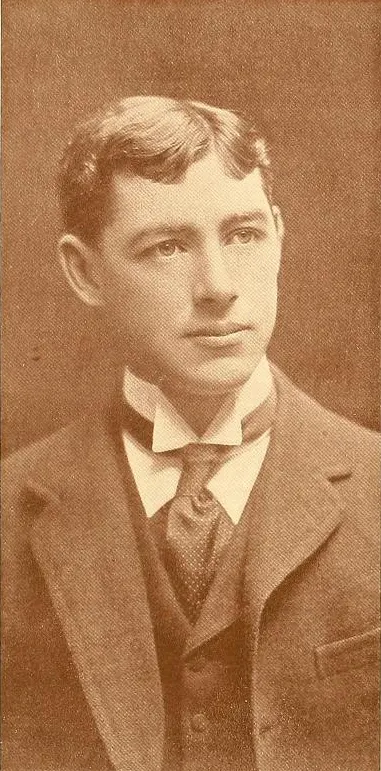
One of the more memorable documented uses of the Winchester Model 1905 came from Harry Payne Whitney, the American businessman and thoroughbred horse breeder9, who carried a .35 WSL example on an Arctic expedition around 19091. The rifle reportedly cycled reliably in the extreme cold, a real test for any self-loading action of the period, but proved underpowered for taking large game such as musk ox, underscoring the same cartridge weakness that limited the Model 1905's appeal among American hunters1.

The Remington Model 8, built by Remington Arms, used a fundamentally different long-recoil system in which the barrel and bolt traveled rearward together before separating to eject and reload8. It chambered a family of proprietary Remington cartridges up to the .35 Remington, all considerably more powerful than either Winchester Self-Loading round, and it went on to become, in most historical accounts, the first commercially successful semi-automatic rifle sold to American civilians8. Winchester's Model 1905 had beaten Remington to market with a centerfire self-loader, but it did not hold that lead for long. Winchester ended regular Model 1905 production in 1920 after roughly 29,113 rifles, with total output sometimes cited closer to 31,467 once late parts-built examples are included1,10.
The Winchester Model 1905 sat in the middle of a four-rifle self-loading family that shared the same basic blowback action across two decades of Winchester catalogs. The Winchester Model 1903 came first, in .22 Winchester Automatic rimfire with a tube magazine rather than the Model 1905's detachable box, and it was aimed at plinking and small game rather than serious hunting2. Winchester built around 126,000 Model 1903 rifles, more than four times the Model 1905's total, largely because the rimfire cartridge carried none of the underpowered-for-hunting criticism that dogged its centerfire successor2.

The Winchester Model 1907 replaced the Model 1905's cartridges with the .351 Winchester Self-Loading, a longer case that delivered a 180-grain bullet at around 1,800 to 1,875 feet per second, some 20 to 25 percent faster than the .35 WSL it effectively obsoleted within a year or two of its release5. That extra power, plus a hammerless follow-on refinement, made the Model 1907 popular with civilian buyers and gave it real staying power, Winchester kept it in the catalog until 1957 and built more than 58,000 of them, nearly double the Model 1905's total6. The Winchester Model 1910 went further still, chambering the .401 Winchester Self-Loading for genuine big-game work with 200 or 250-grain bullets at up to roughly 2,000 feet per second, though its four-round magazine and heavier build limited its own production to around 20,787 rifles through 19366.
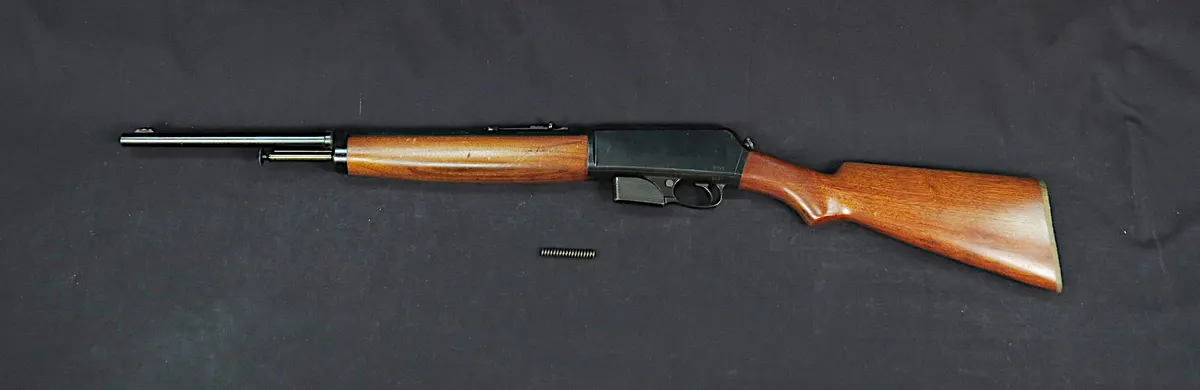
Every model in the family used the same forward-plunger charging system and single-screw takedown that Johnson designed for the Model 1905, and all four rifles remain fully compatible in basic operating concept even though none of the four cartridges interchange with one another6. No formal military variant of the Model 1905 itself was ever adopted. The Model 1907 came closest to a military role, with the French government ordering around 300 rifles in October 1915 and roughly 2,200 more through 1918, a wartime procurement the earlier Model 1905 never received11.

Winchester's own product line did more to sideline the Model 1905 than any outside competitor did. Within two years of the Model 1905's release, Winchester's own Model 1907 and its .351 WSL cartridge made the earlier rifle's .32 WSL and .35 WSL chamberings look underpowered by comparison, and buyers who wanted a self-loading Winchester increasingly chose the newer gun over the original5,6. That internal cannibalization matters more to the Model 1905's story than its rivalry with the Remington Model 8, even though the Remington is the comparison most collectors reach for first.
Where the Winchester Model 1905 used a simple blowback action with no moving barrel, the Remington Model 8 relied on a long-recoil system in which barrel and bolt recoiled together before separating, a mechanically more complex approach that let Remington safely chamber cartridges generating roughly 2,100 feet per second, well beyond anything Winchester's unlocked breech could handle8. The practical result was a clear role split, the Winchester Model 1905 worked as a lightweight varmint and small-game rifle with fast repeat shots, while the Remington Model 8 could credibly stand in for a lever-action .30-30 on a deer hunt.
| Rifle | Cartridge | Muzzle velocity | Muzzle energy |
|---|---|---|---|
| Winchester Model 1905 | .32 WSL | ~1,390 ft/s | ~760 ft-lbs |
| Winchester Model 1905 | .35 WSL | ~1,452 ft/s | ~842 ft-lbs |
| Winchester Model 1907 | .351 WSL | ~1,800 ft/s | ~1,405 ft-lbs |
| Remington Model 8 | .30 Remington | ~2,100 ft/s | comparable to .30-30 Win. |
The numbers explain why the Remington Model 8 is remembered as the first commercially successful American semi-automatic rifle while the Winchester Model 1905 is remembered mainly as the first to reach the market at all1,8. Being first did not translate into staying power once buyers could compare ballistics side by side, and Winchester itself effectively admitted the point by fixing the cartridge problem in the Model 1907 rather than continuing to defend the Model 1905's original chamberings.

What caliber does the Winchester Model 1905 use The Winchester Model 1905 was chambered only in two proprietary Winchester cartridges, the .32 Winchester Self-Loading and the .35 Winchester Self-Loading, neither of which was offered in any other production rifle at the time3,4.
How many Winchester Model 1905 rifles were made Winchester built approximately 29,113 Model 1905 rifles between 1905 and 1920, with total production sometimes cited as high as 31,467 once small parts-built runs from the early 1920s are included1,10.
Is the Winchester Model 1905 still in service today No. The Winchester Model 1905 was a commercial sporting rifle, not a military-issue arm, and it has not been in production or general use since Winchester discontinued it in 1920. Surviving examples today are collector pieces.
What replaced the Winchester Model 1905 Winchester's own Model 1907, chambered in the more powerful .351 Winchester Self-Loading, effectively replaced the Model 1905 in the company's catalog and went on to outsell it by a wide margin5,6.
What is a Winchester Model 1905 worth today Collector values for the Winchester Model 1905 generally range from about $1,000 to $5,000 depending on condition, originality, and finish grade, with first-year and fancy-grade examples commanding the higher end of that range at auction10.
- "Winchester Model 1905", Wikipedia — en.wikipedia.org ↩
- "John Browning's Contemporaries: The Guns of T.C. Johnson", TheFirearmBlog — thefirearmblog.com ↩
- ".32 Winchester Self-Loading", Wikipedia — en.wikipedia.org ↩
- ".35 Winchester Self-Loading", Wikipedia — en.wikipedia.org ↩
- ".351 Winchester Self-Loading", Wikipedia — en.wikipedia.org ↩
- "Winchester Model 1905, Model 1907 and Model 1910 SL rifles (USA)", Modern Firearms — modernfirearms.net ↩
- "The Winchester Self-Loading Rifles", period field reference reproduced by GunLab/kev009 archive — ps-2.kev009.com ↩
- "Remington Model 8", Wikipedia — en.wikipedia.org ↩
- "Harry Payne Whitney", Wikipedia — en.wikipedia.org ↩
- "Winchester Model 1905", Grokipedia — grokipedia.com ↩
- "Winchester Model 1907 Semi-Automatic / Full-Automatic Rifle / Carbine", Military Factory — militaryfactory.com ↩