


The Armscor M16 22 is a .22 Long Rifle rimfire semi-automatic rifle built around the external profile of the American AR-15/M16A1 family, made in the Philippines since 1970.1,2 It began life as the Squires Bingham Model M-1622, nicknamed the Baby Armalike by its own factory literature, and was rebranded the M1600 in 1980 when its maker reorganized as Arms Corporation of the Philippines, or Armscor.2,3 The rifle was never meant to replicate a real M16 mechanically. It was built to look like one, cheaply, so shooting clubs, farmers guarding crops, and security guards could train and plink with a familiar military-style silhouette at rimfire cost.1
- Low cost of entry into an M16/AR-15 profile
- Light weight and mild recoil for extended training sessions
- Detachable box magazine, quick reloads for drills
- Simple, field-proven blowback mechanism
- Zero parts interchangeability with an actual M16 or AR-15
- Reliability drops noticeably with low-velocity or bulk-pack .22 LR
- Small carrying handle and sights feel toylike next to a real AR-15
- Import into the United States has been restricted at times by assault-weapon look-alike rules
Despite the shared name and profile, no parts interchange between the Armscor M16 22 and a genuine Colt or FN M16.1 The carrying handle sits smaller and further forward than on a real AR-15, the receiver is a simple tube rather than a machined upper/lower pair, and the stock is Philippine hardwood, not glass-filled nylon.1,2 The weight empty is 2.95 kg (6.5 lb), light enough for youth and recreational shooters, and the standard barrel runs 18.25 inches (roughly 464 mm), feeding from a detachable box magazine holding 10 or 15 rounds of .22 LR.4,5
The Armscor M16 22 is not a battle rifle and never claimed to be one. It sits at the entry-level end of the broader semi-automatic rifles category, aimed at the same market segment as the American Ruger 10/22, rather than at the assault rifles it visually imitates. Understanding how does the Armscor M16 22 work starts with recognizing that it borrows almost nothing beyond silhouette from the real M16.1,2
Buyers have always split into two overlapping groups, Filipino civilian and security-guard purchasers wanting a familiar-looking home and farm defense rifle, and American recreational shooters wanting a cheap AR-15-profile trainer for young or new shooters.1,2,10 That dual market, more than any single feature, explains why the Armscor M16 22 stayed in catalogs for over five decades while flashier rimfire clones came and went.
Wholly Philippine-designed and Philippine-manufactured rifle, built by Arms Corporation of the Philippines (formerly Squires Bingham) at its own Marikina/Manila-area factory since 1970, with no foreign licensing or design origin despite the M16-styled profile.
Armscor M16 22 specifications center on the .22 LR cartridge rather than anything resembling a genuine 5.56mm rifle's ballistics. The bullet weighs 2.59 g (40 grains), a standard high-velocity rimfire load, and leaves the muzzle at roughly 380 m/s (1,247 ft/s).1,4 That combination gives light recoil and low ammunition cost, the entire point of the design, at the expense of range and terminal energy next to any true centerfire M16 variant.
- Ağırlık (Boş)2,95 kg
- Halen HizmetteEvet
The rifle's operating system is the single most commonly mislabeled Armscor M16 22 spec online. It cycles by blowback, not by any form of locked-breech recoil operation. The unlocked bolt is held closed purely by its own mass and spring pressure, and chamber pressure alone pushes it back to eject, cock, and feed the next round, exactly the operating principle used on nearly every other .22 LR semi-automatic on the market.6,7 Several enthusiast and collector references describe the mechanism directly as a simple blowback unit, inherited wholesale from the company's earlier Model 20 rimfire rifle to save on tooling costs when the M16-styled variant was rushed into production.2,6 A locked or delayed-locking system like short recoil or true recoil operation would be pointless overengineering for a cartridge this weak, and no manufacturer sourcing on the Armscor M1600 describes one.
- Fişek.22 LR
- Çap5,6 mm
- Kovan Uzunluğu15,1 mm
- Çap Sınıfıkenar ateşlemeli
- Mermi Ağırlığı2,59 g
- Kenar AteşlemeliEvet
- Kovansız MühimmatHayır
That blowback layout puts the Armscor M16 22 in the same mechanical family as the Ruger 10/22, the dominant American rimfire semi-automatic since 1964, though the two solve the reliability problem differently. Ruger's designer William B. Ruger, working with Harry Sefried, gave the 10/22 a compact rotary magazine that lies flat in the stock, and the standard rifle stays fed with almost any .22 LR load.8 The Armscor design instead uses a conventional detachable box magazine adapted from the Model 20 platform.
- Mekanizma TipiBlowback (Geri İtmeli)
- Atış Modlarıyarı otomatik
- Seçmeli AtışHayır
- Besleme SistemiÇıkarılabilir Şarjör
- Şarjör Kapasitesi10
That difference in magazine design shows up directly in reported reliability. The Armscor design is noticeably pickier about ammunition than the Ruger, several owners report frequent stoppages on cheap bulk-pack .22 LR while the same rifle runs cleanly on standard-velocity or high-velocity rounds.6,7
- Namlu Çıkış Hızı380 m/sn
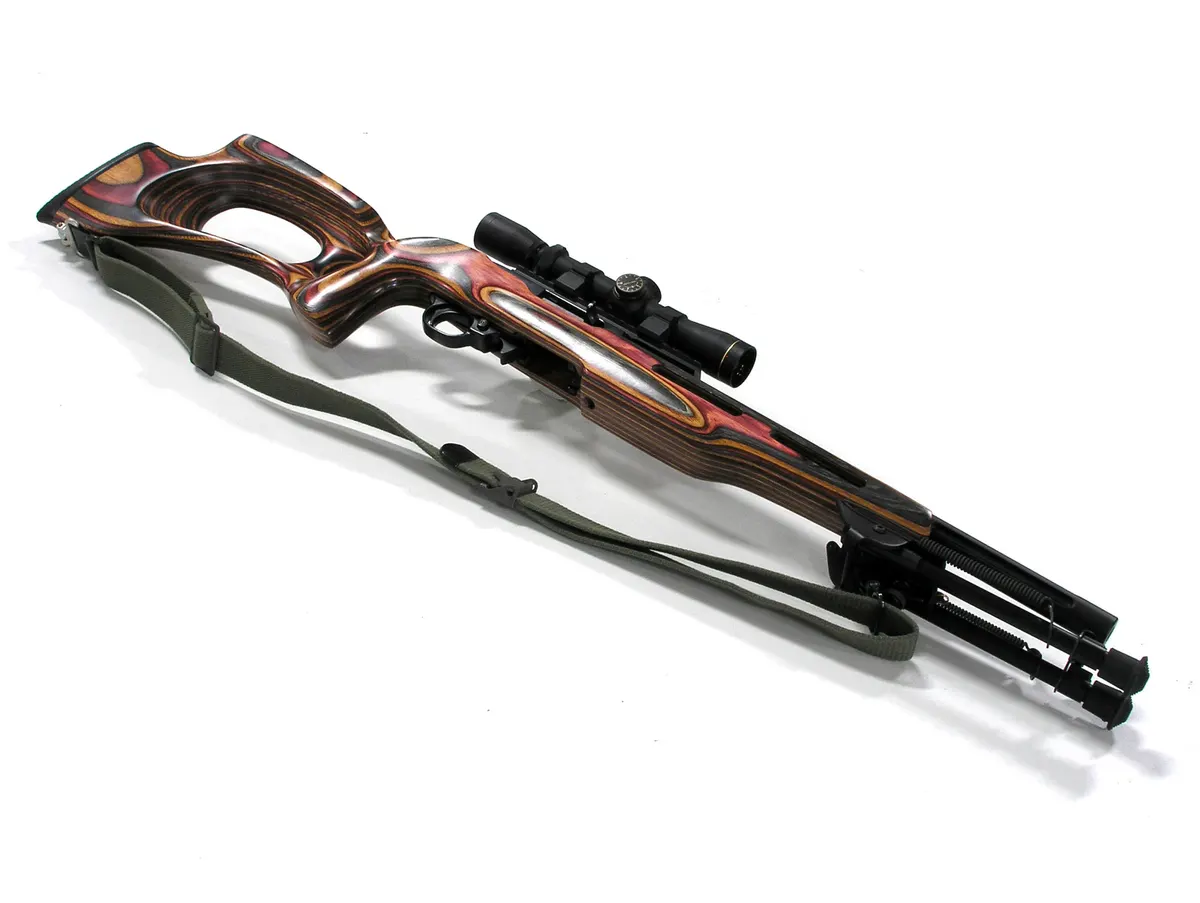
Furniture is Philippine mahogany, finished in black to imitate the plastic furniture of a real M16, with a plastic buttpad and plastic pistol grip.1,2 Sights are fixed iron sights, a post front sight built into the carry handle housing and a peep-style rear aperture, adjustable for windage.1,4 There is no forward assist, no bolt catch that functions like a real AR-15's, and no compatibility with AR-15 optics mounts beyond whatever a gunsmith improvises. The magazine well accepts only the rifle's own proprietary rimfire magazines, not any AR-15 or M16 magazine.
- Namlu Uzunluğu464 mm
- Nişangah TipiMekanik nişangah
- Açık NişangahEvet
- Kabza/Dipçik Malzemesiahşap
- Katlanır / Toplanır DipçikEvet
- Bullpup DüzeniHayır
- Bombaatar KabiliyetliHayır
- Gaz PistonluHayır
- Varyantlar2
Squires Bingham traces back to a Manila print shop founded in 1905, later diversifying into sporting goods, motorcycles, and eventually firearms.3,9 Don Celso Tuason bought the company in 1941 as wartime import restrictions made locally produced arms and ammunition valuable, and in 1952 he secured the Philippines' first private firearms manufacturing license, renaming the firm Squires Bingham Manufacturing Inc.3,9 Production concentrated in a Parang, Manila facility that had grown past 80,000 square feet by 1958.2
The M16-profile .22 LR rifle itself, originally designated the M-1622 and marketed as the Baby Armalike, reached production in 1970, built directly on the action of the company's existing Model 20 rimfire rifle to hold down tooling costs.2,6 It offered a fixed wooden-stock configuration and a telescoping-stock M-16R version from the start, aimed squarely at Filipino landowners, plantation security details, and hunters who wanted a familiar military-style rifle chambered in a cheap, low-recoil cartridge.2
In 1980, Squires Bingham Manufacturing reorganized into Arms Corporation of the Philippines, and the rifle line was rebranded the M1600, the name under which it is still sold today.3,9 Export to the United States ran through a rotating cast of importers over the following decades, sold at different times under the Squires Bingham, K-Mart, Kassnar, Mitchell Arms, RUKO, and Armscor USA labels, with KBI Inc of Harrisburg, Pennsylvania handling much of the distribution before it closed in 2010.10,11 That importer churn reflects how thin the margins were on a budget rimfire clone, not any problem with the rifle's design.
US import policy shaped the Armscor M16 22's American availability more than any single distributor did. The 1989 executive order restricting importation of semiautomatic rifles judged to lack a sporting purpose, and the follow-on 1998 ATF review that barred 56 more foreign models on the same grounds, targeted rifles built around military-pattern features, exactly the kind of AR-15-style carrying handle and flash-hider-shaped muzzle device the M1600 wears.12 Rimfire .22 LR rifles were generally treated more leniently than centerfire assault-weapon look-alikes under that sporting-purposes test, which is part of why the M1600 kept reaching American shelves even as some centerfire foreign clones did not.12
Armscor still lists the M1600 SA .22LR on its current firearms catalog, built and marketed through the company's American Rock Island Armory brand alongside its Philippine production.13 Blue Book valuations put a new, unfired example at roughly $175, squarely in the budget-rimfire tier next to the Ruger 10/22 and other entry-level .22 LR semi-automatics, underscoring that the Armscor M16 22's price has always been the point of the design, not an afterthought.14
Two configurations account for the Armscor M16 22 line's variant count. The base M1600 carries a fixed Philippine mahogany stock shaped to echo the real M16A1's furniture.1,2 The M1600R (originally the M-16R) swaps that fixed stock for a folding, collapsible stock built from stamped metal, aimed at buyers who wanted a shorter, more concealable package for storage or transport rather than a fixed-length trainer.2 Both variants share the same barrel, action, sights, and magazine, the stock is the only structural difference between them.
Decades of rebranding also produced small running changes rather than formal variants. Rifles sold under the K-Mart, Kassnar, Mitchell Arms, and RUKO labels shared the same action and stock but sometimes differed in finish, sight adjustment range, and included magazine count, since each importer specified its own configuration from the Philippine factory.10,11
A separate, larger-caliber M22 line and the Kalashnikov-profile Armscor AK22 sit outside the M16 22's own variant count but come from the same commercial playbook. The AK22, designed in 1987 by Ruko Products (later folded into KBI's import network) and sold under the Armscor name, applies the identical formula, a proprietary rimfire blowback action wrapped in a hardwood stock cut to resemble a well-known military rifle, this time the Kalashnikov AK pattern rather than the M16.15


The Philippines remains the Armscor M16 22's home operator, used domestically for civilian training, small game hunting, and by private security and plantation guards rather than by the Armed Forces of the Philippines as a service rifle.2,9 The much larger installed base sits in the United States, where decades of import under multiple distributor labels put the M1600 into the hands of recreational shooters, youth training programs, and small-game hunters looking for an inexpensive AR-15-profile .22 LR rifle.10,11
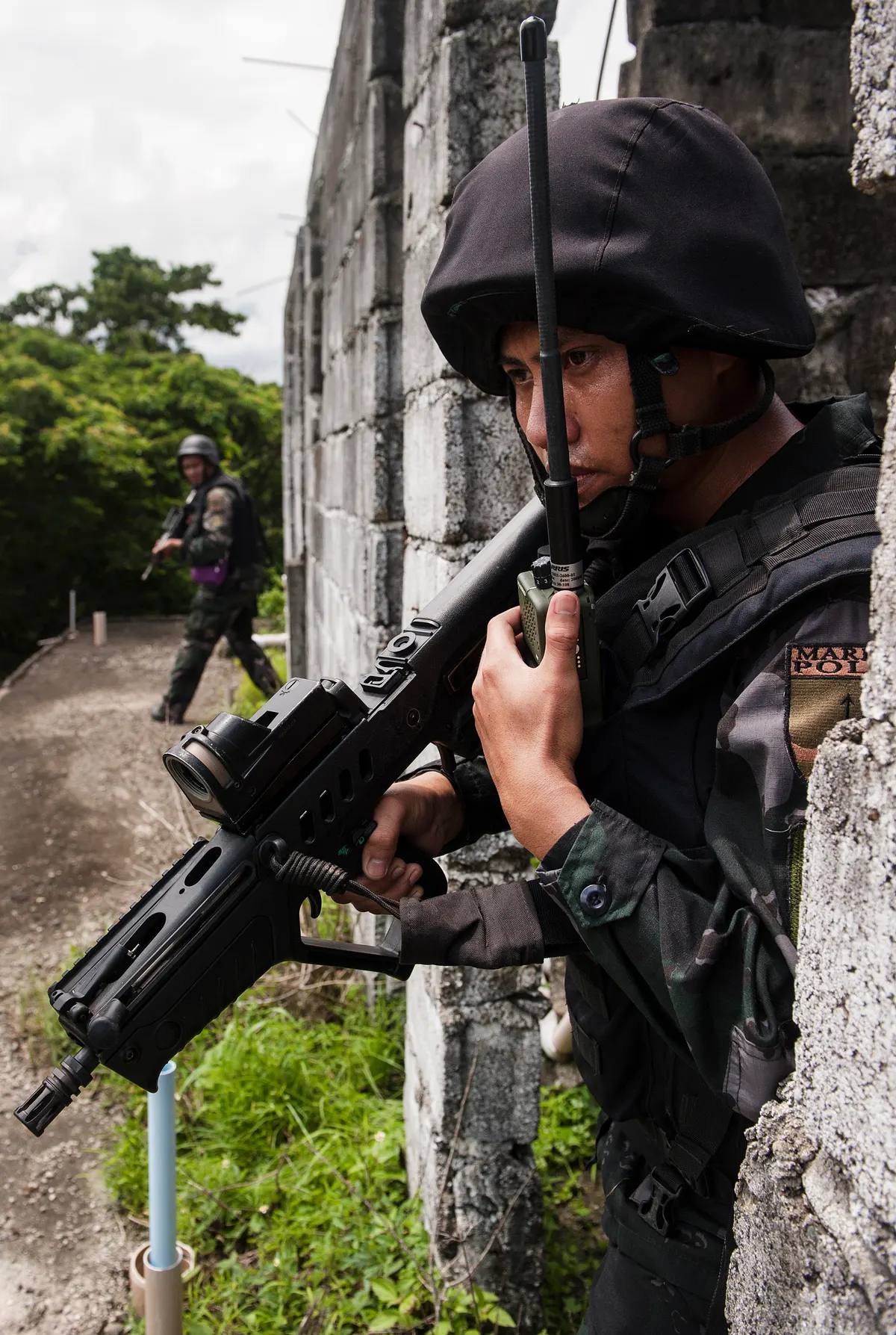
Whether the Armscor M16 22 is still in service today comes down to what service means for a civilian rimfire trainer. It remains in production and in regular use rather than retired to collector shelves.13,14 Neither country ever fielded it as a military service rifle, its operator base has always been civilian shooters, hunters, and security personnel rather than uniformed infantry.
Its closest domestic Philippine sibling in that civilian security role is the Armscor AK22, sold to the same buyers who wanted a Kalashnikov silhouette instead of an M16 one, underlining that Armscor's rimfire clones were built for the training and security market rather than for any formal armed-forces adoption.
The Armscor M16 22's real competition was never the actual M16, it was every other budget .22 LR semi-automatic rifle on the market, and the Ruger 10/22 has dominated that field since 1964.8 Both rifles use blowback actions and both stayed in continuous production for decades, but they solved the rimfire reliability problem in opposite ways. The 10/22's rotary magazine feeds almost any .22 LR ammunition without complaint, while the Armscor design's conventional box magazine, adapted from the older Model 20 platform, runs best on standard or high-velocity rounds and stumbles more often on cheap bulk ammunition.6,7,8 The Ruger also never tried to look like a military rifle, its wood-stocked carbine profile courted a completely different buyer than the M16-silhouette Armscor.
| Spec | Armscor M16 22 (M1600) | Ruger 10/22 |
|---|---|---|
| Introduced | 19702 | 19648 |
| Action | Blowback6,7 | Blowback8 |
| Feed | 10/15-rd detachable box4 | 10-rd rotary (BX-1)8 |
| Weight empty | 2.95 kg (6.5 lb)4 | approx. 2.2 kg (4.9 lb)8 |
Within Armscor's own rimfire clone lineup, the M16 22 and the Armscor AK22 are siblings built to the same brief, a proprietary blowback rimfire action inside a hardwood stock cut to resemble a famous military rifle, sold cheaply to the same plinking and training market. The AK22 came later, designed in 1987 and heavier at roughly 3.18 kg empty against the M16 22's 2.95 kg, and its clamshell receiver construction (two stamped halves screwed together around the action) trades the M16 22's simpler tube receiver for a bulkier, harder-to-strip design.15 Buyers choosing between the two are picking a silhouette, AR-15 or AK, rather than any meaningful difference in what the rifle can actually do.

What caliber is the Armscor M16 22? The Armscor M16 22 is chambered in .22 Long Rifle (.22 LR), a rimfire cartridge, not any centerfire military caliber.1,4
Is the Armscor M16 22 the same as a real M16? No. It shares the visual profile of an M16A1, including the carrying handle and straight-line stock, but the receiver, bolt, magazine, and blowback action are entirely proprietary rimfire parts with no interchangeability with an actual AR-15 or M16.1,2
How does the Armscor M16 22 work? It cycles by direct blowback. The fired cartridge's chamber pressure pushes the unlocked bolt rearward against spring tension, ejecting the spent case and stripping a fresh round from the detachable box magazine on the way forward.6,7
Is the Armscor M16 22 still in production? Yes. Armscor lists the M1600 SA .22LR on its current firearms catalog, sold through its Rock Island Armory brand in addition to Philippine sales.13
What does the Armscor M16 22 (M1600) cost? Blue Book valuations put a new, unfired example at roughly $175, placing it firmly in the budget tier of the rimfire semi-automatic rifle market.14
- "Armscor M16 22", Wikipedia — en.wikipedia.org ↩
- "Armscor Rimfire Battle Guns", Small Arms Review — smallarmsreview.com ↩
- "Armscor (Philippines)", Wikipedia — en.wikipedia.org) ↩
- "M1600 Semi-Automatic Rifle", official owner's manual, Armscor — armscor.com ↩
- "Armscor M1600 Semi Auto Rimfire .22 Long Rifle 10 Round Capacity 18.25 Barrel", Gunwinner — gunwinner.com ↩
- "Squires Bingham M16, A Cheap Rimfire Rifle from Philippines", Combat Operators — combatoperators.com ↩
- "Armscor M1600?", Rimfire Central Firearms Forum — rimfirecentral.com ↩
- "Ruger 10/22 Rifle", American Rifleman, NRA — americanrifleman.org ↩
- "This Is the Story of the Philippines' Biggest Firearms Maker", Esquire Philippines — esquiremag.ph ↩
- "KBI, Inc. All Models", Gun Digest Gun Values — gunvalues.gundigest.com ↩
- "Squires Bingham Model 16, AR/M16 Style Semi-Auto Rifle", listing notes, Guns International — gunsinternational.com ↩
- "Treasury Prohibits Importation of Certain Semiautomatic Assault Rifles", U.S. Department of the Treasury — home.treasury.gov ↩
- "M1600 SA 22LR 10rd", official product page, Armscor — armscor.com ↩
- "Armscor M-1600, For Sale, Price and Used Value", Blue Book of Gun Values — bluebookofgunvalues.com ↩
- "Armscor AK22", Wikipedia — en.wikipedia.org ↩