

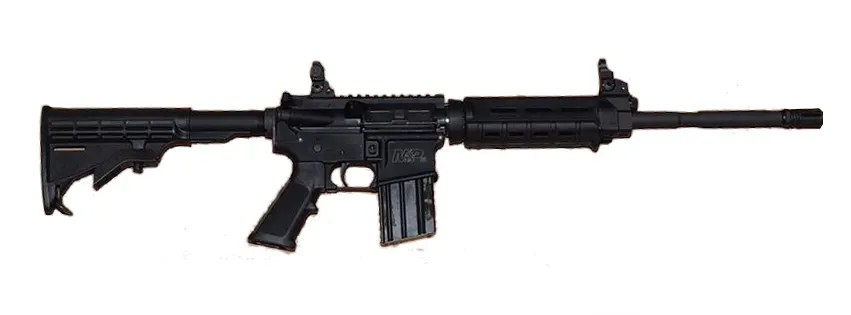

The Smith & Wesson M&P15 borrows its name from a revolver line more than a century older than itself. M&P stands for Military & Police, the name Smith & Wesson gave the Smith & Wesson Model 10 after the U.S. Army and Navy ordered the first Hand Ejector revolvers in 1899.1 Smith & Wesson revived that name in January 2006 for a very different kind of firearm, a gas-operated, semi-automatic, AR-15-pattern rifle chambered in 5.56x45mm NATO and the closely related .223 Remington, introduced at that year's SHOT Show alongside a flat-top variant called the M&P15T.2,3 It was Smith & Wesson's first rifle of any kind in decades and its first entry into the AR-15-pattern rifle market that Colt had defined since 1964.
- mil-spec AR-15 pattern, wide parts and magazine compatibility
- consistently among the lowest-priced factory AR-15-pattern rifles
- light 5.56mm NATO / .223 Remington chambering, low recoil
- backed by Smith & Wesson's lifetime service warranty
- base Sport-tier models ship with basic non-free-float handguards
- discontinued gas-piston variant left a support gap for early adopters
- brand carries the same political scrutiny as the wider AR-15 category
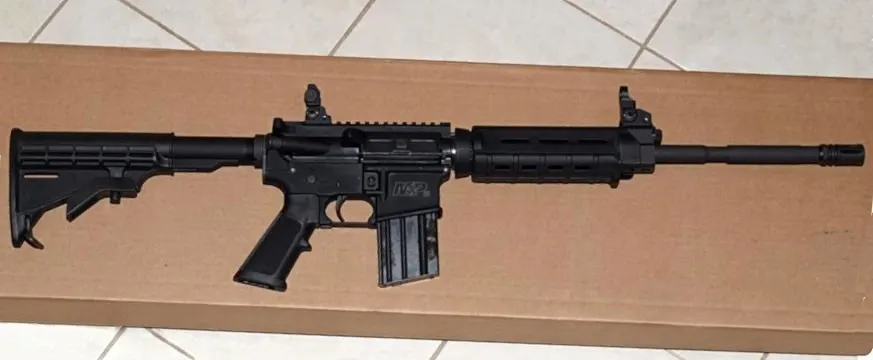
The M&P15 arrived during the sharpest growth period the American AR-15-style rifle market has ever seen. The federal assault weapons ban expired on its own sunset clause on September 13, 2004, and manufacturers that had stayed on the sidelines during the ban decade moved quickly to compete with Colt, whose semi-automatic Colt AR-15 had held the category almost by itself since the 1960s.4 Smith & Wesson entered that market from outside, and research into the company's earlier corporate history turns up no confirmed AR-15 manufacturing or licensing arrangement with Colt predating 2006. Smith & Wesson had built the M76 submachine gun for U.S. Navy SEALs during the Vietnam War and had briefly sold a Howa-made bolt-action rifle as the Smith & Wesson Model 1500, but neither connects to the AR-15 platform, and no period source documents Smith & Wesson producing AR-15-pattern rifles under Colt license before the M&P15 launch.
The Smith & Wesson M&P15 belongs to the semi-automatic rifles category and, within it, to the AR-15-pattern family built around a detachable magazine and a direct-impingement bolt carrier group. Smith & Wesson M&P15 specifications track the mainstream of that category closely, a 16 inch barrel, a six-position collapsible stock, and a 30-round magazine on most factory configurations, which is exactly the point. The M&P15 was built to be an affordable, reliable, mil-spec-pattern alternative to Colt rather than a rifle that reinvents the platform.
Smith & Wesson M&P15 price has stayed near the affordable end of the AR-15-pattern category since 2006. Current mainstream trims, sold under the Sport and Sport III names, carry suggested retail prices in the $700 to $900 range, well under a comparable Colt AR-15, which is a large part of why the M&P15 line became one of the best-selling AR-15-pattern rifles in the United States rather than a niche also-ran.5,6
The Direct Impingement System and Why the M&P15 Stayed With It
Like the Colt AR-15 it competes against, the standard Smith & Wesson M&P15 uses Eugene Stoner's direct impingement gas system, tapping propellant gas from a port in the barrel and routing it back through a tube into the bolt carrier rather than through a separate piston.7 Smith & Wesson did experiment with an alternative. In January 2009 the company introduced the M&P15 PS and M&P15 PSX, short-stroke gas-piston models built around a licensed Adams Arms piston system and marketed on lower fouling and a cooler-running action.8 The piston line never caught on commercially and Smith & Wesson discontinued it within a few years, citing weak sales, leaving direct impingement as the design the M&P15 name is actually known for today.9
- İlk Üretim Yılı2006
- Ağırlık (Boş)2,93 kg
- Halen HizmetteEvet
Barrel length has been consistent across the line. Most Smith & Wesson M&P15 rifles, from the original 2006 M&P15 through the current M&P15 Sport III, use a 16 inch (406mm) barrel, generally 4140 steel with a black Armornite finish, cut with a 1 in 9 inch twist on mainline Sport models to stabilize the widest range of common .223 Remington and 5.56mm NATO ammunition.10,11 The barrel is threaded at the muzzle under a standard A2-pattern flash suppressor, and the front sight base retains the classic AR-15 bayonet lug and sling swivel even though almost no M&P15 buyer ever attaches a bayonet.11
- Fişek5.56mm NATO/.223 Remington
- Çap5,56 mm
- Kovan Uzunluğu45 mm
- Çap Sınıfı.223/5.56mm
- Kenar AteşlemeliHayır
- Kovansız MühimmatHayır
Receiver, Furniture, and What Separates Sport from Pro Trims
The Smith & Wesson M&P15's upper and lower receivers are machined from aluminum forgings, in the same two-piece upper and lower configuration every AR-15-pattern rifle uses, with black polymer furniture on the handguard, pistol grip, and six-position collapsible stock.11 Weight on a standard M&P15 Sport-tier rifle runs about 6.45 lb (2.93 kg) empty, and overall length is roughly 35 inches (889mm) with the stock extended, figures that track closely with the Colt AR-15 and other mil-spec-pattern carbines in the same class.10,12 Magazine capacity is 30 rounds in a standard STANAG-pattern detachable box magazine, with 10-round versions sold into states that cap capacity by law.11
- Mekanizma TipiGazlı
- Atış ModlarıSemi-automatic
- Seçmeli AtışHayır
- Besleme SistemiÇıkarılabilir Şarjör
- Şarjör Kapasitesi30
Smith & Wesson has separated its M&P15 catalog into tiers rather than a single fixed configuration. Base Sport-tier rifles ship with a basic aluminum handguard, fixed A2 front sight, and a Magpul MBUS folding rear sight, made by accessory manufacturer Magpul. Higher trims, most recently the 2022 Volunteer XV and Volunteer XV Pro series, add free-floated M-LOK handguards, PWS muzzle brakes, B5 Systems stocks and grips, and ambidextrous Radian Raptor charging handles, features aimed at buyers who intend to mount optics and accessories rather than shoot the rifle with iron sights out of the box.13 Law enforcement customers can order a dedicated M&P15 Patrol Rifle, restricted to agency sale, built around the same mil-spec receiver but configured with a Magpul M-LOK handguard and dual-aperture rear sight intended for duty use.14
- Namlu Uzunluğu406 mm
- Nişangah TipiFolding iron sights
- Optik RayıEvet
- Açık NişangahEvet
- Dişli NamluEvet
- Toplam Uzunluk889 mm
- Gövde Malzemesi (Receiver)aluminum
- Kabza/Dipçik Malzemesipolymer
- Katlanır / Toplanır DipçikHayır
- Bullpup DüzeniHayır
- Çift Yönlü KumandalarHayır
- Susturucuya HazırHayır
- Süngü TakozuEvet
- Entegre BipodHayır
- Bombaatar KabiliyetliHayır
- Gaz PistonluHayır
- Üretim Başlangıcı2006
- Birim Maliyet800 USD
The 1899 M&P Revolver Name, Borrowed for a Rifle 107 Years Later
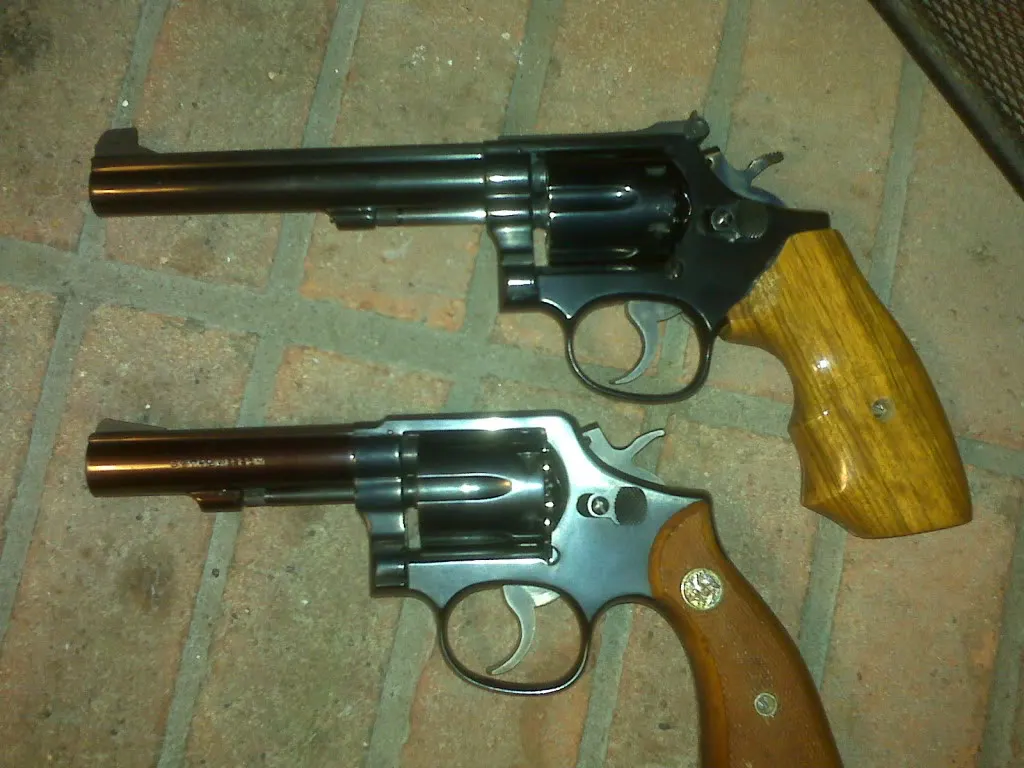
The Military & Police name predates the AR-15-pattern rifle it now labels by more than a century. Smith & Wesson introduced the .38 Hand Ejector Model of 1899 after the U.S. Army and Navy ordered several thousand of the revolvers for service, then renamed it the .38 Military & Police once the design proved itself, a revolver later cataloged as the Smith & Wesson Model 10 and produced in the millions across the 20th century.1 When Smith & Wesson decided to build a rifle for the booming post-2004 AR-15 market, the company reached for that same M&P name rather than inventing a new one, explicitly trading on the revolver line's reputation for duty-grade reliability.2
Launch, Stag Arms, and the Early Manufacturing Arrangement
Smith & Wesson's own long-gun manufacturing capacity in 2006 could not yet support a rifle program on short notice, so the earliest Smith & Wesson M&P15 rifles were built under contract by Stag Arms, then the commercial arm of Continental Machine & Tool, and shipped under the Smith & Wesson name and warranty.15,16 Smith & Wesson brought M&P15 manufacturing in-house over the following years, and after acquiring Thompson/Center Arms in 2007 it began sourcing M&P15 barrels from that subsidiary rather than an outside contractor.17 The arrangement mirrored a common pattern in the mid-2000s AR-15 boom, in which new entrants leaned on established small-parts manufacturers until their own tooling and quality-control processes matured.
Demand outpaced Smith & Wesson's own projections. By the end of 2010, cumulative M&P15 production had already passed 277,000 rifles, with more than 100,000 built in 2009 and again in 2010 alone, years when the wider AR-15-pattern market was also expanding rapidly on the strength of expiring state assault weapons bans and growing civilian and law enforcement demand.18 Industry trade group NSSF coined the marketing term modern sporting rifle in 2009 specifically to reposition AR-15-pattern rifles like the M&P15 as sport-shooting and hunting equipment, a label Smith & Wesson and most competitors adopted in their own catalogs soon after.19
Expanding the M&P Family, Piston Models, the M&P15-22, and the M&P10
Smith & Wesson broadened the M&P rifle line steadily through the 2010s rather than replacing the original design outright. In May 2008 the company released the M&P15R, chambered in the Soviet 5.45x39mm cartridge to take advantage of cheap surplus ammunition, though poor sales led Smith & Wesson to discontinue it by 2011.20 The gas-piston M&P15 PS/PSX followed in January 2009, and later that same year Smith & Wesson launched the M&P15-22, a blowback-operated .22 Long Rifle trainer built to mimic the M&P15's controls and dimensions at a fraction of the ammunition cost, originally aimed at law enforcement training budgets before becoming a popular recreational rifle in its own right.21 In 2013, Smith & Wesson scaled the same basic platform up to .308 Winchester as the M&P10, an AR-10-pattern rifle built for hunting and long-range shooting rather than the AR-15-pattern M&P15's closer-range role.22 None of these three, the M&P15, the M&P10, and the M&P15-22, share a receiver, bolt, or magazine, despite the common M&P name Smith & Wesson uses across all of them.
Corporate ownership of the M&P line has shifted more than the rifle itself has. Smith & Wesson's parent company split its firearms and outdoor-products businesses into separate public companies in 2020, keeping the M&P15 under the newly separated Smith & Wesson Brands, Inc.25 In September 2021, citing proposed Massachusetts legislation that would have restricted certain firearm manufacturing in the state, Smith & Wesson announced it would relocate its corporate headquarters and most long-gun assembly from Springfield, Massachusetts, where the company had been based since its 1852 founding, to a new facility in Maryville, Tennessee, completing the move in October 2023.26,27 Revolver production and roughly a thousand jobs remained in Massachusetts.26
The Smith & Wesson M&P15 line has grown into a wide catalog of factory configurations rather than a single fixed rifle, mirroring how Colt and other AR-15-pattern manufacturers segment their own product lines by trim level and intended buyer.
- M&P15 / M&P15T (2006), the original launch pair, a standard configuration and a flat-top variant with folding sights and a four-rail handguard.3
- M&P15R (2008 to 2011), chambered in 5.45x39mm for cheap surplus ammunition compatibility, discontinued for poor sales.20
- M&P15 PS / PSX (2009 to early 2010s), short-stroke gas-piston models built on a licensed Adams Arms system, later discontinued.8,9
- M&P15-22 (2009 to present), a separate rimfire .22 Long Rifle trainer, not a caliber option of the M&P15 itself.21
- M&P15 Sport and M&P15 Whisper (2011), budget-focused rifles that established the Sport naming Smith & Wesson still uses for its mainline M&P15 today.
- M&P10 (2013 to present), a separate AR-10-pattern .308 Winchester rifle, not a caliber option of the M&P15.22
- M&P15 Sport II (2016 to 2024), the long-running mainstream trim most reviewers treat as the definitive modern M&P15.
- M&P15 Patrol Rifle, a law-enforcement-only configuration with a Magpul M-LOK handguard and dual-aperture rear sight.14
- M&P15 Volunteer XV and Volunteer XV Pro (2022), upgraded trims with free-floated M-LOK handguards, PWS muzzle brakes, and ambidextrous controls.13
- M&P15 Pistol (December 2020) and M&P15 Sport III (2024), the newest additions, a braced-pistol configuration and a free-float, mid-length-gas-system refresh of the Sport line respectively.11


The Smith & Wesson M&P15's primary user base is the American civilian market, where its low price relative to Colt and other established brands drove much of its early sales growth after the 2006 launch.18 Beyond individual buyers, a meaningful number of United States municipal and state law enforcement agencies have adopted the M&P15 Patrol Rifle as a duty carbine, including the Chicago Police Department, which ordered 275 rifles, and the Minnesota State Patrol, which purchased 90 rifles, both citing accuracy and reliability results from head-to-head testing against rival brands.14 Smith & Wesson has also stated that M&P-series rifles have won more than 90 percent of the law enforcement procurement trials in which they have competed, a marketing claim rather than an independently audited figure, though it points to real sustained agency-level adoption.14
The Smith & Wesson M&P15 has no formal U.S. or foreign military adoption and no documented combat use, since it was designed from the outset as a civilian and law-enforcement product rather than a service rifle. It has, however, been the rifle recovered after a small number of high-profile American mass shootings, including the July 2012 Aurora, Colorado theater attack, where the shooter fired 65 of his 76 total rounds from a Smith & Wesson M&P15 Sport before the drum magazine he had loaded it with malfunctioned, and the December 2015 San Bernardino, California attack.23,24 Those incidents made the M&P15 a recurring reference point in American gun-policy debate even though the underlying rifle is mechanically the same product sold to hundreds of thousands of ordinary civilian buyers and law enforcement agencies each year.
Smith & Wesson built the M&P15 to compete on price against the rifle that defined the category. Where a Colt AR-15 trades heavily on its original trademark, decades of military and law enforcement contracts, and mil-spec parts tolerances that predate the modern AR-15-pattern market, the Smith & Wesson M&P15 has generally undercut Colt's retail price by several hundred dollars on directly comparable specifications, the same 5.56x45mm NATO chambering, a 16 inch barrel, and a 30-round detachable magazine.5,6,12 That price gap, more than any mechanical difference, is what has made the M&P15 one of the best-selling AR-15-pattern rifles in the United States while Colt's own civilian AR-15 line has remained a comparatively premium product.
| Spec | Smith & Wesson M&P15 (Sport-tier) | Colt AR-15 (LE6920-pattern) |
|---|---|---|
| Cartridge | 5.56x45mm NATO / .223 Rem | 5.56x45mm NATO / .223 Rem |
| Barrel length | 16 in (406mm)10 | 16.1 in (409mm) |
| Weight (empty) | 6.45 lb / 2.93 kg10 | 6.95 lb / 3.15 kg |
| Magazine capacity | 30 rounds | 30 rounds |
| Typical MSRP | roughly $700 to $9005,6 | roughly $1,000 to $1,300 |
The comparison against Smith & Wesson's own M&P10 and M&P15-22 is a different kind of comparison entirely, since neither is really a rival to the M&P15 so much as a stablemate built for a different job. The M&P10 scales the same basic AR platform up to .308 Winchester for hunting and longer-range shooting, at roughly double the M&P15's typical price and weight, while the M&P15-22 scales it down to inexpensive .22 Long Rifle ammunition purely for low-cost practice and training, firing a rimfire cartridge with a fraction of the M&P15's power and recoil. A buyer asking whether the M&P15 vs the M&P10 is the better choice is really asking whether they want a 5.56mm NATO carbine or a .308 Winchester rifle, not choosing between two versions of the same gun.


Is the Smith & Wesson M&P15 the same rifle as a Colt AR-15? No. Both are AR-15-pattern rifles chambered in 5.56x45mm NATO and .223 Remington, and their magazines and most furniture are interchangeable, but they are built by different manufacturers and sold as separate product lines, with the Colt AR-15 tracing directly back to Colt's original 1964 commercial rifle and the Smith & Wesson M&P15 introduced in 2006 as a lower-priced competitor.2,4
How much does a Smith & Wesson M&P15 cost? Current mainstream M&P15 Sport-tier rifles carry suggested retail prices of roughly $700 to $900, with upgraded Volunteer XV Pro trims running higher, generally undercutting a comparable Colt AR-15 by several hundred dollars.5,6
What is the difference between the M&P15 and the M&P10? The M&P15 is an AR-15-pattern rifle in 5.56x45mm NATO / .223 Remington, while the M&P10 is a larger AR-10-pattern rifle in .308 Winchester introduced in 2013. They share styling and the M&P name but not a receiver, bolt, or magazine.22
Is the Smith & Wesson M&P15 still in production? Yes. Smith & Wesson has continuously updated the line since 2006, most recently with the M&P15 Sport III in 2024 and the Volunteer XV and Volunteer XV Pro trims introduced in 2022.11,13
What caliber does the Smith & Wesson M&P15 use? The standard M&P15 is chambered in 5.56x45mm NATO and the closely related .223 Remington. The related but mechanically distinct M&P10 uses .308 Winchester, and the M&P15-22 uses .22 Long Rifle.2,21,22
- "The First M&P, the Smith and Wesson Military and Police Hand Ejector Model of 1899", Gunblast — gunblast.com ↩
- "Smith & Wesson M&P15", Wikipedia — en.wikipedia.org ↩
- "Smith & Wesson Enters Long-Gun Market with M&P15 Rifles", Smith & Wesson Investor Relations — ir.smith-wesson.com ↩
- "Colt AR-15", Wikipedia — en.wikipedia.org ↩
- "SMITH & WESSON M&P15 SPORT II For Sale, Price and Used Value", Blue Book of Gun Values — bluebookofgunvalues.com ↩
- "Smith & Wesson M&P15 Sport II, A Top-Selling AR-15", American Rifleman (NRA) — americanrifleman.org ↩
- "ArmaLite AR-15", Wikipedia — en.wikipedia.org ↩
- "S&W M&P15 PS and PSX (piston AR-15)", The Firearm Blog — thefirearmblog.com ↩
- "S&W Discontinuing the Gas Piston M&P15's", Smith & Wesson Forum — smith-wessonforum.com ↩
- "S&W M&P15 Sport II Review, 1,000+ Round Hands-On", USA Gun Shop — usa-gun-shop.com ↩
- "M&P 15 SPORT III", Smith & Wesson — smith-wesson.com ↩
- "Colt LE6920 Review, Dependable LE Patrol Carbine", Athlon Outdoors — athlonoutdoors.com ↩
- "New For 2022, Smith & Wesson Volunteer AR-15 Series", American Rifleman (NRA) — americanrifleman.org ↩
- "M&P 15 Patrol Rifle, Law Enforcement Only", Smith & Wesson — smith-wesson.com ↩
- "S&W M&P15 made by Stag Arms?", Sniper's Hide Forum — snipershide.com ↩
- "M&P 15 parts come from Continental Machine & Tool (CMT)", Smith & Wesson Forum — smith-wessonforum.com ↩
- "Smith and Wesson AR15, who actually makes it?", Northwest Firearms — northwestfirearms.com ↩
- "Understanding the Smith & Wesson M&P15 Semiautomatic Assault Rifle", Violence Policy Center — vpc.org ↩
- "A Brief History of the Modern Sporting Rifle", National Shooting Sports Foundation — nssf.org ↩
- "Smith & Wesson M&P15", Military Wiki (Fandom) — military-history.fandom.com ↩
- "Smith & Wesson M&P15-22", Wikipedia — en.wikipedia.org ↩
- "Smith & Wesson M&P10", Wikipedia — en.wikipedia.org ↩
- "2012 Aurora theater shooting", Wikipedia — en.wikipedia.org ↩
- "Backgrounder on Smith & Wesson M&P15 Assault Rifle Used in Mass Shooting at Marjory Stoneman Douglas High School in Parkland, Florida", Violence Policy Center — vpc.org ↩
- "Smith & Wesson", Wikipedia — en.wikipedia.org ↩
- "Smith & Wesson to Relocate Headquarters to Tennessee", Smith & Wesson Investor Relations — ir.smith-wesson.com ↩
- "Smith & Wesson opens new headquarters Tennessee after moving from Mass.", WBUR — wbur.org ↩