

The EM-4 rifle is a British experimental bullpup semi-automatic rifle designed from 1944 by Sir Charles Dennistoun Burney, an aeronautical engineer and inventor better known for leading construction of the R100 airship and for inventing the HESH anti-armour shell.1,5 It fired a wholly non-standard round, the .27 Broadway Trust, named after the Broadway Trust Company, a small engineering concern jointly owned by Burney, ICI, and the Ministry of Supply that acted as a cover for his wartime ordnance work.3,5 The rifle was trialled by the British Army in 1946 and 1947 alongside its far better known stablemates, the EM-2 and the EM-1, but showed too little promise to continue and the project was closed in March 1948.1
- genuinely novel high-low pressure cartridge concept
- compact bullpup layout years ahead of general adoption
- backed by a proven ordnance inventor (Burney)
- persistent obturation and tolerance problems in trials
- accuracy undermined by poor bullet/barrel fit
- never approached the maturity of the rival EM-2
- abandoned before any service issue
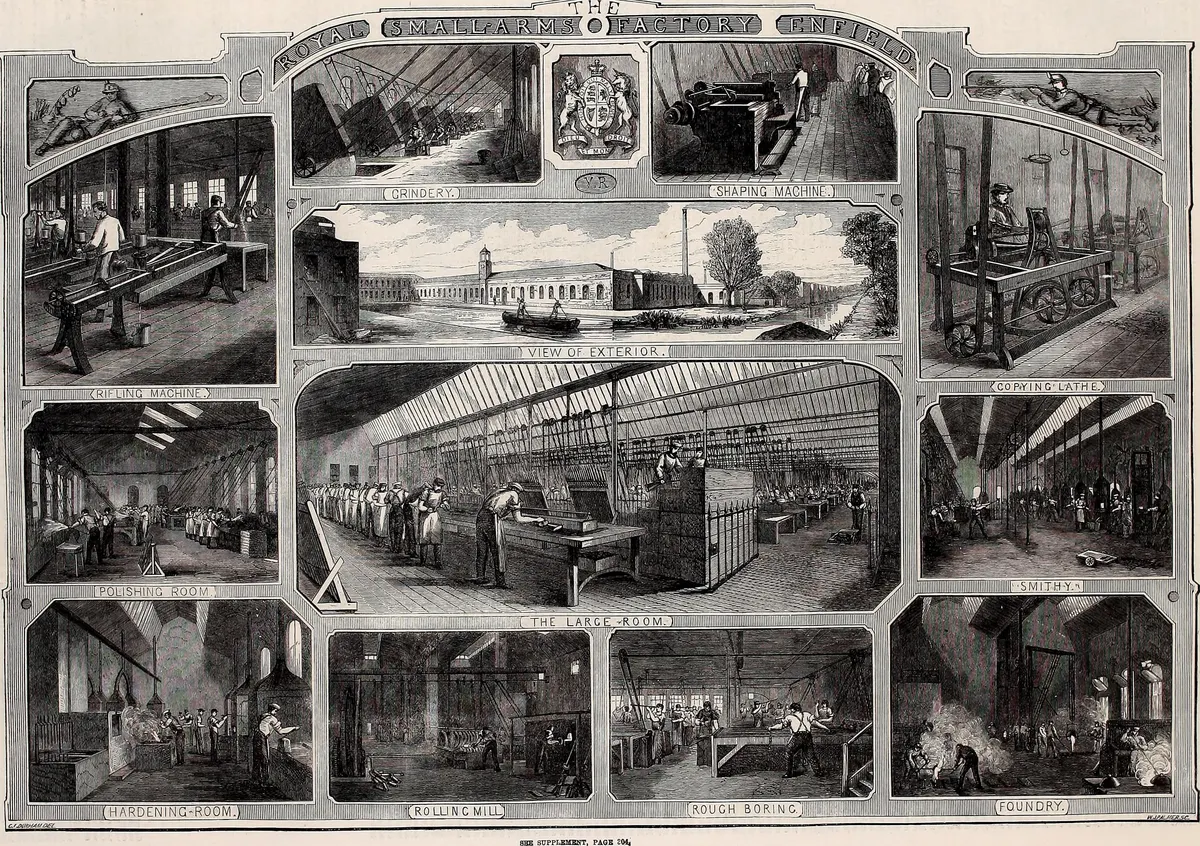
Because it never left the prototype stage, the EM-4 rifle is one of the more obscure entries in the postwar Royal Small Arms Factory (RSAF) Enfield bullpup trials, and it is frequently confused with, or overshadowed by, the EM-2, which was briefly adopted for British service before being cancelled for NATO standardisation reasons.6,8 Surviving documentation is thin. No production run of any size followed the handful of hand-built test rifles, and most detailed technical description comes from cartridge-collector research into the unusual 7x55mm .270 Broadway Trust Company Experimental round rather than from conventional small-arms histories.4
The United Kingdom of the mid-1940s was running several parallel bullpup rifle experiments out of RSAF Royal Small Arms Factory Enfield, and the EM-4 rifle was the least developed of them.1,6 Where the EM-2 used a fairly conventional locked-breech gas system in an intermediate cartridge, Burney pursued a far stranger idea, an expanding-chamber cartridge that bled propellant gas through a perforated case wall, the same high-low pressure principle he was simultaneously applying to his own recoilless anti-tank guns.3,10
The EM-4 rifle used a short-recoil action in which the barrel, bolt, and even the magazine moved together under recoil rather than the bolt alone.1,2 On firing, the barrel assembly was held to the rear against a return spring by the trigger sear. Releasing the sear let the whole assembly drive forward until a fixed cam struck the pivoted hammer against the firing pin. The arrested forward momentum at the end of that stroke then drove a separate cam that rotated a splined bolt head out of its locking recesses, extracting the fired case, after which a bolt spring chambered the next round and a torsion spring rotated the bolt head back into lock.1,2 Burney's design team called the deliberate mismatch in timing between the barrel and bolt differential recoil, and it proved to be one of the mechanism's biggest headaches once live trials began.4
- İlk Üretim Yılı1944
- Tasarımcıdennis_burney
- Halen HizmetteHayır
The .27 Broadway Trust cartridge (formally the 7x55mm .270 Broadway Trust Company Experimental) was the real point of the whole design.3,4 Its case measured roughly 55 mm and was drilled with a pattern of holes so that propellant gas, instead of acting only on the base of the bullet, expanded first into an enlarged secondary chamber before being exhausted down the bore.3,4 The intent, drawn directly from Burney's recoilless-gun patents, was to keep peak chamber pressure low while raising the mean pressure over a longer pressure curve, pushing more velocity out of a given case for a given peak load.4 Collectors have recorded at least three bullet weights tested through 1946 and 1947, roughly 167, 200 and 206 grains (about 11 to 13 grams), with muzzle velocities that climbed from around 630 m/s in early February 1946 firings to about 783 m/s (2,570 ft/s) with the heaviest projectile once the loading was refined, for a muzzle energy near 4.1 kJ.4 The current database record for this weapon lists the cartridge as ".27 Broadway Trust" and the calibre as 6.86 mm. Multiple independent specialist sources, cartridge-collector references, and Wikipedia's own EM-4 rifle entry confirm both figures are correct as written, not a corrupted or garbled value, so no correction to the cartridge name or calibre is warranted here.1,3,4
- Fişek.27 Broadway Trust
- Çap6,86 mm
- Kovan Uzunluğu55 mm
- Çap Sınıfıorta güçlü
- Mermi Ağırlığı13 g
- Kenar AteşlemeliHayır
- Kovansız MühimmatHayır
Mechanically the EM-4 rifle was a true bullpup, with the action and magazine set behind the trigger group to shorten overall length while keeping a long barrel, reportedly over 800 mm, inside a pull length of roughly 390 mm.4 It fed from a detachable magazine and carried plain iron sights, with a steel receiver and wood furniture typical of a hand-built 1940s prototype rather than a rifle designed for volume production.1 None of that solved the rifle's core problem. RSAF Enfield ordered twelve rifles in late 1946 to expand the trial, but the order was suspended after testing turned up obturation failures at the perforated case, bolt and trigger malfunctions, and accuracy so poor that bullets were reportedly slipping in the rifling because of loose bullet and barrel tolerances.4 Differential recoil timing, the mechanism's whole reason for existing, never stabilised enough to fix any of it, and the programme was formally abandoned in March 1948.1,4
- Mekanizma TipiKısa Geri Tepmeli
- Atış Modlarıyarı otomatik
- Seçmeli AtışHayır
- Besleme SistemiÇıkarılabilir Şarjör
- Tetik Tipitek kademeli
- Emniyet TipiElle
Surviving documentation on the EM-4 rifle is thin even among specialists. Cartridge researchers trace most of the surviving technical detail to Peter Labbett's period Guns Review magazine article and to Tony Edwards' cartridge references, and collectors cataloguing the .27 Broadway Trust round describe surviving cases, in any configuration, as very rare.4
- Namlu Çıkış Hızı783 m/sn
- Namlu Enerjisi4.100
- Namlu Uzunluğu820 mm
- Nişangah Tipidemir
- Optik RayıHayır
- Açık NişangahEvet
- Dişli NamluHayır
- Gövde Malzemesi (Receiver)Çelik
- Kabza/Dipçik Malzemesiahşap
- Katlanır / Toplanır DipçikHayır
- Bullpup DüzeniEvet
- Çift Yönlü KumandalarHayır
- ModülerlikYok
- Susturucuya HazırHayır
- Süngü TakozuHayır
- Entegre BipodHayır
- Bombaatar KabiliyetliHayır
- Gaz PistonluHayır
- Üretim Başlangıcı1944
- Üretim Bitişi1948
- Varyantlar0
Dennis Burney was not a career firearms designer. He trained as a naval and aeronautical engineer, sat as Member of Parliament for Uxbridge through the 1920s, and made his name managing the Airship Guarantee Company, a Vickers subsidiary that built the R100 airship with Barnes Wallis as chief designer and the novelist Nevil Shute Norway on the stress-calculation team.5,9 After the Imperial Airship Scheme collapsed following the R101 disaster in 1930, Burney moved into ordnance invention, working through the war years with ICI and the Ministry of Supply under the Broadway Trust Company, a jointly owned engineering cover that ran from October 1943 to 1948.3,5

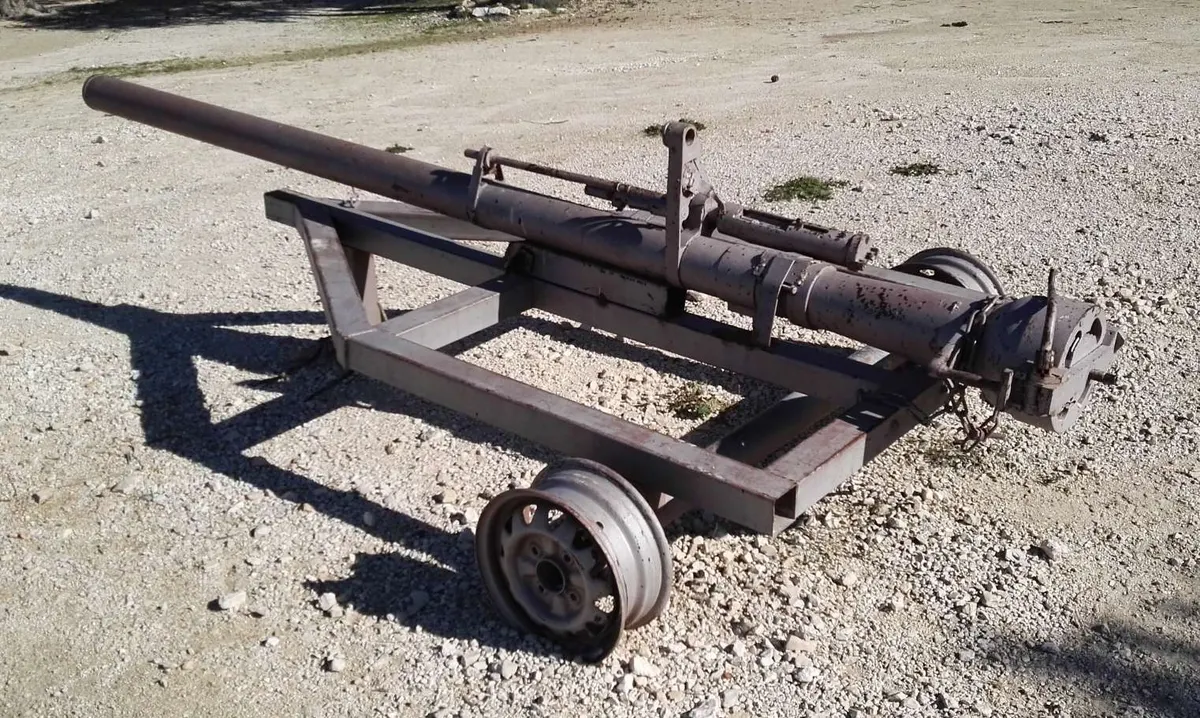
His best known wartime work by far was the recoilless anti-tank gun family that came to bear his name, the Burney gun, in 3.45-inch and 3.7-inch calibres, using the same venturi-tube gas-bleed principle later carried into the EM-4 rifle's cartridge.10,11 Neither Burney gun entered wartime service, but the concept survived him, evolving through the 1950s BAT (Battalion Anti-Tank) gun into the WOMBAT and MOBAT recoilless guns that armed British and Commonwealth forces into the 1980s.10 Burney is also separately credited as the inventor of the High Explosive Squash Head (HESH) shell, a design still in wide anti-armour use decades later.5
The EM-4 rifle fit into a wider, largely forgotten British effort. RSAF Enfield was running four parallel bullpup rifle designs immediately after the war, chasing a new intermediate-cartridge infantry rifle to replace the bolt-action Lee-Enfield.1,6 Two of them, the EM-1 and the Stefan Janson designed EM-2, matured into genuine contenders. A third, from Major Eric Hall, and Burney's EM-4, never got past prototype trials.1 The EM-2, chambered for the related .280 British intermediate round, went furthest of all, formally adopted on 25 April 1951 as the Rifle, Automatic, Calibre .280, No. 9.6
The incoming government of Winston Churchill reversed that adoption within months, in the name of NATO cartridge standardisation.6,8 When the United States rejected the .280 calibre in January 1952, Britain and Canada abandoned the whole EM-series bullpup concept and instead adopted a licensed, non-bullpup FN FAL derivative from Belgium as the L1A1 Self-Loading Rifle.6,7,8 Burney's EM-4 rifle, abandoned three years earlier in 1948, had already been out of the running long before that final political decision was made.

The obvious point of comparison for the EM-4 rifle is not a foreign contemporary but its own stablemate, the EM-2, built at the same factory during the same 1944 to 1948 window. The two designs answered the same brief, a compact bullpup infantry rifle for the United Kingdom, in almost opposite ways. The EM-2 used a conventional gas-operated, multi-lug rotating bolt firing the purpose-built .280 British intermediate cartridge, and it was refined enough to reach formal adoption in April 1951 as a select-fire rifle before politics, not engineering, killed it.6,8 The EM-4 rifle relied instead on Burney's idiosyncratic expanding-chamber cartridge and a moving barrel/bolt/magazine assembly, and it never got past unreliable, low-rate trials before being shelved in March 1948, three years before the EM-2's brief service career even began.1,4
| EM-4 rifle | EM-2 rifle | |
|---|---|---|
| Cartridge | .27 Broadway Trust (7x55mm) | .280 British |
| Action | Short-recoil, moving barrel/bolt | Gas-operated, rotating bolt |
| Fire modes | Semi-automatic only | Select-fire |
| Outcome | Abandoned 1948, trials only | Adopted 1951, cancelled for NATO standardisation |
Neither rifle mattered much for what replaced it. When Britain finally settled on a service rifle for the NATO era, it passed over both bullpup designs entirely and adopted the conventional-layout L1A1 Self-Loading Rifle, a licensed FN FAL variant chambered for the far more powerful 7.62x51mm NATO round that neither the EM-4's cartridge nor the EM-2's .280 British was ever intended to handle.7,8


What cartridge did the EM-4 rifle use? The EM-4 rifle fired the .27 Broadway Trust, formally the 7x55mm .270 Broadway Trust Company Experimental, a roughly 6.86 mm intermediate round with a perforated case for its high-low pressure system, not a variant of the EM-2's separate .280 British cartridge.3,4
Was the EM-4 rifle a bullpup? Yes. The EM-4 rifle placed its action and magazine behind the trigger group, in the same bullpup layout used by its EM-1 and EM-2 stablemates, to keep a long barrel inside a short overall length.1,4
Why was the EM-4 rifle rejected? Trials in 1946 and 1947 found persistent obturation failures at the perforated cartridge case, bolt and trigger malfunctions, and poor accuracy from loose bullet and barrel tolerances, and the differential recoil timing central to the design never stabilised. The programme was abandoned in March 1948.1,4
Did the EM-4 rifle ever enter service? No. It remained a limited trials prototype, with only a small hand-built batch produced, and it was cancelled well before the related EM-2 briefly reached formal British Army adoption in 1951.1,6
- "EM-4 rifle", Wikipedia — en.wikipedia.org ↩
- "Burney rifle", Gun Wiki (Fandom) — guns.fandom.com ↩
- "7mm Broadway Trust Company", Cartridge Collector — cartridgecollector.net ↩
- "7 mm Broadway Trust", International Ammunition Association Forum — forum.cartridgecollectors.org ↩
- "Dennistoun Burney", Wikipedia — en.wikipedia.org ↩
- "EM-2 rifle", Wikipedia — en.wikipedia.org ↩
- "FN FAL", Wikipedia — en.wikipedia.org ↩
- "The Prototype .280 FAL from 1950s NATO Trials", Forgotten Weapons — forgottenweapons.com ↩
- "R100", Wikipedia — en.wikipedia.org ↩
- "Burney Recoilless Rifle Historical Marker", Historical Marker Database — hmdb.org ↩
- "Ordnance, RCL, 3.45 in", Wikipedia — en.wikipedia.org ↩