

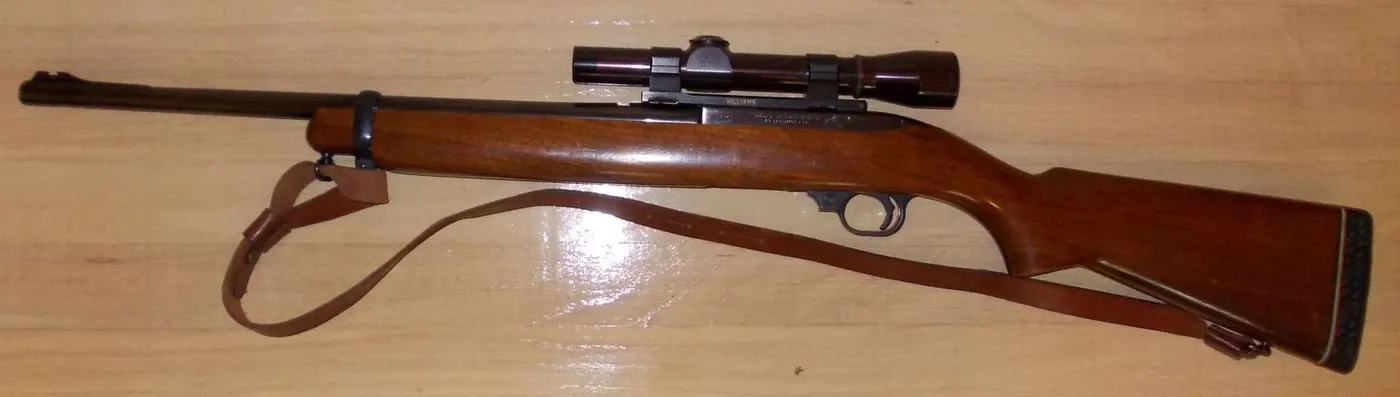

The Ruger Deerstalker was the marketing name Sturm, Ruger & Co. used for exactly one year, 1961 into 1962, on what became far better known afterward as the Ruger 44 Carbine (also cataloged as the Ruger Model 44).1 It is a gas-operated semi-automatic hunting carbine chambered in .44 Remington Magnum, built around a 4-round tubular magazine carried under the barrel, and it was the first long gun Sturm, Ruger & Co. ever put into production, arriving nine years after the company's founding as a maker of pistols only.2 Production ran from 1961 to 1985, and roughly 250,000 examples left the factory in New Hampshire before rising machining costs ended the run.3
- fast semi-automatic follow-up shot for a woods hunting cartridge
- short, light, quick-handling in dense cover
- genuinely novel engineering for a 1961 debut product
- simple bottom-loading tubular magazine, no detachable box to lose
- gas system fouls badly on lead (non-jacketed) bullet loads
- expensive machined-steel receiver made it costly to build
- only 4-round capacity versus rival lever guns holding 10 or more
- discontinued in 1985 with no factory parts support since
The rifle was purpose-built for a specific American hunting problem, taking a fast second shot at a whitetail deer inside heavy timber, where a bolt-action rifle's cycling time could cost a hunter the follow-up. Its 18.25 inch barrel and roughly 36.75 inch overall length made it short and quick to swing between trees, while the .44 Remington Magnum cartridge (already known from Smith & Wesson's Model 29 revolver) gave it stopping power at the sub-100 yard ranges most Eastern and Northern woods hunting actually happens at.2 The Deerstalker and the later-renamed 44 Carbine are the same weapon at different points in its history, not two separate rifles, a naming distinction covered in detail in History below.
The semi-automatic rifle category this carbine belongs to normally gets associated with military and police weapons, but the Ruger 44 Carbine is a purely civilian hunting design, and it sits at the origin point of a whole family of later Sturm, Ruger & Co. long guns, most famously the Ruger 10/22 rimfire carbine that followed it in 1964. Chief engineer Harry Sefried, who joined Sturm, Ruger & Co. in 1959 specifically to help founder William B. Ruger turn the .44 Magnum carbine concept into a working product, later reused pieces of its gas system and rotating-bolt logic on the smaller rimfire gun.4 Both rifles remain grouped under the same semi-automatic rifles category, and understanding the 44 Carbine's mechanism explains a great deal about where Ruger's later rifle designs came from.
Search interest in this rifle today usually falls into two buckets, people asking what caliber the Ruger Deerstalker is chambered in, and collectors and current owners asking what a used Ruger 44 Carbine is worth on today's market (commonly $1,000 to $1,500 depending on condition, well above its original list price).5 Both questions get answered in detail below, along with the specific reason Sturm, Ruger & Co. stopped calling it the Deerstalker after barely a year on dealer shelves.
A Short-Stroke Gas Piston Built for .44 Magnum, Not Rifle Cartridges
The Ruger 44 Carbine uses a short-stroke gas piston tapping propellant gas from a port partway down the barrel, pushing a slide rearward that cams a three-lug rotating bolt out of battery.2 This is a genuine gas-operated action, the same broad mechanical family used by many military rifles, but scaled down and re-engineered for a handgun cartridge rather than a full-power rifle round. The receiver itself started life as a solid billet of steel, machined into its final shape with the bolt's three locking lugs cut directly into the inside of the receiver walls, an expensive process compared to the stamped and cast receivers common on cheaper carbines of the era.2 That machining cost is a large part of why the rifle was eventually discontinued.
- İlk Üretim Yılı1961
- TasarımcıWilliam B. Ruger, Harry Sefried
- Ağırlık (Boş)2,6 kg
Empty weight runs about 2.6 kg (5.75 lb), and overall length is roughly 933 mm (36.75 in) with an 18.25 inch (about 464 mm) barrel, per American Rifleman's factory-spec writeup on the rifle.2 Sights are a fixed gold bead post up front and a folding leaf rear sight, adjustable for elevation, with no factory scope rail, though the receiver top was drilled and tapped on some production runs for aftermarket mounts.
- Fişek44 Remington Magnum
- Çap10,9 mm
- Kovan Uzunluğu32,8 mm
- Mermi Ağırlığı15,5 g
- Kenar AteşlemeliHayır
The 4-Round Tubular Magazine and Its Shotgun-Style Loading Gate
Feed is via a tube magazine holding four rounds of .44 Remington Magnum, loaded bottom-first through a gate much like a pump shotgun rather than through a detachable box.2 That four-round capacity was a deliberate tradeoff, a hunter rarely needs more than a couple of aimed shots at a deer inside 100 yards, and the tubular layout keeps the action's centerline low and the rifle compact. It does mean the 44 Carbine is outgunned on raw capacity by lever-action rivals using the same tube concept, discussed further in Comparison below.
- Mekanizma TipiGazlı
- Besleme SistemiTüp Şarjör
- Şarjör Kapasitesi4
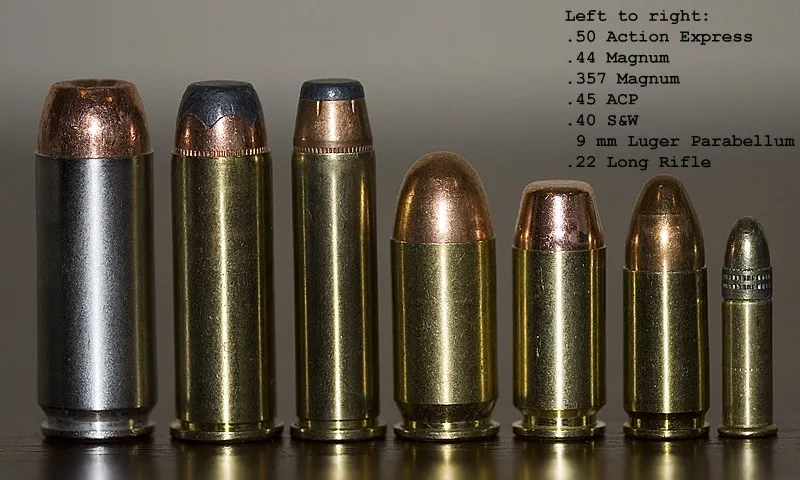
The chambering itself is .44 Remington Magnum, a centerfire (not rimfire) revolver cartridge that Smith & Wesson and Remington had introduced together only four years earlier, in 1955.7 Bullet diameter works out to roughly 10.9 mm (.429 in), firing a 240 grain (about 15.5 gram) jacketed bullet. Muzzle velocity from the carbine's longer 18.25 inch barrel runs meaningfully faster than the same load fired from a revolver, commonly cited around 1,700 fps (roughly 518 m/s) for jacketed handloads, distinctly closer to a rifle-length velocity than the shorter-barrel pistol speeds the same cartridge produces from a revolver.8 At that velocity the muzzle energy works out to roughly 2,000 to 2,100 joules. Effective range for the deer-hunting role it was built for stays around 100 meters, since the flat-nosed hunting bullet sheds velocity quickly past that distance.
- Namlu Çıkış Hızı518 m/sn
- Namlu Enerjisi2.050
- Etkili Menzil (nokta)100 m
Furniture is American walnut on the standard model, with variant stock styles covered in Variants below. Designer credit goes jointly to founder William B. Ruger, who conceived the .44 Magnum carbine concept, and chief engineer Harry Sefried, who spent roughly two years turning that concept into a manufacturable rifle before shipments began in 1961.4
- Namlu Uzunluğu464 mm
- Nişangah Tipigold bead front sight, folding leaf rear sight
- Açık NişangahEvet
- Toplam Uzunluk933 mm
- Gövde Malzemesi (Receiver)steel (machined billet, solid-topped)
- Kabza/Dipçik Malzemesiwalnut
- Gaz PistonluEvet
- Toplam Üretim250.000
- Üretim Başlangıcı1961
- Üretim Bitişi1985
- Birim Maliyet108 USD
From a 1959 Concept to a Trademark Fight Over Its Own Name
William B. Ruger had been eyeing the newly introduced .44 Remington Magnum cartridge as a rifle round almost as soon as Smith & Wesson launched it in the Model 29 revolver in 1955, but Sturm, Ruger & Co. did not have a rifle engineering program yet to act on the idea.7 That changed in 1959 when Harry Sefried, previously at Winchester and High Standard, joined the company as chief engineer and began working with Ruger on a semi-automatic carbine built specifically around the pistol cartridge.4 The two spent roughly two years refining the gas system and receiver before the first production rifles shipped in 1961, marketed under the name Deerstalker, a name Sefried himself proposed out of his own interest in Scottish stag hunting.9
The Deerstalker name lasted barely a year on the market. The Ithaca Gun Company objected that it too closely resembled its own Deerslayer branding used on Ithaca's Model 37 slug-barreled shotguns, and by 1962 Sturm, Ruger & Co. had dropped the name, marketing the same unchanged rifle afterward simply as the Ruger 44 Carbine or Ruger Model 44 for the rest of its production run.1 Some accounts hold there was never a formal lawsuit and that Ruger simply avoided a fight by renaming the gun on his own, but the more commonly repeated version among firearms historians is that Ithaca's objection was the direct cause.10 Either way, the name Deerstalker itself only ever described the rifle's branding for its first production year, not the name it carried for the following 23 years of manufacture.
Why Sturm, Ruger & Co. Discontinued the 44 Carbine in 1985
Sturm, Ruger & Co. offered several stock variants of the rifle through the 1960s, covered in Variants below, but pulled most of them from the catalog by 1971 to simplify production. The core Standard model soldiered on for another 14 years, including a 25th anniversary edition with a Ruger medallion inlaid in the stock, before the entire line was discontinued in 1985.1 The stated reason was cost, the machined-billet steel receiver that gave the rifle its solid-topped strength was expensive to produce compared to newer manufacturing methods, and by the mid-1980s Sturm, Ruger & Co. judged the design no longer commercially viable at a price hunters would pay.3 Ruger did not return to a .44 Magnum semi-automatic carbine until the mechanically unrelated Deerfield Carbine, built on an open-top receiver resembling the M1 Carbine and fed from a 10/22-style rotary box magazine, was sold from 2000 to 2006, and it too was eventually discontinued.11 The Deerfield replaced the older gun in Ruger's lineup by name and role only, not by mechanism, and should not be confused with the 1961 to 1985 gas-piston carbine covered here.
Today an original Ruger 44 Carbine in worn but functional condition typically sells in the $1,000 to $1,500 range on the used market, well above its original list price of roughly $108 in the early 1960s once inflation is set aside, reflecting real collector demand for a discontinued, factory-unsupported design.5 Sturm, Ruger & Co. offers no parts support for the model today, and owners rely on the secondary market and gunsmiths for repairs.1
The Standard (bottom-loading, walnut stock) configuration described above was the core, continuously produced model across the full 1961 to 1985 run. Several factory variants existed alongside it before Sturm, Ruger & Co. trimmed the lineup in 1971.
- RS model added factory-fitted sling swivels and a rear aperture (peep) sight for faster field aiming.1
- International model used a full-length Mannlicher-style stock, with the walnut forend running nearly to the muzzle, and dropped the RS model's peep sight in favor of standard open sights.1
- Sporter model fitted a raised Monte Carlo-profile stock aimed at hunters who preferred a scoped rifle's cheek weld, though the base gun never carried a factory scope rail.1
- 25th Anniversary edition, issued shortly before the line's 1985 discontinuation, added a Ruger medallion inlaid into the stock but made no mechanical changes.1
None of these variants changed the rifle's gas system, magazine capacity, or chambering. All were dropped from the catalog in 1971, leaving only the Standard model in production for the final 14 years before the 1985 discontinuation covered in History above.
Variant-specific production totals are not broken out separately from the roughly 250,000 figure for the whole line, and collectors generally identify which factory configuration a given rifle started as from its stock profile and sight furniture rather than from any serial number range, since the underlying action and chambering never changed between them.
The Ruger 44 Carbine's closest period rival came from an entirely different mechanical family, Marlin's Marlin Model 1894, a lever-action carbine that Marlin Firearms rechambered for .44 Remington Magnum in 1969, eight years after Ruger's carbine had already established the cartridge as a viable rifle round.12 The two rifles compete for exactly the same hunter, someone wanting a short, quick-handling brush gun for whitetail deer at typical Eastern woods ranges, but they solve the follow-up-shot problem in opposite ways.
| Spec | Ruger 44 Carbine | Marlin Model 1894 (.44 Mag) |
|---|---|---|
| Action | Gas-operated semi-automatic | Lever-action |
| Magazine | 4-round tube | Up to 10-round tube |
| Cycling | Automatic | Manual lever |
| Lead bullet handloads | Not recommended (gas fouling) | Fully compatible |
The Ruger 44 Carbine's gas-operated action gives it a genuine speed advantage on a true follow-up shot, since the hunter never breaks the sight picture to cycle a lever, but that advantage comes at the cost of the gas port fouling problem discussed in Specs and Design above, a limitation the Marlin's simple lever gun never has, since it can digest cast lead handloads without complaint.13 The Marlin also holds more than double the ammunition on board, up to ten rounds in its magazine tube against the Ruger's four, though few deer hunters in either camp ever fire more than two shots at a single animal. In practical terms the Ruger 44 Carbine wins on raw speed to a second aimed shot, while the Marlin wins on reliability with cheaper handloaded ammunition and on total rounds carried, and both remain genuinely collectible today rather than being clearly obsoleted by one another.
Sturm, Ruger & Co.'s own later Ruger 10/22, though chambered in the far milder .22 Long Rifle rather than .44 Magnum, shares enough of the 44 Carbine's gas system and rotating-bolt logic through Harry Sefried's continued engineering work that it is worth naming as a direct engineering descendant rather than a competitor, discussed further in History above.4

What caliber is the Ruger Deerstalker chambered in?
The Ruger Deerstalker, later renamed the Ruger 44 Carbine, is chambered in .44 Remington Magnum, a centerfire revolver cartridge adapted to rifle-length use. It is not a rimfire rifle.7
Is the Ruger 44 Carbine still made today?
No. Sturm, Ruger & Co. produced it from 1961 to 1985 and has not resumed production since, though a mechanically unrelated .44 Magnum semi-automatic, the Deerfield Carbine, was sold from 2000 to 2006.11
How much is a Ruger Deerstalker worth today?
Used market prices for an original Ruger 44 Carbine (Deerstalker) commonly run $1,000 to $1,500 depending on condition, well above its original early-1960s list price of roughly $108.5
Why was the Ruger Deerstalker renamed the Ruger 44 Carbine?
Ithaca Gun Company objected that the Deerstalker name was too close to its own Deerslayer shotgun branding, and Sturm, Ruger & Co. renamed the rifle by 1962 rather than fight the objection, keeping the Ruger 44 Carbine (Ruger Model 44) name for the rest of its production run.1
Was the Ruger Deerstalker ever used by police or the military?
No. It was designed and sold purely as a civilian deer-hunting carbine. Sturm, Ruger & Co.'s later, unrelated Police Carbine (PC9/PC40), chambered in 9mm and .40 S&W and fed from pistol magazines, is the model that actually saw law enforcement issue, most notably with the Maryland State Police.14
- "Ruger Model 44", Wikipedia — en.wikipedia.org ↩
- "I Have This Old Gun: Ruger 44 Carbine", American Rifleman — americanrifleman.org ↩
- "POTD: Ruger's .44 Magnum Legacy, The Deerstalker That Started It All", AllOutdoor — alloutdoor.com ↩
- "Harry Sefried, gun designer and former YCGG President", Ye Connecticut Gun Guild — ycgg.org ↩
- "RUGER 44 CARBINE New and Used Price, Value, & Trends 2026", TrueGunValue — truegunvalue.com ↩
- "Ruger .44 Magnum Carbines", GUNS Magazine — gunsmagazine.com ↩
- ".44 Magnum", Wikipedia — en.wikipedia.org ↩
- "The illustrious Ruger .44 Mag. Carbine", Wild Game Dynasty — wildgamedynasty.com ↩
- "H.H. Sefried II, Bill Ruger's Master Gun Designer", RugerForum.net — rugerforum.net ↩
- "The Ruger Deerslayer, The Real Story", Canadian Gun Nutz — canadiangunnutz.com ↩
- "Ruger Deerfield carbine", Wikipedia — en.wikipedia.org ↩
- "Marlin Model 1894", Wikipedia — en.wikipedia.org ↩
- "44 mag carbine problem", Ruger Forum — rugerforum.net ↩
- "A Look At the Patrol Rifle of Yesteryear", GunsAmerica Digest — gunsamerica.com ↩