

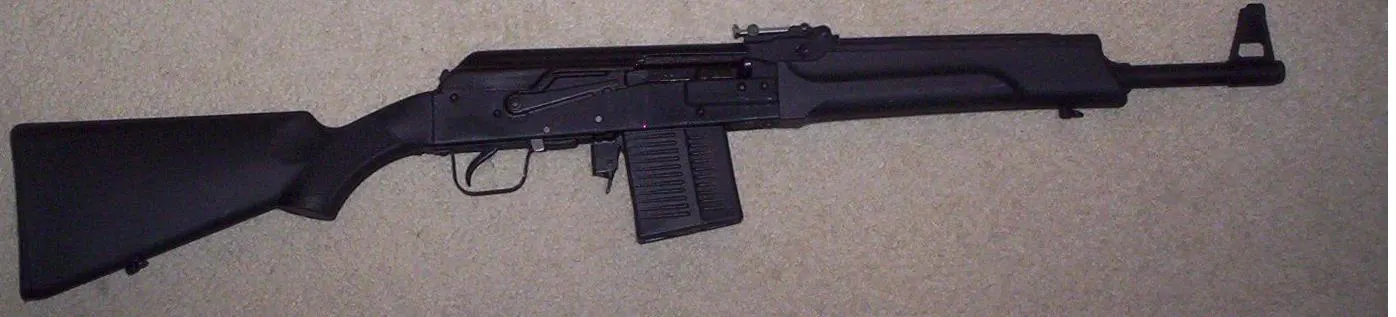

The Saiga semi-automatic rifle began life as a wildlife-control carbine. Izhmash engineers built the original version in the late 1970s to help Kazakh and Soviet wildlife managers control saiga antelope and wild boar populations, chambering it for the obscure .220 Russian (5.6x39mm) cartridge and selling barely 300 examples before the project quietly died.1,2 The rifle that carries the name today is a different, far more successful product, a semi-automatic, gas-operated civilian carbine built on the same receiver, bolt and long-stroke piston as the military AK-47, relaunched in the early 1990s and sold into dozens of countries as a hunting and sport-shooting rifle for three decades.1,2
- AK-pattern reliability and simple maintenance
- hammer-forged, chrome-lined barrel resists corrosion
- wide caliber spread, 7.62x39mm through .308 Winchester
- cheap, abundant parts and gunsmith familiarity
- compliant factory configuration for restrictive US states
- semi-automatic only, no select-fire option
- proprietary sporter magazine needs modification for AK-pattern mags
- Russian import blocked in the US and EU since 2014
- civilian sporter trigger group less crisp than a military AK
Izhmash, renamed Kalashnikov Concern in 2013, built the Saiga at its factory in Izhevsk, the same complex where Mikhail Kalashnikov worked and where the military AK family is still assembled.1,3 By the early 2010s the Saiga line, offered in calibers from 7.62x39mm to .308 Winchester, had become the single best-known Russian rifle on the American civilian market, sold through dedicated importers rather than any state arms-export agency.1 That commercial success ended abruptly. A 2014 US sanctions order aimed at Kalashnikov Concern over Russia's actions in Ukraine cut off new imports overnight, and the Saiga has not returned to American gun-store shelves since.4,5 Weighing 3.6 kg empty with a 415 mm barrel, the rifle belongs to the broader semi-automatic rifles category, sharing that classification with hunting and sporting carbines worldwide rather than with any nation's infantry inventory.1
Anyone searching for Saiga rifle specifications or asking how the Saiga rifle works is mostly asking about two things, the gas system it borrows wholesale from the AK-47 and the sporter-configured furniture and magazine that keep it legally distinct from a military rifle in most jurisdictions.1,6 Both are covered in detail below, alongside the rifle's caliber family, its history under Izhmash and Kalashnikov Concern, and the sanctions and conversion culture that now define its reputation more than any single specification does.
The AK-47's Long-Stroke Piston, Kept Semi-Automatic Only
The Saiga's operating system is the AK-47 action itself, built on the same stamped-steel receiver, the same long-stroke gas piston fixed rigidly to the bolt carrier, and the same rotating bolt that locks into the barrel trunnion.1,2 Propellant gas bled from a port in the barrel drives the piston and carrier rearward as one unit, camming the bolt out of battery, extracting the spent case, and compressing the recoil spring before the whole assembly returns forward under spring pressure to strip and chamber the next round.2 That mechanism is famous for tolerating dirt, poor lubrication and rough handling better than most rival rifle designs, and Saiga engineers changed almost none of it when converting the military AK into a civilian sporter.1 What did change was fire control. Every Saiga is built semi-automatic only from the factory, with a two-position safety lever (safe and fire) in place of the three-position selector that gives a military AK-47 or AKM its automatic setting, and the internal parts that would allow full-automatic fire are simply never installed.1,2
- İlk Üretim Yılı1974
- TasarımcıMikhail Kalashnikov (base AK action); no specific named engineer identified in sourcing for the 1990s Saiga hunting-carbine redesign
- Ağırlık (Boş)3,6 kg
- Halen HizmetteHayır
The barrel is hammer-forged and chrome-lined on every production Saiga, a manufacturing detail Izhmash carried over directly from military AK production and one that gives the civilian rifle unusually good corrosion resistance and barrel life for its low retail cost.1 Standard rifles carry a 415 mm (16.3 in) barrel and weigh 3.6 kg (7.9 lb) unloaded, with an official effective range quoted at roughly 500 m, though civilian sporter open sights and factory triggers rarely let a shooter exploit that range the way a trained rifleman with optics could.1 Rear sights are a simple tangent notch graduated out to 100 to 300 meters depending on the model, a much shorter sight radius commitment than a dedicated hunting rifle, reflecting the Saiga's origin as a pest-control carbine rather than a long-range sporting design.7
- Kenar AteşlemeliHayır
- Kovansız MühimmatHayır
Seven Calibers, One Receiver
Few civilian rifle families spread across as many chamberings as the Saiga did. Beyond the abandoned .220 Russian original, production-era Saigas have been built in 7.62x39mm, 5.45x39mm, .223 Remington/5.56x45mm, .308 Winchester/7.62x51mm, .30-06 Springfield, and the rimmed 9x53mmR hunting cartridge, each requiring its own bolt face, barrel and, for the larger .308 and .30-06 versions, a lengthened and reinforced receiver to handle the higher bolt thrust.1,2 The 7.62x39mm and 5.45x39mm variants are dimensionally closest to the military AK-47 and AK-74 they derive from and accept modified AK-pattern magazines most readily, while the .308 Winchester Saiga (sold as the Saiga-308) needed the most substantial receiver redesign of the family and, unlike the smaller-caliber versions, never achieved a fully reliable aftermarket conversion to standard detachable AK magazines.1 Later Saiga-MK carbine variants added a side-folding polymer stock, a factory Picatinny rail on the receiver's hinged dust cover for red-dot or scope mounting, and a magazine well reworked to accept standard double-stack AK magazines directly from the factory, closing much of the gap between the sporter configuration and a military-pattern rifle without Izhmash ever installing a selector.7
- Mekanizma TipiGazlı
- Atış Modlarıyarı otomatik
- Seçmeli AtışHayır
- Besleme SistemiÇıkarılabilir Şarjör
Sporter Furniture and the Compliance Question
Factory Saiga rifles ship without a pistol grip, a bayonet lug, a threaded muzzle device or a folding stock in most configurations, a deliberate design choice that keeps the rifle outside the assault weapon feature tests written into several US state laws, including California's.9 Collectors and gunsmiths refer to this as a featureless configuration, built around a fixed sporter stock, a hunting-style trigger, and a magazine release that functions like an ordinary bolt-action rifle's rather than an AK's paddle-style release.9 One feature the factory Saiga added that the military AK-47 never had is a last-round bolt-hold-open, letting the action lock back on an empty magazine, a small ergonomic improvement enthusiasts frequently cite as proof the sporter redesign was not merely a stripped-down military rifle.7
- Namlu Uzunluğu415 mm
- Nişangah TipiDemir "yaprak" nişangah
- Optik RayıEvet
- Açık NişangahEvet
- Dişli NamluHayır
- Gövde Malzemesi (Receiver)presli çelik
- Katlanır / Toplanır DipçikHayır
- Bullpup DüzeniHayır
- Çift Yönlü KumandalarHayır
- Susturucuya HazırHayır
- Süngü TakozuHayır
- Entegre BipodHayır
- Bombaatar KabiliyetliHayır
- Gaz PistonluEvet
- Üretim Başlangıcı1990
- Varyantlar7
- Genişlik70 mm
- Yükseklik220 mm
A Failed Antelope-Control Carbine, Then a 1990s Relaunch
Izhmash's original late-1970s Saiga carbine, chambered in the underpowered .220 Russian round and intended for population control of saiga antelope and wild boar in Kazakhstan and southern Russia, sold in such small numbers, roughly 300 rifles, that the factory shelved the project entirely.1,2 The Saiga name and the underlying AK-based hunting-carbine concept were revived in the early 1990s as the collapsing Soviet defense industry looked for civilian revenue, and Izhmash reintroduced the rifle first in 7.62x39mm and .223 Remington before expanding into the wider caliber family described above through the 1990s and 2000s.1,2 Sourcing does not identify a single named engineer credited specifically with the 1990s hunting-carbine redesign, distinct from Kalashnikov's original AK action, a gap in the public record rather than an invented claim.
Russian American Armory and later the Russian Weapons Company (RWC) became the Saiga's exclusive US importers through the 1990s and 2000s, building an aftermarket conversion industry around the rifle almost as large as the factory business itself.1,10 Companies sold hammer pack and trigger-group kits, US-made pistol grips, and 922(r)-compliant parts lists that let American owners legally rebuild a sporter Saiga into something close to a semi-automatic AK-47 clone, keeping the exact ratio of foreign to domestic parts required under US assembly law.10,11 By the early 2010s that conversion culture, combined with the Saiga's reputation as the cheapest genuinely Russian-made AK derivative on the market, had made it a staple of American gun shows and online forums built entirely around Saiga-specific gunsmithing.11
Izhmash Becomes Kalashnikov Concern
On 13 August 2013, Izhmash merged with the smaller Izhevsk Mechanical Plant (Izhmekh) at the urging of deputy prime minister Dmitry Rogozin, who argued the individual factory names meant nothing commercially next to the Kalashnikov brand itself.3,12 The merged company took the name Kalashnikov Concern, consolidating Russia's small-arms industry under a single vertically integrated holding company and continuing Saiga production at the same Izhevsk facility under the new corporate name.3,12 Civilian rifles, with the Saiga as the flagship product, made up roughly half of Kalashnikov Concern's total sales in the years just before 2014, and the United States alone absorbed something close to 90 percent of the company's export volume, an extraordinary dependence on a single foreign civilian market for a state-linked Russian defense manufacturer.13,14
The 2014 Sanctions That Ended US Imports Overnight
On 16 July 2014, in response to Russia's actions in Ukraine and Crimea, US President Barack Obama signed an order that added Kalashnikov Concern to the Treasury Department's Office of Foreign Assets Control sanctions list, effective the following day.4,5 The listing blocked American persons and companies from any new business with Kalashnikov Concern, immediately halting fresh imports of Saiga rifles, carbines and shotguns, though it did not affect Saiga firearms already inside the United States, which owners could keep and resell freely.4,5 The European Union imposed its own parallel sanctions the same year.1

The market reaction was immediate. Retail Saiga rifles that sold for roughly 600 dollars before the ban were reselling for as much as 1,500 dollars within two months on the secondary market, as dealers and collectors bought up remaining stock in anticipation of permanent scarcity.13 Kalashnikov Concern itself estimated it lost as much as 90 percent of its global civilian-arms market share by 2018 as a direct result of the US and EU sanctions, forcing the company to pursue new civilian markets outside the sanctioning states and lean more heavily on Russia's own domestic civilian gun market.1,15
An American Brand Fills the Gap
RWC rebranded itself Kalashnikov USA, based in Pennsylvania with manufacturing set up in Florida, and began building AK-pattern rifles domestically under the Kalashnikov name using US-made receivers and enough American-made parts to satisfy federal assembly law, entirely independent of the sanctioned Russian parent company.1,19 The first American-made rifles reached dealer shelves in 2015, explicitly marketed to buyers who could no longer get a genuine Russian Saiga, though the domestic product is a different rifle built by a different, unrelated company rather than a continuation of Izhmash production.19 Inside Russia, Kalashnikov Concern kept building Saiga-pattern hunting carbines for its own domestic civilian market and for export to countries outside the US and EU sanctions regime, and the company's own catalog continues to list current Saiga-MK models for sale in the mid-2020s.1

The Saiga-9, a Different Action Wearing the Same Name
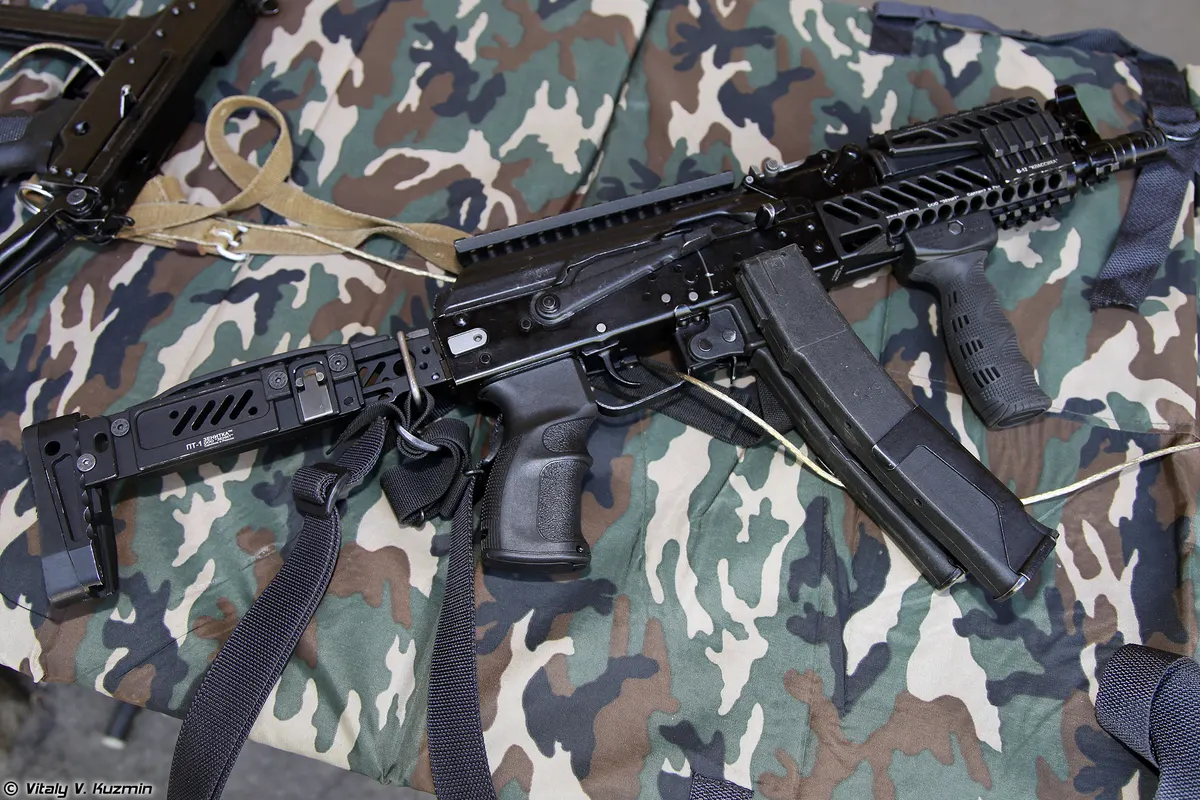
Not every rifle carrying the Saiga name shares the AK gas-piston action described above. The Saiga-9, chambered in 9x19mm pistol-caliber, is built instead on the simple blowback action of the PP-19 Vityaz submachine gun, firing from a closed bolt with a plastic double-stack magazine restricted to 10 rounds for the Russian civilian market rather than the long-stroke piston system every rifle-caliber Saiga uses.20,21 It is a genuinely different mechanism sharing a marketing name, aimed at civilian buyers wanting a compact, low-recoil carbine for home defense or sport shooting rather than a rifle-caliber hunting gun.21
The Saiga-MK Carbines and the .308 Outlier
Later Saiga-MK carbines shortened the barrel, added a side-folding stock and a factory Picatinny rail, and in some versions reworked the magazine well to accept standard AK double-stack magazines without aftermarket modification, effectively closing most of the gap between the sporter Saiga and a converted, AK-configured rifle.7 The Saiga-308, chambered for the more powerful .308 Winchester/7.62x51mm cartridge, needed the largest departure from the standard 7.62x39mm receiver of any variant and never achieved the same reliable aftermarket magazine compatibility that made the smaller-caliber Saigas so popular with conversion gunsmiths.1
A smaller .30-06 Springfield and 9x53mmR version of the Saiga-MK line targeted European hunters specifically, calibers with almost no following in North America but a long tradition among Russian, Baltic and Scandinavian big-game hunters, underscoring that the Saiga family was always tuned market by market rather than sold as one fixed product worldwide.1,2


The Saiga's real user base was never a military one. It sold almost exclusively into the civilian hunting and sport-shooting markets of the United States, Russia, and, before the EU's own 2014 sanctions, several European countries, with the United States alone absorbing something close to 90 percent of Kalashnikov Concern's total export volume in the years before the ban.13,14 No armed force has adopted the Saiga for service use, and unlike the select-fire AK-47 it derives from, the rifle has no combat or conflict record of its own to record.1 It has, however, turned up repeatedly in American federal firearms-possession cases simply because it remained legal to own and resell after 2014, including a 2019 Pittsburgh case in which a previously convicted felon was indicted for possessing a 5.45x39mm Saiga rifle recovered by federal agents.18
Inside Russia itself, the Saiga remains a common civilian hunting rifle sold through Kalashnikov Group's own domestic retail network, entirely separate from the company's sanctioned military and export business.1 The rifle's real legacy on the American civilian market is arguably more industrial than military, a decades-long gunsmithing subculture built around converting sporter-configuration Saigas into AK-pattern configurations, one that continued to sell parts and services for years after the source rifles themselves stopped arriving from Russia.10,11
After the EU shut its own market in 2014, Kalashnikov Concern redirected Saiga-pattern civilian sales toward countries outside the US and EU sanctions regime, opening roughly five new national markets and adding about ten new foreign buyer countries within a few years, part of a broader pivot away from the company's former reliance on Western civilian sales.1,14
Molot's own Vepr hunting carbine, catalogued among the wider carbines category itself, was built on the identical AK action at a separate factory in Vyatskiye Polyany, sold into the exact same American civilian niche as the Saiga throughout the 2000s and 2010s, and priced roughly 50 percent higher.16 Molot marketed the Vepr as the premium option of the two, built on a thicker receiver stamping intended for the semi-automatic RPK light machine gun rather than the AK-47's, at around 900 dollars against a roughly 600 dollar Saiga just before the 2014 sanctions hit.13 That price gap reflected a real quality difference collectors still argue over, the Vepr's heavier receiver against the Saiga's lower cost and far larger installed base of aftermarket conversion parts and gunsmithing knowledge built up over two decades of Saiga-specific hobbyist culture.13,16
The two rifles' fates then diverged in a way that had nothing to do with either one's mechanics. When the July 2014 sanctions named Kalashnikov Concern specifically, Molot and the Vepr were left off the list entirely, and Vepr imports briefly picked up much of the volume Saiga sales lost, until OFAC caught up in June 2017 and added Molot to the same sanctions regime for helping Kalashnikov Concern falsify export invoices to dodge the original ban.16,17 Both rifles are now equally unavailable as new imports in the United States for the same underlying reason, Russian origin and US sanctions policy, rather than because either design lost a technical argument to the other.
| Spec | Saiga (7.62x39mm) | Molot Vepr (7.62x39mm) |
|---|---|---|
| Action | Gas-operated, AK-47 receiver | Gas-operated, RPK-pattern receiver |
| Fire control | Semi-automatic only | Semi-automatic only |
| Pre-ban US retail price | Approx. $600 | Approx. $900 |
| US import status (2026) | Banned since July 2014 | Banned since June 2017 |
Every figure in that table is sourced above in History and Comparison.13,16,17
A second, less direct rival is the Romanian WASR-series rifle, built by an entirely separate factory with no design relationship to the Saiga, yet competing for the exact same American budget-AK buyer both before and after 2014.1 Unlike the Saiga, the WASR-10 kept arriving into the United States after the Russian import ban, since Romania's Cugir Arms Factory was never a sanctions target, and it became one of the default replacement options for American buyers who could no longer get a genuine Russian rifle, a market position the Saiga itself once held unchallenged.


Is the Saiga rifle still in service anywhere Not with any armed force, and it never was. The Saiga was built and sold exclusively as a civilian hunting and sport-shooting rifle, and its only service has been in private ownership across Russia, the United States and, before 2014, parts of Europe.1
Can you still buy a Saiga rifle in the United States Not a genuine new import. New Saiga rifles have not entered the United States since Kalashnikov Concern was sanctioned in July 2014, though rifles imported before that date remain perfectly legal to own and resell on the secondary market.4,5
What caliber does the Saiga rifle use Production Saiga rifles have been chambered in 7.62x39mm, 5.45x39mm, .223 Remington/5.56x45mm, .308 Winchester/7.62x51mm, .30-06 Springfield and 9x53mmR, making it one of the widest caliber families built on a single AK-derived receiver design.1,2
Can a Saiga be converted to an AK-47 A Saiga can be converted to accept AK-pattern furniture, a pistol grip and standard double-stack magazines, and it already shares the AK-47's gas system and receiver design, but it cannot legally be converted to select-fire automatic function without violating US federal machine-gun law.10,11
How much does a Saiga rifle cost Pre-2014 retail prices ran around 600 dollars for a standard 7.62x39mm Saiga, roughly doubling to 1,200 to 1,500 dollars on the secondary market within months of the import ban, and original Russian-made examples have generally held or gained value since, since no new stock can legally enter the country.13
Who manufactures the Saiga rifle Izhmash, renamed Kalashnikov Concern in 2013, manufactures the Saiga at its factory in Izhevsk, Russia, the same complex that builds the military AK-47 and AK-74 family.1,3
- "Saiga semi-automatic rifle", Wikipedia — en.wikipedia.org ↩
- "Saiga rifle", Modern Firearms — modernfirearms.net ↩
- "Kalashnikov Concern", Wikipedia — en.wikipedia.org ↩
- "Obama Executive Order Bans Import of Kalashnikov - Saiga AKs", AmmoLand — ammoland.com ↩
- "U.S. sanctions ban import of 'Concern Kalashnikov' guns!", all4shooters — all4shooters.com ↩
- "Saiga semi-automatic rifle", Grokipedia — grokipedia.com ↩
- "Test: Izhmash Saiga MK in 7.62x39mm", all4shooters — all4shooters.com ↩
- "Saiga Conversions", Parham Custom Guns — parhamcustomguns.com ↩
- "California Featureless Modified Saiga", Gunboards Forums — gunboards.com ↩
- "The Saga of the Saiga", The Loadout Room — loadoutroom.com ↩
- "FAQ About 922r Compliance", Carolina Shooters Supply — carolinashooterssupply.com ↩
- "Russian Gunmaker Izhmash Renamed Kalashnikov Concern", Sputnik International — sputniknews.com ↩
- "Kalashnikov Prices in U.S. Soar as Sanctions Cut Supply", The Moscow Times — themoscowtimes.com ↩
- "Kalashnikov, Russia's AK-47 Manufacturer, Eyes Domestic Civilian Market To Increase Sales Amid Western Sanctions", International Business Times — ibtimes.com ↩
- "Kalashnikov, Aiming at Giant US Civilian Gun Market, Hammered by Sanctions", Russia Insider — russia-insider.com ↩
- "Molot, Maker of Vepr Rifles, Named in Russian Sanctions", International Sportsman — internationalsportsman.com ↩
- "Treasury Department Adds Molot Vepr to Import Ban", GunsAmerica Digest — gunsamerica.com ↩
- "Pittsburgh Felon Indicted for Illegally Possessing a Semi-Automatic Rifle", ATF — atf.gov ↩
- "Skirting Sanctions, First American-Made AK-47s to Hit U.S. Shelves", The Trace — thetrace.org ↩
- "PP-19 Vityaz", Wikipedia — en.wikipedia.org ↩
- "Saiga 9x19", Modern Firearms — modernfirearms.net ↩