

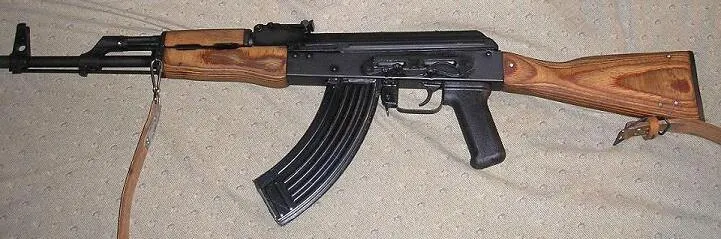

The WASR-series rifles are a family of Romanian semi-automatic gas-operated carbines built by the Cugir Arms Factory for commercial sale, chiefly in the United States. The name is not a model designation in the Soviet or Romanian sense at all. It is an acronym for the Wassenaar Arrangement, the 1996 multilateral export control accord that governs how conventional weapons and dual-use technology move between member states.1 Every WASR is a civilian derivative of the Pistol Mitralieră model 1963/1965 (PM md. 63/65), Romania's own licensed adaptation of the Soviet AKM, built with a detachable magazine holding 30 rounds, wood furniture, and a stamped steel receiver typical of the wider Kalashnikov lineage that also produced the AK-47.1,2
- Genuine forged/stamped Cugir receiver, not a parts-kit build
- Chrome-lined barrel and bolt carrier tolerate poor ammunition and neglect
- Among the cheapest true AK-pattern rifles sold new in the US
- Enormous aftermarket parts and furniture support
- Factory fit and finish (sights, wood, coatings) is inconsistent between production runs
- Early imports suffered painful *trigger slap* until the 2007 parts change
- Some batches ship with mismatched or unreliable magazines
- Supply has been repeatedly disrupted by events at the single source factory in **Romania**
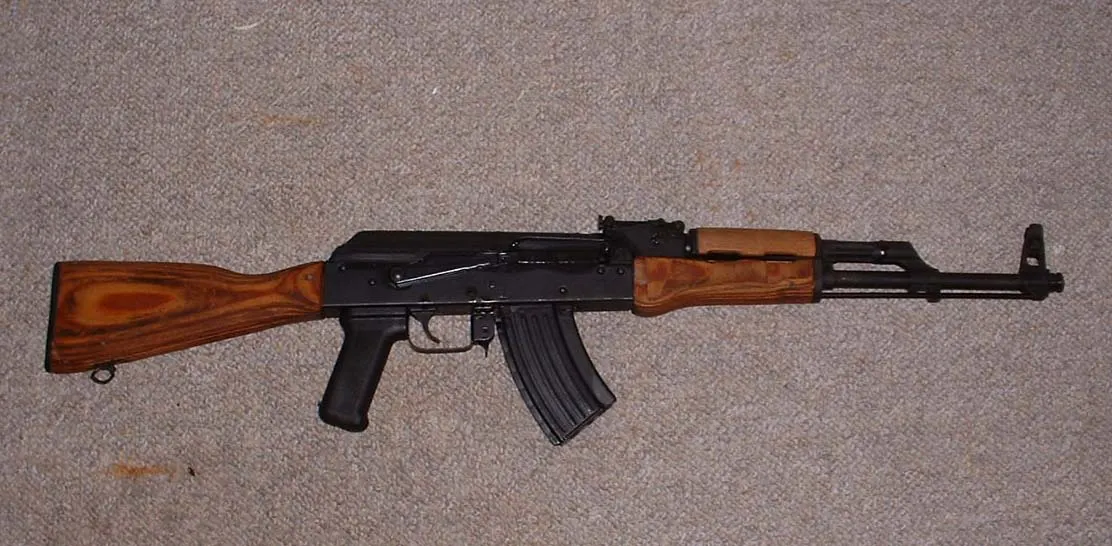
Century International Arms, a Vermont-based importer founded in 1961, began bringing the rifle into the United States in 2003 chambered in 7.62x39mm, replacing an earlier Romanian import called the SAR-1.3,4 The 7.62x39mm WASR-10 became the flagship of the line, but Cugir and Century also fielded a 5.45x39mm WASR-2, a 5.56x45mm NATO WASR-3, a .22 Long Rifle WASR-22 trainer, and, much later, a 9mm Luger WASR-M carbine built around Glock-pattern magazines.1 All of them trade on the same premise as any semi-automatic rifle, a functional, low-cost AK-pattern platform stripped of select-fire capability for the domestic United States civilian and collector market, where it has remained one of the cheapest ways to own a real Romanian-made Kalashnikov derivative rather than a WASR clone assembled from parts kits.
The WASR-10 in particular has become a fixture of budget AK ownership in the US precisely because it is not trying to be a precision rifle. Reviewers routinely describe it as the entry point into the Kalashnikov world rather than the best example of it, a rifle bought to be shot hard and modified rather than admired.5,6
Cugir's design starts from the PM md. 63/65 action, a gas-piston-operated long-stroke system copied directly from the AKM, with a rotating bolt, chrome-lined bore, and a detachable magazine feeding from a 1mm stamped steel receiver.1,7
- İlk Üretim Yılı2003
- TasarımcıCugir Arms Factory (based on the Soviet AKM via the Romanian PM md. 63/65)
- Ağırlık (Boş)3,1 kg
- Ağırlık (Yüklü)3,6 kg
- Halen HizmetteEvet
That receiver thickness is thinner than the 1.5mm stampings used by some rival AK-pattern makers, and Cugir compensates differently from the Soviet original too. Rather than the pressed dimples that reinforce most AK receivers above the magazine well, WASR receivers use internally welded steel spacer plates to center the magazine and take the recoil load, a Cugir-specific detail collectors use to identify genuine Romanian production at a glance.7
- Fişek7.62x39mm
- Çap7,62 mm
- Çap Sınıfıorta güçlü
The 7.62x39mm WASR-10 carries a 415mm (16.3 inch) chrome-lined barrel rifled at 1 turn in 9.25 inches, matched to the standard Kalashnikov iron sight line adjustable out to 800 meters and a sight radius of roughly 378mm.1 Muzzle velocity runs close to 710 m/s, giving a muzzle energy figure near 2,017 joules, in line with any full-length AKM-pattern barrel firing the 7.62x39mm intermediate round.1 Cyclic rate of the underlying action is around 600 rounds per minute, though since every WASR ships as a semi-automatic-only carbine that figure describes the mechanism's bolt cycle rather than anything a shooter can access, unlike the select-fire AKM it derives from.1 Loaded weight sits around 3.6kg, empty closer to 3.1kg, with the same iron sights, side-rail mount for optics, and bayonet lug fitted to most AK-pattern service rifles.1
- Mekanizma TipiGazlı
- Atış Modlarısemi-automatic only
- Seçmeli AtışHayır
- Besleme SistemiÇıkarılabilir Şarjör
- Şarjör Kapasitesi30
- Teorik Atış Hızı600
- Pratik Atış Hızı40
Two design compromises define the line more than any single spec number. First, factory-original rifles as manufactured in Romania were built around single-stack, 10-round magazines to satisfy Wassenaar Arrangement export terms, a detail the WASR name references directly, and Century modified US-bound rifles to accept standard double-stack 30-round magazines before sale.1,3 Second, early-2000s WASR-10 imports used the unmodified Romanian trigger group, whose hammer and disconnector geometry let the bolt carrier strike the trigger finger under recoil, a well-documented problem called trigger slap. Century did not resolve it until 2007, when US-made TAPCO Intrafuse AK G2 trigger groups became standard equipment on new production.1,8
- Namlu Çıkış Hızı710 m/sn
- Namlu Enerjisi2.017
- Etkili Menzil (nokta)300 m
- Etkili Menzil (alan)500 m
- Azami Menzil1.500 m
- Nişan Menzili800 m
Quality control has also varied across production runs. Some early-2000s and post-2007 WASR-10 batches left Cugir with the front sight block or gas tube canted slightly off the barrel's vertical axis, a defect that can make the rifle difficult or impossible to zero without drifting the front sight to one extreme, and furniture quality has visibly declined over two decades, from Romanian surplus-pattern laminate through to a much lighter, softer blonde wood used on rifles imported around 2018 to 2019.6,9 None of this is fatal to function. The chrome-lined bore and bolt carrier group are the same components used in Romanian military rifles, and most reviewers who report cosmetic or fitment complaints still describe the underlying action as reliable.5,6
- Namlu Uzunluğu415 mm
- Yiv Adımı1:9.25 in
- Yiv Sayısı4
- Nişangah Mesafesi378 mm
- Optik RayıEvet
- Açık NişangahEvet
- Dişli NamluHayır
- Gövde Malzemesi (Receiver)presli çelik
- Kabza/Dipçik Malzemesiahşap
- Katlanır / Toplanır DipçikEvet
- Bullpup DüzeniHayır
- Çift Yönlü KumandalarEvet
- Modülerliksınırlı yan sanayi uyumluluğu
- Susturucuya HazırHayır
- Süngü TakozuEvet
- Entegre BipodHayır
- Bombaatar KabiliyetliHayır
- Gaz PistonluEvet
- Üretim Başlangıcı2003
- Birim Maliyet800 USD
Cugir's own arms-making history predates the Kalashnikov entirely. The factory traces its origin to an Austrian Empire ironworks established in the Transylvanian town of Cugir in 1799, expanded into a major metallurgical and arms plant through the 19th and early 20th centuries.2 After the Second World War, Romania joined the Warsaw Pact, and in the early 1960s the Soviet Union encouraged member states to build their own AKM-pattern rifles domestically rather than depend on Soviet export supply. Romania's own version, developed with Soviet technical assistance and put into production at Cugir in 1963, was designated Pistol Mitralieră model 1963 (PM md. 63), later refined into the model 1965.2,10 Romanian production added a distinctive laminated wood forward handguard, extended ahead of the gas tube, meant to help conscript riflemen control muzzle climb during automatic fire, a feature carried straight through into the semi-automatic WASR decades later.2

The state restructured Cugir's parent enterprise in 2004, folding the Cugir Arms Factory in as a subsidiary of the newly formed state conglomerate Romarm.2 By then the WASR name had already entered US retail. Century International Arms started importing the Wassenaar-compliant Cugir carbine as the WASR-10 in 2003, positioning it to replace an earlier Romanian import, the SAR-1, and pricing it well under competing AK-pattern imports of the day, roughly $300 to $350 for a new rifle in the mid-2000s.1,11 That pricing held for years. Buyers were still finding new WASR-10s for around $450 to $500 through 2008 to 2012, before broader firearms market pressure, including the 2020 to 2022 US ammunition shortage, pushed new rifles toward $600 to $900 and beyond by the early 2020s.11
Supply has never been fully secure, because every WASR still comes from one factory. On 12 November 2018 an explosion and fire in a weapons-testing tunnel at the Romarm-run Cugir plant killed a worker and forced Century Arms to warn US retailers that WASR and Draco pistol deliveries could be delayed while the facility investigated the cause and resumed testing.12,13
The 2018 shutdown never became permanent. Century resumed WASR-10 and Draco deliveries once Cugir cleared its testing tunnel for use again, though the episode underlined how exposed the whole product line remains to any problem at a single Romanian plant, a dependency the company has never diversified away from.12
The WASR-series rifles were never adopted by any government's armed forces. Their significance in an actual conflict comes almost entirely from illegal cross-border trafficking into the Mexican drug war. A multi-outlet 2011 investigation by the Center for Public Integrity, the Investigative Reporting Workshop, and PBS Frontline found that WASR-10 rifles bought legally in the United States and then smuggled south into Mexico had become the single most common firearm traced to crimes there between 2006 and 2011, with ATF records showing more than 500 Century-imported WASR-10s recovered at Mexican crime scenes in that period, over 17 percent of all US-sourced firearms traced there.14
Cartel buyers favored the rifle for the same reasons US civilian shooters did, low retail price and wide domestic availability, purchased through straw buyers near the border and moved south in what investigators nicknamed the iron river.14 That trafficking pattern has continued well beyond the original 2011 reporting window, tracking a broader rise in AK-pattern and AR-pattern rifles recovered by Mexican authorities and traced back to the United States in ATF data through the 2020s.15 No government has ever formally fielded the WASR-10 or its variants as a service rifle, so unlike a true military-issue Kalashnikov the weapon's conflict history is a story about civilian commerce turning into cartel logistics rather than one of national armed forces in combat.
The core of the range is the 7.62x39mm WASR-10, sold in several sub-configurations including a GP (general purpose) version and low-capacity, factory 10-round GP WASR-10 models built to satisfy state-level magazine restrictions in the US.1 Cugir also produced the WASR-2 in 5.45x39mm, matching the cartridge of the Soviet AK-74 rather than the AKM's 7.62x39mm, and the WASR-3 in 5.56x45mm NATO, notable for early production runs that shipped with surplus 5.45x39mm AK-74 magazines that did not reliably feed the narrower 5.56mm round until Century began supplying dedicated Wieger-pattern or Galil-compatible steel magazines instead.1,16 A rimfire WASR-22 trainer in .22 Long Rifle and a 9mm Luger WASR-M carbine fed from Glock-pattern magazines, introduced around 2020, round out the family for buyers who want AK ergonomics without centerfire rifle ammunition costs.1
Cugir's most commercially important spinoff is not a rifle at all. The Draco pistol takes the same PM md. 90 side-folding carbine action, shortens the barrel, and removes the stock entirely to import into the United States as a pistol rather than a rifle under US firearms law, first arriving via Century in 2010.17 Mini and Micro Draco sub-variants shortened the barrel further, and Century eventually began assembling an American-made Draco domestically from US-sourced parts to meet demand the Romanian supply chain alone could not satisfy.17 The Draco's popularity among American buyers who want AK ergonomics in pistol form has made it, by unit volume, arguably as important a commercial line for Cugir as the WASR-10 rifle itself, and Century's decision to assemble an American-made version reflects how much of the product family's profitability now rests on the compact pistol variants rather than the original carbine.17


| Yıl | Alıcı | Adet | Tutar | Bugünkü Değer (2025) |
|---|---|---|---|---|
| 1995 |  Hindistan | 100,000 | $8.5 M | $18.0 M |
The WASR-series rifles have no formal military or police operator of record. They were designed from the outset as a Wassenaar Arrangement compliant commercial export product for the American civilian firearms market, not a service weapon offered to any state's armed forces, which sets the line apart from most other entries in the semi-automatic rifles leaf that began life as issued military hardware.1,3 Ownership is concentrated among individual buyers, collectors, and gun-range shooters in the United States, with a smaller secondary population in Canada and other markets where Century or affiliated importers have distributed the rifle.
Receiver steel thickness is the single spec that best separates the WASR-10 from the Zastava M70, sold domestically as the PAP M70 or ZPAP M70 by Zastava Arms of Serbia. Both rifles are civilian semi-automatic AK-pattern imports built on genuine military-derived receivers rather than parts-kit clones, and US buyers cross-shop them constantly, but the two factories made different tradeoffs at the metal. Zastava stamps its receiver from 1.5mm steel against the WASR's 1mm, adds a bulged front trunnion originally engineered to survive rifle grenade launching, and fits a chrome-lined, hard nickel-plated bolt carrier group, differences reviewers credit with the M70's typically steadier recoil impulse and slightly tighter accuracy.18 The tradeoff is weight and price. The heavier Zastava costs more, historically running $200 to $300 above a comparable WASR-10 at retail, while the WASR remains the cheaper way into a genuine AK-pattern rifle even after 2020s price increases pushed both up.18,11
| Spec | WASR-10 | Zastava M70 (PAP/ZPAP) |
|---|---|---|
| Receiver thickness | 1mm stamped steel7 | 1.5mm stamped steel18 |
| Cartridge | 7.62x39mm | 7.62x39mm |
| Barrel | 415mm, chrome-lined | Chrome-lined, cold hammer-forged18 |
| Typical new price (2020s) | Lower | ~$200-300 higher18,11 |
Framed against the parent AKM design it descends from, the WASR-10 is a deliberately simplified, semi-automatic-only civilian reading of the same Cugir action that has armed Romanian conscripts since the 1960s, with select-fire capability removed and nothing added in return.1,2 The comparison that matters to most buyers is not the WASR against a service rifle at all, but the WASR against other budget AK imports competing for the same shelf space and the same first-time buyer.


What does WASR stand for? WASR stands for Wassenaar Arrangement Semi-automatic Rifle, referencing the 1996 export control accord that shaped how Cugir configured the rifle for legal import into the United States.1
What caliber is the WASR-10? The WASR-10 is chambered in 7.62x39mm, the same intermediate cartridge used by the AK-47 and AKM it descends from. Sibling models cover 5.45x39mm (WASR-2), 5.56x45mm NATO (WASR-3), .22 Long Rifle (WASR-22), and 9mm Luger (WASR-M).1
Who manufactures the WASR-10? Every WASR-series rifle is built by the Cugir Arms Factory in Romania, a subsidiary of the state defense conglomerate Romarm, and imported into the United States by Century International Arms.1,2
Is the WASR-10 still being imported? Yes, though supply has been interrupted before, most notably after a fatal explosion at the Cugir factory in November 2018 that temporarily halted deliveries.12
How much does a WASR-10 cost? New WASR-10 pricing has climbed from roughly $300 to $350 in the mid-2000s to commonly $600 to $900 by the 2020s, reflecting broader firearms market inflation and periodic ammunition shortages rather than any change to the rifle itself.11
Is the WASR-10 a good AK-47? It is a genuine Cugir-built AK-pattern rifle rather than a true AK-47, since it lacks select-fire capability, and reviewers generally rate it as a reliable, inexpensive entry point into Kalashnikov ownership rather than a refined or particularly accurate example of the design.5,6
- "WASR-series rifles", Wikipedia — en.wikipedia.org ↩
- "Cugir Arms Factory", Wikipedia — en.wikipedia.org ↩
- "Century International Arms", Wikipedia — en.wikipedia.org ↩
- "Century Arms WASR-10: An Imported Romanian AK", American Rifleman — americanrifleman.org ↩
- "Review: Century Arms WASR-10 Rifle", Shooting Illustrated (NRA) — shootingillustrated.com ↩
- "The Cugir WASR-10: Function Over Form", Gun Digest — gundigest.com ↩
- "WASR-10: No bolt hold open?", AR15.com forum discussion citing receiver construction details — ar15.com ↩
- "WASR-10 Trigger slap", The Firing Line Forums — thefiringline.com ↩
- "About WASR 10 Furniture?", Gunboards Forums — gunboards.com ↩
- "Pistol Mitralieră model 1963/1965", Wikipedia — en.wikipedia.org ↩
- "WASR 10 New and Used Price, Value, & Trends", TrueGunValue — truegunvalue.com ↩
- "Century warns that Romanian accident could affect Draco, WASR supply", Guns.com — guns.com ↩
- "Explosion at Factory that Produces Guns Imported by Century Arms Kills Woman", The Firearm Blog — thefirearmblog.com ↩
- "Romanian weapons modified in the U.S. become scourge of Mexican drug war", Center for Public Integrity — publicintegrity.org ↩
- "Firearms Trace Data: Mexico, 2017-2022", Bureau of Alcohol, Tobacco, Firearms and Explosives — atf.gov ↩
- "Romanian WASR 3 5.56 AK Rifles Available Again", Gun Digest — gundigest.com ↩
- "The Cugir Draco: When Demand Outweighs Supply", Gun Digest — gundigest.com ↩
- "Zastava ZPAP M70 Vs WASR-10 V2 Which AK Wins?", ExocTactical — exoctactical.com ↩